
The best dropshipping platform depends on where you want to sell and who will maintain the operation. Shortlist Shopify for a hosted dedicated store, WooCommerce for a capable WordPress team, Wix for a simpler integrated website, and BigCommerce for a commerce stack with specific integration needs. Consider Amazon or eBay when your sourcing and fulfillment arrangement meets their marketplace rules.
Those are starting recommendations, not a universal ranking or a hands-on performance benchmark. An attractive storefront can still fail your business if its payment provider is unavailable to your company, its supplier connection loses variants or its operating costs exceed the margin.
This comparison covers selling platforms using official documentation checked on September 11, 2026. Supplier directories and order-routing apps are a separate choice. Test the exact combination you will use before committing to a plan, migration or large catalog.
01
Choose the selling arrangement first
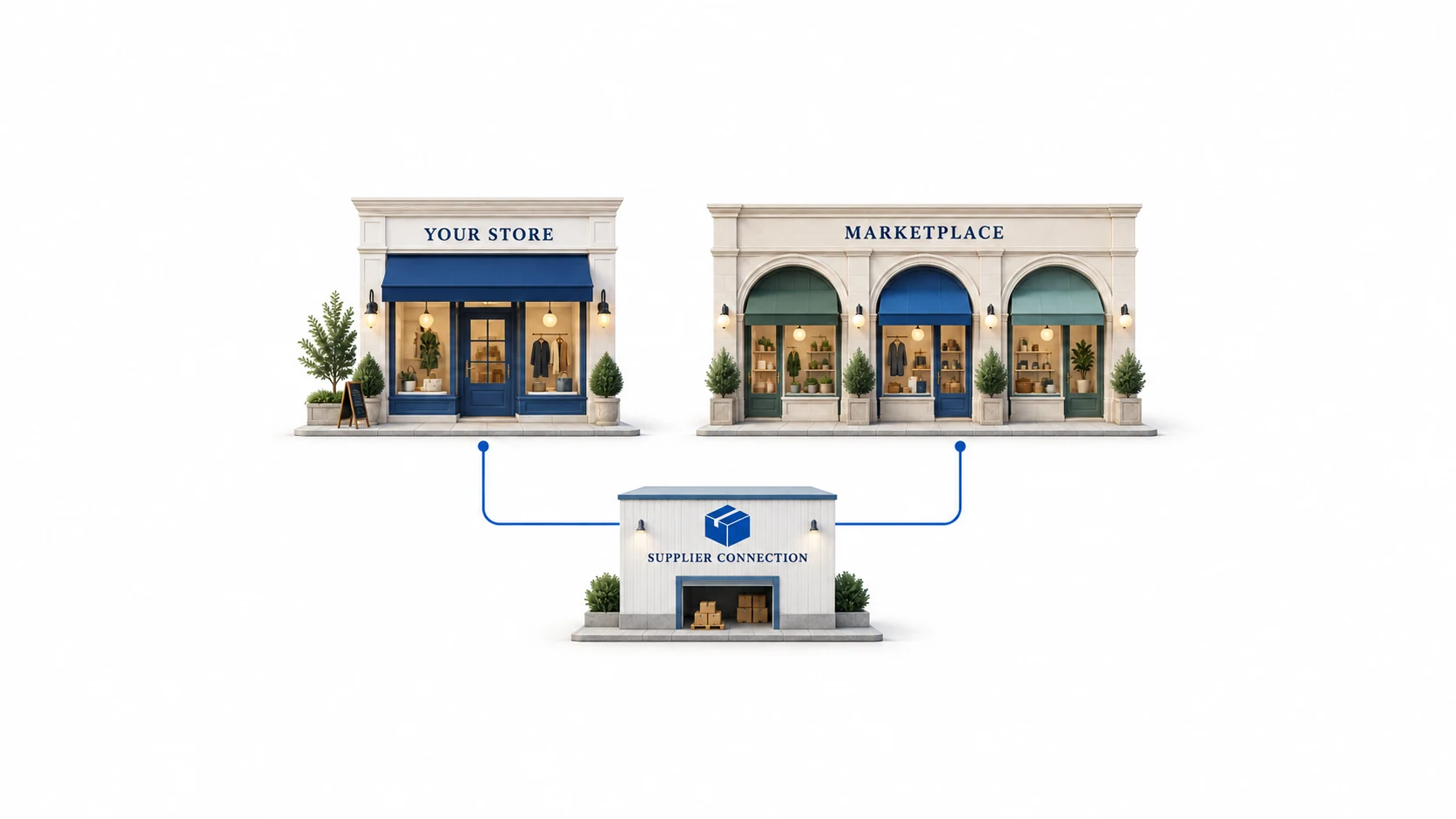
A storefront platform lets you build a shop under your own domain. A marketplace places your offers within a shared shopping environment governed by its seller rules. A supplier app connects inventory or fulfillment to one or more of those channels.
Shopify, WooCommerce, Wix and BigCommerce belong in the first comparison. Amazon and eBay belong in the second. Tools such as a supplier connector should then be evaluated for the platform you choose; they do not replace the checkout, customer promise or channel policy.
An independent store gives you room to develop the brand, merchandising and content experience. You must also acquire visitors and maintain a workable checkout and service process. A marketplace has an existing shopping environment, but access to it does not guarantee visibility, conversion or a suitable supplier model.
If the distinction is still unclear, the dropshipping model overview separates selling, sourcing and fulfillment responsibilities. Start the platform comparison with those responsibilities already assigned.
02
Shopify: a hosted store with a defined app workflow
Shopify is a practical shortlist option when you want a dedicated online store and prefer a hosted commerce service over maintaining the underlying WordPress installation. Its dropshipping documentation describes supplier apps and the merchant’s role in choosing and selling products.
Evaluate the actual app you intend to use. Check variant mapping, inventory updates, order submission, supplier payment, tracking and cancellations. A large app directory does not prove that one connector supports your supplier, currency or exception workflow.
When it fits
Consider Shopify when a verified supplier integration covers your catalog and your team wants to spend more effort on merchandising and operations than on server maintenance. It also gives an existing Shopify team a familiar environment when adding a supplier-direct product range.
What can change the decision
Check payment-provider eligibility for your business location, the plan and app charges, and any fee difference when using the required payment arrangement. Ask whether a necessary customization is possible on the intended plan. Do not assume a feature demonstrated on another merchant’s store is included in your proposed setup.
The Shopify dropshipping guide develops the store-to-supplier workflow once that platform is selected. The selection decision here is whether the tested combination fits your team and economics.
03
WooCommerce: control with maintenance responsibility
WooCommerce belongs on the shortlist when your business already uses WordPress or has a team that can maintain the hosting, updates, backups and integrations. Its flexibility is valuable when you have a specific requirement and the ability to implement and maintain it.
The official WooCommerce Dropshipping extension documentation describes supplier and order-management features. It is documentation for that extension, not proof that every WooCommerce installation includes the same behavior. Compare the extension you will actually deploy with other available integration routes.
When it fits
Consider WooCommerce for a content-led WordPress business that needs to connect editorial pages and commerce within a maintained installation. It can also suit a team with a verified custom supplier integration and a clear owner for its ongoing support.
What can change the decision
Budget the work that a hosted platform would otherwise absorb: updates, compatibility checks, security maintenance, recovery and performance troubleshooting. Assign someone to test checkout and order integration after changes. “We can customize it” is not a complete plan without ownership and a maintenance budget.
Free core software does not make the completed operation free. Hosting, extensions, payment processing and technical labor belong in the comparison. If nobody can restore a failed checkout promptly, a cheaper monthly software bill can be a poor trade.
04
Wix: a simpler website and supported supplier connections
Wix can be worth testing when the business needs a manageable website with a relatively straightforward catalog and the intended supplier workflow is supported. Its dropshipping guidance points to integrations including Modalyst and Printful.
That makes it a concrete candidate for a team that wants to assemble the site and commerce experience in one familiar builder. It does not establish that every supplier, product type or fulfillment exception is supported automatically.
When it fits
Consider Wix when your site requirements are straightforward and a supported integration can demonstrate the whole order lifecycle. A small catalog can make that evaluation manageable, especially if the team already maintains its other pages in Wix.
What can change the decision
Test the exact variants, international checkout and cancellation process before assuming the simple setup extends to a more complicated operation. Verify product limits and charges on both the Wix plan and the supplier service. The website subscription and the supplier’s commercial terms are separate commitments.
If your required workflow depends on extensive custom behavior, compare the work needed against other platforms before building around a workaround. A quick page-building experience should not obscure an unsupported fulfillment requirement.
05
BigCommerce: evaluate the commerce integration you need
BigCommerce is a candidate when the business has a specific catalog, external system or channel requirement and wants to assess a hosted commerce platform around it. Its integration documentation describes prebuilt apps and custom integration options.
Evaluate it with a concrete requirement, such as feeding a defined catalog into multiple supported channels or exchanging order data with an existing system. Avoid selecting it solely because a comparison article calls it suitable for “scale.” The useful question is whether your required integration is supported and maintainable.
When it fits
Consider BigCommerce when an existing operations team can document its data flow and verify the needed apps or API work. Ask for a demonstration using your product variants and exception cases, rather than a generic channel-management presentation.
What can change the decision
Check plan conditions, integration charges, support responsibility and the cost of maintaining custom work. A listed integration may synchronize only some fields or support only certain markets. Confirm who investigates an order that appears correctly in one system but is missing from another.
The platform’s available APIs are a capability, not a finished supplier connection. Include implementation and ongoing monitoring in the purchase decision.
06
Amazon: choose the marketplace only with a suitable supply arrangement
Amazon can be considered when you have products you are eligible to sell and a supplier capable of meeting the marketplace’s policy and service requirements. It is a different operating choice from launching a store under your own domain.
Amazon’s official dropshipping guide identifies seller-of-record, shipment identity and customer-service responsibilities. Evaluate those before counting marketplace exposure as a benefit. A supplier that ships another retailer’s documents can create a problem regardless of how well an integration imports the order.
When it fits
Consider Amazon when you can verify listing identity, sourcing evidence, stock, dispatch, tracking and returns for the relevant marketplace. Model the actual selling fees and cash commitments. An existing shopping environment does not guarantee that your offer will receive profitable demand.
What can change the decision
If the supplier cannot control packing documents, acknowledge orders reliably or meet your customer promise, pause this route. The Amazon dropshipping guide explains the policy-to-order controls in more detail.
Do not treat Amazon as a substitute for developing a product offer. Price, listing accuracy, eligibility and fulfillment performance still need to work together.
07
eBay: wholesale sourcing with seller responsibility
eBay’s dropshipping policy permits fulfillment directly from a wholesale supplier. It does not permit listing an item and then purchasing it from another retailer or marketplace that ships it directly to the customer. The seller remains responsible for delivery within the stated timeframe and the buyer’s experience.
That distinction is a selection gate. A retail-sourcing workflow that can be connected technically may still be unsuitable for eBay. Review the actual supplier relationship rather than relying on the connector’s name or marketing copy.
When it fits
Consider eBay when a legitimate wholesale arrangement supports the products and delivery promises you intend to list. Confirm item condition, variant descriptions, stock updates and the return process. Evaluate the actual fees and customer expectations for the relevant market and category.
What can change the decision
If your sourcing process depends on buying a retail item only after an eBay sale, change the sourcing arrangement or choose a different model. Do not try to solve a policy mismatch by hiding its source in the automation.
08
Match the platform to the work your team can do
Shortlist two candidates, not every platform at once. Choose them from your strongest requirements. A team that already maintains WordPress might compare WooCommerce with Shopify. A straightforward website project with a supported supplier might compare Wix with Shopify. An established operation with specific integration needs might include BigCommerce.
A marketplace comparison should begin only after the sourcing model passes that marketplace’s rules. If it fails, a favorable feature score cannot compensate for the problem. Policy eligibility, payment access and necessary product support are pass-or-stop conditions.
Write the selection note in concrete terms: “We need this payment provider, these variants, this shipping route and this support owner.” That is easier to verify than “we need the most powerful platform.”
09
Test the integration beyond a successful product import
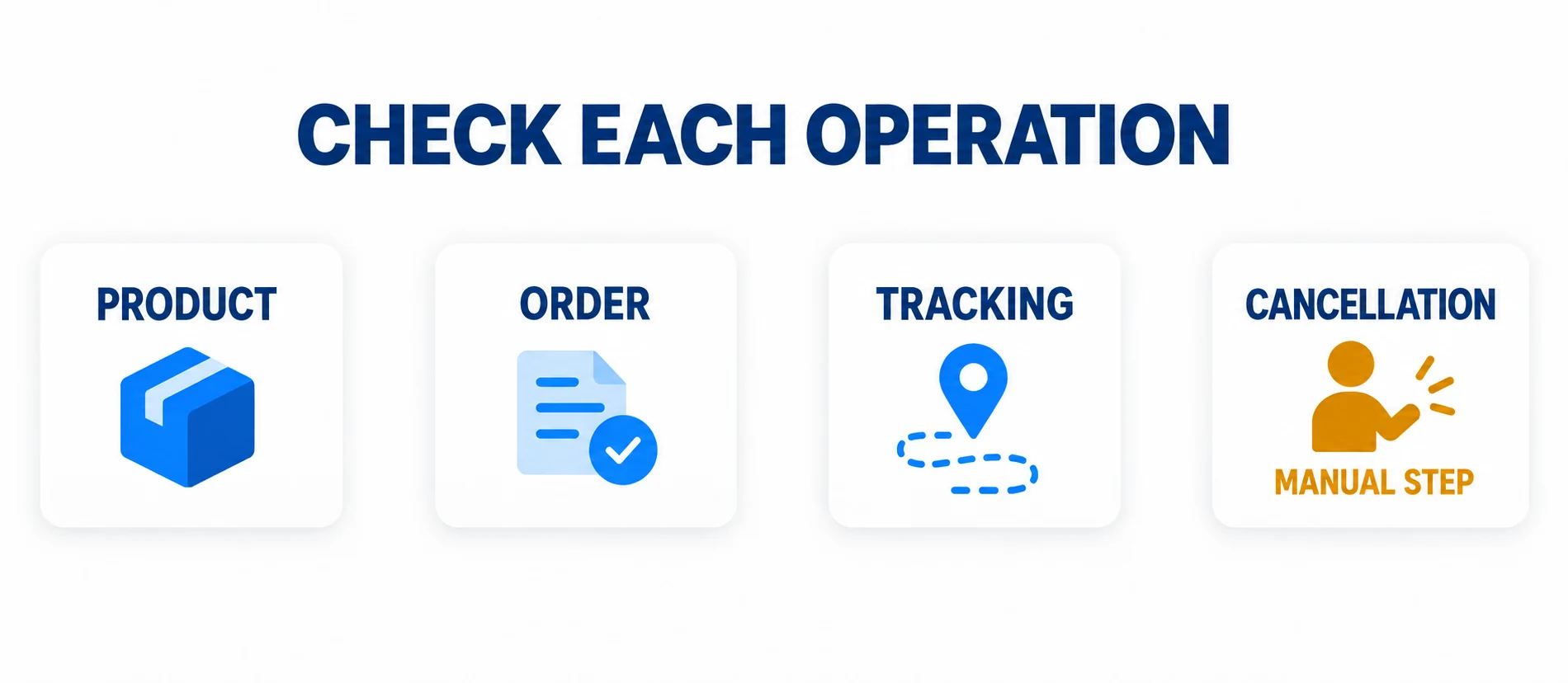
Build a small test catalog containing a normal variant, a variant likely to go out of stock and an order with more than one item. Use the provider’s supported test environment or a legitimate controlled order as appropriate. Do not create fake marketplace transactions or reviews to manufacture performance evidence.
Follow the full flow:
- Import the product and confirm variant identity, price and customer-facing description.
- Change stock through the supported source and observe how the store responds.
- Submit an order and verify the supplier’s actual acknowledgement.
- Test a repeated or unclear submission without creating duplicate fulfillment.
- Match the shipment and tracking to the right order and line items.
- Check cancellation, partial fulfillment, refund and return handling.
Record which steps are automatic, which need a person and which are unsupported. An app that imports a catalog but requires manual cancellation can still be usable if the team has an adequate process. It becomes dangerous when the team assumes the cancellation was automatic.
Check payment and localization together
Verify that the provider can onboard your legal business and settle funds through your intended bank arrangement. Then test the customer’s currency, shipping destination and available payment methods. Your company location and the customer’s country answer different eligibility questions.
Check whether taxes, duties and shipping information shown at checkout match the operating arrangement. A currency selector alone does not establish a complete international selling setup. Obtain the relevant platform and payment documentation for the market before launch.
10
Compare real cost at a realistic workload
Collect current quotes for the platform, required apps, hosting where applicable, payment processing, marketplace fees and implementation. Add the work needed to maintain the catalog, reconcile orders and resolve exceptions. Keep product and shipping costs visible so a platform saving is not mistaken for a profitable order.
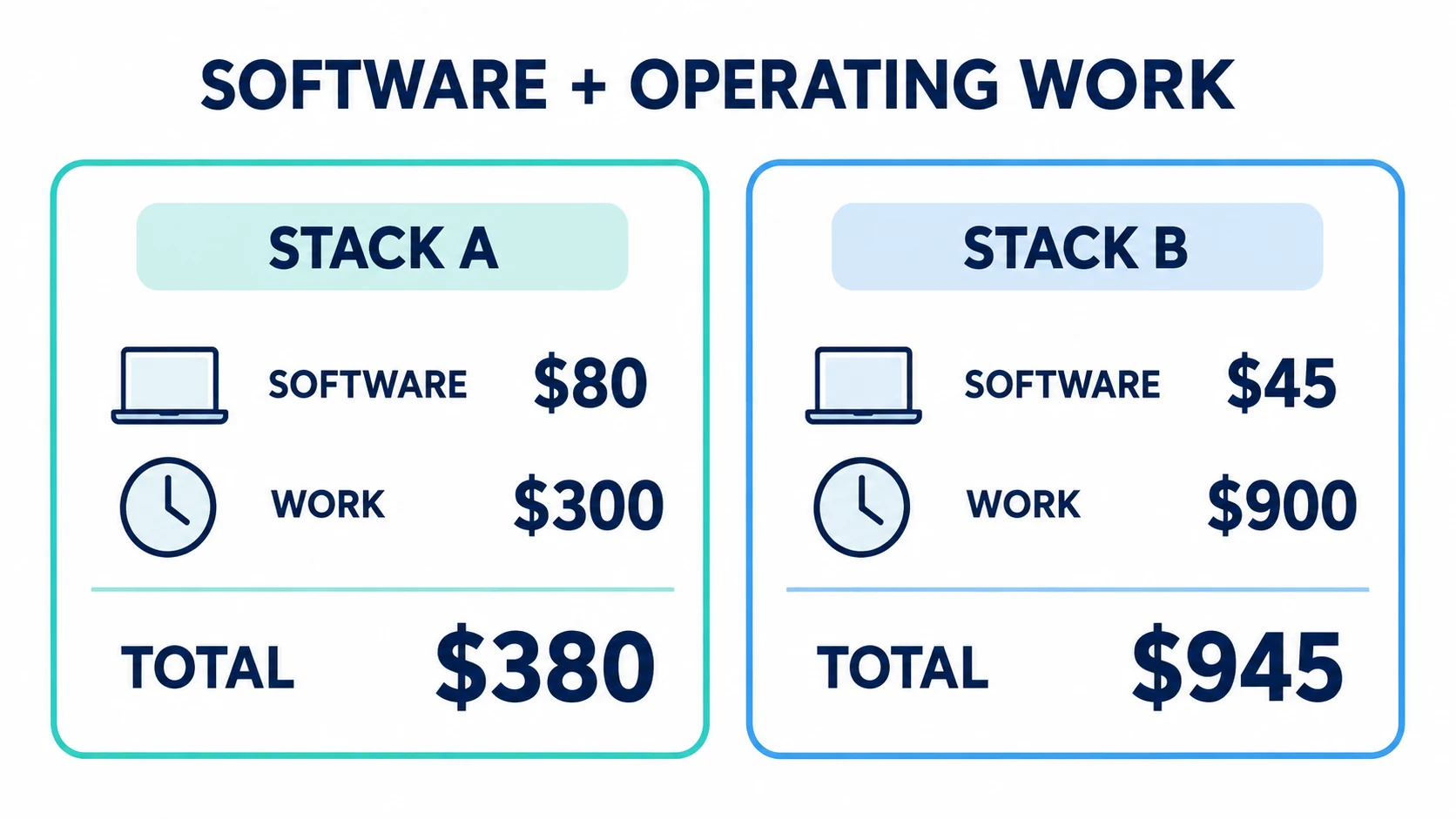
Here is a hypothetical comparison, not a price claim about any named platform. Stack A costs $80 per month and takes 30 minutes a day of operating work. At 30 days and a chosen labor value of $20 per hour, the work costs $300, giving $380 before transaction and product costs.
Stack B costs $45 per month but takes 90 minutes a day. The same labor assumption produces $900 of work and a $945 total. Its software bill is $35 lower, but the modeled combined cost is $565 higher. Replace those assumptions with observed work from your trial.
The comparison should also include failure exposure. An unsupported stock update can produce cancellations; a fragile checkout change can lose orders. Do not invent a monetary loss estimate when you lack evidence, but record the issue and the work needed to control it.
11
Evaluate content control and the exit route
Check how you will publish useful product and editorial content, manage redirects, change metadata and preserve URLs during a redesign. For an independent store, test the actual theme and implementation instead of assuming a platform name guarantees search performance.
Check the exports you can obtain for products, variants, orders and necessary operational records. Determine what happens to supplier mappings and app-specific data if you leave. A catalog export may not include the configuration needed to reproduce the fulfillment workflow.
For marketplaces, review the rules governing customer data and communication. An order record is not blanket permission to market to that customer elsewhere. Build retention and support processes within the applicable rules and permissions.
Before migrating, map important URLs and product identifiers, test checkout and integration, and plan how open orders will finish. Moving the storefront while losing the connection to unfulfilled orders is an operational failure even if the new design looks better.
12
Launch one working channel before adding several
Choose the candidate that passes mandatory requirements and has a manageable cost and support burden. Document the remaining limitations and assign owners. A narrow launch can then test the workflow with real demand without exposing an uncontrolled catalog.
Add another channel after stock allocation, acknowledgements, customer support and reconciliation work consistently. Shared supplier stock must not be counted as independently available on every channel. Decide how an order on one channel changes the quantity offered elsewhere.
Revisit the choice when a material requirement changes: business location, payment eligibility, product complexity, marketplace policy or integration support. A platform can be appropriate for the current operation without being the permanent answer for every future scenario. The store platforms and operating data section connects these decisions with the wider system.
13
Frequently asked questions
Which platform is best for a dropshipping beginner?
Shopify or Wix can be practical hosted candidates when their supported supplier and payment arrangements fit the business. WooCommerce can make sense for an existing capable WordPress team. Test the complete order workflow before choosing; beginner-friendly page building does not guarantee easy fulfillment.
Is WooCommerce cheaper than Shopify?
It depends on the completed setup and maintenance work. Compare hosting, extensions, payment charges, technical labor and exception handling alongside subscription costs. Use current quotes and your own trial rather than a universal cost ranking.
Are Amazon and eBay dropshipping platforms?
They are marketplaces where qualifying supplier-direct arrangements can be used under their policies. They differ from storefront software in channel rules, listing environment and customer interaction. Evaluate the supplier model before comparing features.
Is a supplier app the same as a selling platform?
No. A supplier app may import products, synchronize stock or route orders into a platform. Verify both layers and their commercial terms. A working app connection does not automatically supply traffic, payment eligibility or policy compliance.
Can I change platforms later?
Usually a business can move its store, but the practical cost depends on exports, URLs, integrations and open orders. Check those details before committing. Preserve the records needed to finish existing customer obligations during any transition.