
To start a dropshipping business, choose a customer and a product, verify a supplier, calculate a workable price, set up your business and payments, and build a store that explains the offer clearly. Then test both checkout and delivery, attract your first customers, and manage their orders through fulfillment and any refunds. You can outsource the packing; you still need to run the business.
The practical goal is a small offer that customers can understand and that you can deliver at a sustainable cost. A store with hundreds of imported listings is not further along if nobody has checked the products or worked out what happens after payment.
If the roles are unfamiliar, read how dropshipping works first. The beginner’s introduction explains the essentials and first-order rehearsal. The steps below take you from choosing an offer to learning from your first completed orders.
01
Define the customer and the offer
Begin with a specific customer problem rather than a supplier’s trending-products feed. “Storage products” is a category. “Removable storage for renters with small bathrooms” gives you a person, a constraint, and something a product must do.
Look at competing stores, marketplace listings, customer questions, and relevant communities. Record what people are trying to accomplish, what they complain about, and what they currently pay. Treat reviews as clues to investigate, not proof that every buyer experiences the same problem. A viral video shows attention; it does not reveal the seller’s refunds or profit.
Write a short offer statement: who the product is for, the problem it solves, its important limitation, and why someone would buy from your store. You might offer clearer installation instructions, a useful assortment, or a product demonstration competitors lack. Only promise something you can actually provide.
Next, compare the alternatives a customer can already buy. Include the delivered price, the stated delivery time, and the information needed to choose the right size or version. If your offer is more expensive, identify the specific benefit that could justify the difference. A new logo alone is unlikely to answer that question.
Keep this first decision narrow enough to investigate. You are choosing an initial audience and offer, not committing the business to one product forever. The product research guide goes deeper into evaluating demand and operational fit.
02
Choose products you can actually deliver
Build a small initial assortment around that offer. Each additional variant creates more information to maintain: dimensions, materials, compatibility, price, availability, and delivery expectations. Adding a complementary item can help a customer; adding unrelated products usually creates more work before it creates evidence of demand.
For each candidate, obtain the details needed to describe and ship it. Check the packed size and weight, not just the bare product dimensions. A low supplier price can become unattractive after bulky packaging, destination charges, or frequent replacement shipments.
Use three questions to narrow the range:
- Can you explain it accurately? Get the measurements, variant differences, limitations, and instructions a buyer needs.
- Can the intended route carry it? Confirm the product and destination with the supplier and shipping provider, including any restricted components.
- Can you support it after delivery? Understand likely installation, sizing, damage, and return questions before advertising it.
Check applicable product requirements before accepting orders. A supplier’s willingness to ship an item does not establish that you can lawfully sell it in your target market. For Shopify merchants, its dropshipping compliance guidance makes clear that relevant retailer obligations still apply, with requirements depending on the business and customer locations.
When a product needs claims or documentation you cannot verify, investigate further or choose another product for the initial launch. Do not fill that gap by copying a competitor’s safety claim. The broader dropshipping products guide helps compare candidates without treating a popular category as an automatic recommendation.
03
Find a supplier and order the sample
Ask potential suppliers about the exact product you intend to sell. A general promise that they “support dropshipping” does not tell you whether they can supply your variant to your customer location on acceptable terms.
Send a concise inquiry containing the product link or specification, variants, target destinations, expected initial volume, and packaging needs. Ask for the product price and the shipping charge separately. Confirm whether the quote includes handling, and what could change it.
Before choosing, get written answers on stock updates, order acceptance, substitutions, dispatch, tracking, damaged items, and returns. Identify who can authorize a replacement or credit. If the supplier cannot confirm the ordered variant, your default should be to hold that order for a decision, not accept an unapproved substitute.
Order a sample using the product and shipping route you plan to offer. Examine the item against its description, try the ordinary use you intend to demonstrate, and inspect the packaging. Record when the order was accepted, when the carrier received it, and when it arrived. Ask a recipient in the target market to help if you cannot test that route yourself.
A sample can expose a mismatch; one successful sample cannot prove every future order will be correct. Keep its photos and measurements as a reference for later checks, and agree how changes to the product will be communicated.
If the sample differs from the listing, resolve the difference before writing the product page. If delivery is longer than expected, change the proposed promise or find a more suitable route. The supplier selection article covers the comparison in more detail.
04
Set the price and fund the launch
Calculate the order’s contribution before choosing an advertising budget. Start with the amount the customer actually pays after any discount, then subtract the costs that vary with an order. Product cost alone leaves too much out.
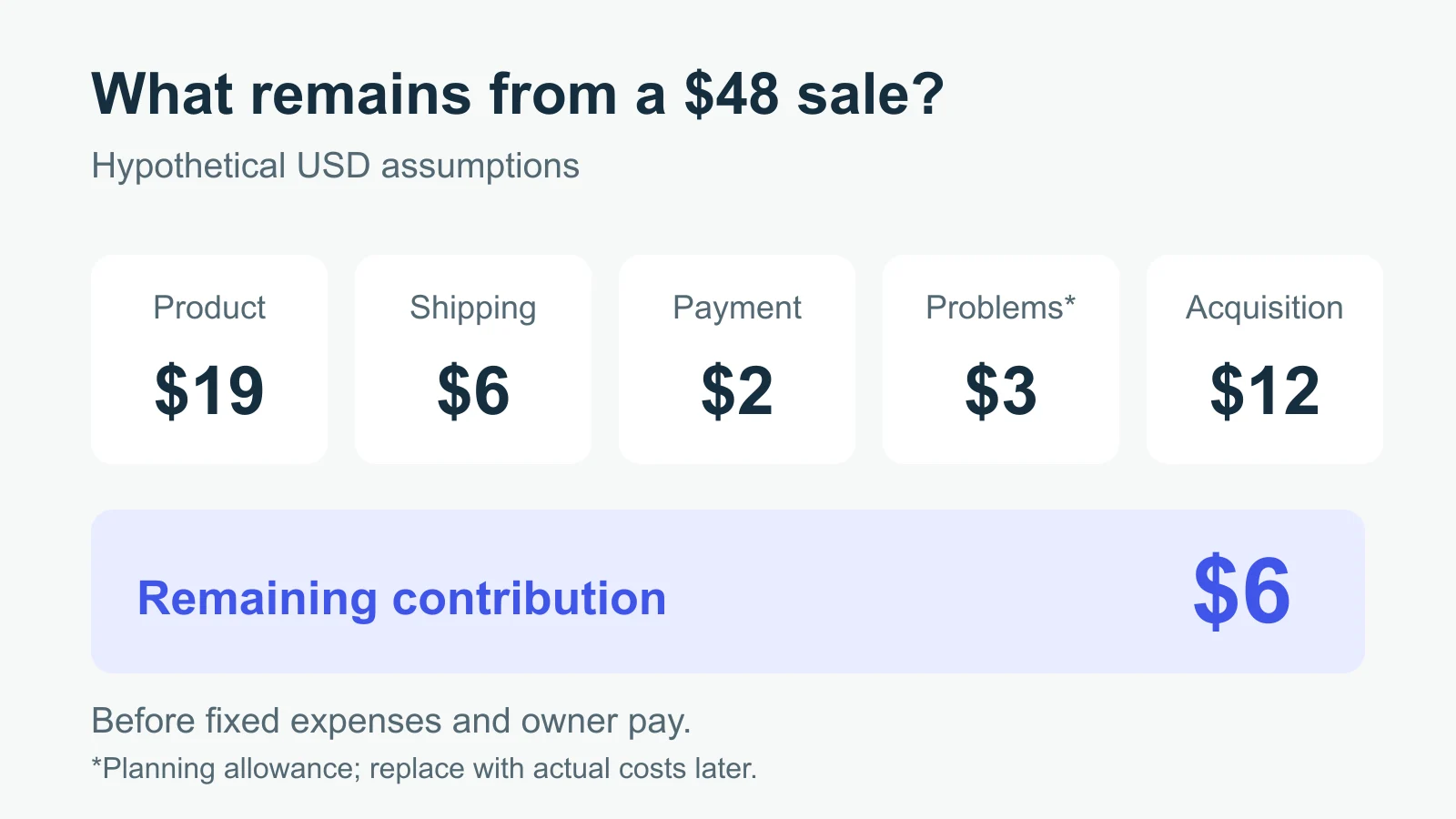
Consider this hypothetical USD example. There is one item per order, no separately charged customer shipping, and no sales tax included in the $48 selling price. The numbers are planning assumptions, not market rates or AIDrop Agent quotes.
| Item | Assumed amount per order |
|---|---|
| Selling price after discounts | $48 |
| Product | −$19 |
| Outbound shipping | −$6 |
| Payment processing | −$2 |
| Allowance for refunds and other order problems | −$3 |
| Contribution before acquisition and fixed expenses | $18 |
| Assumed customer acquisition cost | −$12 |
| Remaining contribution | $6 |
That $6 still needs to cover expenses such as software, bookkeeping, and your work. The $3 allowance is a planning estimate that must later be replaced by actual results; do not deduct it again alongside the same actual refund costs in a final profit calculation.
The example leaves $18 before acquisition, but spending the entire $18 to obtain an order would leave nothing for fixed expenses or profit. Set an acquisition budget below that ceiling based on what the business needs to retain. Use the unit economics workbook when building your own version.
Separate the launch budget into samples and setup, customer acquisition, and working cash for orders and refunds. Decide what you can afford to lose on the experiment without compromising existing obligations. There is no universal amount that makes a launch adequately funded.
Customer payment and available bank cash are different events. For example, Shopify documents that a Payments account hold can delay payouts even when customers can still check out. Confirm your account’s terms and keep money available to meet supplier commitments while receipts are unavailable.
05
Set up the business, payments, and store
Choose your business structure and complete the registrations, tax setup, and permissions that apply to your location and activity. These requirements are not the same everywhere. For US operators, the SBA’s launch guidance provides a starting point for checking business structure, registration, permits, and banking. It is not a requirement for every dropshipper worldwide to form a US LLC.
Confirm that your payment provider supports your actual business location and product category before building a launch around it. Shopify Payments, for example, has supported-country and business requirements. Use accurate business information, finish the requested verification, and understand payout and refund handling.
Then choose a selling platform that fits your channel, budget, and ability to operate it. An independent store gives you a place to present the offer; it does not bring customers automatically. A marketplace offers a different route to customers, with its own seller rules and fees. The Shopify dropshipping guide covers that platform’s setup and supplier handoff.
Your first store needs a clear path from product selection to payment. Prioritize these pages and details:
- A product page with accurate photos, variants, dimensions, contents, and limitations.
- Shipping information that separates preparation from transit and identifies supported destinations.
- Contact details and a realistic way to reach support.
- A returns and refund policy appropriate to the products, market, and customer rights.
- A checkout that shows the correct product, shipping charge, applicable taxes, and total.
Use sample photos and your own explanations where possible, with permission for any supplier assets you use. Do not invent customer reviews or imply that a supplier’s warehouse is your own facility. On mobile, verify that variant selection, delivery information, and the purchase button remain easy to find.
06
Test checkout and the physical order separately
Two different tests answer two different questions: a checkout test checks the store’s configuration, while a physical sample order checks what the customer is likely to receive. Neither replaces the other.
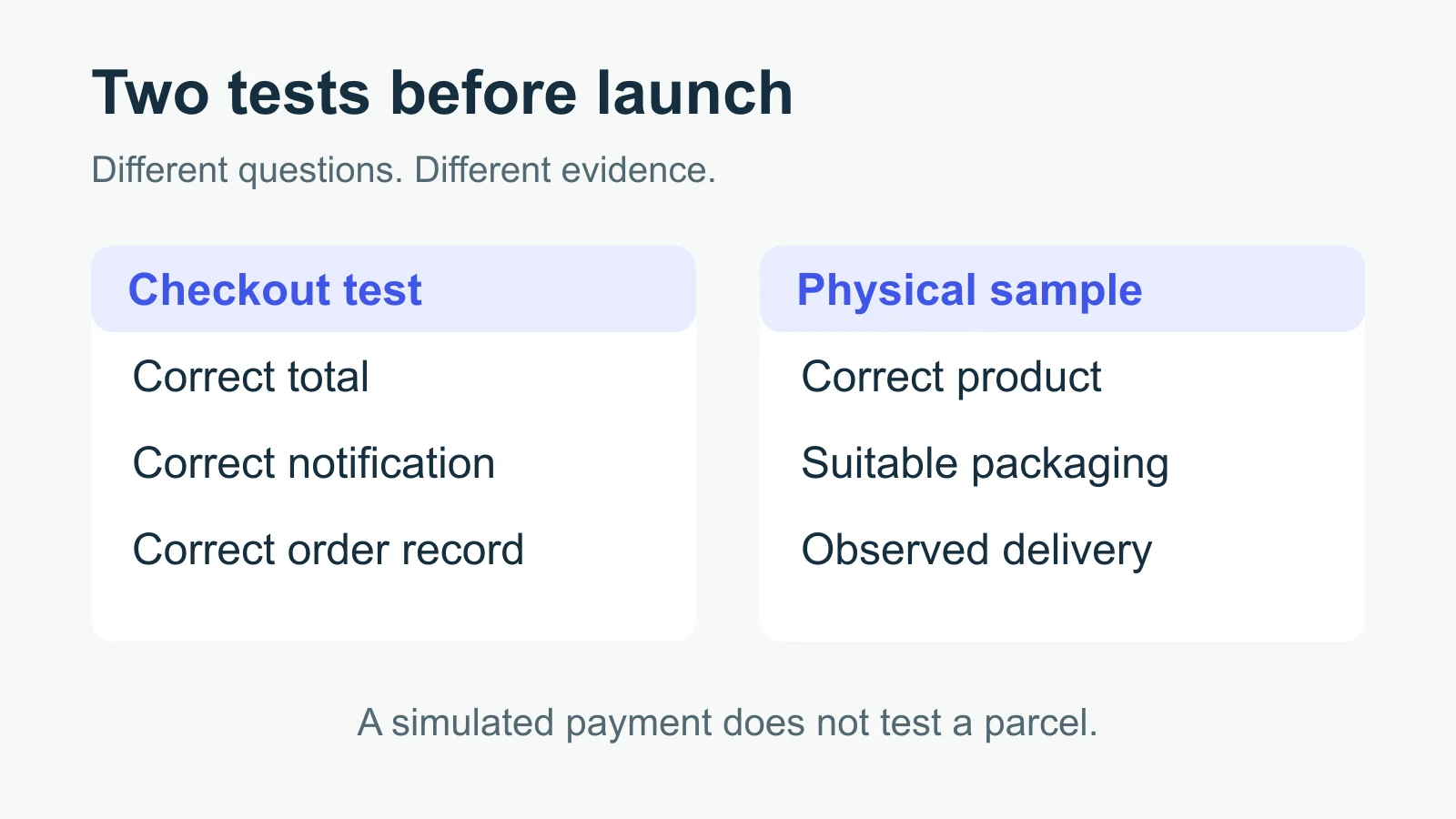
Run a checkout test for the destination, product variant, and shipping option you intend to sell. Check the total, confirmation email, order record, inventory behavior, and supplier routing. A manual review is especially useful if an app can automatically send orders onward: make sure test activity will not accidentally trigger a paid supplier shipment.
Shopify’s test-order instructions explain how simulated transactions can verify configuration. Test orders do not establish that money will reach your bank or that a supplier has dispatched a parcel. Turn payment test mode off before opening for live sales; customers cannot place live orders while the payment provider is in test mode.
For the physical test, follow the parcel through dispatch and delivery, then compare it with the product page and shipping information. A tracking number created by a supplier is not, by itself, confirmation that the carrier has received the package.
A working checkout proves that an order can be recorded. A successful delivery provides different evidence: the product, packaging, and route worked for that particular order.
If either test fails, fix that part before buying traffic. Recheck only the affected path after a correction, such as the shipping rate, notification, or supplier connection. Keep the test notes brief enough that you can use them when changing products later.
07
Launch one customer acquisition channel
Choose a channel based on how the intended customer discovers and evaluates the product. A visually demonstrable item may suit short video. A product that solves a specific searched problem may benefit from useful search content. An existing relevant audience can make email or community participation practical. These are channel choices to test, not promises of cheap traffic.
Create a small set of product-specific messages. Show the problem, demonstrate the product accurately, and explain the limitation that matters to a buyer. Use the same offer and delivery expectations in the advertisement and on the product page. A misleading ad can produce orders you later have to refund.
For a paid test, set a spending limit you can afford before launching it. Track spending, visits, orders, and the contribution those orders leave. For an organic test, record the time spent creating and distributing content as well as the orders. “No ad spend” does not mean the acquisition effort was free.
Diagnose the stage that is failing:
- Few relevant visits: reconsider the audience, message, or channel.
- Visits but little product interest: check the offer and how clearly it is explained.
- Purchase attempts but few completed orders: test checkout, charges, payment availability, and trust concerns.
- Sales followed by complaints: investigate the product or delivery promise before seeking more sales.
Small samples are noisy. A few purchases are a reason to keep learning, not proof of a stable conversion rate. Avoid changing the product, price, audience, and page simultaneously when you need to understand which change helped.
08
Fulfill orders and handle customer problems
For each live order, check the payment and relevant risk signals, address, variant, stock availability, and any unusual request before releasing it. Send the exact order details and supplier payment through the agreed process. Confirm that the supplier accepted the order, then follow dispatch and carrier movement rather than treating the app’s status as the whole story.
Give customers useful updates when something changes. If a variant is unavailable, offer an accurate revised option or the appropriate cancellation and refund path. Do not silently send a different color or size because the supplier considers it equivalent.
For covered US merchandise orders, the FTC’s shipment rule requires a reasonable basis for shipment promises and governs delay consent and refunds. Its default timing concerns shipment, not a universal delivery deadline. Check the rules relevant to the market you serve before making or changing a promise.
Do not make a customer’s required refund depend on recovering money from your supplier. Determine the customer resolution and the supplier claim separately. A return destination also needs confirmation; it is not automatically the supplier’s address or an overseas warehouse.
Keep the order, customer correspondence, photos where relevant, tracking, refund record, and supplier claim linked. The returns guide explains that process without assuming every case needs the same outcome.
09
Use the first orders to decide what to change
Review a small group of completed orders before expanding the offer. Compare the actual selling price and expenses with your estimate, then examine the questions and problems those orders created. Keep outstanding returns and uncompleted deliveries visible so an early revenue total does not become a premature profit conclusion.
You need to know whether customers understood the offer, whether the supplied item matched it, whether the route met the stated expectations, and whether enough money remained. A profitable sale with a preventable service failure still deserves a correction before more customers encounter it.
Continue cautiously when those results support the offer. Revise the page when customers misunderstand a detail you can explain better. Change the product or supplier when the delivered result is wrong. Pause new orders when you cannot keep the promise or fund the existing commitments.
Once you can repeat the process, add products or increase traffic in manageable increments. The dropshipping fundamentals hub connects the next decisions, including business fit and inventory models. Your first useful milestone is a customer who received what you promised, with the costs and follow-up work understood.