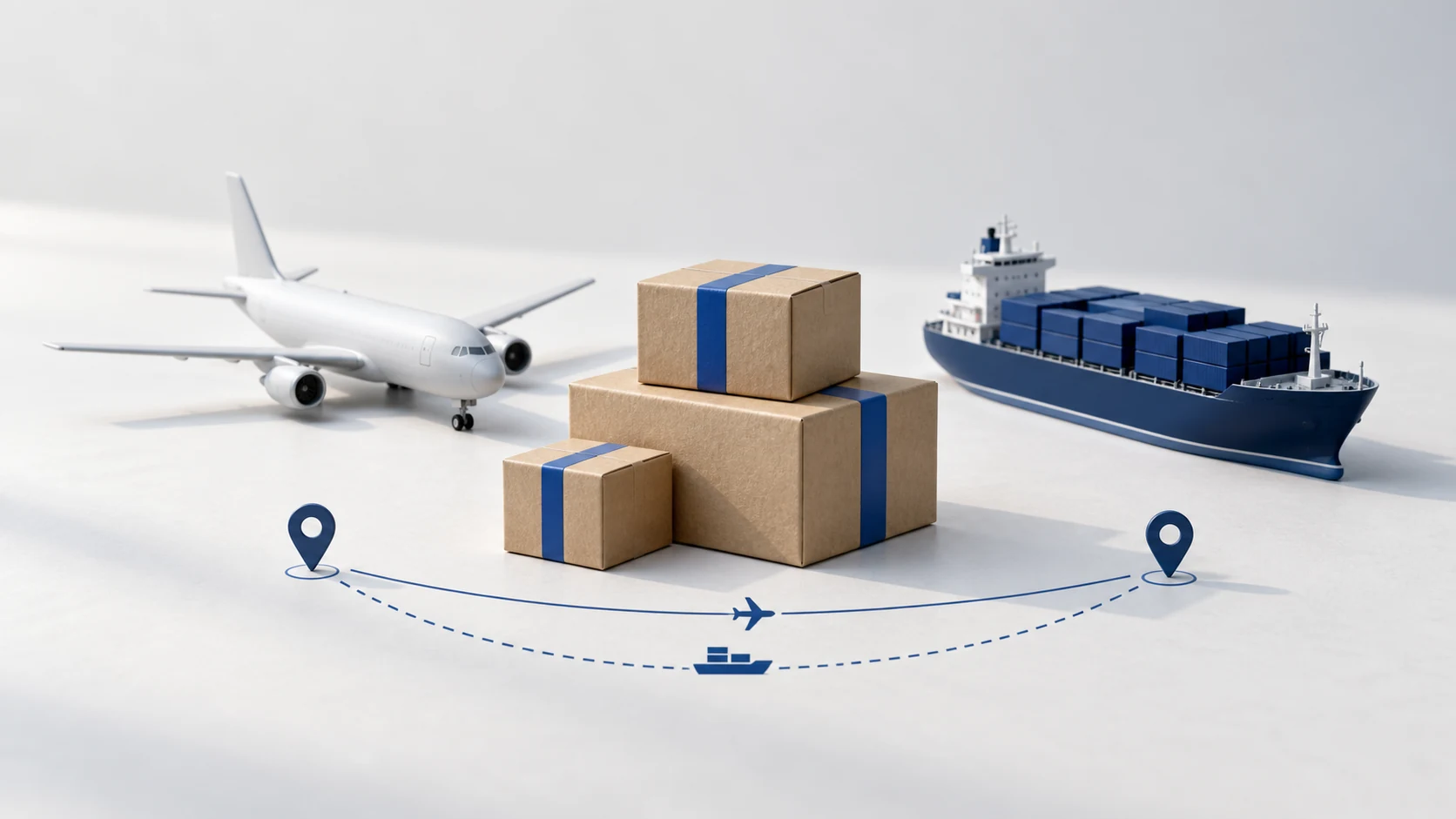
Choose a shipping route that can keep your store’s promise.
Dropshipping shipping is more than a label price. The route must fit the packed product, destination, delivery window, tracking requirement, landed-cost exposure, and a usable fallback when the normal path fails.
Carrier selection comes after these inputs. Compare chargeable weight, destination coverage, tracking, customs exposure, delivery window, landed cost, and what happens when the route leaves the normal path.
01
Product restrictions
Check category restrictions, value, fragility, batteries, liquids, dimensions, and any customs or carrier limits before comparing price.
02
Chargeable weight
Use the final packed dimensions and chargeable weight—not the bare product weight—to compare route economics and packaging trade-offs.
03
Destination + customs
Match the route to destination coverage, declarations, duties, remote-area exposure, and likely clearance or disruption points.
04
Delivery window
Balance the customer-facing window with tracking visibility, handoff quality, service consistency, and support risk.
05
Fallback + recovery
Define who acts when a scan is missing, a route is interrupted, delivery fails, or a return or reshipment is required.
COMPARE THE TRADE-OFF
Speed, cost, tracking, and resilience rarely move together.
A route choice should state what is optimized and which risks remain.
01
Economy path
May prioritize cost but can require different expectations for speed, tracking, or disruption response.
02
Balanced path
Seeks a practical compromise across cost, tracking, speed, and coverage.
03
Priority path
May prioritize speed or service visibility while accepting higher cost or product constraints.
BEFORE HANDOFF
Many shipping problems begin before the carrier receives the parcel.
Dispatch readiness connects stock, product accuracy, packing, labels, address, documentation, and the selected route.
01
Ready product
Correct item, variant, quantity, condition, and approved packaging.
02
Ready data
Valid address, service selection, labels, declarations, and required order references.
03
Ready handoff
Carrier or route acceptance, initial scan expectations, and tracking/status return.
WHEN A SHIPMENT LEAVES THE NORMAL PATH
Decide what changes for the customer and the next shipment.
Classify the event, identify the affected parcels, set the customer message or refund/reship action, and record what must change before the next shipment uses the same route.
Identify the event and the last reliable status or evidence.
02
Own
Assign the next action to fulfillment, carrier, store, customer, or another responsible party.
03
Learn
Use repeated disruptions to change route, packing, address checks, promise, inventory, or customer communication.
PRICE IS ONE INPUT
The lowest shipping price is not always the lowest landed cost.
Carrier relationships and consolidated shipping volume can improve access to route options and commercial rates. The operational value is broader: one China-side coordination layer can compare services, prepare handoff data, return tracking, and own route exceptions without the store managing each carrier conversation.
That can save purchasing time and management attention, but no single route is always cheapest or fastest. Weight, dimensions, destination, customs exposure, delivery promise, and exception cost still determine the useful choice.
Exception ownership — who investigates delays, failed delivery, damage, or return-to-sender events.
The correct output is a documented route assumption and fallback—not an unqualified “lowest price” promise.
ROUTE DECISION MEMO
Choose the route before you promise the delivery date.
The route decision should start with the packed product, origin, destination, delivery promise, tracking need, and fallback—not with a generic “fastest” or “cheapest” label.
No. Delivery depends on product, packing, route, carrier, destination, customs, last mile, and external disruptions. The route review clarifies assumptions and exception handling.
The expected events and connection method are confirmed during onboarding. The workflow should define the tracking source, store status, failed-update owner, and customer communication path.
SEND ONE SKU + DESTINATION + DELIVERY TARGET
Compare viable routes before promising delivery.
Share the product, packed profile, dispatch point, destination, required tracking, and delivery target. The first review will expose missing inputs, viable route families, and the fallback that needs approval.