
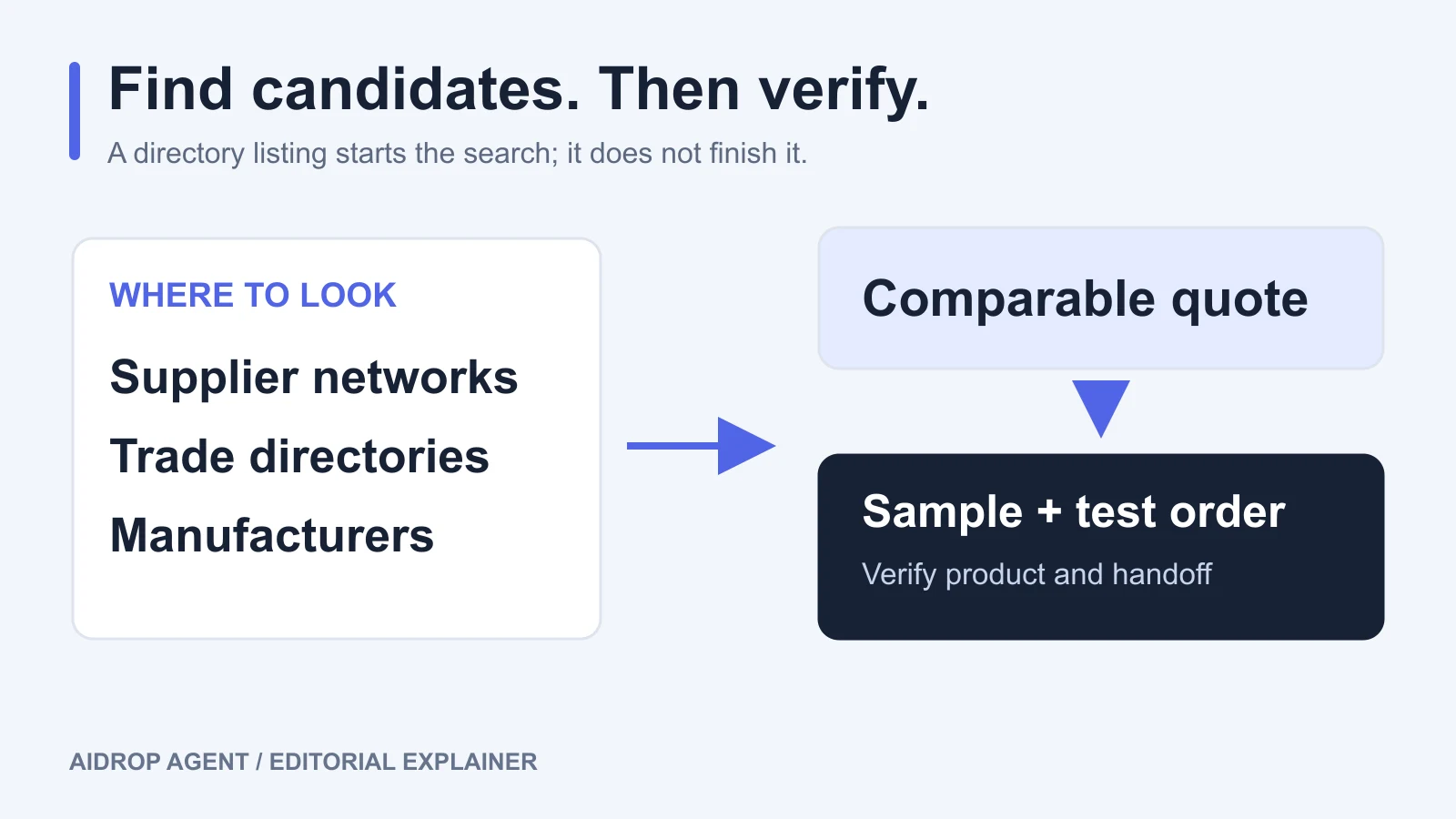
To find dropshipping suppliers, start with supplier directories, product marketplaces, manufacturer and distributor websites, and trade-show exhibitor lists. Filter candidates by the product you need, the countries you sell to, and whether they can fulfill individual customer orders. Then compare written terms and test the exact product through the shipping process your customers would use.
The search becomes much easier when you can describe an order. A supplier might carry your product but require a bulk purchase. Another might ship single units but have no stock of the color you advertise. Finding a suitable partner means resolving those differences before you send customer orders.
01
Where to find dropshipping suppliers
Use the channel that fits what you already know. A seller exploring a category needs a different starting point from a seller who has an exact product reference.
| Where to look | Useful starting point | What to confirm |
|---|---|---|
| Supplier directories and store apps | You want to browse products with supplier contact or integration options | Which company fulfills the order, eligible sales channels, fees, and shipping locations |
| Product marketplaces | You have a product photo, model, or close reference | Exact variant, specification, single-unit fulfillment, and actual dispatch origin |
| Manufacturers and authorized distributors | You know the brand, product type, or technical requirements | Whether they accept your business and offer dropshipping, or can refer you to a distributor |
| Trade-show exhibitor lists and industry associations | You need specialist suppliers that broad searches miss | Current product range, reseller terms, order minimums, and customer-order shipping |
Shopify’s supplier guidance describes directories, trade shows, apps, and broader online searches as discovery options. These routes produce candidates; you still need to confirm the arrangement with each supplier.
Search directories by fulfillment needs
A directory can reduce the time spent finding contacts. For example, SaleHoo describes its directory as covering wholesalers, manufacturers, and dropshippers, with filters for supplier type and location. That distinction matters: a company appearing in a supplier directory may be suitable for wholesale purchasing without accepting single customer orders.
Read the individual supplier’s terms before buying a subscription or importing its catalog. Check where the relevant SKUs are held, which countries they can reach, and whether the integration sends orders automatically or simply imports product information.
Search for the product, then the company
Try combinations such as “travel organizer dropship supplier,” “travel accessories wholesale distributor,” or “organizer manufacturer reseller program.” Add your target country when local fulfillment is a requirement.
A search for a manufacturer may lead to a company that only produces bulk orders. Ask whether it has an authorized distributor offering dropshipping. That referral can be more useful than trying to persuade a factory to build a parcel-fulfillment process for your store.
Product marketplaces can also help identify possible sources. Save the product URL and seller identity, then request specifications. Similar photos do not establish that two sellers offer the same materials, dimensions, accessories, or packaging.
For branded products, ask the brand or its authorized distribution contact about reseller eligibility and permitted sales channels. Finding stock does not by itself establish permission to use brand assets or sell through every marketplace.
02
Write down the order you need a supplier to fulfill
Before contacting anyone, make a short sourcing brief. Include the product reference, important variants, destination countries, sales channel, expected packaging, and whether you need direct fulfillment or can purchase inventory.
Keep forecasts honest. “We are preparing a launch and need individual-order fulfillment” gives a supplier useful information. A large projected daily volume that you cannot support makes its quote less useful.
For a travel organizer, your brief might specify a gray zippered version, the dimensions you intend to advertise, the included accessories, and neutral packaging. Add a representative delivery location and explain whether the quote is for one unit or a multipack. These are example fields, not product specifications you should adopt without checking your own item.
Set the non-negotiable conditions early. If you cannot buy stock, a supplier requiring a production batch is unsuitable for the current launch. If you need a particular color, “similar color available” is an unresolved substitution. If your promise relies on local stock, ask about the dispatch warehouse for that exact SKU.
Clarify whether a minimum applies to each customer order or to stock you must purchase in advance. The dropshipping MOQ explanation separates product, variant and packaging commitments so you can compare the actual cash requirement.
The supplier, agent, and 3PL comparison can help when different companies would handle sourcing, inspection, and fulfillment. For the supplier search itself, focus on who can provide and ship the required product.
03
Send an inquiry that is easy to answer
Start by establishing fit. You do not need an exhaustive questionnaire in the first message, but you do need enough detail to prevent a generic catalog reply.
You can adapt this inquiry:
Hello,
We sell [product category] through [store or sales channel] to customers in [countries]. We are looking for [product reference and required variants].
Can you fulfill individual customer orders for this product? Please confirm the dispatch location, any minimum purchase or account requirements, and whether the requested variants are currently available.
For a test order to [representative location], please quote the product, packaging, handling, and shipping separately. Please also confirm normal processing time, the shipping service, tracking availability, and how damaged or incorrect items are handled.
We would like to order a sample of the same version and packaging used for regular orders. Please identify any difference between sample fulfillment and normal customer fulfillment.
Our current stage is [prelaunch or actual order volume]. Thank you.
Send the same product brief to suitable candidates so their answers can be compared. When a reply is incomplete, ask about the missing item directly: “Does that shipping price include handling?” or “Is this stock available in the warehouse you quoted?”
Observe whether the supplier answers the question and keeps its answers consistent. Speed alone is insufficient. A fast reply that leaves the SKU, stock, or order minimum unclear does not help you decide.
If the supplier proposes an alternative product, keep it as a separate option with its own specifications. Do not silently substitute it into the original comparison.
04
Check what verification and order protection actually cover
Three different questions need answers: does the company exist as represented, what protection applies to your purchase, and can this product reach your customers as promised?
Alibaba’s Verified Supplier program describes third-party on-site verification and an assessment report. Read the report and compare its company identity and capabilities with the supplier you are contacting. Treat it as information about the assessed business, rather than approval of your particular order.
Trade Assurance concerns the purchase and its agreed terms. Alibaba’s buyer explanation emphasizes the online order, payment through Alibaba.com, and the product-quality and shipping terms agreed with the supplier. Review the terms shown for your actual order; do not assume a refund is automatic or that an off-platform payment has the same protection.
Neither mechanism replaces a test of the SKU, packaging, and shipping arrangement you intend to use. An assessed manufacturer can still have an unsuitable minimum order. A protected transaction can still involve a product you have never tried.
Also compare the business name across the quotation, invoice, supplier profile, and payment instructions. Ask for an explanation of discrepancies before paying. A trading company or distributor is not automatically a poor choice; what matters is knowing which company is responsible and what it has agreed to provide.
05
Compare a complete quote, then test an ordinary order
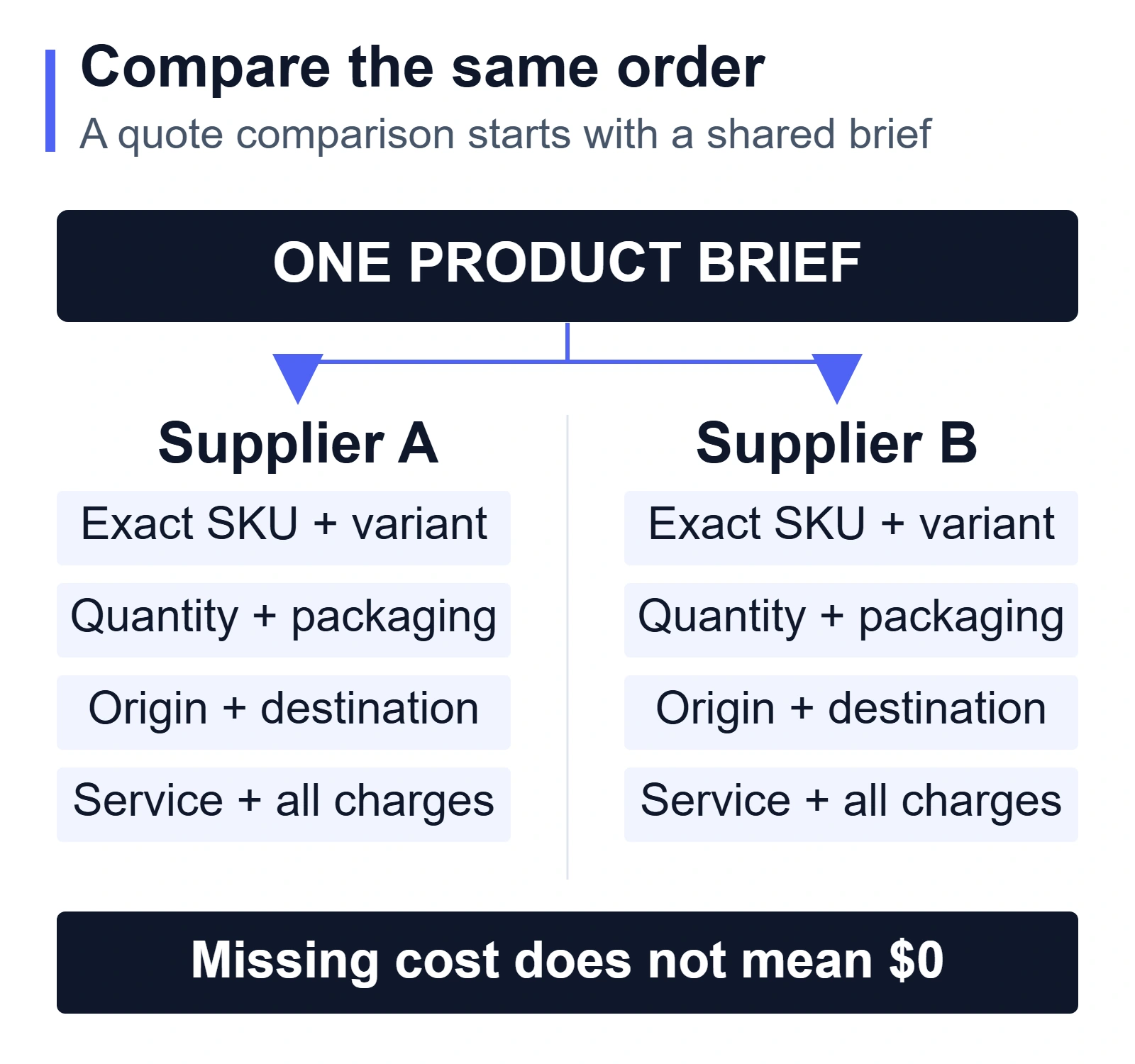
Once you have suitable candidates, compare their quotes on the same basis. The product, variant, order quantity, destination, and packaging should be the same across the comparison.
| Quote item | Question to resolve before choosing |
|---|---|
| Product and variant | Is the price for the exact specification, color, and included parts? |
| Quantity and inventory | Is it a single-order price, a price conditional on prepaid stock, or a bulk price? |
| Packaging and handling | Are protection, packing labor, inserts, and per-order charges included? |
| Shipping | Which service, dispatch origin, and destination does the price cover? |
| Additional charges | What is excluded, and who pays any applicable import or delivery charges? |
| Problems after dispatch | What evidence, deadlines, and costs apply to damage, wrong items, loss, or replacement? |
| Changes | How long is the quote valid, and what triggers a new price or product approval? |
A missing cost is still unknown. Do not enter zero to make the spreadsheet look complete. Resolve exclusions before deciding whether the product supports your selling price.
When coordinating the brief and supplier responses is becoming difficult, AIDrop Agent’s product sourcing page explains the information to bring for a sourcing review.
Separate product approval from fulfillment testing
Use a sample to examine the product you plan to sell. Check the actual variant, measurements, finish, accessories, and normal function against the brief. Photograph the package and keep the approved sample or a clear record of it.
Then establish how the sample was sent. A specially prepared sample shipped by express courier tells you little about routine customer delivery through a different service.
Place a test order through the intended ordering method and request the normal SKU, packing, and shipping option. Shopify recommends test orders to observe order handling, shipping, tracking, packing, and communication.
Record when the order was accepted, when a label appeared, when the carrier recorded possession, and when delivery occurred. Label creation and physical dispatch are different events. Keep those observations separate when assessing a processing-time claim.
One successful delivery is a limited observation. It cannot establish an average delivery time or a dependable defect rate. Test the important differences in your intended offer—such as another variant or destination—rather than assuming the first result applies everywhere.
If the product fails a stated requirement, describe the discrepancy and request a corrected sample before approval. If dispatch or tracking differs from the quote, ask whether the promised process is actually available. Repeatedly changing explanations are a reason to choose another candidate.
06
Start with a limited commitment and a qualified backup
Proceed when the supplier fits your order model, the product meets your requirements, the quote is complete enough to assess, and the relevant tests have no unresolved material problems.
Save the approved supplier name, SKU, variant, sample reference, packaging instructions, and written terms together. Ask the supplier to notify you before changing the product, materials, packaging, or fulfillment location. Approval should refer to something both sides can identify.
Before importing the catalog, use the supplier data requirements to confirm variant identifiers, stock definitions, update timing and the fields needed to send the correct order.
A backup supplier needs its own qualification. Matching listing photos are insufficient. Confirm its product, packing, price, order method, and shipping route before it becomes your emergency replacement.
If the search reveals that you need someone to coordinate several suppliers or manage local inspection, use the dropshipping agent selection guide for that separate decision. The dropshipping hub covers the broader operating choices around sourcing and fulfillment.
07
Frequently asked questions
Can I find dropshipping suppliers for free?
Yes. Manufacturer websites, search engines, marketplace listings, and publicly available exhibitor lists can provide leads without a paid directory. Samples, shipping, software, or account services may still cost money. Evaluate those charges against the work they provide.
Do manufacturers offer dropshipping?
Some do, but manufacturing capability does not establish single-order fulfillment. Ask about order minimums, stock, individual packing, dispatch, and returns. If the manufacturer cannot support your order model, ask for an authorized distributor or another suitable sales contact.
Is one sample enough to approve a supplier?
One sample can help you assess that unit and version. It does not establish consistency across future stock, variants, destinations, or normal order processing. Define which uncertainties remain and test those before increasing your commitment.