
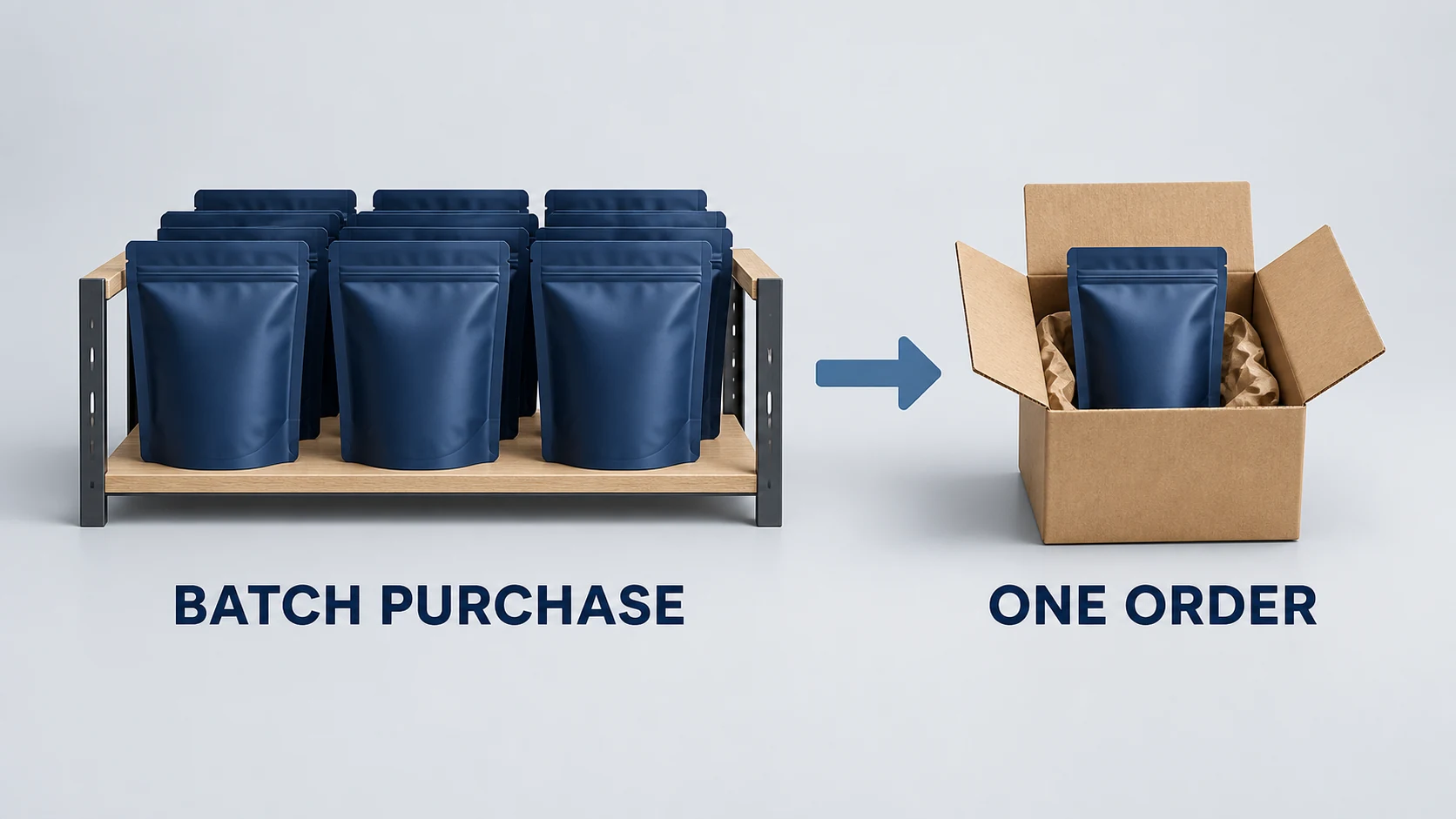
MOQ means minimum order quantity: the smallest purchase a supplier will accept under a particular arrangement. In dropshipping, a supplier may ship one item to each customer while still asking you to buy a batch of products, packaging or reserved inventory first. Confirm the minimum for your purchase separately from the quantity in each customer parcel.
You can find services that fulfill individual items without an upfront product batch. You can also find factories willing to ship individual orders only after you fund production. Both can deliver one parcel at a time, but they expose your business to very different cash and inventory commitments.
Before comparing prices, ask: “Can I pay for one unit after each sale, with no prior stock purchase or ongoing minimum?” A clear answer is more useful than a general “we support dropshipping.”
01
One customer order can sit on top of a larger purchase
A customer buying one pouch does not tell you how the pouch was financed. The supplier might own ready stock and sell you one unit. Alternatively, you might have purchased 100 pouches and instructed a warehouse to release them one by one.
In the second arrangement, the warehouse can fulfill a single unit, but you have already accepted the risk of the other 99. Physical storage at someone else’s premises does not remove your financial ownership or the terms attached to it.
Shopify defines MOQ around the minimum a supplier accepts, and explains why production and order costs influence it. For a dropshipping store, the important detail is which transaction the supplier means: manufacturing, purchasing stock, ordering packaging or releasing an individual parcel.
Imagine a shelf holding a prepaid batch and one pouch leaving in a customer parcel. The outgoing parcel contains one unit; the purchase commitment remains the whole batch. That distinction should be visible in your quote, stock records and cash plan.
For the broader process of checking supplier claims, use how to find dropshipping suppliers. MOQ is one commercial condition within that review, rather than proof of whether a supplier is good or bad.
02
Identify the minimum at each level
“Minimum 100” is incomplete. It could mean 100 units of one color, 100 units across a style, or 100 items in a combined purchase. A supplier may also require case multiples, so meeting the total does not necessarily create an order it will accept.
| Minimum or rule | What you are committing to | Question to ask |
|---|---|---|
| Per-product minimum | A total for one product or design | Can sizes and colors be mixed? |
| Per-variant minimum | A quantity for each specific option | Does every color-size combination need its own minimum? |
| Case-pack multiple | Buying in fixed packs | After the minimum, must quantities increase by a full case? |
| Minimum order value | A currency amount per purchase | Which items and charges count toward the value? |
| Packaging minimum | A batch of boxes, inserts or labels | Who owns and stores unused packaging? |
| Account commitment | A recurring spend or order requirement | What happens in a quiet month? |
Minimum order value and minimum order quantity are not identical. A $300 purchase requirement could allow mixed items; a 30-unit minimum for one variant might not. Ask for the applicable currency and whether shipping, tax or service fees count toward a value requirement.
Customization can introduce another minimum even when the standard item is available individually. A plain box taken from existing stock and a newly printed branded box involve different purchasing arrangements. Request both alternatives before choosing a logo treatment that forces a larger commitment than the product itself.
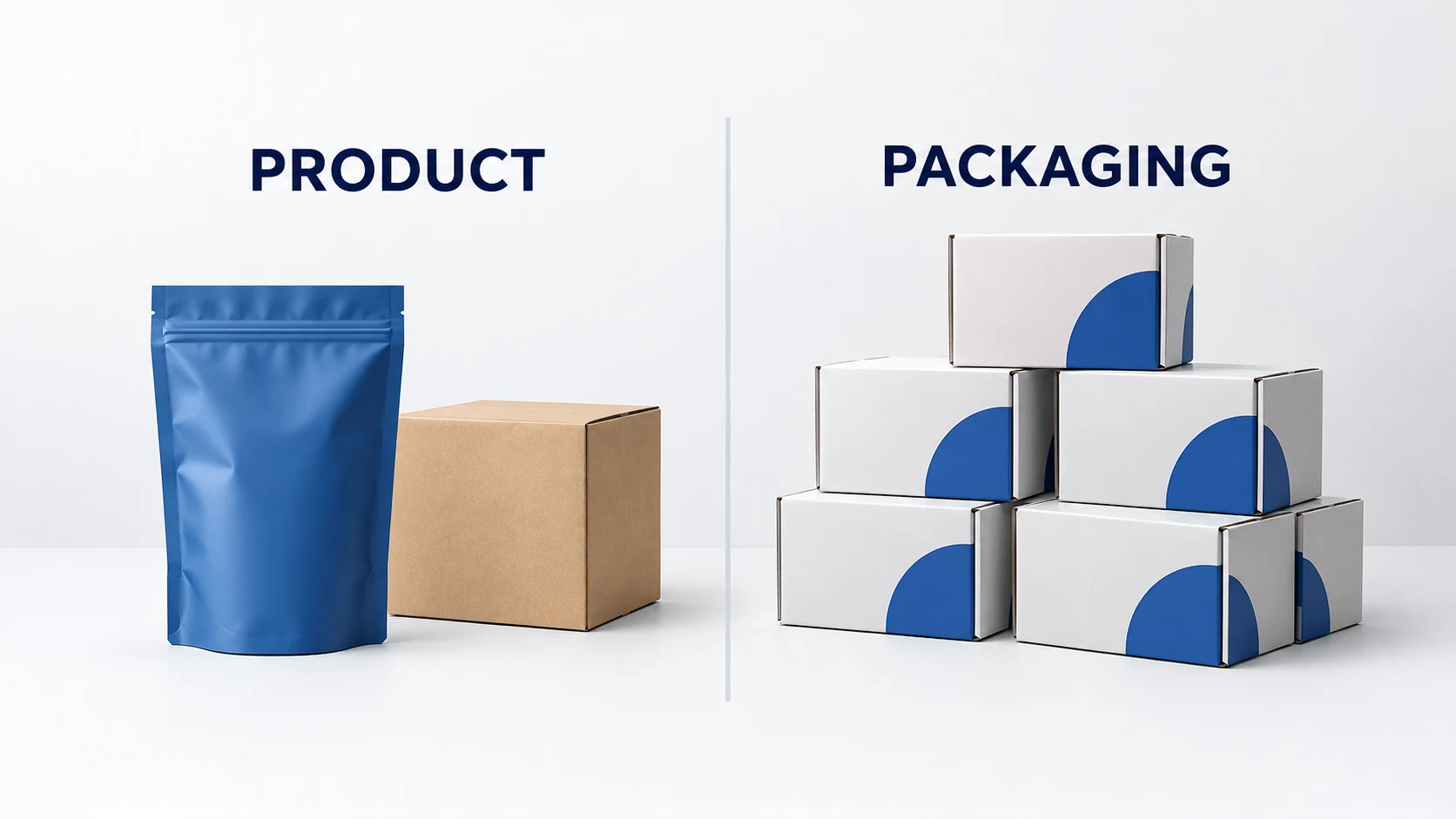
Do the arithmetic across variants. If a supplier requires 25 units in each of four colors, your commitment is 100 units. It is not 25 assorted units unless the supplier agrees. A larger option range can therefore consume cash before it produces any evidence that customers want those options.
Test the proposed variant mix against every rule
Write the quantity beside each sellable variant before totaling the order. In this hypothetical purchase, you want 20 blue, 20 black, 10 green and 10 red pouches. The supplier requires at least 24 of each ordered color, supplied in multiples of 12. Buying all four colors therefore requires 96 units, not the 60 you initially wanted.
| Color | Initially wanted | Smallest accepted quantity under these example rules | Additional units |
|---|---|---|---|
| Blue | 20 | 24 | 4 |
| Black | 20 | 24 | 4 |
| Green | 10 | 24 | 14 |
| Red | 10 | 24 | 14 |
| Total | 60 | 96 | 36 |
If you test only blue and black, the same rules allow 48 units. That reduces the initial commitment, but it also changes the assortment being tested. If there is a separate 100-unit combined minimum, 96 still fails; with these case multiples, at least one variant must increase by another 12, giving a 108-unit purchase. Ask the supplier to confirm that allocation before payment.
Minimums and increments are distinct rules. Shopify’s B2B quantity documentation provides a platform example of separate minimum, maximum and increment settings. Your supplier’s agreement determines the purchase rules you actually face; a store setting does not negotiate them away.
03
What “no MOQ” does and does not establish
No MOQ can mean you may purchase one product at a time. It does not promise a low delivered cost, guaranteed availability, free packaging, or the absence of every account fee. Read it alongside the actual service and destination you intend to use.
Printful’s print-on-demand service advertises no minimum order requirements. That supports the availability of an individual-order production model. It does not mean every separately purchased branding material or external fulfillment arrangement has the same conditions.
A different example appears on CJdropshipping’s service-fee page. At the time of review, its overseas-warehouse stocking condition states at least 10 pieces per variant and 100 pieces in total. That is a condition for sending inventory into overseas warehouses, not a universal minimum for every customer order through the provider. Confirm the current arrangement directly before funding stock.
These examples explain why you should compare the specific service, rather than collecting “no MOQ” badges from supplier homepages. A store purchasing single items from existing stock and a store replenishing its own overseas inventory are making different purchases.
04
Calculate the commitment before accepting the cheaper unit price
A lower product price helps only to the extent that you sell the stock and retain enough margin after the extra costs. Separate the cost of units sold from cash tied up in units you still own.
Consider this hypothetical comparison, with identical products and outbound shipping and handling held equal:
| Item | Purchase after each sale | Purchase a batch first |
|---|---|---|
| Product purchase | $12 per unit as needed | 100 units at $9 each |
| Product cash paid before sales | $0 | $900 |
| Additional setup and storage for this comparison period | $0 | $120 |
| Product cost for 40 sold units | $480 | $360 |
| Unsold units after 40 sales | None purchased in advance | 60 units, purchased for $540 |
At 40 sales, the batch has saved $120 on the product cost of sold units: 40 × ($12 − $9). That exactly covers the assumed $120 in additional setup and storage. It has not recovered all the cash committed to inventory. You still hold 60 units that cost $540.
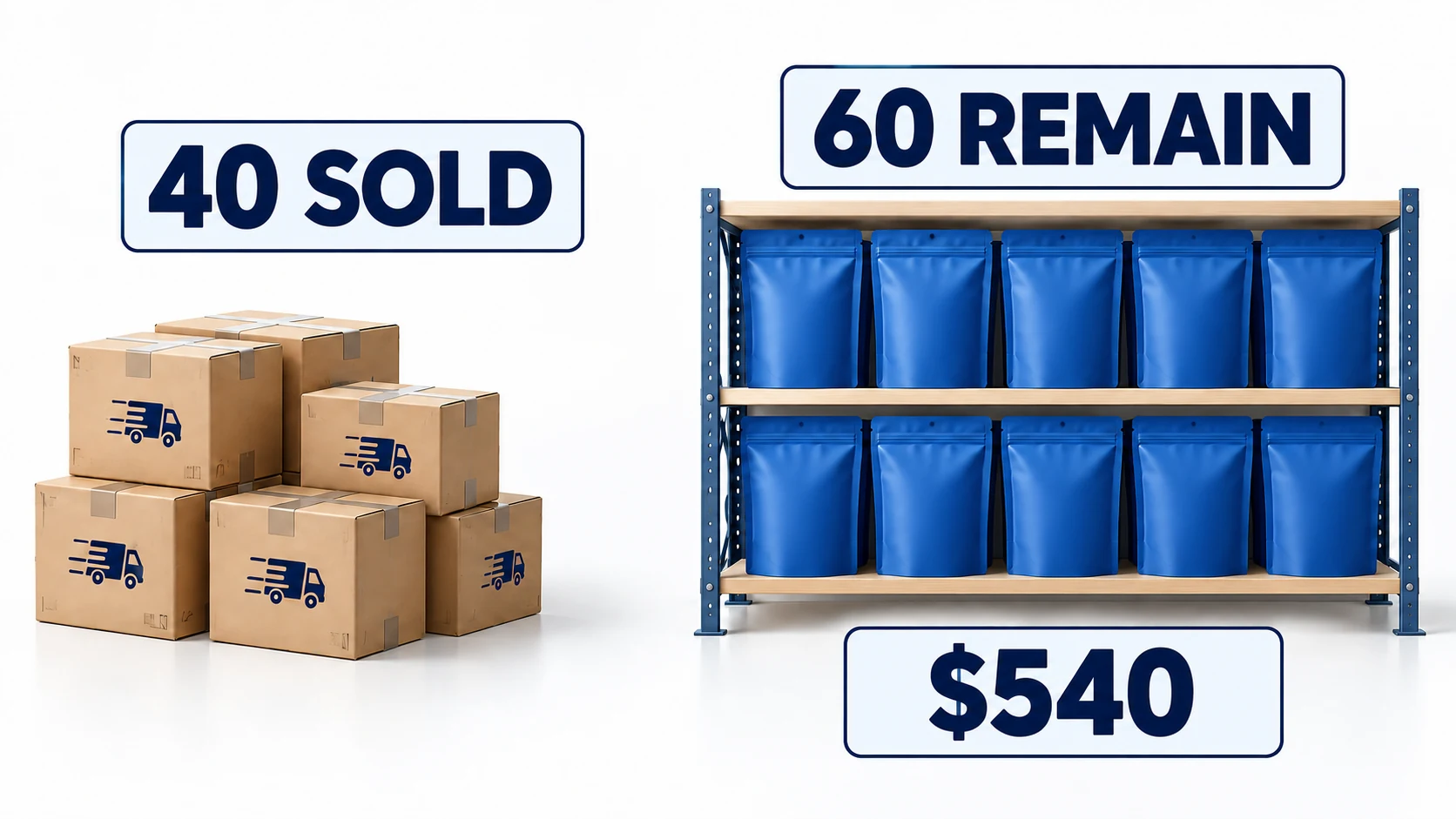
The batch required $1,020 before sales in this simplified example. Purchasing 40 units as needed would have required $480 in product payments as those orders arrived. The $540 difference is cash still represented by unsold batch inventory. It is not automatically a loss, but it is unavailable for other uses until recovered or financed another way.
If only 20 units sell during the period, the $60 saving on sold products does not cover the $120 extra charge. If all 100 sell, the $300 product saving leaves $180 after that charge. Neither result is net business profit: advertising, payment fees, refunds, outbound costs and other expenses are outside this comparison.
Use your own quotes and a realistic review period. Storage can keep accumulating, demand can change, and unsold items may need discounting or disposal. A simple “break-even quantity” based on a unit saving should not be mistaken for a forecast that the whole batch will sell.
Separate the deposit from the total obligation
A deposit changes payment timing; it may not reduce the amount you are committed to buying. In the 100-unit example, an illustrative 30% deposit on the $900 goods bill would be $270, with $630 still due later. Add the $120 setup and storage cost at its actual due dates rather than assuming all charges follow the deposit schedule.
Before accepting that arrangement, identify the balance trigger: production completion, inspection, warehouse receipt or another agreed event. Confirm whether paying the deposit commits you to the balance and what happens if goods fail the agreed requirements. Do not infer a refund right merely because the payment is called a deposit.
Build the cash view from dates rather than unit margin alone. List the deposit, balance, inbound movement, packaging purchase and first customer-order costs against available cash and expected payouts. Keep funds needed for existing orders and refunds separate. The batch may be profitable on paper while its balance falls due before customer money is available.
Choose proceed, renegotiate or hold from the same comparison
Proceed when the exact product has been approved, the accepted variant mix fits observed demand, the total commitment can be funded, and the storage and release terms are workable. A lower unit price is supporting evidence, not the whole decision.
Renegotiate when the product fits but the commitment does not. Reduce optional colors, use existing packaging, compare a smaller-order surcharge, or request a different payment or release schedule. Recalculate the total after the supplier responds; shifting charges between lines does not necessarily reduce exposure.
Hold when important terms remain unknown, when the required stock would consume money needed for current obligations, or when the demand case depends on selling every variant at the planned price. A supplier’s limited-time discount does not resolve those gaps.
After a purchase, review sell-through by variant rather than only by total units. Strong blue sales can hide slow green stock. A repeat order that satisfies the same mixed minimum may replenish a winner while increasing the unwanted balance of another color. Ask whether a replenishment order can use a different mix.
05
Negotiate the part that creates the minimum
Ask why the supplier needs the quantity. A production setup, purchased material, carton multiple and account-handling cost create different possibilities. You will have a more useful discussion when you offer a change that addresses the actual constraint.
Reduce variation before increasing the order
Ask whether the trial can use an existing product, standard material, one color or neutral packaging. You may lose some customization while reducing the quantity required. That can be sensible when the immediate goal is to test an offer rather than launch every possible variant.
Be explicit about what must remain unchanged. A cheaper trial that uses a different material or construction may not test the product you intend to reorder. Record any difference between the sample, trial batch and future production quote.
Compare a small-order surcharge with excess stock
A supplier may accept a smaller purchase at a higher unit cost or with a setup charge. Calculate the total alongside the larger MOQ instead of treating the higher unit price as an automatic rejection.
For example, paying more per item can preserve cash when the alternative is purchasing many units before demand is clear. It is a trade-off between margin on sold units and exposure to unsold units. No single MOQ is right for every product or stage of the business.
Clarify mixed orders and staged releases
Ask whether several variants can count toward one total and whether the supplier allows staged releases from a committed batch. Staged shipping may reduce the quantity arriving at once, but it may leave the full purchase obligation intact.
Do not describe a release schedule as a smaller MOQ unless the agreement actually reduces what you must buy. The payment dates, stock ownership and cancellation rights should make that distinction clear.
06
Set stock ownership, storage and exit terms
Before paying for a batch, confirm where it will be held, when ownership passes, how quantities are recorded, and whether stock is reserved for your account. Ask how damaged or missing units are handled and what evidence you receive when a batch arrives.
Unused custom packaging needs its own answer. You may sell through the product while still owning boxes or inserts that cannot be used with a new size. Keep those balances separate from finished goods so the remaining commitment is visible.
Agree storage charges, any free period, stock-transfer fees and disposal instructions before they become urgent. Find out whether you can move remaining goods to another warehouse and what information or payment is required. A useful exit term describes the practical release process, not merely a statement that the inventory belongs to you.
When a supplier proposes funding stock through an agent, establish which business receives your payment and which one records your ownership. The dropshipping agent role can include coordinating the purchase, but the particular agreement determines who holds the goods and who owes you performance.
Make the exit decision before storage keeps growing
Set a review date and compare the remaining options using additional cash from that point onward. You might keep selling, transfer the stock, accept a supplier buyback if offered, discount it, or dispose of it. The original purchase cost remains relevant to reporting the overall result, but paying it does not make every further expense worthwhile.
For example, imagine the 60 remaining units can be moved for a $90 transfer charge, or held for another period costing $60. Transferring is not automatically better: the receiving warehouse can add handling and storage, while staying only makes sense if there is a credible use for the stock. Obtain those additional charges and compare the likely recoverable amount under each option. This is a decision method, not a forecast of what the goods will sell for.
Before a transfer, reconcile finished goods, damaged or held units and unused packaging separately. Request a count by variant, the receiving address and reference, release authorization, transport arrangement and confirmation when the new warehouse receives the goods. Resolve which outstanding charges prevent release. Keep disposal instructions explicit so an uncertain stock balance is not treated as permission to discard your inventory.
07
Put the answer into the purchase terms
Before accepting a quote, write back a short confirmation covering the product, variant mix, minimum units or value, packaging commitment, payment timing and individual-order release arrangement. Include the cost of the small-order alternative if one is available.
Ask the supplier to correct any misunderstanding before payment. “100 units total, mixed across these four colors, stored for our account and shipped individually after order approval” is more useful than “MOQ confirmed.” Add the agreed unit allocation and charges rather than relying on that sentence alone.
Then choose the commitment your cash and evidence can support. Existing product and supplier guides can help connect the purchase decision to sampling, product selection and supplier checks.
08
Frequently asked questions
Can I dropship with an MOQ of one?
Yes, where the supplier accepts a one-unit purchase and direct customer delivery. Confirm there is no separate advance stock, packaging or account commitment, and compare the total order cost.
Does an MOQ of 100 mean one customer must buy 100?
Not necessarily. It may be your purchase commitment while the supplier or warehouse releases individual customer orders. Ask which transaction the number applies to.
Is a supplier with a high MOQ unsuitable for dropshipping?
It may be unsuitable for a store testing demand without inventory capital. It could fit a store with established demand that deliberately buys stock for individual fulfillment. The minimum alone does not establish product quality or reliability.
Can an agent remove a factory’s MOQ?
An agent can ask about existing stock, alternative suppliers, mixed purchases or another arrangement. It cannot guarantee that a factory will accept a smaller run. Confirm whether an apparent reduction leaves you with another advance purchase or fee.