
A dropshipping agent coordinates agreed sourcing and order operations on behalf of a seller. The work can include finding products, arranging purchases, checking goods, managing stock, packing parcels and organizing shipping. Some agents perform these tasks with their own team; others coordinate suppliers and warehouses. The agreement determines what you actually receive.
You still decide what your store sells, what it promises customers and which exceptions you approve. Hiring an agent can reduce the number of separate operational contacts you manage, but it does not make the entire business the agent’s responsibility.
Start by identifying the work that needs an owner. A store struggling to obtain a consistent product needs a different arrangement from one that has reliable stock but cannot track late parcels. The word “agent” alone does not describe either solution.
01
How an agent differs from a supplier or fulfillment company
A supplier provides the product. A warehouse holds goods and may prepare orders. A carrier transports parcels. An agent can coordinate several of these relationships, or combine coordination with one or more services.
These roles can overlap within one business. Avoid assuming that a company manufactures an item merely because it sources it, or owns a warehouse because it offers storage. Ask which business performs each material step and which business is responsible to you under the agreement.
| Role | Main task | What the role alone does not establish |
|---|---|---|
| Product supplier | Supplies the agreed item | Individual-order packing, integration or ongoing exception management |
| Sourcing agent | Helps find and purchase suitable goods | Continuous customer-order fulfillment after sourcing is complete |
| Dropshipping agent | Coordinates an agreed combination of sourcing and order operations | Ownership of every facility or responsibility for every business decision |
| Fulfillment provider or 3PL | Stores, picks, packs and dispatches goods within its service | Product development or supplier negotiation |
| Carrier or logistics provider | Moves shipments under the selected service | Responsibility for your product offer or supplier quality |
These are practical distinctions, not exclusive company categories. Shopify’s explanation of dropshipping describes third-party suppliers shipping to customers on the seller’s behalf. An agent can add coordination around that arrangement, but using one is not a requirement of the model.
When you are ready to assess particular providers, the guide to choosing a dropshipping agent covers selection and verification. This article focuses on what the role should own once you define the work.
02
Follow the work from product request to shipment
An agent relationship often begins with a product brief: the exact item, required options, intended destination, expected order pattern and what must match the approved sample. A listing link can help identify a starting point, but it rarely specifies everything needed for a purchase.
The agent may contact suppliers, compare offers and arrange samples. You approve the product and commercial terms before committing to an order. If the arrangement includes advance stock, clarify its ownership, location and payment terms separately from the cost of shipping customer orders.
After goods arrive, the agreed checks determine whether they can be released. Packing then follows the approved contents and packaging requirements. The parcel is handed to the selected carrier or logistics service, and shipment information returns to your store.
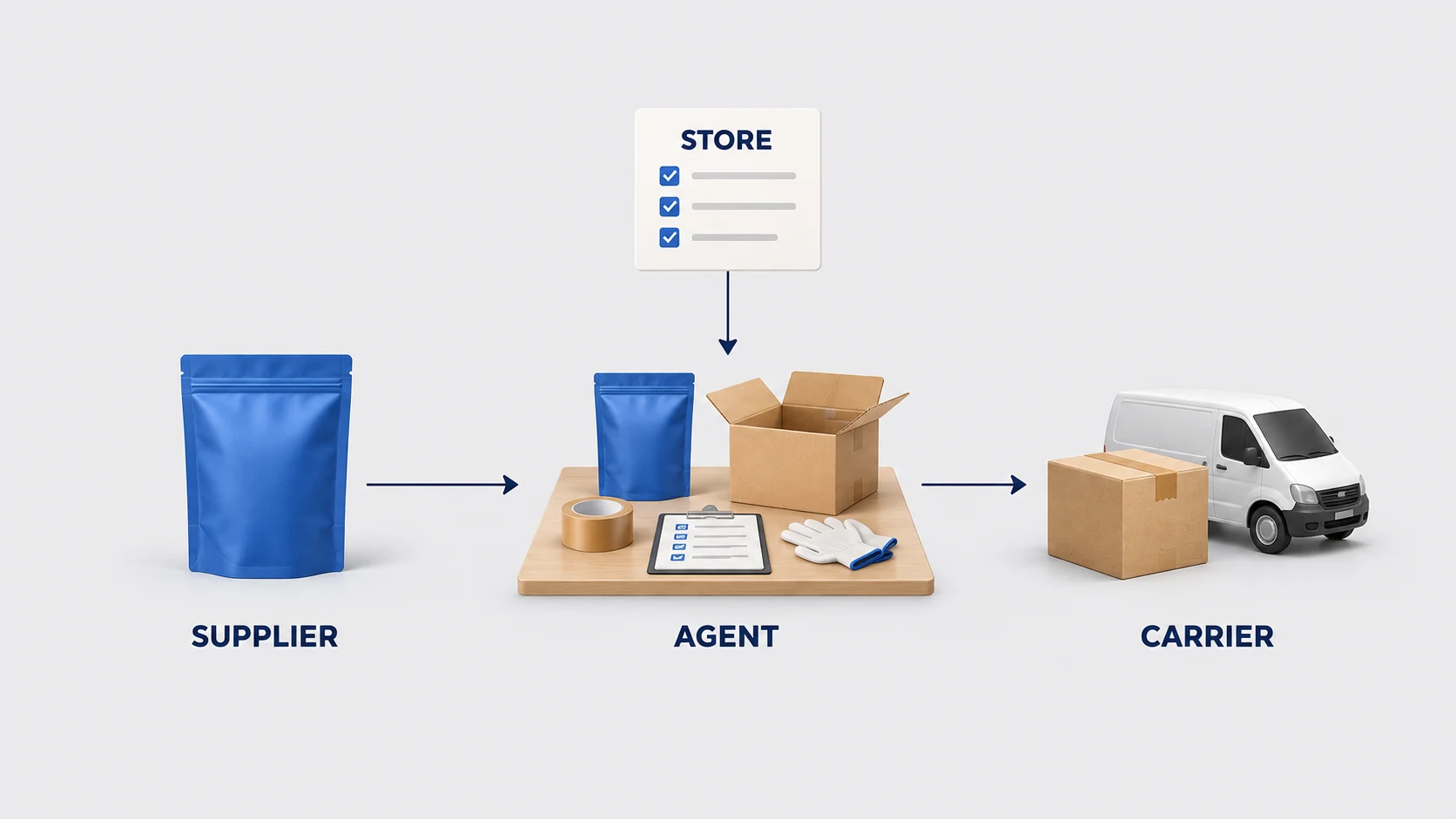
Picture three connected work areas: a supplier provides the item, an agent coordinates inspection and packing, and a carrier receives the parcel. Your store sits above that sequence, providing the approved product and order instructions. This describes a division of work; it does not mean every agent owns all three operations.
Public providers demonstrate how broad the service bundle can be. CJdropshipping’s service page lists storage, inspection, packing, labeling and other fulfillment charges. Those are examples of separately identifiable tasks. Their inclusion in one provider’s offering does not establish the scope or price of another agent’s quote.
For the detailed order sequence and status distinctions, see the dropshipping fulfillment guide.
03
Separate the work from the authority to make decisions
An agent can perform a check without having authority to accept a defect. It can request a replacement without having authority to change the product your customer bought. Write down who can act, who must approve an exception, and how the resulting cost is assigned.
| Situation | Possible agent task | Decision to reserve or explicitly delegate |
|---|---|---|
| Supplier offers a substitute | Obtain specifications and sample information | Whether the substitute meets the customer offer |
| An item fails the agreed check | Hold it, record findings and contact the supplier | Rework, replacement, cancellation or an agreed limited release |
| A shipping service becomes unavailable | Present supported alternatives and costs | Whether the price and delivery change are acceptable |
| A customer requests a refund | Supply order and shipment evidence | Customer remedy under your policy and applicable obligations |
| Stock is running low | Report quantity and replenishment options | Additional purchase and cash commitment |
For example, suppose the agent finds a torn seam before packing a pouch. A useful process is to hold the item, record the defect and request a supplier remedy. It should not quietly ship the damaged item or substitute a different pouch just to keep an order moving.

The seller then approves the permitted next step, or the agent follows a previously agreed rule within its authority. The record should connect the held item, the replacement decision and the final order. This makes the exception manageable without turning every routine order into a meeting.
A quality check has a defined scope. Confirm what is checked, on which goods, against what reference, and what happens when something fails. An appearance check is not a laboratory safety test, and an approved sample is not proof that every later unit is identical.
Shopify’s dropshipping responsibilities guidance makes clear that merchants must consider the rules applicable to their products and selling regions. An agent’s operational help does not establish that your listing, product or customer terms meet every relevant obligation.
Define a service promise you can measure
A useful service-level agreement names the starting event, the work to finish, the clock used and the evidence of completion. “Fast processing” leaves all four open. Ask whether the clock starts when your store receives payment, when the agent accepts the order, or when the required stock and approvals are available.
| Service event | Definition to agree | Record you should receive |
|---|---|---|
| Order acceptance | Complete order received before the stated cutoff, with stock and payment conditions defined | Accepted or rejected reference and timestamp |
| Product check | Specified checks against the approved product, for an agreed quantity or sampling basis | Findings, affected quantity and release or hold status |
| Dispatch | Physical handoff under the named route; label creation recorded separately | Carrier or logistics handoff evidence linked to the parcel |
| Exception response | Acknowledgement and first useful action within agreed working hours | Named owner, current facts, next action and update time |
| Stock reconciliation | Counts and adjustments for the agreed location and period | Opening stock, receipts, releases, holds and closing balance |
Specify working days, time zone, order cutoff and exclusions before setting a duration. A reply time is different from a resolution time. An agent may acknowledge a carrier investigation promptly while the carrier takes longer to establish what happened. Your agreement should require meaningful updates during that interval rather than describing every acknowledgement as a solved issue.
For a hypothetical operating rule, an order with confirmed stock and payment received before 14:00 on a working day might be due for handoff by the end of the next working day. If stock is missing, the rule should create a visible exception with a new update deadline. This is an example of how to define a promise, not an AIDrop Agent SLA or a standard every provider offers.
Track outcomes against the agreed denominator. If 20 orders meet the stated conditions and 18 are handed over on time, the on-time result for that defined sample is 90%. Do not quietly remove the two late orders to improve the rate. Orders excluded under the agreement should remain visible in a separate category with their reasons. A small trial percentage describes that trial and should not be presented as a long-term reliability rate.
Keep evidence attached to the decision it supports
For a held item, record the order, variant, quantity, defect and approved action together. For a price change, retain the old quote, new quote and effective date. For a replacement, distinguish authorization from actual dispatch and record the replacement shipment reference.
The person performing the work may differ from the party paying for a failure. A supplier may agree to replace an item while outbound reshipping remains chargeable. State the cost allocation rather than assuming that “replacement approved” includes every expense. Also identify whether your contract is with the agent directly or whether a remedy must be pursued with another business.
04
Understand how the agent is paid
An agent may quote a combined product-and-service price, separate fees, a percentage on a defined purchase amount, or a recurring charge for a specified scope. The names matter less than understanding what you pay for a comparable order and what remains outside it.
A bundled quote can be convenient when the item and destination remain consistent. Ask which product, packaging, checks and shipping assumptions it includes, and what causes the price to change. A separate-fee quote can make the components easier to see, but it still needs a complete list of applicable charges.
For a percentage fee, confirm the calculation base. Product value, product plus freight, and total paid to a supplier can produce different charges. Also ask whether there is a minimum fee, whether samples are charged separately and whether supplier rebates or other commercial arrangements affect the quote.
Compare two quotes on the same scope
Consider two hypothetical $18 headline quotes for the same item and destination. Quote A includes the agreed inspection and packaging. Quote B excludes a $1 inspection charge and $1 packaging charge. After those additions, B costs $20 for the scope being compared.
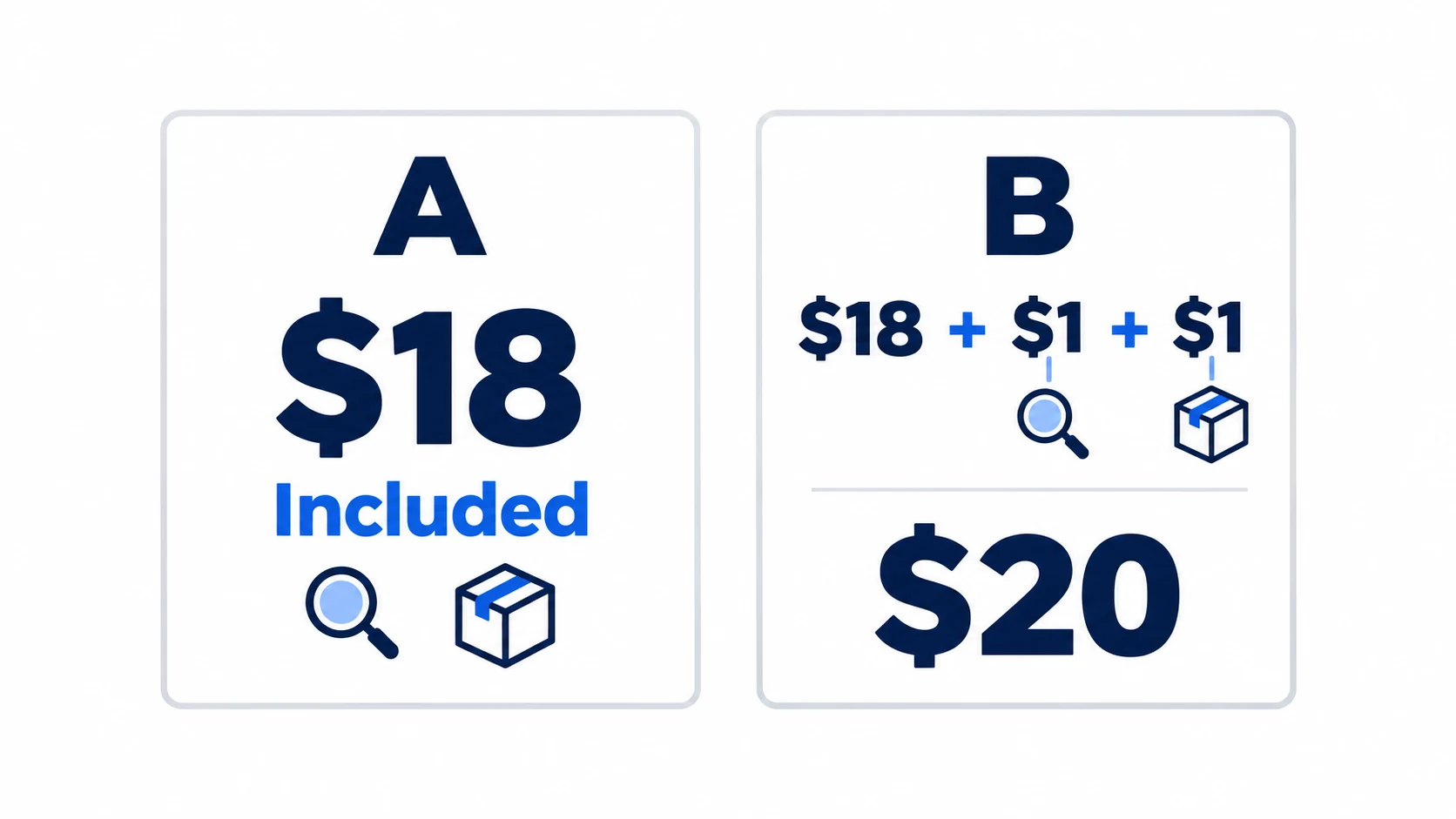
That comparison says nothing about which provider performs better. It simply shows why an identical headline price is not an identical offer. The extra $2 must enter the order calculation before you compare margins.
Ask about inbound receiving, storage, extra items in a parcel, returns, reshipping and stock transfers where relevant. A published rate table is a starting point; the exact product, warehouse, parcel and service determine which lines apply. Avoid treating another merchant’s quote as a standard industry rate.
Keep charges caused by a particular exception attached to that event. A replacement can involve product, packaging and shipping costs, and the agreed remedy may cover only some of them. You need that distinction when deciding whether a low purchase price still produces a workable order.
05
When an agent is useful
An agent can be useful when the coordination work is recurring and consequential: several suppliers need to be combined, product details must stay consistent, packaging instructions are specific, or exception follow-up is consuming too much of your team’s time.
The case is stronger when you can describe the current failure and the service that would address it. “Supplier substitutions reach customers without review” points toward approval controls. “We cannot reconcile warehouse stock” points toward inventory records and a clear owner. General promises of convenience are harder to evaluate.
You do not need a universal daily order threshold to make this decision. Product complexity, the number of suppliers, the cost of an error and the agent’s own commercial terms matter alongside volume. A small number of complex orders can require more coordination than many simple repeat orders.
If you are still testing a basic product and a supplier already provides a suitable individual-order service, an additional agent may add cost and another handoff without solving a material problem. Compare the actual work saved and responsibilities gained against the fees and purchase commitments.
An agent also cannot create customer demand by sourcing a product. Keep product validation and marketing decisions in your own operating plan, even when someone else helps obtain samples or shipping estimates.
06
Define the relationship before connecting the store
Prepare a short operating scope before enabling automatic order release. Name the products, variants, destinations, approved packaging and checks. Specify who funds stock and when each payment is due.
Agree the information exchanged with each order and the permissions required to perform the work. Use the store’s supported access controls, grant only the necessary access, and establish how access will be removed when the relationship ends. An agent handling fulfillment does not automatically need control of pricing, marketing or every store setting.
Then run a limited, agreed trial. Follow one order through supplier acceptance, any check, packing, carrier handoff and tracking return. Record the actual timestamps and unresolved questions. One successful trial is useful evidence about that order, not a guarantee of future performance at a different volume.
The trial should also establish who responds when something goes wrong. Set a contact, expected response process and escalation route for held goods, incorrect variants and uncertain shipments. Match these arrangements to the customer promises your store can support.
Run a trial that includes the difficult handoffs
Start with a defined product and destination, then select the variations that could change the process: a second variant, a combined order or a parcel requiring different packaging. Keep the trial small enough to inspect, and agree any test or simulation with the agent before sending it. Do not create defects or mislead customers to see what happens.
For each trial order, compare the requested variant with the agent’s acceptance record, the received goods, packing contents and shipment information. Reconcile the final charge against the accepted quote. A tracking number arriving in your store is only one result; you also need to know that it belongs to the right items and actual shipment.
Use a safe simulation or existing documented example to review three exceptions: unavailable stock, a failed product check and a cancellation after release has started. Ask the agent to show which step stops, who receives the alert, who may approve a change and how the final outcome returns to your store.
Cancellation deserves particular attention. Shopify’s fulfillment guidance explains that canceling a request in the admin does not automatically stop a third-party service already processing it. Agree how the agent confirms that the physical order has stopped before your team treats it as canceled. If stopping is no longer possible, the next customer action must reflect that fact.
Accept the trial when the product and references match, the charges reconcile, the timing is explainable and the selected exceptions have a demonstrated owner and response. Record unresolved issues and the condition for retesting them. A successful normal order should not cancel an unresolved stock or cancellation problem.
Expand gradually across the variations you actually intend to sell. Changing the product, warehouse, packaging or carrier can change what the initial trial established. Review the affected step rather than claiming the first trial approved every future arrangement.
07
Keep an exit path for stock and unfinished orders
Before paying for inventory, ask how remaining goods and packaging can be counted and transferred. Confirm outstanding fees, the release process, records supplied and how unfinished orders are treated. These terms are easier to agree while both parties are planning the relationship.
Keep your product references, approved specifications, order records and relevant shipment information accessible to your business. If the relationship changes, those records help another operator understand what was purchased, what remains and what has already shipped.
Evaluate the agent against the agreed scope over time. A missed handoff, recurring mismatch or unexplained charge should lead to a specific review of the cause and corrective action. Adding more services is useful only when those services have a clear owner and an observable result.
The related fulfillment and logistics guides cover stock, shipping and customer-order issues in greater depth. Use them to define the tasks you need before seeking a broader service bundle.
Before removing access, reconcile open orders into three groups: not yet accepted, accepted but not dispatched, and already dispatched. Agree who completes or cancels each group and who continues supplying tracking or claim information. Export the references your business needs while access is still available, then remove permissions and integrations under the store’s supported process. This avoids losing visibility over customer orders during an otherwise orderly supplier change.
08
Frequently asked questions
Does a dropshipping agent own the products?
It depends on the arrangement. The supplier may own ready stock, the agent may buy and resell it, or you may fund inventory held by the agent or a warehouse. Confirm ownership, payment and release terms for the actual goods.
Does every agent offer quality control?
No single service scope can be assumed from the title. Ask which checks are included, who performs them and what evidence or failure handling you receive. Additional or specialist testing may require a separate arrangement.
Is an agent cheaper than buying directly?
It may reduce some purchasing or coordination costs while adding service fees. Compare the same product, packaging, checks, destination and exception terms. There is no universal saving that applies to every store.
Can an agent handle returns and refunds?
An agent may coordinate evidence, returned goods or supplier remedies if contracted to do so. Your customer-facing refund decisions and applicable obligations still need an owner in your business. Confirm return destinations and costs before offering a process to customers.