
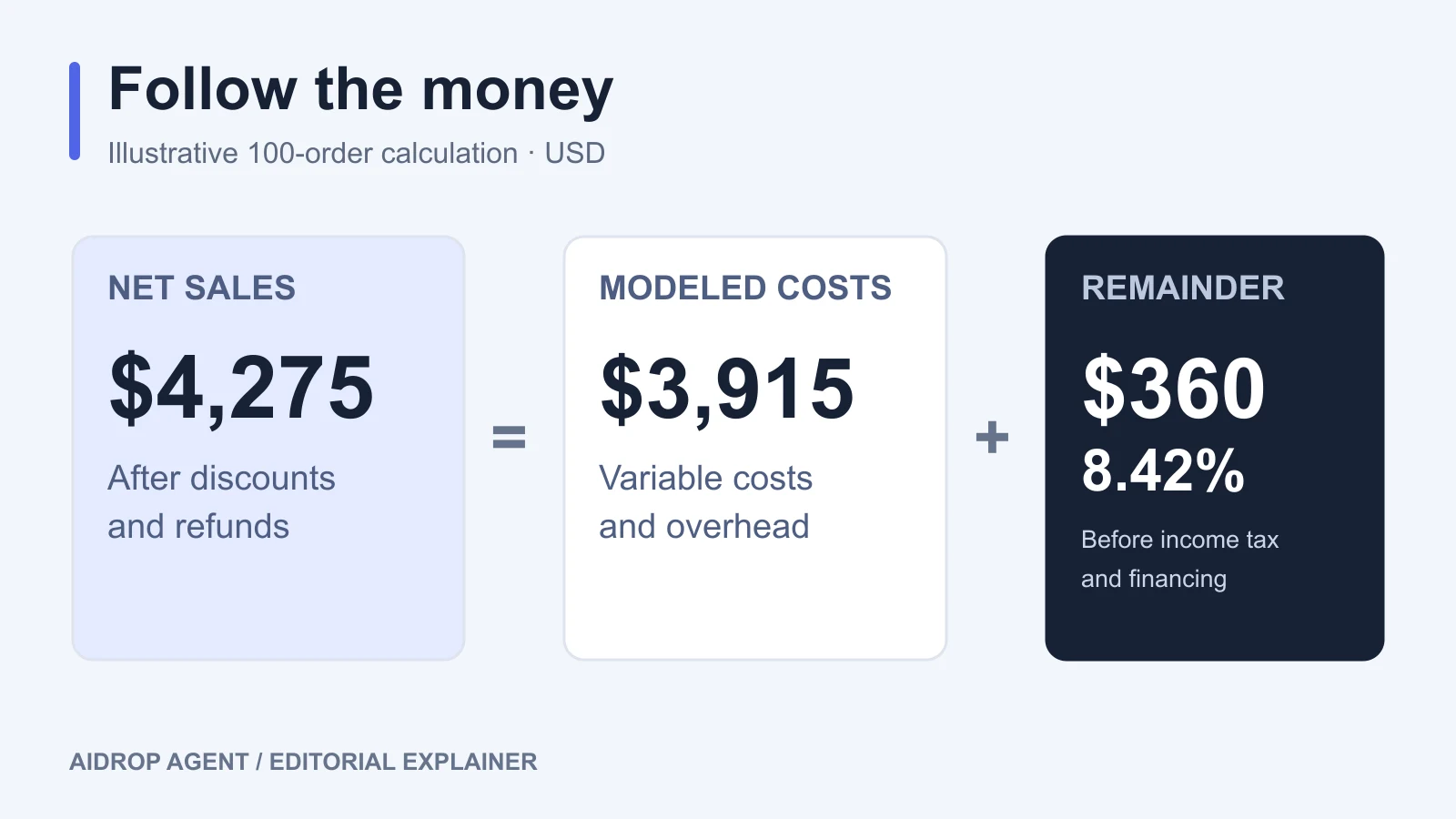
Dropshipping profit margin tells you how much of each sales dollar remains after the costs you counted. Calculate it as profit ÷ net sales × 100. If $100 of net sales leaves $10 of profit, that margin is 10%.
The cost definition matters. Gross margin, contribution margin and net margin subtract different expenses. A product can look profitable before advertising while the business loses money after its other bills.
To judge your own margin, start with sales after discounts and refunds, deduct the costs required to earn those sales, and decide how much profit must remain. The calculation below follows 100 assumed orders through that process, including what happens when a discount, refund increase, or higher advertising cost changes the result.
Explore this topic
- How Much Do Dropshippers Make? Revenue, Margin and Owner Pay Explained
- How to Price Dropshipping Products From Landed Cost and Risk
01
What is a good dropshipping profit margin?
A good margin covers the costs included in your calculation, leaves enough profit for your business, and survives the changes you reasonably expect. A percentage without a cost definition cannot tell you whether an offer meets those conditions.
Published ranges need care. For example, Shopify’s dropshipping overview cites margins of 10–15% for open-marketplace sourcing and 20–50% for some supplier networks. Those ranges describe different sourcing arrangements; they are not a verified promise of after-tax profit for your store. Do not use them as a substitute for your own expense records. Shopify’s dropshipping overview
Set a target with a clear meaning. For example:
We want to retain 10% of net sales before income tax and financing costs, after advertising and our stated overhead.
That is an illustrative planning target, not an industry minimum. A different business may need more to pay its owners, develop products or absorb uncertain returns.
Check the dollar amount beside the percentage:
- A 20% margin on $20 of net sales leaves $4.
- A 10% margin on $100 leaves $10.
Neither shows the required labor, risk or cash commitment by itself. For the broader operating costs behind an order, see the dropshipping unit economics guide.
02
Keep gross margin, contribution, net margin, and markup separate
Use the same sales period and cost definitions throughout your calculation. In this article, net sales means sales after discounts and refunds. The examples exclude sales tax collected for remittance and assume no separate customer-paid shipping charge.
| Measure | Calculation | What it tells you |
|---|---|---|
| Gross margin | (Net sales − cost of goods sold) ÷ net sales × 100 | What remains after the costs classified as goods sold |
| Contribution margin | (Net sales − all variable costs) ÷ net sales × 100 | What remains to cover fixed costs and profit |
| Net profit margin | Net income ÷ net sales × 100 | What the business retains after all applicable expenses, including income tax |
| Markup percentage | (Selling price − chosen cost basis) ÷ chosen cost basis × 100 | How much price exceeds that cost basis |
Gross margin and contribution margin answer different questions. Selling expenses can fall outside cost of goods sold while still varying with each order. Contribution includes those variable expenses. Use your accounting policy consistently when classifying shipping, handling, and other costs. AccountingCoach’s explanation of gross and contribution margin
Markup divides by cost; margin divides by sales. For a $20 cost and $50 selling price:
- Markup: the $30 difference ÷ $20 cost = 150%.
- Margin against that cost: the same $30 ÷ $50 sales = 60%.
The price is 2.5 times cost. Advertising, payment fees and overhead still need to be deducted before you know what the business keeps.
When using a calculator, read its cost fields before trusting its “net profit” label. If it subtracts only order-level costs, the result may still need to pay for subscriptions, staff, professional services, and other fixed expenses.
03
A worked calculation for 100 orders
These are illustrative USD assumptions, not AIDrop Agent client results or market averages. Assume one product per order, a $50 regular price, and a 10% discount that brings the amount charged to $45. All 100 orders ship, and five are later fully refunded.
Each order costs $18 for the product and $6 for outbound shipping. Assume a processing fee of 3% plus $0.30 on every original payment, with none of that fee returned. Advertising costs $10 per order. Each refunded order adds $10 of handling or other unrecovered return expense. There is no supplier credit or recoverable inventory value. Fixed overhead for this modeled period is $300.
The 3% plus $0.30 fee is a calculation assumption, not a quoted payment-provider rate. Actual refund treatment also depends on the payment method and agreement; a processor can retain the original processing fee after a refund. Stripe’s refund fee explanation
Here is where the money goes across those 100 orders.
- Sales after the discount, before refunds: 100 × $45; Amount: $4,500
- Refunds: 5 × $45; Amount: −$225
- Net sales: $4,500 − $225; Amount: $4,275
- Product costs: 100 × $18; Amount: −$1,800
- Outbound shipping: 100 × $6; Amount: −$600
- Processing fees: 100 × ($45 × 3% + $0.30); Amount: −$165
- Advertising: 100 × $10; Amount: −$1,000
- Additional return expense: 5 × $10; Amount: −$50
- Contribution after variable costs: Net sales minus the five expense lines above; Amount: $660
- Fixed overhead: Assumed cost for this period; Amount: −$300
- Profit before income tax and financing costs: $660 − $300; Amount: $360
The contribution margin is $660 ÷ $4,275 × 100, or 15.44%. After the modeled overhead, the remaining profit is $360 ÷ $4,275 × 100, or 8.42% of net sales. It is a pre-tax result, not final net income.
Any owner compensation or other business expense absent from the assumed $300 overhead would reduce it further.
For comparison, treating only the $1,800 product cost as cost of goods sold would show a 57.89% gross margin. That is a deliberately narrow cost classification for this illustration. It explains how an attractive product margin can leave much less for the business once shipping, fees, advertising, and overhead are included.
Notice that refunds reduce sales once. The product and outbound shipping costs remain for all 100 shipped orders because this example assumes they cannot be recovered. The additional $50 is separate return expense; it does not include the $225 already refunded. In your own records, account for supplier credits, recoverable stock, partial refunds, and reshipments according to what actually happened.
Build a dropshipping profit margin calculator in a sheet
To reproduce this example, put the labels in column A and the values in column B. Enter numbers rather than text with dollar signs. Use percentage cells for B7 and B12; 3% is not the number 3.
| Cell | Input | Example value |
|---|---|---|
| B2 | Orders shipped in the period | 100 |
| B3 | Amount charged per order, after discount | 45 |
| B4 | Orders fully refunded | 5 |
| B5 | Product cost per shipped order | 18 |
| B6 | Outbound shipping per shipped order | 6 |
| B7 | Processing percentage | 3% |
| B8 | Fixed processing charge per original payment | 0.30 |
| B9 | Advertising cost per original order | 10 |
| B10 | Extra expense per refunded order, excluding its refunded sales | 10 |
| B11 | Period’s fixed overhead | 300 |
| B12 | Desired pre-tax margin on net sales | 10% |
Use a positive order count and a refund count between zero and the shipped-order count. This small model assumes identical single-item orders, full refunds and unrecovered product, shipping and processing costs. Mixed baskets, supplier credits or partial refunds need their actual records rather than these shortcuts.
Enter these formulas in column B. Leave B13 blank. The examples use English function names; spreadsheet settings can change separators or function labels.
| Cell | Result | Formula | Check value |
|---|---|---|---|
| B14 | Net sales | =(B2-B4)*B3 |
$4,275 |
| B15 | All modeled variable costs | =B2*(B5+B6+B3*B7+B8+B9)+B4*B10 |
$3,615 |
| B16 | Contribution | =B14-B15 |
$660 |
| B17 | Profit before tax and financing | =B16-B11 |
$360 |
| B18 | Pre-tax margin; format as percentage | =IF(B14=0,"",B17/B14) |
8.42% |
| B19 | Amount per order before advertising | =(B16+B2*B9)/B2 |
$16.60 |
| B20 | Break-even ad cost after overhead | =B19-B11/B2 |
$13.60 |
| B21 | Ad-cost limit for the chosen profit target | =ROUNDDOWN(B20-B14/B2*B12,2) |
$9.32 |
Check the sheet before using your own data: B14 should show $4,275 and B17 should show $360. Then change only B4 from 5 to 6. Net sales falls by $45, the extra return expense rises by $10 and pre-tax profit becomes $305.
If your result falls by $100 instead of $55, check whether you subtracted the $45 refund twice. Restore B4 to 5 after this check. This calculator reproduces the stated example; it does not supply a market-average margin or replace a complete set of accounts.
04
A small discount can remove much of the profit
Hold the 100-order volume and all other assumptions constant. At the full $50 price, the model earns $820 before tax and financing. At $45, it earns $360. The 10% discount reduces modeled profit by $460, or about 56%.
The loss is slightly less than the $500 discount given across the orders because the refunded amounts and percentage-based processing fees also fall. Product costs, outbound shipping, advertising per order, and fixed overhead do not change in this comparison.
| Scenario for the same 100 orders | Net sales | Profit before tax and financing | Margin on net sales |
|---|---|---|---|
| $50 price; 5 refunds; $10 ad cost per order | $4,750 | $820 | 17.26% |
| $45 price; 5 refunds; $10 ad cost per order | $4,275 | $360 | 8.42% |
| $45 price; 10 refunds; $10 ad cost per order | $4,050 | $85 | 2.10% |
| $45 price; 5 refunds; $12 ad cost per order | $4,275 | $160 | 3.74% |
| $45 price; 10 refunds; $12 ad cost per order | $4,050 | −$115 | −2.84% |
This is a sensitivity comparison, not a forecast of customer behavior. A discount might improve conversion or change the basket mix. To judge the promotion, add evidence about those changes rather than assuming the extra orders will compensate for the lower earnings per order.
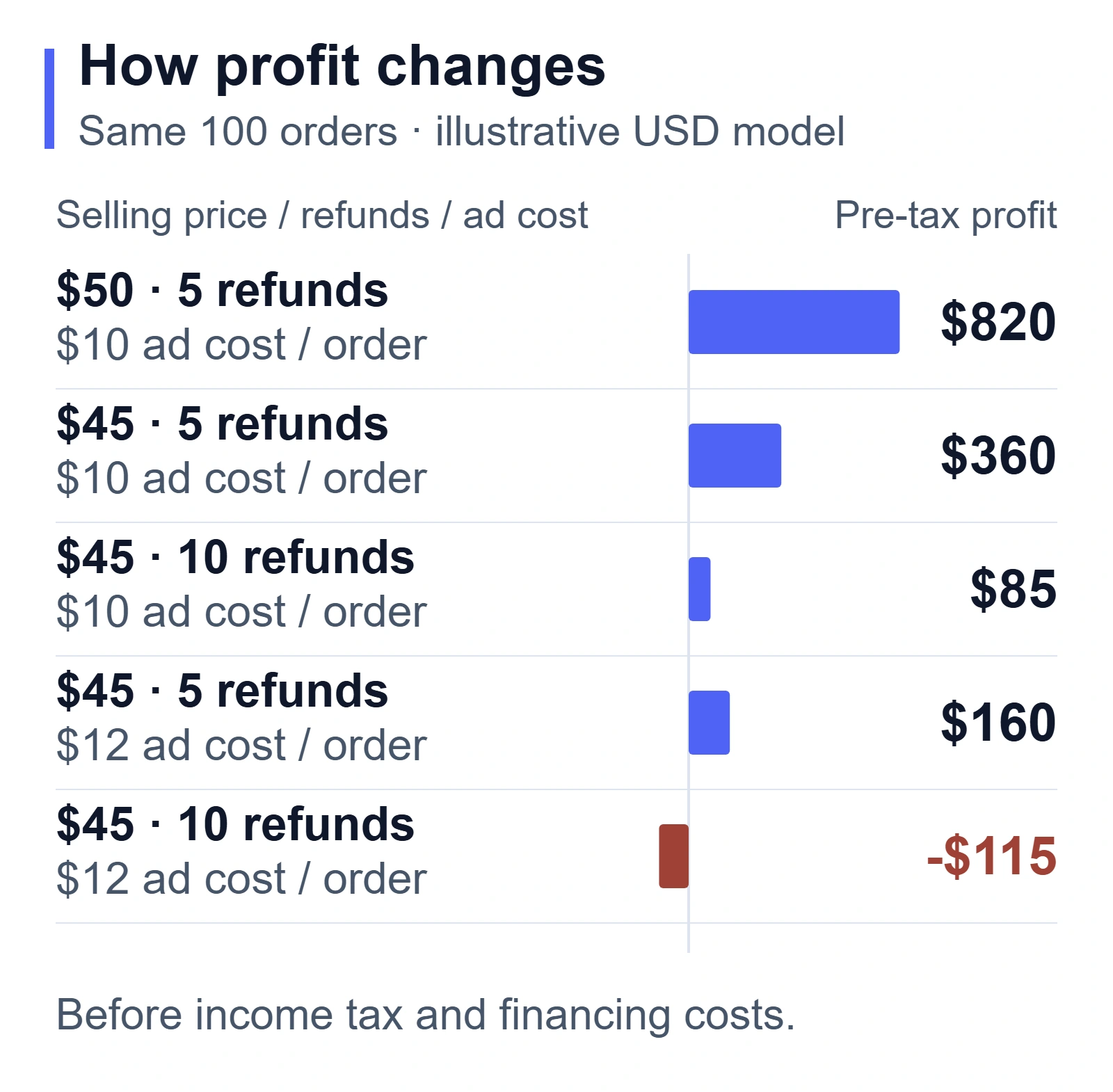
Refunds deserve the same treatment. In the discounted example, one additional full refund removes $45 of revenue and adds $10 of return expense, costing another $55 under the stated assumptions. Five extra refunds therefore reduce the result by $275. If refunds keep rising, connect the repeated reason—such as product expectations, damage, or delivery problems—to a corrective action using the dropshipping risk management guide.
05
Calculate the advertising cost your target allows
The 100-order example leaves $1,660 before ads, or $16.60 per original order. The answer to “how much can I spend to get a sale?” changes with the profit target:
| Decision | Ad-cost limit per original order | Calculation |
|---|---|---|
| Spend everything left before ads | $16.60 | Leaves nothing for fixed bills or profit. |
| Break even after $300 monthly overhead | $13.60 | $16.60 − $3 overhead per order. |
| Keep 10% of $42.75 net sales per order | $9.32 | $16.60 − $3 − $4.275 target profit, rounded down. |
The current $10 ad cost clears the $13.60 break-even limit but misses the $9.32 target. That is why the worked month shows an 8.42% margin rather than 10%. If sales volume falls, the same $300 overhead is spread across fewer orders and the break-even limit falls too.
For your own offer, subtract fixed costs per order and your desired profit from the amount available before ads. A negative answer means the offer misses that target even with no advertising spend; check price and costs before setting a campaign budget.
Here, ad cost per order is cost per acquisition of an order, often reported as cost per purchase or CPA.
Customer acquisition cost, or CAC, instead uses newly acquired customers as its denominator and can include acquisition spending beyond media. They coincide in this simplified example only if all 100 orders are first purchases from 100 new customers and the advertising budget is the entire acquisition cost. Keep repeat purchases separate when applying the result to your store.
ROAS also needs a stated revenue basis. At the $1,360 advertising budget that leaves this model at pre-tax break-even, $4,500 of sales before refunds implies a 3.31× ROAS. Using $4,275 after refunds gives 3.14×. These are two descriptions of the same calculation. Compare a platform’s reported ROAS only after checking whether its revenue, refund treatment, and attributed orders match yours.
06
Why Shopify's margin may differ from your calculation
Shopify’s Gross profit by product report uses net sales and the recorded product costs. Product variants need cost information at the time of sale to appear in the relevant profit calculation. A missing cost record can therefore leave gaps; a reassuring percentage is not proof that every order was included. Shopify’s profit report documentation
Shopify also explains that a product’s displayed margin can differ from its reported gross margin after discounts or refunds. Its order and market profit reports contain additional cost and charge fields, so check the specific report you are reading rather than assuming every profit screen measures the same thing.
Before accepting the report’s result, make three checks:
- Match the expenses. Reconcile supplier invoices, shipping charges, payment statements, advertising spend and business expenses with the reported orders.
- Match the basis. Use one currency and period, and check how discounts and refunds enter that report.
- Allow time for returns. Review older order groups after returns have had time to appear. Recent sales with few recorded refunds are an incomplete view of their eventual result.
Cash in the bank is another measure again. A payout arriving later, a supplier payment made earlier, or a refund processed next month changes cash timing without making a simple dashboard margin a complete account of profit.
07
Improve the cost that is actually reducing your margin
Start with the amount and reason for the shortfall. In the discounted example, the store needs $67.50 more profit to reach its 10% target: $427.50 desired profit minus $360 achieved. That can come from a combination of better pricing, lower acquisition cost, or lower operating losses. The calculation does not establish which change customers or suppliers will accept.
A genuine $1 reduction in cost across all 100 orders adds $100 to this modeled result, provided it introduces no new expense or loss. A cheaper product that causes more refunds may fail that test. Compare supplier offers on the same specification, packaging, shipment destination, and service scope; the pricing and quote guide explains which details to clarify before comparing the totals.
Then examine discounts and returns by product and channel. Stop applying a blanket discount simply because one product can afford it. Where repeat customers cost less to serve or acquire, verify their actual contribution before using expected repeat purchases to justify a loss on the first order.
The next useful record is a completed period with identifiable invoices, fees, refunds, and acquisition costs. Replace the assumptions above with those records, state your target, and calculate the spending limit again when the offer changes.
08
Frequently asked questions
Is a 50% gross margin good for dropshipping?
It may leave room for other costs, but it is not enough information to judge profitability. On $40 of net sales, a 50% gross margin leaves $20 before expenses outside cost of goods sold. Whether that covers advertising, selling costs, overhead, and the desired profit depends on the actual amounts.
Can I leave advertising out if customers come from organic traffic?
Use the costs incurred for that channel. There may be no paid-media expense on a particular order, but content production, affiliate payments, staff, and tools can still cost money. Classify those expenses consistently instead of treating the entire channel as free.
Should I average the margin percentages of my products?
Calculate the combined margin from combined profit divided by combined net sales. A simple average gives a low-volume product the same weight as a high-volume one. For example, $20 profit on $100 of sales and $90 profit on $900 of sales produce $110 ÷ $1,000 = 11% overall, not the 15% simple average of their 20% and 10% margins.

How Much Do Dropshippers Make? Revenue, Margin and Owner Pay Explained
Dropshipping income ranges from losses to profit. Separate sales, contribution, business profit and cash available to the

How to Price Dropshipping Products From Landed Cost and Risk
Calculate a retail price from the delivered cost of one variant, selling fees and required contribution, then
Dropshipping Cash Flow: Supplier Payments, Payouts and Refund Buffers
Plan dropshipping cash flow by date. Separate pending payments from usable cash, fund supplier bills, and test