

Supplier payment terms must name the amount, due-date trigger, currency and cancellation or credit rules. Prepayment can be due before the buyer’s money reaches your bank. Net 30 is usable only after the supplier grants it to your account with a defined starting event and limit.
This is why a store can own no inventory and still run short of operating cash. The payment timing, cancellation right and refund route are as important as the product’s unit cost.
Explore the broader topic: How to Find Dropshipping Suppliers You Can Actually Work With.
01
Put the customer and supplier on one timeline
A paid buyer does not eliminate the cash gap
Begin with one order. A buyer pays your store on Monday. The order passes your address and fraud review. You send it to the supplier. The supplier requests a product charge plus freight. Only after the supplier accepts or receives payment does the shipment move forward. Your payment processor may transfer the buyer’s money to your bank later. A store can be profitable on paper and unable to fund today’s dispatch.

Write the events with actual timestamps in a small table:
| Event | Who acts | Cash or evidence to record |
|---|---|---|
| Customer payment authorized or captured | Store/processor | Gross amount, fee and payout estimate |
| Order approved for release | Merchant | Final SKU, address, fraud and stock check |
| Supplier charge accepted | Supplier/merchant | Product, freight, currency, invoice/order ID |
| Parcel handed to carrier | Supplier | Tracking and first physical scan |
| Customer refund or replacement | Store and supplier | Credit note, returned payment and timing |
On a phone, swipe the table sideways to compare every column.
The order-release checklist supplies the operational gate before payment. Do not push an ambiguous variant to the supplier just because the buyer’s card was charged.
02
Prepayment and credit terms are different promises
Write the trigger, currency and dispute terms
Under prepayment, you fund the supplier order before fulfillment. Under written credit terms, the supplier allows a defined payment date after a specified event. “Net 30” needs a starting point: invoice date, shipment date or another agreed trigger. It also needs a credit limit, currency, late-payment terms and a process for disputed items. Never assume a wholesaler’s terms offered to another merchant apply to your account.
Give net 30 a start date and a usable limit
A credit label is incomplete until the supplier confirms the starting event and calendar due date in the actual agreement.
Invoice-date terms
In a fictional agreement counting 30 calendar days after a September 1 invoice, the due date is October 1. A September 5 dispatch does not restart the clock. If dispatch slips, the invoice-date debt can still become due.
Shipment-date terms
If the written trigger is instead a September 5 shipment, the same 30-day count gives October 5. At a $1,000 granted credit limit, forty $26 orders total $1,040; $40 needs another approved funding source or a reduced release. Existing unpaid invoices can reduce the available limit further.
Confirm how the supplier counts days, weekends and invoice disputes. Do not use either teaching date or a promised credit limit until the supplier has granted that term to your account.
In Shopify Collective, eligible automatic payments debit the retailer’s Shopify Payments balance; the supplier receives the transfer when it marks the order fulfilled. Verify both events. Other suppliers follow their own written terms.
Similarly, Alibaba Trade Assurance can protect eligible orders when product and delivery terms are documented and payment follows the program. It is not the payment policy for a separate private dropshipping agent or a guarantee that any supplier will extend credit. Ask which agreement governs your specific order.
Read Collective payment status before making another payment
Use the current official payment guide for a Collective relationship. Manual outside suppliers follow their own account terms.
Inspect the supplier setting
Open Apps → Collective → Suppliers and inspect Automatic payments. An eligible supplier’s detail page has a Payments section to turn it on and confirm Turn on. Only the supplier can turn an active arrangement off; ask them when required.
Reconcile the actual movement
Open Apps → Collective → Payments for fulfilled-order date, supplier, state and transferred amount. For Payment pending, inspect the balance and existing debit; Collective retries. Customer PayPal money does not fund that balance. Agree dispatch instead of making a duplicate manual payment.
Both stores’ supported country, currency and Shopify Payments setup affect eligibility. Changing payout cadence is a store-specific cash decision.
Record the line items, not just “supplier fee”
Break down the supplier charge
For each SKU and destination, get the product charge, packaging, pick/handling, freight, surcharge, tax or duty treatment where relevant, and payment fee. Note which amount can change after the buyer orders. If a supplier quotes in another currency, record who bears conversion and the date the rate locks.
Shopify’s purchase-order supplier documentation shows how supplier-specific payment information belongs with an order record. Your dropshipping system may use a different form, but the principle is the same: a shared chat message about “usual terms” should not be the only evidence.
03
Calculate a cash gap without inventing revenue
Five orders need $130 before settlement
Imagine five customer orders arrive on Monday. The supplier charges $20 product plus $6 freight for each, so $130 is due to release them. Your processor is expected to settle the customer payments on Thursday. You need access to at least that $130 in the meantime, plus room for a replacement or refund. The figures are illustrative; actual payout timing and supplier charges vary.
Find which charge can actually be stopped
Now imagine two buyers cancel before shipment. If the supplier has not accepted the orders, can you stop them without a charge? If it has accepted or packed them, what portion is refundable and when does a credit appear? That timing determines how much cash stays tied up. A store that books only expected sales revenue will miss this exposure.
| Cash question | Find the answer in |
|---|---|
| When is the supplier amount due? | Account terms and actual checkout/invoice |
| When is buyer money usable? | Processor payout schedule and bank statement |
| How many orders might overlap? | Peak daily paid-order count, not monthly average |
| How quickly are reversals credited? | Supplier cancellation/return terms and past credit notes |
On a phone, swipe the table sideways to compare every column.
The cash-flow guide expands the timing model. Here the immediate decision is whether one order can be released without guessing who pays whom and when.
04
Write cancellation and exception terms before scaling
Name the cancellation and remedy cost owner
A useful supplier agreement names the point at which an order becomes non-cancelable, the treatment of an address correction, the amount charged for a failed delivery and how a wrong or defective item is credited. It should also say who pays for a replacement and whether freight is refunded. Our supplier-agreement guide gives the broader negotiation context.
Test a low-risk order and reconcile the records. The store order ID, supplier order ID, payment receipt, shipping charge, tracking and any credit note should connect. If an invoice arrives with a different currency, freight amount or SKU, stop bulk automation until the mapping is corrected. A supplier can ship the right parcel while your ledger still records the wrong cost.
Separate the buyer refund from supplier recovery
When a buyer requests a refund, pay attention to two separate flows. Your customer-facing refund may be due before the supplier reimburses you. The supplier might also issue store credit rather than cash. The invoice guide helps maintain the records, but the actual credit method must be agreed for this supplier.
05
Reconcile one invoice against one customer order
Match the blue 500 ml item to the invoice
Before turning on bulk processing, run a small real order and lay the documents next to each other. The customer bought the blue 500 ml item, but the supplier invoice may contain a slightly different catalog description. Match the supplier SKU and variant, quantity, destination, product charge, shipping service and currency. Save the supplier’s acceptance time and the first physical tracking event.
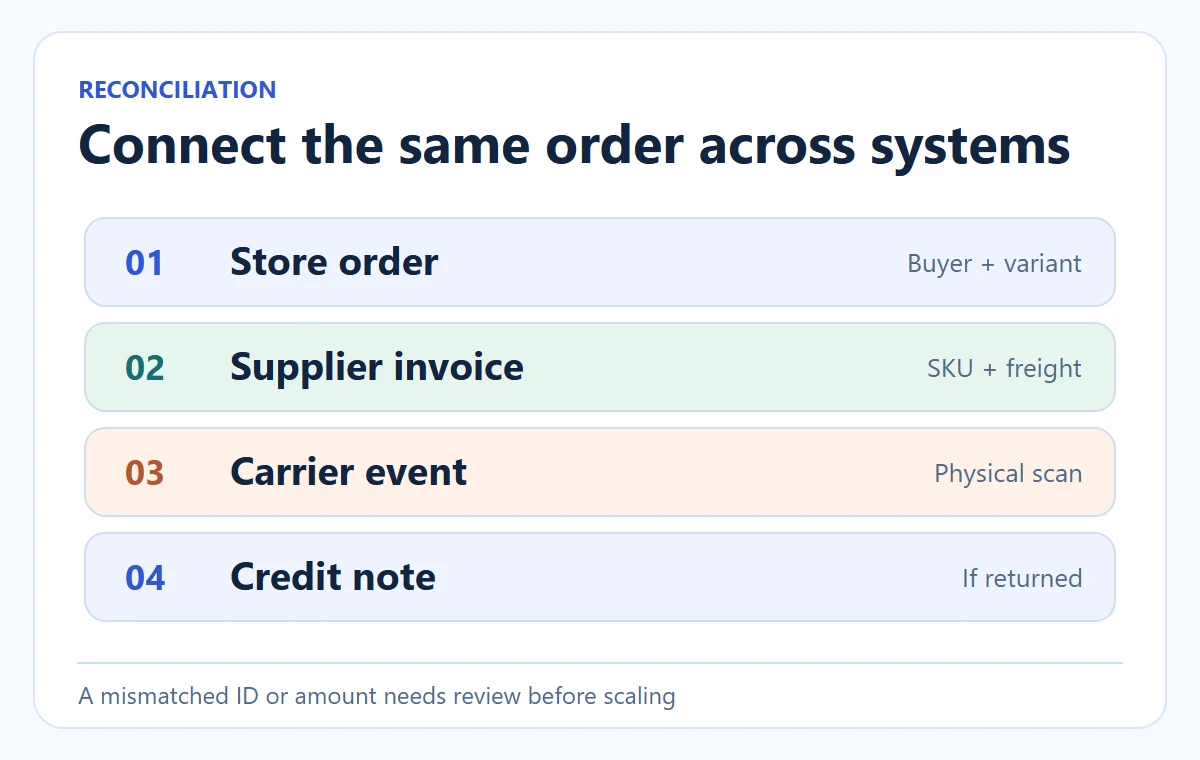
If the supplier invoice says $28 but the approved quote said $26, do not bury the $2 difference in a “miscellaneous” line. Ask whether it is freight, a payment fee, a price update or a wrong SKU. The answer changes both the margin sheet and future price. If the supplier changes price frequently, define a maximum variance that holds an order for review instead of automatically paying it.
Turn the $26 quote into a release record
For the fictional blue 500 ml item, agree the terms and line items before the customer order is released. These are merchant record fields, not a supplier app screen.
Record what can be paid
Save store order 1042, the actual linked supplier ID, exact blue 500 ml SKU, one unit, approved destination/service and currency USD. The teaching $26 total includes $20 product and $6 freight; separate any extra packaging or payment fee instead of calling it included.
Record the trigger and exception
As a proposed term, payment is due after written stock/address confirmation and before dispatch, using the recipient/payment route verified in the actual order. A $28 invoice is held until the extra $2 is explained and approved. Record the cancellation cutoff and whether a later credit is cash or supplier balance.
After payment, reopen the saved order and match one charge to one supplier acceptance. A fulfilled label, a bank payout estimate and a credit note are different evidence. Refund the buyer through the applicable customer process while recording supplier recovery separately.
A credit note may not be cash
After the parcel is delivered, test the credit path with a legitimate exception if one occurs, or at least obtain the documented process in writing. How does a credit note reference the original supplier order? Does it refund the payment method or sit as balance against a future purchase? A bookkeeper can reconcile cash only when those records connect.
| Document | ID it should carry | Amount or state to compare |
|---|---|---|
| Store order | Customer order ID and exact variant | Customer charge and refund status |
| Supplier acceptance | Supplier order ID linked to store ID | Accepted SKU, address and quantity |
| Invoice/payment | Supplier order ID | Product, freight, fee, currency and due date |
| Tracking | Supplier or store order ID | Actual carrier handover and delivery |
| Credit note | Original supplier invoice/order ID | Refund amount, method and date |
On a phone, swipe the table sideways to compare every column.
The row does not need a sophisticated ERP. A reliable spreadsheet can expose an error that three disconnected dashboards hide.
06
Put a maximum daily exposure into the plan
Forty orders need $1,040, not the $130 average
Use peak day orders rather than a monthly average. A store may sell 150 units in a month but receive 40 orders during a promotion. At the illustrative $26 supplier charge, that is $1,040 due to release those 40 orders, perhaps before the processor’s payout. A monthly average of five orders a day would suggest only $130 and understate the required buffer by $910.
Check limits before promoting a surge
Set an order-release cap or an approved payment source for the surge. Check whether card limits, supplier checkout limits or weekend bank transfers can block the purchase. A marketing campaign should not produce more paid orders than your team can pay for and release within the delivery promise.
If the supplier offers written credit terms, repeat the calculation using its actual limit and due-date trigger. A $1,000 credit limit does not cover a $1,040 peak without another payment method. If the due date starts from invoice rather than delivery, a shipping delay can mean the supplier is paid before the customer receives the parcel. This is why the defined trigger matters.
Questions to put in the supplier conversation
Ask for the events and supporting documents
Ask whether payment is required on order upload, after stock confirmation or at dispatch; whether freight is fixed at quote or recalculated at checkout; which payment methods and currencies are accepted; when an order becomes non-cancelable; and how a return is credited. Request an example invoice and credit note with private customer details removed. If the answers are verbal, send back a short written summary and ask the supplier to confirm it before you scale.
The result should be a schedule of events and amounts, not the phrase “flexible terms.” It should let a colleague release a paid order without guessing, and let finance see the cash required if an order is cancelled or replaced.
07
Decide what terms your store can support
Do not demand credit merely because another business receives it. Suppliers decide whether to extend it based on their own risk and relationship. A smaller merchant can often improve its position by sending accurate orders, paying on time and documenting volume; a written term is still needed before using it in a cash forecast.
Fit promotion to the funding window
If prepayment creates a gap, consider a smaller product set, controlled daily order cap or a supplier route with clearer settlement timing. Do not promise instant shipment while you wait for a bank payout that may arrive after the supplier’s cutoff.
Compare the actual quote and payout constraint
AIDrop Agent can examine the China-side quote and operational handoff for a real SKU and destination. Send the current supplier invoice, expected daily volume and payout constraint through the review form if you want to compare arrangements. We will not present unagreed credit terms as a standard service.
08
Frequently asked questions
Does dropshipping mean I pay the supplier only after the customer receives the parcel?
No. Payment timing depends on the supplier agreement and platform. Many per-order routes require payment before dispatch; other integrations or negotiated terms can differ.
Is “net 30” automatically available to a new store?
No. It is a credit arrangement that must be granted, with a defined start date and limit. Put the exact terms in writing.
Who refunds the customer if the supplier has not credited me yet?
Your store’s customer obligation and the supplier’s credit timing are separate. Plan enough cash to handle the buyer promptly under your policy and applicable rules while you pursue the supplier credit.
Dropshipping Profit Margin: Calculate What You Keep
Calculate dropshipping gross, contribution, and net margins. See how discounts, refunds, and ad costs change profit in

How to Price Dropshipping Products From Landed Cost and Risk
Calculate a retail price from the delivered cost of one variant, selling fees and required contribution, then
Dropshipping Cash Flow: Supplier Payments, Payouts and Refund Buffers
Plan dropshipping cash flow by date. Separate pending payments from usable cash, fund supplier bills, and test
