

Products worth considering for a focused dropshipping store include compact desk organizers, fabric travel pouches, nonpowered phone accessories, selected pet accessories, apparel, printed merchandise, and small home decor. Each can serve a clear customer need, but the exact design, package and selling offer matter more than the category name.
A zippered pouch and a rigid storage box both organize belongings. A poster and a glass-framed print both decorate a wall. They create different shipping, quality and customer-service demands. Those differences help determine which product you can sell and support well.
The ideas below are candidates to investigate, not a ranking of proven bestsellers. If you are new to the model, start with how dropshipping works, then use these comparisons to build a realistic shortlist.
01
Practical product types to consider
Start with a customer situation you understand. The useful question is whether you can explain why this particular product deserves a place in that person’s home, bag or routine.
| Product type and examples | Customer use | Potential advantage | Main limitation to investigate |
|---|---|---|---|
| Desk organization: cable clips, small trays, document pouches | Keep a workspace usable | The function can be shown in a real setup | Dimensions, adhesive performance and low selling-price headroom |
| Travel storage: packing pouches, shoe bags, cable organizers | Separate items inside luggage | Fabric versions can fold compactly | Zippers, seams and misleading capacity photos |
| Nonpowered phone accessories: stands, cases, straps | Hold, carry or protect a device | A specific use or device fit can make the offer clear | Compatibility, stability and unsupported protection claims |
| Pet accessories: waste-bag holders, storage pouches, feeding mats | Organize an owner’s daily routine | Can fit a focused pet-owner assortment | Attachment quality, cleaning and intended-use safety |
| Apparel: T-shirts, sweatshirts, hats | Wear a style or identify with a group | Design and audience can distinguish the offer | Fit, fabric expectations and variant stock |
| Print-on-demand goods: totes, shirts, posters | Buy original artwork or merchandise | Production can follow the customer’s order | Print quality, production time and supplier return exclusions |
| Soft home decor: cushion covers, small textile accents | Change a room’s appearance | An unfilled textile item may pack compactly | Actual measurements, texture and care expectations |
| Wall art: unframed prints or framed pictures | Decorate a specific space | A coherent collection can serve a distinct taste | Creases, frame damage, glass and protective-package size |
The advantages in this table are conditional product characteristics. They do not establish demand, regulatory compliance or profitable acquisition costs. Compare a specific SKU and the package your customer will receive.
02
Compact functional products: make the fit easy to understand
Desk organizers and cable accessories
A cable clip, drawer tray or small desktop organizer gives you a concrete problem to demonstrate. Show the item in an ordinary workspace, with the cables, drawer or desk surface it actually fits. A photograph of an empty organizer tells the customer much less than an accurate size comparison.
The details can decide whether it works. A tray that is slightly too tall prevents a drawer from closing. A clip with a narrow opening will not hold a thick cable. An adhesive accessory needs clear surface and installation information supported by the product’s actual instructions and testing.
These items can be hard to justify as a standalone order if shipping and customer acquisition consume most of the selling price. A relevant set may be more useful, provided the supplier can assemble the promised combination and quote its complete shipment.
Fabric pouches and travel organizers
Packing pouches, shoe bags and cable organizers can suit a shop focused on a particular travel routine. Compare an overnight trip, a work commute and a family suitcase: the required sizes and compartments are different.
A soft pouch can fold when empty, while a rigid organizer retains its shape. That creates a useful packing comparison, but it does not mean every soft item is preferable. A rigid case may be the point of the product when the customer needs structure or protection.
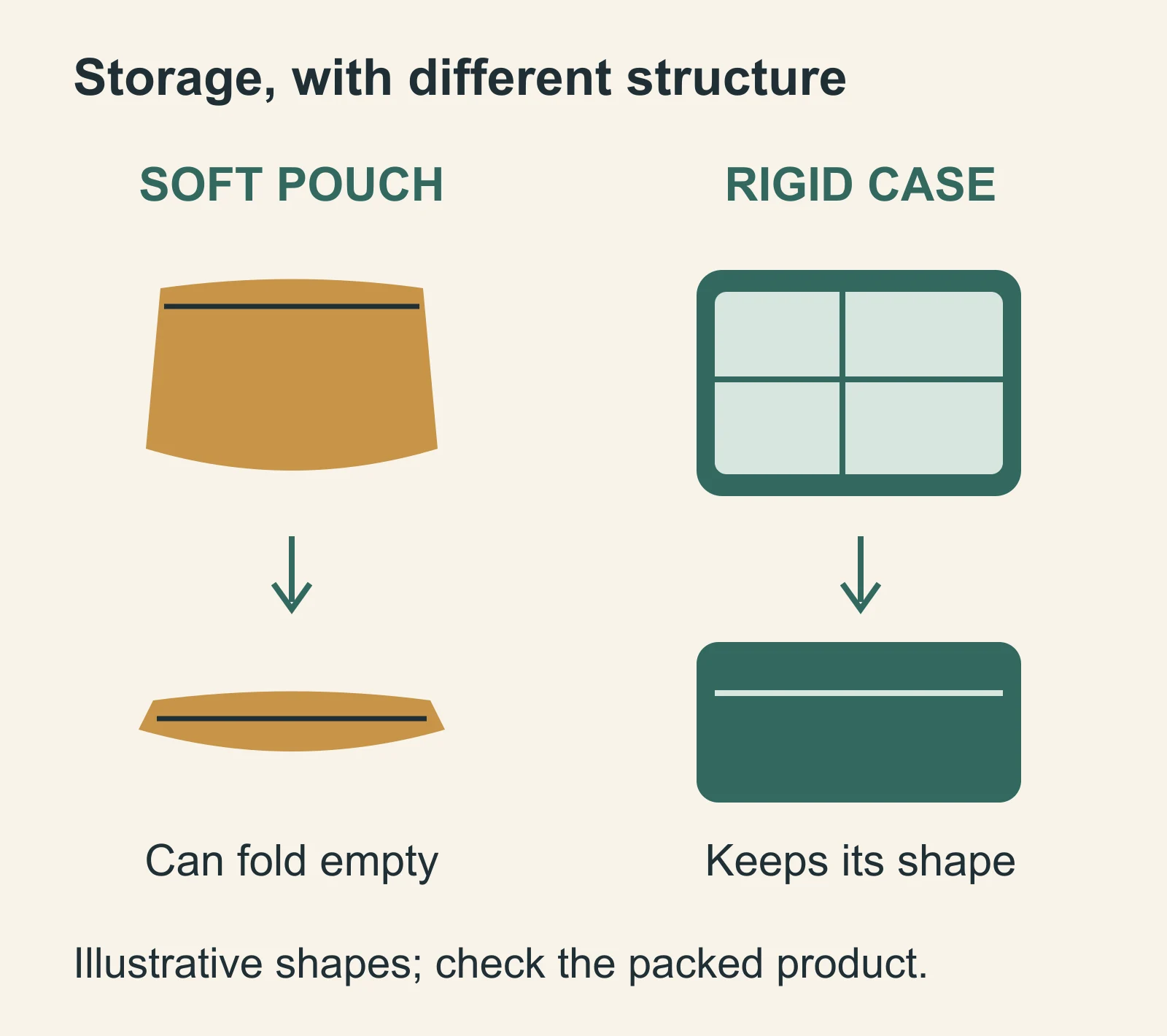
Show usable capacity, not just exterior dimensions. Inspect zipper movement, seams, lining and how the item closes when filled. If photographs imply room for a laptop charger and several cables, test that arrangement with representative items rather than stretching the pouch for the photograph.
Nonpowered phone accessories
A folding stand or model-specific case can serve a clear purpose without adding a battery or charging system. Start with the exact device and use: a stand for video calls on a desk is a different offer from a mount used in a moving vehicle.
For cases, check model, button and camera openings, dimensions and any claimed accessory compatibility. For stands, check the supported device size, stability, adjustment and folded shape. A description such as “universal” needs support; it should not conceal known exceptions.
Avoid advertising drop protection, waterproofing or a load capacity solely because a supplier included the phrase in a listing. Those are claims about performance. A nonpowered product still needs appropriate safety and claim review.
Pet accessories for an owner’s routine
Waste-bag holders, storage pouches and feeding mats are examples to evaluate around a particular owner’s routine. A clip-on holder, for instance, needs to attach securely to the intended leash or bag and dispense the chosen roll size without frustration.
Keep the intended use precise. An accessory carried by the owner is not automatically suitable for an animal to chew or wear. Do not turn a decorative attachment into a restraint device through photographs or copy. Inspect fasteners, loose parts, material information and cleaning instructions for the use you actually advertise.
Pet food, supplements and treatment claims introduce different questions. Treat them as separate product decisions rather than casually adding them to the same assortment because they share a pet category label.
03
Apparel and printed merchandise: sell a reason to choose the design
Apparel can make sense when you understand a style, activity or audience. A shirt with a specific design has a different buying reason from an undifferentiated shirt using the same supplier photo as many stores.
The customer still receives a physical garment. Review the fabric description, garment measurements, seams, print or embroidery, care instructions and appearance after appropriate care. A label such as medium is less informative than a useful size chart for that actual garment.
Keep these two choices separate:
- Stocked apparel: confirm the colors and sizes available, how inventory changes reach your store, and whether an out-of-stock variant can be substituted.
- Print on demand: approve both the blank product and the finished design, and account for production before the parcel enters transit.
Printful’s cost documentation gives a concrete POD example: products can be ordered without minimum quantities, while product and shipping costs still apply. That can avoid buying a batch of finished prints before orders arrive. It does not remove the cost of samples, marketing or customer support.
A printed tote and a printed shirt create different support work
A tote removes the garment-size selection, but customers still care about dimensions, handle length, fabric, capacity and print placement. A shirt adds body fit and several size variants. Neither is automatically more profitable; they ask different things of your product page and support process.
Check the supplier’s remedies before offering exchanges. Printful’s return policy generally excludes ordinary buyer’s remorse, wrong-size and wrong-color selections, with destination-specific exceptions such as its Brazil policy. Supplier terms do not replace your store’s applicable customer obligations or any additional promises you make.
For original merchandise, also establish that you have the necessary rights to the artwork, wording and other assets. A supplier’s ability to print an image does not establish your permission to sell it.
04
Home decor: compare the product after it is packed
A cushion cover and a filled cushion may serve the same decorating idea, but their packed dimensions can differ substantially. A cover also needs a clear explanation of what is included. If the photograph shows a filled cushion, make the absence of an insert obvious before purchase.
Texture and color deserve realistic images and descriptions. Customers cannot touch the fabric online, so close details and accurate measurements are more useful than exaggerated luxury claims. Review care requirements and avoid presenting lighting-dependent colors as an exact match for every screen.
Unframed art versus a glass-framed picture
An unframed print can need protection against bending, moisture and surface damage. A glass-framed picture adds fragile components and requires a package that protects the assembled product. The frame’s retail appeal should be evaluated alongside that extra handling work.
FedEx’s guidance for breakables emphasizes a suitable box and space for cushioning. Its dimensional-weight explanation states that charges use actual or dimensional weight, whichever is greater. A lightweight item therefore does not necessarily have a low shipping charge.
Compare the finished packages for the unframed and framed versions. Request the outer measurements, packed weight, service and destination quote. If the supplier cannot show how the fragile version is protected, resolve that before listing it. Use the packaging guide for the more detailed approval work.
05
Product types that need more preparation
Some products require capabilities beyond an attractive listing and an ordinary parcel. That does not make an entire category unsuitable, but it changes what must be established before you sell.
Batteries and powered products
A passive phone stand and a power bank should not receive the same review simply because both are phone accessories. The powered product adds electrical, battery and transport questions.
IATA’s battery guidance addresses the requirements for transporting batteries by air. The applicable handling depends on the battery and shipment configuration, and carrier acceptance must be established for the route. Obtain the required product and transport information before assuming your usual shipping service will accept it.
Cosmetics and products with health claims
A cosmetics bag and the moisturizer inside it create different obligations. For the US market, the FDA’s cosmetics fact sheet explains responsibilities for safety and labeling. It also explains that intended use and claims can affect whether an item is regulated as a cosmetic, a drug or another product type.
Do not copy a supplier’s treatment claim into your store without establishing what it means for that exact product. “Natural” language or attractive packaging does not settle the safety, labeling or classification questions.
Children’s products
A toy or child-use product requires its own review. In the US, the CPSC’s online-seller guidance points sellers to relevant testing, certification and other product requirements. The requirements depend on the product and its intended use.
Do not treat an ordinary sample check as compliance approval.
A sample can reveal finish or assembly problems, but it cannot replace documentation or testing that the product requires. If you cannot establish those requirements and obtain suitable evidence, defer the listing.
Large or expensive goods
Furniture, complex equipment and other expensive products can need installation information, spare parts, warranty handling or a workable return route. A larger selling price does not prove that the remaining margin covers those responsibilities.
Evaluate the full customer experience before selecting them. The high-ticket dropshipping guide addresses that decision in more detail. The regulatory examples above concern specific US or air-transport contexts; they are not a complete rulebook for every product or country.
06
Calculate what remains from the completed order
Choose products using the order you can actually quote. Start with the price the customer pays and subtract costs you expect to incur to acquire and fulfill that sale. Keep unknown expenses visible rather than treating them as zero.
This hypothetical example isolates the effect of a shipping-cost difference. The prices are illustrative, not supplier quotes or a forecast:
| Per-order amount | Smaller parcel | Larger protective parcel |
|---|---|---|
| Selling price | $32 | $32 |
| Product cost | −$9 | −$9 |
| Shipping | −$5 | −$9 |
| Payment cost | −$1 | −$1 |
| Customer acquisition | −$7 | −$7 |
| Remainder before other costs | $10 | $6 |
The extra $4 in shipping reduces the remainder from $10 to $6, with everything else held equal. These amounts are before overhead, refunds, replacements, taxes and any other applicable charges. They are not net profit.

Real framed and unframed products would usually differ in more than one cost, so obtain complete quotes for each actual configuration. The example shows why a package can change the decision even when the product’s purchase price looks attractive.
Also consider the cost of an unsuccessful order. If you refund the customer but cannot recover the product and shipping payments, those costs remain. A high percentage markup on a low-price item may leave few dollars to absorb that loss. Use dropshipping profit-margin calculations to model your own offer and review the returns process before setting customer promises.
07
Build a small assortment around one customer use
A coherent range gives related items a reason to appear together. It also makes your product pages and demonstrations more specific than a store that combines unrelated trending products.
Three possible starting concepts illustrate the difference:
- A small-workspace shop: a correctly sized desk tray, a cable organizer and a document pouch. Demonstrate a real workspace and explain the fit of each item.
- A short-trip shop: packing pouches, a shoe bag and a cable pouch. Show what fits inside a representative bag without implying universal capacity.
- An illustrator’s shop: a related print collection and a tote using original artwork. Keep the artwork coherent while explaining the different materials, dimensions and production expectations.
These are assortment examples, not demand findings. A shared audience gives you a reason to investigate the products together; it does not establish that customers will buy all of them.
Before offering a set, confirm whether its components can ship together. Separate suppliers may mean separate parcels, charges and arrival dates. Do not photograph a gift-ready kit and then deliver loose items in unrelated shipments without clearly explaining the arrangement.
Compare the supplier channels that fit your chosen products. An original printed collection, a stocked accessory range and a custom manufactured item need different supplier relationships.
08
Decide which candidates deserve a real test
A popular category is a starting point for investigation. Your store still needs evidence for the particular product, audience, selling price and delivery offer. Search interest, competitor availability and social attention answer different questions; none guarantees orders for your version.
Before promotion, make sure you can explain:
- Who needs the item and which specific problem, preference or occasion it serves.
- Why the customer would choose your offer at the actual delivered price.
- What your sample and documentation establish, and which questions remain unanswered.
- How the product will be packed, shipped, tracked and supported if the order goes wrong.
Then test the truthful offer on a scale you can support. Review what customers ask, what they receive and which costs arise, rather than evaluating only clicks or orders placed. The full product-research process explains how to turn that evidence into a supplier brief.
Keep the broader product and sourcing guides available as the assortment develops. Add a product when it serves the customer and you can support its order requirements.
09
Frequently asked questions
What products are suitable for a beginner?
Consider products with understandable use, manageable variants, clear specifications and a package you can quote. A fabric pouch or simple desk accessory may be easier to evaluate than powered equipment, but it still needs demand, quality and safety checks. Choose something you can explain accurately and support after delivery.
Are phone cases and T-shirts too saturated?
A crowded category does not answer whether a specific audience wants your offer. Compare the actual designs, compatibility or fit information, delivered prices and customer alternatives. If your version has no meaningful reason to be chosen, a different product or audience may be a better use of your testing budget.
Should I choose cheap or expensive products?
Compare the dollars remaining after realistic costs and the work involved in a failed order. Cheap items can leave little room for shipping and acquisition. Expensive items can require more support, repair or return capability. Price alone does not determine suitability.
How many products should I launch with?
Start with an assortment small enough that you can verify every listing, variant and order route. There is no useful universal count. A tightly related selection with clear product information is more manageable than a large catalog whose stock, quality and delivery arrangements you have not checked.