
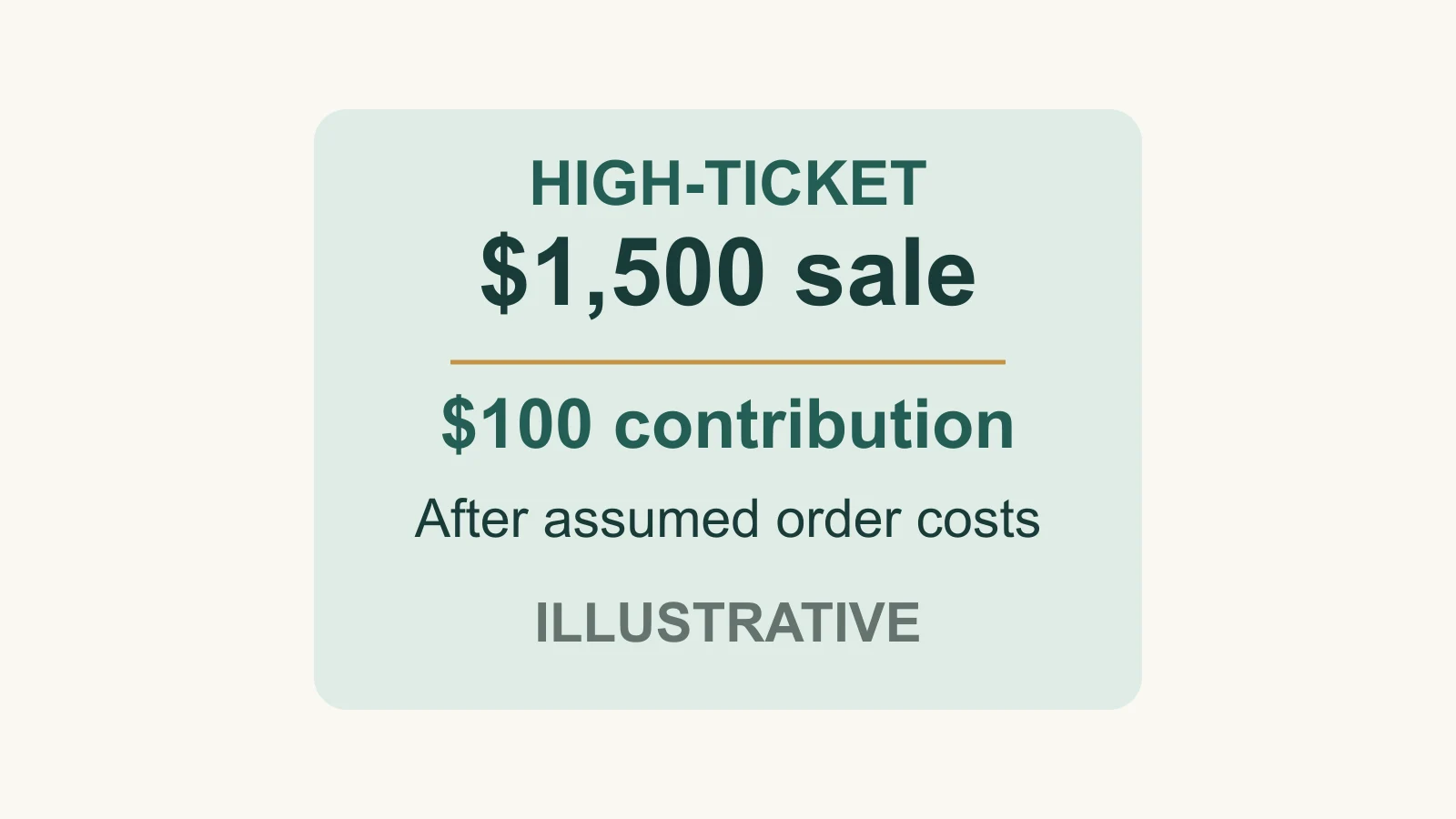
High-ticket dropshipping means selling relatively expensive products that a supplier ships directly to the buyer. There is no universal price cutoff: the term usually points to purchases costing hundreds or thousands of dollars, with the boundary varying by category and seller. A higher selling price can leave more dollars per order, but it does not establish a better profit margin or an easier business.
Before starting, choose products you can explain and support, obtain supplier terms, calculate the full cost of a sale and plan the cash needed before payment reaches your bank. Delivery, installation and returns deserve attention early because one difficult order can absorb the contribution from several successful ones.
The broader dropshipping overview explains the model. Here the question is whether a higher-priced offer works after its larger costs and customer expectations are included.
01
What counts as high-ticket dropshipping?
The phrase describes a selling approach, not a regulated product class. Shopify’s high-ticket explanation includes expensive furniture, equipment and other products. Published price conventions differ; use the term to describe your intended purchase range rather than treating one threshold as a business rule.
Compare the proposed product with its own category. A $300 accessory can require more explanation and reassurance than a routine accessory purchase. A $300 piece of commercial equipment may be inexpensive within its market. The buyer’s decision, competing offers and service requirements matter alongside the number on the price tag.
More revenue per order is not the same as more take-home profit. Product cost, freight, acquisition, payment processing and post-sale problems still need funding. You may also spend longer answering questions before an order arrives.
This model can suit a seller with category knowledge, access to an appropriate supplier and enough cash to handle the order cycle. A beginner can develop those capabilities, but raising the price does not remove the need to learn them.
02
Choose a category you can explain and support
Start with a product family whose purchase conditions you can make clear. The examples below are possible categories to investigate, not a ranking of guaranteed winners.
| Category and example | What the buyer must establish | Operating issue to check |
|---|---|---|
| Office furniture, such as desks or conference tables | Dimensions, materials, access and assembly | Bulky delivery, damage, missing hardware and return freight |
| Fitness equipment, such as exercise bikes | User fit, space, power requirements and maintenance | Installation, replacement parts and warranty support |
| Technical equipment, such as specialist printers | Compatibility, consumables and intended workload | Setup assistance, authorized resale and repair arrangements |
| Outdoor equipment, such as substantial storage or recreational products | Dimensions, weather suitability and site requirements | Delivery access, assembly and seasonal demand |
For each candidate, read the manufacturer’s specifications and competing listings. Identify the questions a buyer would need answered before spending the money. If you cannot verify a capacity, compatibility statement or installation requirement, resolve it before publishing it.
Demand alone is not enough. A product can attract searches yet be a poor fit if you cannot obtain authorized supply, afford the freight or support a repair. Use dropshipping product research to investigate the market, then narrow the list through operational constraints.
Be cautious about adding products solely because the price is attractive. Fragile, difficult-to-install or tightly regulated goods can demand capabilities your store does not yet have. Choose a narrower range when that allows you to answer questions accurately and keep replacement parts and service arrangements understandable.
03
Get supplier permission and service terms before building the catalog
Look for a manufacturer’s dealer or wholesale application, a regional distributor serving the category, or a supplier network with identifiable businesses behind the listings. Ask whether it accepts your business model, intended markets and sales channels, and whether it will ship individual orders directly to consumers.
A dealer account, a dropshipping arrangement and permission to use a marketplace are separate questions. Get the answer for your proposed operation rather than assuming that access to a price list settles all three.
Request written terms covering:
- Product costs, payment timing and order minimums.
- Stock visibility, reservation and dispatch arrangements.
- Product images, specifications and permitted sales channels.
- Warranty eligibility, parts, repairs and responsibility for customer support.
- Cancellation, damage, returns, restocking and supplier-credit timing.
Manufacturer terms can contain exclusions that change your economics. For example, Flash Furniture’s published shipping and returns policy states that dropship products are not available for returns. That is a provider-specific restriction to investigate, not a rule for furniture generally or a substitute for the retailer’s obligations to customers.
Order a sample or arrange a physical inspection appropriate to the product’s cost. Evaluate packaging, instructions, assembly and access to support. When you cannot inspect every variant, document what you checked and avoid implying that one sample proves the entire range. The supplier qualification article provides a fuller set of questions for that conversation.
04
Calculate what one sale really contributes
Build the calculation from a specific product, route and acquisition plan. “We buy for $950 and sell for $1,500” leaves too many costs outside the decision.
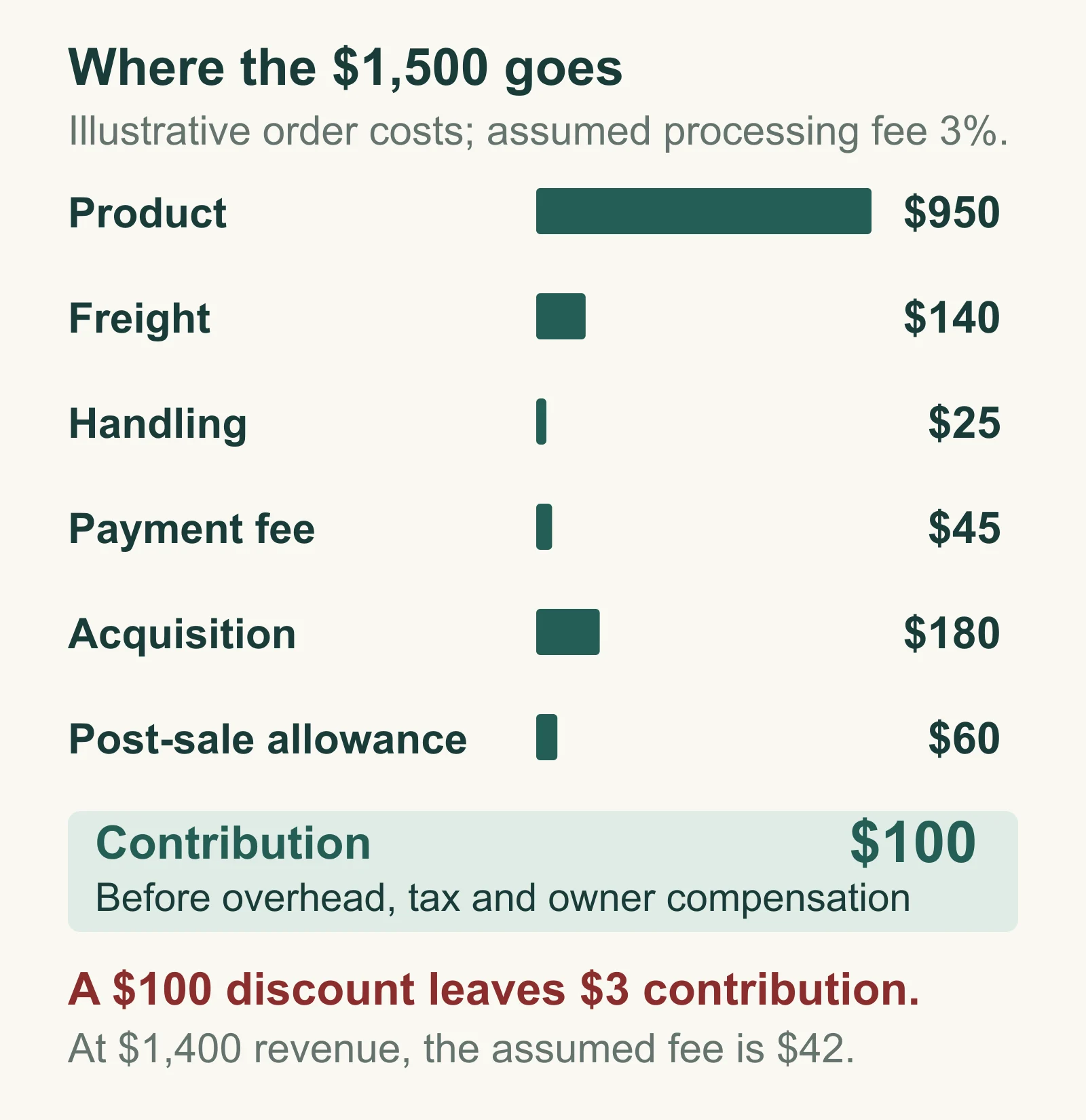
This illustrative $1,500 order leaves $100 of contribution after the assumed costs below. The figures are invented for calculation; they are not AIDrop results, supplier quotes, typical margins or payment-plan pricing.
| Item | Assumed amount |
|---|---|
| Selling price | $1,500 |
| Supplier product cost | −$950 |
| Outbound freight | −$140 |
| Handling | −$25 |
| Payment processing, assumed at 3% | −$45 |
| Customer acquisition | −$180 |
| Allowance for post-sale costs | −$60 |
| Contribution before overhead, tax and owner compensation | $100 |
The calculation is $1,500 − $950 − $140 − $25 − $45 − $180 − $60 = $100, or approximately 6.7% of revenue. The $60 allowance is a planning assumption for expected post-sale costs across orders. It does not cap the cost of a particular return or replace cash for a full refund.
Now discount the product by $100 while leaving every non-payment cost unchanged. Revenue becomes $1,400 and the assumed 3% processing charge becomes $42. Contribution falls to $3: $1,400 − $950 − $140 − $25 − $42 − $180 − $60.
That example makes two decisions visible. You need a price that supports the whole offer, and you need to know what an advertising campaign can afford. An extra $100 of acquisition cost would consume the original $100 contribution before any overhead is paid.
Replace every assumption with your actual quote, fee schedule or measured result. Include any applicable nonrecoverable charges and be consistent about taxes. Use the margin guide to distinguish markup, gross margin and contribution when comparing products.
05
Plan cash for orders that have not paid out yet
A profitable order can still require cash you do not have available. The supplier may need payment before dispatch while the customer payment is settling or waiting for payout. Shopify’s payout documentation distinguishes settlement, payout scheduling and bank processing; the applicable timing depends on the account and payment circumstances.
Suppose three orders from the same illustrative example need funding before their customer payments are available. Product, freight and handling total $1,115 per order. Three orders require $3,345 for those costs; add $540 of acquisition spending already due and the modeled cash requirement is $3,885 before payout.
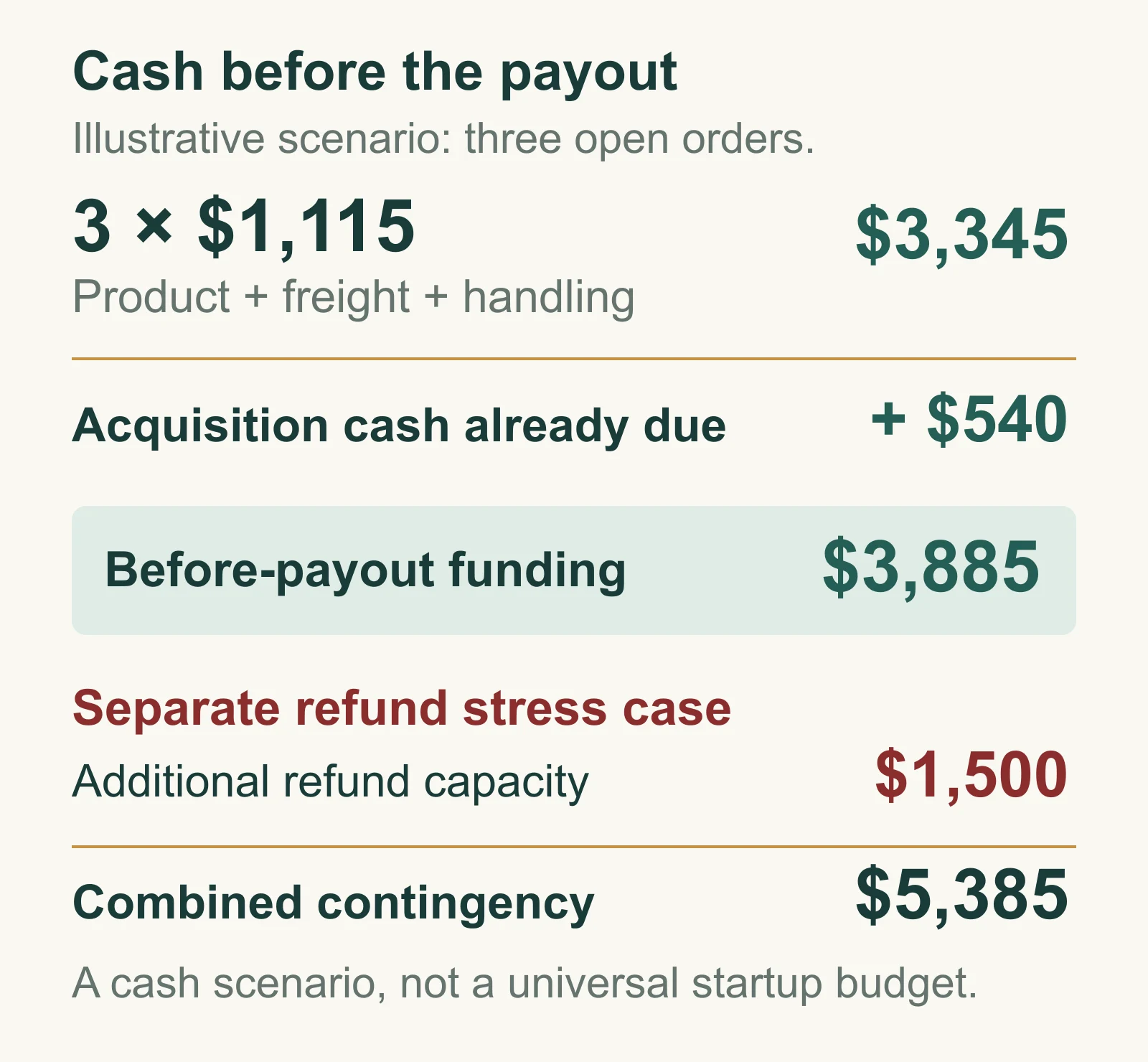
This is a scenario to recalculate, not a recommended universal startup budget. It excludes other bills, assumes those supplier charges and ad costs must be paid first, and assumes customer funds cannot yet be used. Different credit terms or payout timing can change it substantially.
Test a separate adverse event: could you fund a $1,500 customer refund while a payout or supplier credit is unavailable? If you choose to reserve that additional amount on top of the modeled $3,885, the combined contingency is $5,385. The refund amount is a liquidity stress case, not another routine expense to subtract from every order’s contribution.
Do not rely on an expected supplier credit to fund a refund today. Check how your payment provider handles the actual balance. Stripe, for example, uses available funds for refunds and can hold card refunds pending when that balance is insufficient; other payment methods can behave differently. Stripe’s refund documentation describes those processor-specific conditions.
Disputes need their own attention. Read the notice, response deadline and transaction status before issuing a separate refund that could duplicate a reimbursement. Preserve order, communication and delivery evidence under your provider’s dispute process.
06
Match the sales channel to a considered purchase
Choose channels according to how buyers evaluate the product. Someone searching for a particular equipment model may already be comparing availability, specifications, delivery and the seller’s credibility. A detailed product page can answer those questions more directly than a broad promise about premium quality.
For a search-led offer, build pages around useful buying information: model differences, dimensions, compatibility, what is included and the delivery service. If you use paid search or shopping ads, verify current platform eligibility and product-data requirements before launch, then cap the test spend according to the contribution available. No channel removes the need for an accurate offer.
Social content can help when a demonstration makes the product easier to understand. Show the actual product and its use with material you have permission to use. A demonstration should clarify fit or function, not imply that you tested a product you have never handled.
Give buyers a practical way to ask questions. Record the questions that delay purchases, answer them on the relevant page and identify those that require supplier expertise. If each sale needs substantial personal support, include that workload when deciding whether the business can scale.
For a store you control, the Shopify setup walkthrough covers checkout, supplier connections and order testing. Marketplace selling adds another set of channel and supplier-permission checks; approval for your own website does not establish approval everywhere else.
07
Define delivery, installation and returns before checkout
Find out how the product will travel before advertising a delivery offer. A parcel service, a pallet freight delivery and an in-home service create different customer expectations. “Home delivery” is too vague if the buyer expects the item inside and the booked service leaves it at an accessible delivery point.
Ask the provider to specify the destination coverage and exactly what the quoted service includes:
- Appointment scheduling and the information required from the customer.
- Access restrictions, stairs and whether lifting equipment is needed.
- The delivery point: curbside, threshold or an agreed room.
- Assembly, installation, packaging removal and any exclusions.
- Charges for failed access, redelivery or refused delivery.
Treat each service separately. Inside delivery does not by itself establish assembly or installation. Confirm the current service description and quote for the actual address instead of borrowing a carrier’s premium-service language for a cheaper option.
Explain how to inspect and report delivery damage using the provider’s procedure. Agree on replacement parts and repair support before a missing component becomes your first customer-service lesson. Do not promise warranty coverage without checking eligibility, territory and who will perform the work.
Write the customer returns offer with the likely reverse journey in mind. Confirm the return address, authorization, packaging, collection and inspection, plus any charges you may lawfully pass on. A supplier refusing a return does not automatically remove the retailer’s customer obligations. Use the returns article to work through those separate responsibilities.
For covered US orders, the FTC requires a reasonable basis for shipping promises and sets requirements for delays, consent and refunds. Consult the FTC’s mail and internet order guidance when preparing the offer. Avoid publishing a dispatch or delivery promise simply because it appears on an unverified supplier listing.
08
Start with a narrow range and a real delivery test
Begin with products for which you have authorized supply, usable specifications, a support arrangement and a complete cost calculation. Favor a range you can explain accurately over a large catalog that leaves important questions unanswered.
Put a real order through the intended process. Check supplier acceptance, charges, dispatch, tracking, delivery service and the condition of the product. If assembly or installation is part of your offer, verify that experience too. The fulfillment walkthrough connects those physical checks with order and customer-service records.
Set a limited acquisition test and review what it produces: qualified inquiries, completed sales, contribution after actual costs and problems after delivery. Keep unresolved orders visible when assessing results. A sale that still needs an expensive remedy is unfinished evidence.
Expand when the offer works across the relevant orders and you can fund the next ones. The fundamentals section of the Dropshipping Hub connects the surrounding business decisions, including whether the model fits your resources in the first place.