
Choose dropshipping packaging by starting with the protection the product needs, then adding a useful brand layer. Measure and weigh the completed parcel, compare the full packing and shipping cost, and approve a filled sample before the supplier uses that configuration for customer orders.
A printed box is only one part of the decision. The product must arrive in the condition you promised, the shipping label needs a suitable surface, and the parcel must fit the delivery service you intend to use. An attractive mockup cannot establish any of those things.
01
Find out what the supplier currently sends
Ask for the complete packing arrangement for the exact product and variant. Request views of the item before packing, its retail container or protective bag, the internal supports, the closed outer package, and everything inserted into the parcel.
Separate the layers by their job.
- The retail package presents or contains the product.
- Internal protection limits damaging contact or movement.
- The transit package encloses the shipment.
- A card or leaflet communicates with the customer.
Some packages serve more than one purpose, but the design must support each one.
This distinction matters when the retail box is part of the offer. A gift box arriving crushed can disappoint the buyer even if the item inside still works. Agree whether that box is expected to arrive in presentation condition and what protects it during shipping.
If the supplier only provides a product-listing image, request a filled sample through the intended packing process. Until you see the complete arrangement, you cannot reliably price a change or approve the customer experience. Ask whether different variants, bundles, or destinations use different packaging.
02
Match protection to the way the product can fail
Look for vulnerable corners, exposed surfaces, loose accessories, sharp edges, and parts that can move against each other. Consider whether pressure, impact, moisture exposure, or friction could damage the item or its retail packaging. The product’s shape and construction matter as much as its weight.
| Product or customer requirement | Packaging option to investigate | What to verify on the packed sample |
|---|---|---|
| Soft, durable item with no vulnerable fittings | Suitable mailer with any needed inner protection | The contents do not puncture the mailer, the closure holds, and the material provides the needed protection |
| Item with crush-sensitive or fragile parts | Corrugated outer box and product-appropriate internal support | Vulnerable parts are supported, separate pieces cannot strike each other, and the packing method is suitable for transport |
| Product whose retail box must arrive presentable | Protective transit packaging around the retail box | Corners, surfaces, and closures remain in the agreed condition |
| Several items sold as one bundle | A defined arrangement with separation or individual protection | Every item fits in the tested configuration without damaging another component |
Treat these as starting options. A mailer suitable for a plain T-shirt may be unsuitable for a garment with an exposed decorative fitting. A padded envelope may reduce surface contact while providing too little protection against crushing.
Choose the fill for the product as well. UPS’s packaging guidance distinguishes materials used for cushioning and void fill, including limitations for sharp items and temperature-sensitive air bags. Empty space filled with the nearest available material is not necessarily effective protection.
Ask the packer to show how the item sits before the container is closed.
- Look for movement, contact between components, and pressure on vulnerable features.
- A loose accessory should have an identified place instead of being dropped beside the main product.
03
Add branding where it serves the customer
- An insert can explain assembly, care, or how to get support.
- A label or sleeve can identify the product and its version.
- A printed mailer or box can make the parcel recognizable.
Choose the component for the information or presentation you want the customer to receive.
For a first packaging customization, compare a simple addition with replacing the entire package. An instruction card may solve the actual customer problem without changing the outer carton. A custom-shaped insert may be justified when it holds the product securely and presents the parts clearly. Ask for the actual materials, print method, and assembly steps behind each option.
Check the artwork at the size it will be printed.
- Read the small text, verify the support address or link, and check whether the component can be inserted without bending or covering another label.
- Necessary product and transport information must remain visible and correct; review product-specific requirements before changing labels or instructions.
There is no automatic sales uplift from a logo or a heavier box.
Judge the proposed addition against the customer task, the cost, and the effort needed to reproduce it. The branded dropshipping guide covers how packaging fits into a broader product and customer-experience decision.
04
Price the sealed parcel, including its size
- Measure the outside of the finished package with the product, protection, accessories, and inserts inside.
- Weigh the same completed parcel.
Supplier box dimensions may describe the inside space, and a product-only weight leaves out the materials that travel with it. Shopify’s packaging and weights guidance specifically advises checking outside dimensions and accurate packaging weights.
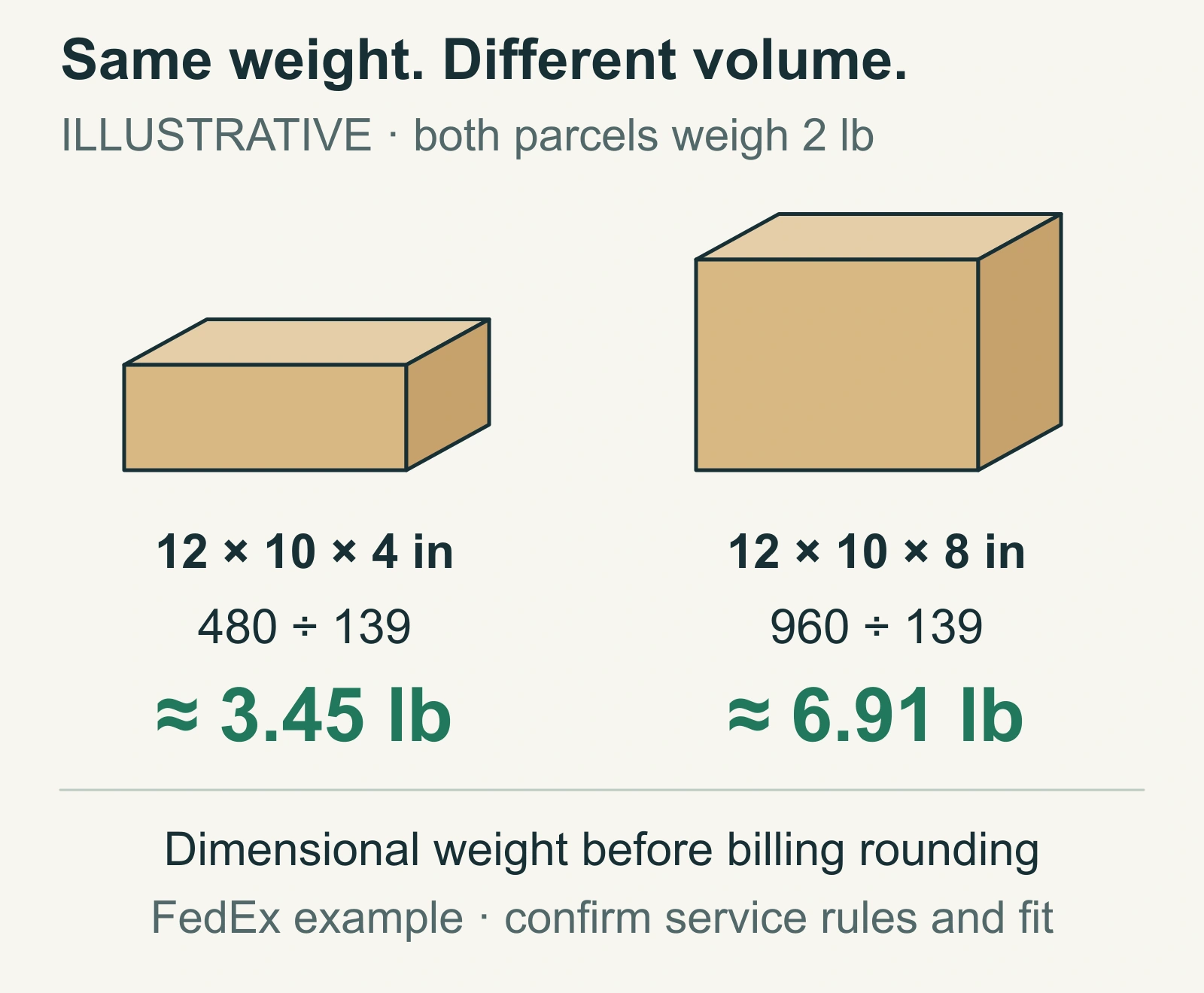
Parcel size can change the weight used to calculate shipping. For example, FedEx publishes a dimensional-weight calculation using length × width × height in inches divided by 139 for its stated U.S., Puerto Rico, and international shipment scope. Its guidance compares dimensional weight with actual weight. Confirm the applicable service, account terms, measurement rules, and billing rules for your own shipment. FedEx dimensional-weight guidance.
Consider two hypothetical parcels with the same base and actual weight. Doubling the height doubles their calculated dimensional weight under that formula:
| Illustrative parcel | Outside dimensions | Actual weight | Volume ÷ 139, before billing rounding |
|---|---|---|---|
| Shallower carton | 12 × 10 × 4 inches | 2 lb | 480 ÷ 139 = approximately 3.45 lb |
| Taller carton | 12 × 10 × 8 inches | 2 lb | 960 ÷ 139 = approximately 6.91 lb |
These are arithmetic examples, not shipping quotes or final billed weights.
They also do not establish that the shallower carton safely holds a particular product. The comparison shows why an extra decorative layer or unnecessarily tall box deserves a fresh packing and shipping review.
Compare the complete alternatives on the same product, order quantity, destination, and service. Ask the provider to itemize:
- Packaging materials, printing, and inserts per order.
- Setup, tooling, artwork preparation, and sample charges.
- Additional packing or assembly work.
- Minimum purchases for each component and responsibility for unused stock.
- Storage and replenishment arrangements where materials are held.
- Shipping effects based on the completed parcel.
Avoid hiding a large purchase behind an attractive unit price. A lower-priced box can require buying more stock than the current product needs. Artwork changes can also leave unused materials. Ask what happens to those materials if the product is discontinued or the packing version changes.
Use the dropshipping profit-margin guide to incorporate the recurring costs into the offer. Keep upfront spending visible separately. Any expected reduction in damage or increase in repeat purchases remains an assumption until you have observed it.
05
Approve a filled sample, not just the artwork
A digital proof can help you review layout, spelling, and placement.
A physical printed sample adds evidence about the actual material and appearance.
Neither necessarily shows how the complete product fits or survives transport.
Request a filled sample assembled with the intended product and accessories, using the proposed materials and packing method.
If the supplier substitutes a different item, insert, or box for the sample, record the substitution and resolve it before treating the final configuration as approved.
Examine the sample in the order a customer encounters it:
- Check the outside dimensions, weight, closure, and shipping-label position on the sealed parcel.
- Open it and note where the instructions and accessories sit.
- Inspect the supports and separation before removing the product.
- Check the item and any presentation box for the damage you defined as unacceptable.
- Compare the contents, print, and packing method with the proposed specification.
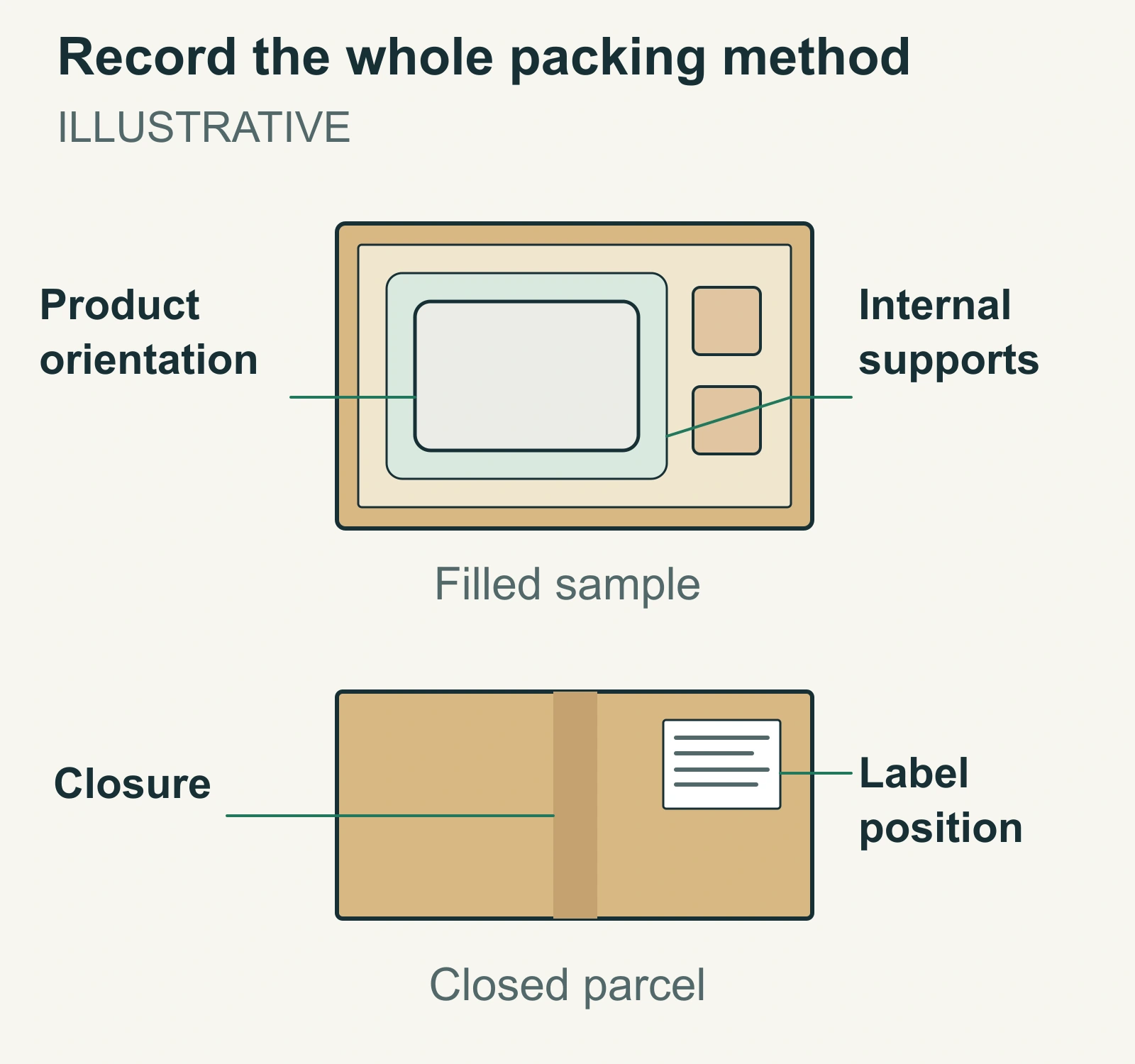
Keep photos of the assembled layers as well as the final closed package. Someone repeating the packing needs to see the product orientation, support placement, closure, and label area. A photograph of the finished exterior cannot show those hidden details.
Ask what the transport evidence actually covers
For a fragile item or an unresolved damage risk, discuss appropriate packaged-product testing with a qualified packaging specialist or laboratory.
ISTA distinguishes screening tests from general simulations of transport hazards. Its Procedure 3A addresses individual packaged products in parcel delivery within its stated scope. The applicable procedure depends on the product and distribution arrangement. ISTA’s test-procedure descriptions provide the starting point.
Ask for the tested product and packaging specification, the procedure used, the result, and any differences from what you intend to ship.
- A report about a different box or lighter product may not answer your question.
- Do not describe a casual handling demonstration as an ISTA test.
A sample sent through the normal shipping service can also reveal practical problems: an awkward label position, poor packing execution, or damage during that particular journey.
- Record the route, packing configuration, and arrival condition.
- One successful delivery gives you that observation; it cannot establish protection across all future handling conditions.
If important evidence is missing, keep the decision specific. You might approve the artwork while withholding approval of the filled pack, or accept the physical fit while requesting a suitable transport assessment. Name what is still needed so the provider can resolve it without guessing.
06
Make the approved arrangement repeatable
Give the finished packing configuration a reference and version.
- Link it to the applicable product SKUs, variants, and order combinations.
- Include the material list, product orientation, support placement, inserts, closure method, label position, and the measurements used for the shipping quote.
A single-unit sample does not automatically cover a two-item order.
Decide which combinations use the same pack and which need a separate configuration. A second item should not be forced into the first approved carton simply because it appears to fit.
Agree who holds the packaging materials and how their availability is reported. Finished products can be in stock while the required insert or carton is unavailable.
- Set the response in advance: hold the order or use a specifically approved alternative.
- Avoid leaving a worker to substitute a different material under pressure to dispatch.
Use the quality-control guide to connect the approved packing reference to checks on later orders.
- The required check might concern the correct insert, orientation, material, or bundle configuration.
- Request evidence of the parts that matter to your product instead of a generic statement that packing was checked.
Review the configuration when the product, internal supports, outer package, closure, or packing process changes. ISTA’s retesting guidance calls for retesting after changes that may affect packaged-product performance. A revised color alone may have a different implication from thinner board or a heavier item; establish what changed and whether prior evidence still applies.
If you need help comparing options, send the actual product, current packing photos, intended destination, order pattern, and desired customer-facing change for a private-label and packaging review. Request the proposed configuration, costs, sample scope, and responsibility for repeating it before committing to a material batch.
07
Frequently asked questions
Can I use custom packaging without holding inventory myself?
Potentially, if the supplier or fulfillment provider can obtain, store, and apply the materials. Confirm the arrangement for the exact product. You may still need to purchase a minimum quantity of packaging even when you do not hold finished products yourself.
Is a box always better than a mailer?
No. Choose according to the product’s vulnerability and the condition promised to the customer. A suitable mailer may work for a soft, durable item; a product needing crush protection or an intact presentation box may require a different arrangement. Verify the completed package.
Should I pay for a packaging sample?
Ask what the sample includes and how it will be made. A charge may cover a blank structural sample, printed material, a filled package, or shipping, and those provide different evidence. Confirm the scope and any credit against a later order before paying.
When is custom packaging worth the additional cost?
When it solves an identifiable protection, information, or presentation need that the offer can support financially. Compare the full recurring cost and upfront material commitment. Measure the outcome after use rather than assuming a more elaborate package will produce more revenue.