
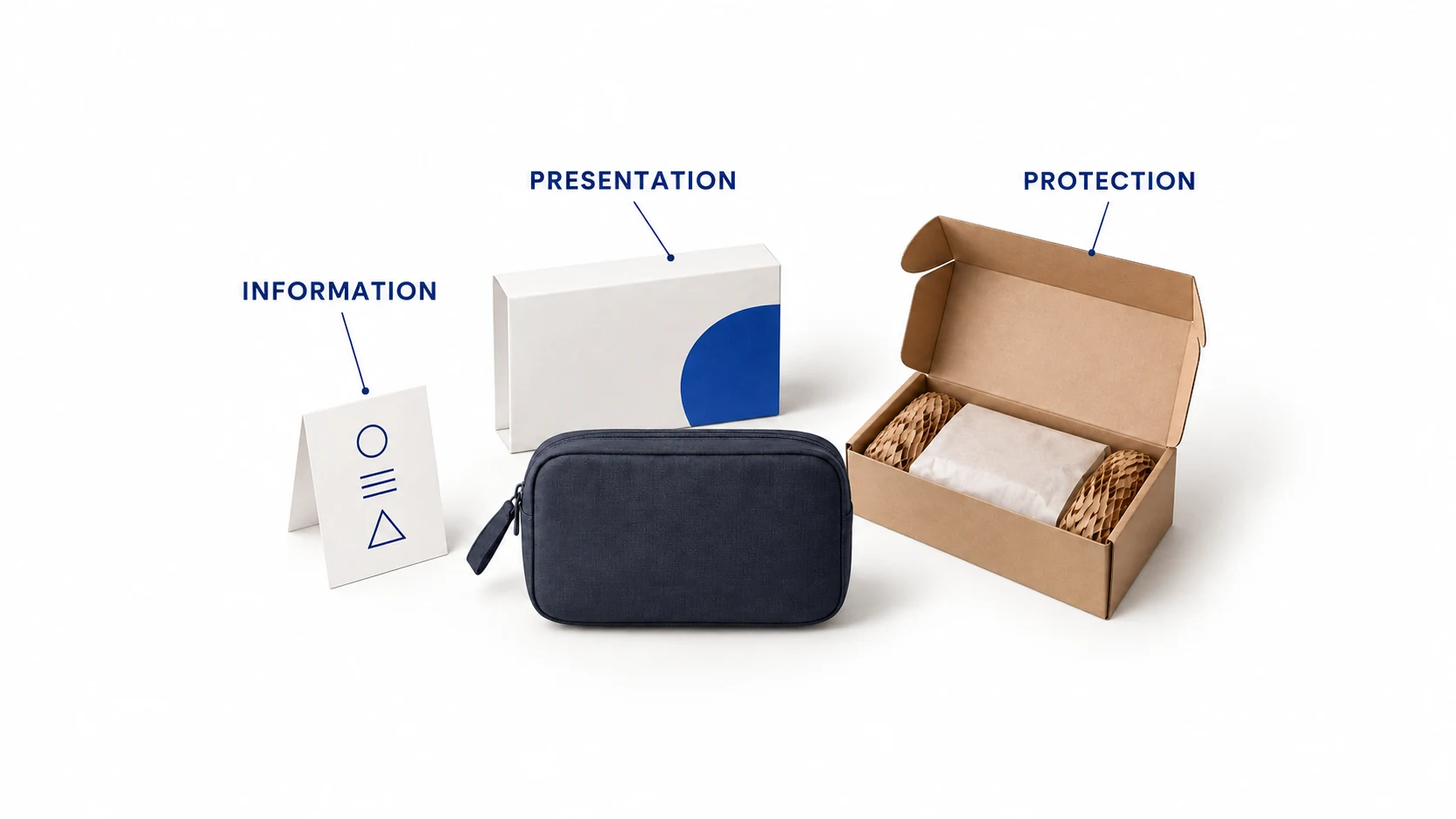
Custom dropshipping packaging means adding your chosen branding or presentation to orders that a supplier or fulfillment partner ships to your customers. Start with a customization the fulfillment route can support, approve a packed physical sample, and agree who buys, stores and replenishes the materials. The package you promise must be available where the order is actually packed.
A printed box can look inexpensive in a supplier quote and still create a large commitment. You may buy hundreds of boxes before selling the products, pay to move them into a warehouse, and discover that some orders ship from a different location. The design decision therefore needs a purchasing and fulfillment decision beside it.
This guide covers choosing the scope, approving the result and keeping repeat orders consistent. For the broader relationship between presentation, protection and parcel cost, start with the dropshipping packaging guide.
01
Start with the part the customer sees
Choose the change that solves a specific problem. A care card can explain use. A well-fitted insert can keep accessories together. A branded outer package can make the delivery recognizable. These are different jobs, with different material and handling requirements.
Inserts and applied branding
A card, sticker, sleeve or other added component can let you customize a standard package without ordering an entirely new box. It still needs an approved placement and a stock record. A loose card may be missed during packing; a sticker may cover information the customer or carrier needs.
Check whether the same component works across your assortment. A generic care card is useful only when its instructions actually fit the included product. Avoid printing a large quantity around a temporary promotion, a changing support address or a claim you cannot substantiate.
Printed mailers and shipping boxes
A custom outer package changes the item the carrier handles. Its dimensions, closure and strength need to suit the contents. A decorative retail box may still require a protective shipping carton, so ask which layer the quote describes.
For a soft product, a suitable mailer might achieve the desired presentation with less empty space. A fragile or easily crushed product may need a different construction. Choose on the basis of the product and route, then evaluate how the branding fits that construction.
Product-specific presentation
Custom compartments, fitted inserts and presentation boxes can improve the way a set is organized. They also tie the packaging more closely to a particular product shape or bundle. If the supplier changes the accessory dimensions, yesterday’s fitted insert may no longer work.
Record whether the customization belongs to the product, the bundle or the customer order. A two-item order may require one outer carton but two product boxes. Without that distinction, both the quote and the stock forecast can be wrong.
02
Confirm what the fulfillment route supports
Ask the party that will pack the order to approve the proposed materials before placing a print order. A supplier offering custom packaging may support only certain products, facilities, package types or order combinations.
Printful provides a useful provider-specific example: its custom packaging page says orders use white-label packaging when custom packaging is unsuitable, unavailable at the fulfillment location or out of stock. That condition matters if your product page promises a particular presentation. Other partners may have different fallback rules; obtain the rule for your arrangement.
Send the partner your product list, expected order combinations, shipping destinations and proposed package dimensions. Request an answer for each combination that materially changes packing. “We support branding” is not enough to confirm that a large bundle and a single small item use the same packaging.
Before approving a supplier, establish:
- Which facility holds each packaging item and which orders can use it.
- Whether the packing team receives the required packaging version with each order.
- Whether split shipments receive separate inserts or only one component of the order does.
- Which standard material is permitted if a custom item is missing.
- Whether an unsupported combination is held, rerouted or sent in standard packaging.
If the provider cannot hold an order for missing packaging, build your customer promise around the service it can reliably provide. Paying for extra materials does not create a capability that its system lacks.
03
Write a packaging specification the supplier can quote
The specification should identify what you are buying and how it will be used. A logo file alone leaves most of the purchasing decision unresolved.
Physical construction
Name the package type, material, finished internal and external dimensions, closure and required contents. Include the actual product variant and quantity that must fit. If a protective insert is required, describe its purpose and show how the product sits inside it.
Agree tolerances for dimensions and other measurable properties with the supplier. Do not borrow a generic tolerance from an unrelated product. A small dimensional change might be harmless for a loose fabric bag and unacceptable for a fitted compartment.
Appearance and content
Identify the approved artwork file, print positions, colors and finish. State what must remain readable after the package is assembled. For important color matching, agree the physical reference and viewing conditions instead of relying entirely on an illuminated screen.
Keep customer-service text, care instructions and marketing copy separate from mandatory product or shipping information during review. Customization should not hide required labels. If you add environmental, material or performance claims, obtain support for those specific claims before printing them; a supplier’s generic “eco” description is not evidence for your finished package.
Packing and receiving instructions
Show the sequence in which the product, protection and printed components go into the parcel. Specify the number of each insert and where labels belong. Request identifiable cartons for inbound packaging stock, including the packaging item code, version and count.
A useful approval request might read: “Quote 500 units of box BX-01, artwork revision C, for one organizer plus its accessory pouch. Include the fitted insert shown in the reference, supply a packed physical sample, and quote inbound delivery separately.” The codes are illustrative; their value is that the quote and eventual delivery refer to the same object.
04
Approve a packed physical sample
Approve appearance and packing performance as separate checks. A digital proof can catch text or placement errors, but it cannot show how a box closes around the actual product. A flat material sample cannot establish whether the final parcel has enough protection.
Request the exact product, protective components and printed material assembled together. Photograph the unopened parcel, the packing layers and the unpacked contents. Record finished parcel dimensions and weight for a fresh shipping quote. A larger presentation box can affect freight even if the product is unchanged.
Check the customer-facing result
Look for readable print, the agreed finish, correct insert quantity and a package that opens as intended. Check whether the product is immediately understandable, whether accessories are easy to find, and whether tape or labels damage the branded area.
Verify the actual contact details and any QR destination rather than approving their visual appearance alone. A perfectly printed code pointing at an unfinished page is still a failed component. Test using the physical printed sample, where size and contrast may differ from the artwork file.
Check protection and handling
Check fit, movement inside the closed package and protection around vulnerable parts. UPS’s packaging guidance emphasizes selecting a suitable rigid box and appropriate cushioning. Apply the current guidance for the carrier and product you will use; a branding approval is not a carrier damage guarantee.
An ordinary test shipment can reveal a crushed corner, loose insert or closure problem on that journey. It does not establish a universal transit failure rate. Where formal transport testing is needed, agree the appropriate method with a qualified testing provider rather than calling an improvised drop test a certification.
Record the outcome as approved, hold for correction or rejected, naming the item and version. If the sample needs a stronger insert, inspect that revised packed configuration before release. Approval of the print does not automatically approve the changed construction.
05
Calculate the commitment before the unit price
Separate the minimum purchase of packaging from the number of products in one customer shipment. You may fulfill one product at a time while owning a large quantity of packaging. The dropshipping MOQ guide explains how these commitments can sit at different layers.
Ask whether a minimum applies per size, artwork, color or combined order. A quote for “500 boxes” may mean 500 of each design. Request setup charges, sample charges, inbound freight, storage, handling and removal terms alongside the unit price.
A 500-box example
Consider a hypothetical order for 500 boxes at $0.60 each, with $60 setup and $40 inbound delivery. You commit $400 before customer fulfillment: $300 for boxes plus $100 for setup and inbound delivery. The amounts are illustrative, not a supplier quote.
If you fulfill 100 orders using one box each, you have consumed $60 of the purchased boxes and still hold 400 boxes. Dividing the initial $400 cash outlay by those 100 orders gives $4 per fulfilled order so far. That is a cash-commitment view, not the accounting cost of the material consumed in each order.
If all 500 boxes are eventually used, the same initial outlay averages $0.80 per order before storage, packing labor, disposal or any extra outbound freight. Comparing only the $0.60 print price with standard packaging misses those other costs.

Compare a smaller commitment
Suppose a second hypothetical option is 100 simpler packages at $1.10 each, with $20 inbound delivery and no setup fee. That requires $130 upfront. Using all 100 averages $1.30 before other costs. It has a higher full-use average than the larger run, but requires $270 less cash at the start and leaves no purchased balance after those 100 orders.
The choice depends on credible demand and how likely the design is to change. Calculate both the cost if the run sells through and the cash exposure if it does not. A larger run is difficult to justify through savings alone if most of it becomes obsolete after a product revision.
Confirm payment dates as well as totals. A deposit, balance due before dispatch and warehouse receiving charge can fall before your store receives enough customer revenue. Keep the product purchase and customer-service reserve visible beside the packaging spend.
06
Make packaging stock part of order release
A product can be available while its approved packaging is unavailable. Track both before treating a branded order as ready to ship. The inventory record needs the packaging item, version, facility, usable quantity, reserved quantity and replenishment status.
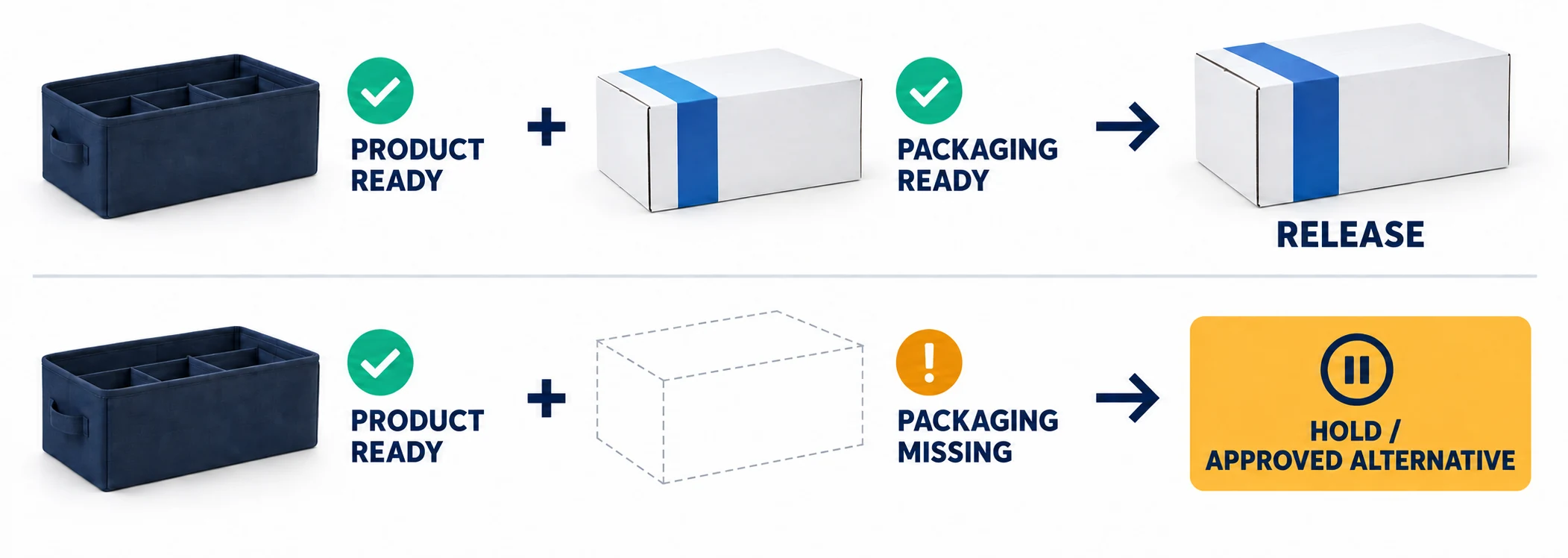
Printful’s warehousing terms illustrate why location matters: custom packaging stock does not determine the fulfillment location, and it is available only where that packaging is stocked. A global total therefore cannot prove that a specific order will receive it.
Release against the right components
For an order requiring a box and an insert, confirm one usable unit of each is allocated at the packing location. Damaged boxes and superseded inserts should not count as available. If a split order consumes two outer packages, reserve the components for both parcels.
The packing instruction should state the product combination, packaging code and version, component quantities, placement and permitted fallback. Ask how the warehouse records a substitution. A missing item should produce an identifiable exception, not an unexplained discrepancy discovered in a customer’s photo.
Reorder before stock reaches zero
Use replenishment time that includes production, inbound transport, receiving and release for use. A print shop’s production estimate alone ends too early. New material sitting at the warehouse dock cannot necessarily be used in that day’s orders.
For example, at a hypothetical 10 packages per day and 14 days from reorder to usable stock, expected consumption during replenishment is 140. Adding a chosen 40-unit buffer gives a reorder-review trigger of 180 available units. The buffer is an illustrative business choice, not a universal rule; review it when demand or lead-time reliability changes.
Before placing another purchase, check replenishment already ordered, its expected usable date and known demand not yet allocated. Account for each incoming quantity and demand commitment once, so the stock alert does not create duplicate purchases or overlook orders already promised.
Do not apply the same trigger blindly to every size. The fastest-moving package can run out while the overall packaging count still looks healthy. Reconcile warehouse usage against shipped orders and investigate unexplained consumption before it becomes a replenishment surprise.
07
Set a repeat-order and change rule
A repeat purchase should refer to the approved specification and physical reference, not just an old invoice. Confirm that the material, construction, print method and fulfillment location remain the same. Require notice before the supplier substitutes something that affects the approved result.
For unchanged repeats, agree a receiving check that verifies identity, quantity and relevant quality points. When construction or materials change, decide which checks and samples must be repeated before the new stock becomes usable. Do not quietly mix revised material with the original stock.
Record who owns unused packaging and what happens when a product is discontinued. Ask about storage periods, retrieval, transfer fees, disposal authorization and access to usable design files or tooling where applicable. The agreement should also cover who bears the cost when delivered material differs from the approved specification.
Avoid printing a revision until the old-stock decision is clear. You may choose to use up acceptable older material, separate it for a particular product run or remove it. If old content is wrong or misleading, lower unit cost is not a reason to keep sending it.
08
Resolve the exceptions before launch
The custom packaging is missing
Apply the agreed choice: hold, use an approved alternative or reroute if the partner supports it. If the presentation is part of what the customer bought, consider the customer promise before sending a plain substitute. Record the affected orders and notify the team responsible for customer communication.
The product no longer fits
Hold the affected product-and-package combination. Compare the actual variant with the approved sample and check whether the product, packaging or both changed. Resume only after an acceptable combination is documented; forcing the contents into the box can create a new damage problem.
The materials arrive defective
Separate suspect stock from usable stock and capture the defect, item code, version, quantity checked and quantity affected where known. Request correction or replacement against the agreed specification. Do not extrapolate an exact defect count from a few photographs without checking the remaining stock.
The packaging commitment is too large
Reduce the number of designs, simplify the component or negotiate staged purchasing where available. A standard protective package with one useful branded insert can be a sensible starting point. Upgrade when the demand, fulfillment coverage and repeat-order controls support the larger commitment.
09
Frequently asked questions
Can I use custom packaging while dropshipping individual orders?
Yes, if the supplier or fulfillment partner supports it. Individual order fulfillment can use packaging you purchased in advance. Confirm the packaging minimum, stock ownership, compatible products and facilities before buying it.
Do I need a printed box to create a branded delivery?
No. Depending on the product and partner, a well-designed insert, label, sleeve or mailer may achieve the required presentation. Choose a component that has a clear purpose and does not reduce protection or hide important information.
Should I approve a mockup before paying for packaging?
Use a mockup or digital proof for artwork review, then approve the relevant physical sample before releasing the production commitment. The packed sample should establish fit and presentation with the actual contents. Agree sample fees and payment stages in advance.
Will custom packaging increase repeat purchases?
It may support a recognizable and useful customer experience, but the packaging alone does not establish a sales lift. Evaluate its cost and actual customer feedback alongside product quality, delivery and service. Avoid making the purchase decision depend on an unmeasured retention promise.
What should I send to a packaging partner first?
Send the product and order combinations, destination markets, proposed customization, dimensions, expected usage and target launch date. Ask for compatibility, samples, minimums, complete charges and fallback rules. Use the quality and packaging section of the Dropshipping Hub to connect that request with product approval and fulfillment planning.