
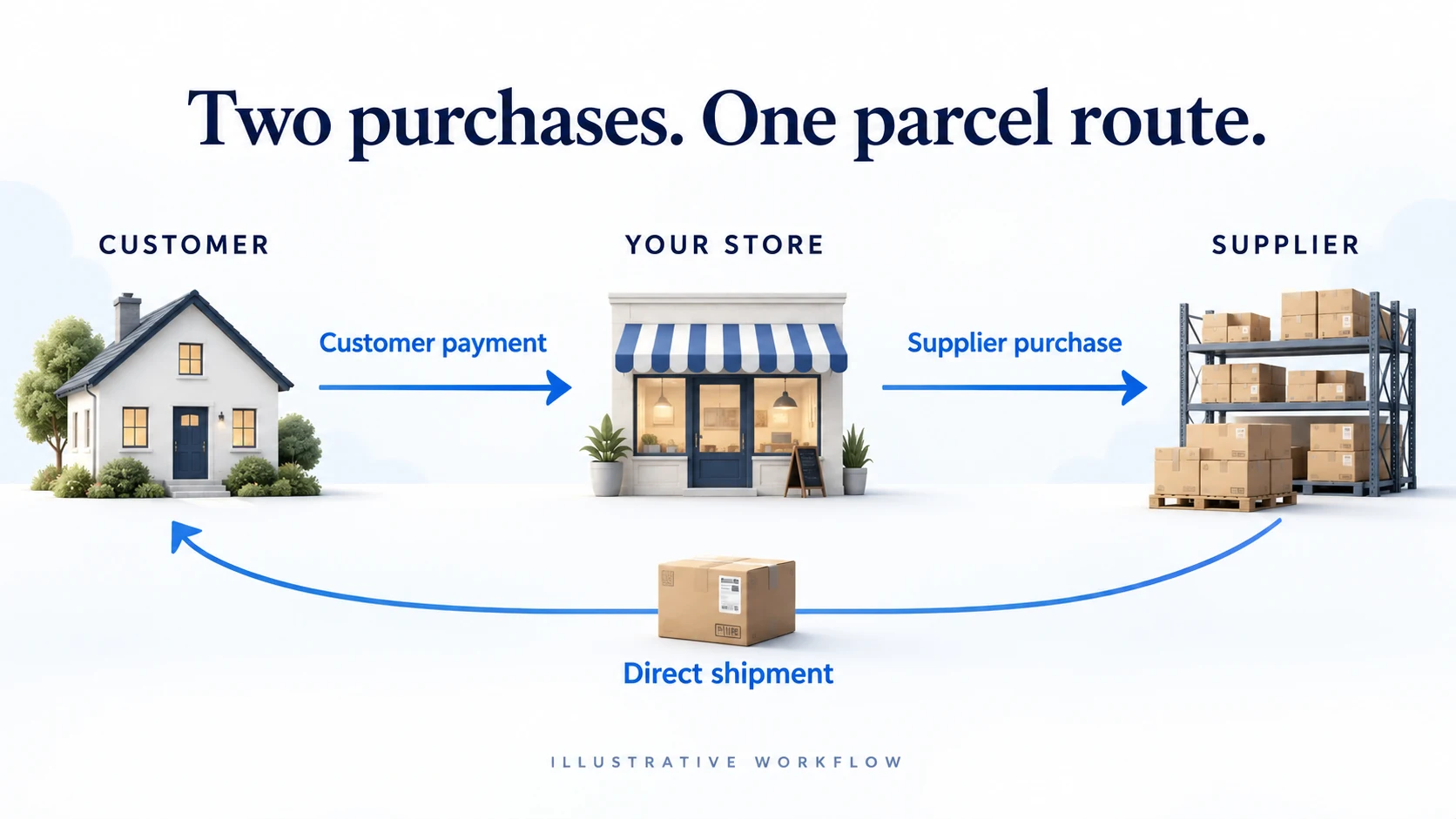
AliExpress dropshipping means selling a product through your own store, then purchasing it from an AliExpress seller who ships it directly to your customer. You can test a product without buying a large batch of stock first. You still need to choose the seller, fund the purchase, make an accurate offer and resolve problems with the customer.
Start with one product. Order a sample, check the delivery route and work out what each completed sale would leave after costs. You can expand the catalog once you know that the product matches your description and that you can deliver it at a workable price.
For the wider model, the guide to what dropshipping means explains the parties and responsibilities beyond AliExpress.
01
What AliExpress changes about the business
You use AliExpress to find and purchase the products. Your customer shops on your own website. That is the distinction between dropshipping from AliExpress and opening a seller account to sell on the marketplace.
Buying individual units, where the listing allows it, gives you room to test demand before paying for stock. The downside is easy to see: other stores, and your customers, can often find the same products. Your description, service or selection needs to give them a reason to buy from you.
Your store: sets the price, describes the product, takes payment and helps the customer with the order.
The AliExpress seller: supplies and ships the item under your purchase terms. Agree on the variant, packaging, handling and delivery method before relying on them.
You hold less unsold stock, but depend on the seller for availability and dispatch. If a variant sells out while your store still advertises it, the resulting customer order is yours to resolve. Check stock changes and pause affected listings promptly.
AliExpress is a reasonable starting route when the product can tolerate the supported delivery window and the complete cost leaves room for customer acquisition and service. It is a poor fit when your offer depends on unverified customization, urgent delivery or technical claims you cannot substantiate.
02
Follow the money and the parcel through one order
Each order involves two purchases: the customer pays your store, then you pay the supplier. The supplier sends the parcel directly to the customer. You remain the person the customer contacts about it.
- A customer chooses a variant and pays through your store.
- You check the order, delivery address, payment status and available supplier offer.
- You purchase the matching variant using the customer’s authorized delivery details.
- The supplier processes the order and hands the parcel to a carrier.
- You pass accurate tracking information to the customer and monitor exceptions.
- You handle the customer’s questions, delivery problem or refund request while separately pursuing any supplier remedy.
The customer’s payment may not have reached your bank before step three. Plan to fund supplier orders during the payout gap. A business can show a positive margin on its orders and still struggle to pay for the next day’s purchases.
An integration can reduce manual entry. DSers’ own getting-started documentation separates product mapping, customer-order confirmation, supplier ordering and payment, and tracking synchronization. That separation is useful when something goes wrong: find the last confirmed event before sending another order.
Check the carrier acceptance scan before saying an order is on its way. A store can be marked fulfilled when software receives a tracking number, even though the carrier has yet to receive the parcel.
03
Choose a product you can explain and support
Someone buying an organizer for a small desk needs to know whether it fits their space and holds their equipment. Dimensions, usable compartments and assembly details matter more to that buyer than a listing’s popularity badge. Start with that kind of specific need, then compare what the customer can already buy locally.
Find several listings that meet those requirements and compare their specifications. Check dimensions, materials, included parts, variants and available shipping routes. Save the listing URL and selected variant: two offers using the same photo may supply different items.
Check demand outside the supplier marketplace. Customer questions, competing retail offers and search behavior can help you identify an unmet need. Marketplace orders show activity within that marketplace; they do not establish how much a new store can charge or what it will cost to win a customer.
The product research guide covers that broader demand assessment. At this stage, your useful output is a short product brief: intended customer, required function, acceptable dimensions or materials, included accessories and a realistic selling-price range.
Treat difficult product categories as separate projects
Battery-powered products, children’s goods, cosmetics, food-contact items and products making health claims can require additional documentation, labeling, transport controls or other checks for the intended market. A marketplace category or seller assurance is not enough to settle those requirements.
Choose products whose requirements you can understand and verify. If you cannot establish what a certificate covers, whether it matches the exact item or who can provide the required documents, resolve that gap before selling. A less complicated product is often a better learning project than one with unanswered safety or shipping questions.
Branded goods also need care. Do not assume a listing gives you permission to resell a trademarked product or reuse somebody else’s photography. Confirm rights or create your own permitted material.
04
Screen the seller beyond the star rating
Read the reviews behind the rating, particularly recent comments about the exact product. Look for recurring complaints: parts that break, the wrong variant arriving, slow dispatch or unanswered messages. Customer photos can also show differences that are hard to spot in the listing.
Then ask questions that test the arrangement you actually need:
- Is the selected variant available for the expected order pattern?
- What processing time applies before carrier handoff?
- Which shipping method and origin apply to the destination you plan to serve?
- Can the seller omit promotional inserts and retail advertising without removing required product or customs information?
- What happens if stock changes, the wrong item ships or a parcel arrives damaged?
- Can the seller supply the relevant product specifications and supporting documents?
Save the replies with the product record. “We support dropshipping” leaves most of these questions unanswered. If you need plain packaging or dispatch within a particular period, get an explicit answer before building that promise into your store.
You may find multiple sellers offering what looks like the same item. Do not make one an automatic replacement until its sample and terms are checked. Switching a supplier can change the material, included accessories or packaging even when the product title looks familiar.
05
Order a sample and approve the customer experience
Order the exact variant using the shipping method you plan to offer. If you pay for express delivery to see the product sooner, record that choice; you will still need to assess the slower customer route separately.
When the parcel arrives, compare it with your brief:
- Measure the dimensions and check the material and finish.
- Count the included parts and try the basic functions.
- Read the instructions and inspect the packaging for damage.
- Photograph discrepancies and correct the product page before taking orders.
For the desk organizer example, confirm the usable internal space, whether pieces need assembly and whether the photographed accessories are included. A product can arrive intact and still disappoint if the page implied a different size or bundle.
Approve the description as well as the sample. If the organizer works well for pens but cannot hold the equipment shown in your photos, the page needs to change even when the product itself is sound.
One sample is not a statistical guarantee of production consistency. Keep it as a reference and compare later complaints or samples against it. For an expanding catalog, the quality-control guide explains how to connect a reference, inspection findings and a release decision.
06
Calculate profit and working cash separately
Your selling price must cover more than the AliExpress item price. Include shipping, relevant import costs, payment fees, discounts, customer acquisition, returns, support and your operating costs. A low supplier price can still produce an unprofitable order.
The following is a hypothetical example, not a current supplier quote or an earnings forecast. Suppose a store keeps $35 in order revenue after any customer discount, excluding tax collected for a tax authority.
| Assumed item | Per order |
|---|---|
| Product purchase | $10.00 |
| Supplier shipping | $5.00 |
| Payment fees | $1.50 |
| Expected refund and replacement allowance | $2.00 |
| Allocated operating cost | $1.00 |
| Customer acquisition | $10.00 |
| Total modeled cost | $29.50 |
| Remainder before any omitted costs and income tax | $5.50 |
The order leaves $5.50, or about 15.7% of revenue, under these assumptions. Looking only at the $35 sale and $10 item would overstate what you keep. Add any applicable import charge or other omitted fee; the example assumes neither is included in shipping.
Work backward to an advertising limit
Before acquisition, these costs leave $15.50. Spending that full amount to win the customer would leave zero in this simplified model. To retain $5, you could spend at most $10.50. Use your actual fees, basket sizes and refund results to update that limit.
The refund allowance is an estimate across orders. Use realized refunds and replacement costs when reviewing completed orders, so you do not subtract both the allowance and the same actual loss twice. The profit-margin guide distinguishes the different margin levels in more detail.
Why a profitable order still needs cash
Suppose you receive 20 orders per day and pay $15 in product and shipping costs for each one. A seven-day delay before usable customer funds arrive creates approximately $2,100 in supplier purchases to fund: 20 × $15 × 7. This is an illustrative steady-volume calculation, not a predicted payout schedule.
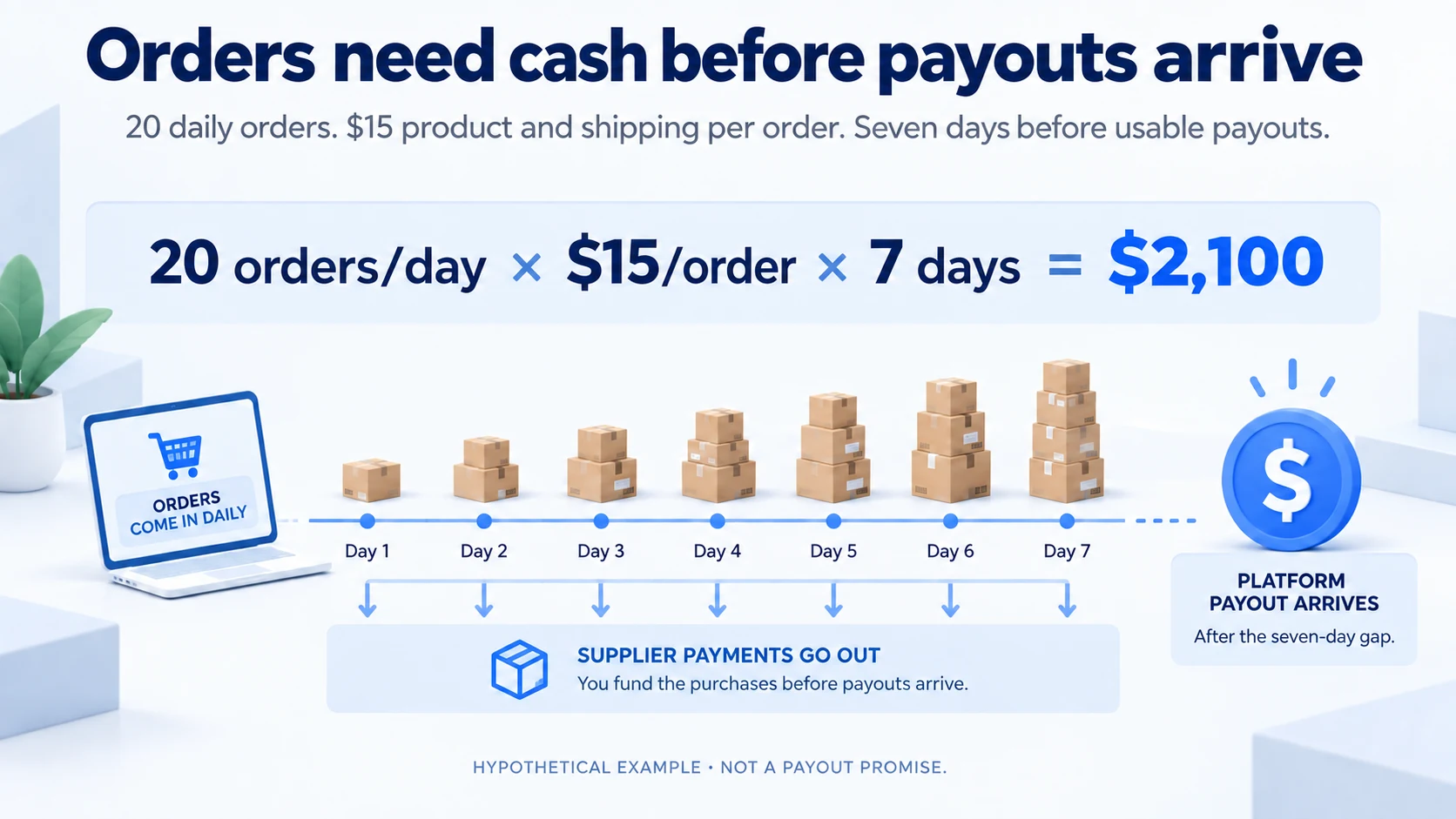
That cash requirement is separate from the order’s profit calculation. Add room for refund payments, advertising bills and an unexpected payout delay. Check the actual settlement arrangement with your payment provider instead of relying on a typical interval from a tutorial.
Also budget for samples and store setup before the first sale. Paying suppliers after a customer order reduces an inventory commitment; it does not make the business free to start.
07
Build a store offer that adds a reason to buy
Use what you learned from the sample to write the product page. Give dimensions, name variants clearly, list what is included and show permitted images of the right item. A claim copied from the supplier still needs supporting evidence.
For the organizer, that could mean a photograph showing its scale on a desk, a diagram of the usable compartments and assembly instructions. A carefully chosen range or a bundle can also help, provided you can supply it as described.
Publish the delivery information, return policy, business contact details and other required store information before launch. Review them together. A product page promising fast delivery cannot be repaired by a much slower estimate buried in a policy page.
If you use Shopify, the AliExpress-to-Shopify setup guide covers the specific connection and order-flow checks. Keep your first imported catalog small enough to verify each variant and route. Importing a product is the beginning of listing preparation, not its completion.
08
Process orders with checks around automation
Map each store variant to the intended supplier variant. Pay particular attention to bundles, color names, sizes and packs containing multiple units. A customer buying a two-pack should not receive a single item because the supplier’s selector uses a different naming system.
Before enabling bulk ordering, test what happens when a variant is unavailable, a price rises or an address cannot be served. Review the app permissions and billing settings too. You need to know which orders will stop for your attention.
Before submitting: check payment, variant, address, shipping method and the current supplier cost.
After submitting: confirm the supplier order and payment. If the response times out, check the order history before retrying to avoid a duplicate purchase.
Track the store order and supplier order together. That makes it possible to answer a customer’s question and find the corresponding purchase without searching a large inbox. Review failed orders and unshipped orders regularly; automation cannot resolve an unanswered supplier question for you.
09
Set delivery expectations for the actual route
Build your estimate around the selected variant and route. Allow for supplier processing, carrier transit, any customs clearance and local delivery. A delivery estimate for a different seller or destination cannot tell you when this order will arrive.
An overseas-warehouse label is useful only when the required variant is stocked there and can be shipped to the customer. Check the selected option at purchase. A catalog-level warehouse claim does not prove the parcel will start there.
Likewise, a free-shipping or fast-delivery label has conditions. AliExpress’s published service terms tie these services to participating products and the applicable order conditions. Verify the actual checkout offer instead of applying one listing’s badge across your store.
Record sample order dates and, as sales accumulate, actual order-to-delivery results. Use that evidence to refine the customer-facing estimate. Do not promise the fastest observed delivery as though every parcel will match it. The shipping-times guide explains how to distinguish the stages and investigate delays.
Confirm import charges before quoting delivery
Ask who handles import charges and which documents the route requires. Product origin, destination and classification can affect the amount. Get confirmation of any costs included in the shipping quote so the customer does not discover an unexpected bill at delivery.
10
Handle customer refunds and supplier recovery separately
Your customer bought from your store. When an item is wrong, damaged or missing, collect the information needed to understand the problem and respond under your applicable obligations and published policy. Pursue the supplier or marketplace remedy as a related but separate process.
For a damaged item, retain the customer order, supplier order, tracking events and clear photos of the item and packaging. For a missing parcel, check the latest carrier event and address details. Ask for relevant evidence without repeatedly requesting information the customer has already supplied.
Read the return and dispute conditions attached to your purchase. Note the applicable deadline, permitted return route and evidence requirements. Do not tell a customer to mail a product to an unconfirmed address. A cross-border return can cost more than the recoverable value, so understand the options before promising one.
Keep unrecovered costs in your margin calculation. Even after the supplier refunds a purchase, advertising, payment fees, support time or a replacement you funded may remain your expense.
AliExpress’s conditional service terms should not be copied as your entire customer policy. Your transaction with the supplier and your sale to the customer are different arrangements. The dropshipping returns guide explains how to plan the customer response and recovery process together.
11
Market the offer, then improve the completed order
Choose an acquisition approach that fits the product and your ability to create useful material. A product that solves a visible problem may suit a clear demonstration. A purchase requiring explanation may need search content, comparisons or detailed instructions. Use permissioned assets and claims the product can support.
Set a test budget you can afford to lose. Judge the offer using the complete order outcome: acquisition spend, paid purchases, delivered orders, returns and contribution. A click is evidence of interest in an ad; it is not evidence that the product can generate profitable repeat sales.
Review where the orders go wrong:
- Visitors leave without buying: investigate price, trust and whether the page explains the offer clearly.
- Customers buy, then request refunds: look at the promised versus delivered product, quality and delivery.
- Delivered orders leave little money: revisit acquisition spend and the complete cost calculation.
These patterns suggest where to investigate; compare the customer feedback and order records before deciding on a fix.
Keep your first expansion modest. Add a related product only when its sample, supplier and economics are understood. A larger catalog introduces more mapping, stock and support work even when the product-import tool makes the upload easy.
12
Decide when to change the sourcing arrangement
You do not need to abandon AliExpress at a predetermined daily order count. Change the arrangement when a specific constraint justifies it: repeated stock uncertainty, packaging requirements, a need for consolidation or a delivery promise the current route cannot support.
A direct supplier, sourcing agent or stocked fulfillment arrangement may offer more control under an agreed scope. It can also introduce minimum purchases, storage charges, service fees and unsold inventory. Compare those commitments with the actual problems you are trying to solve.
Before migrating, approve the replacement sample, quote, packaging and shipping route. Move a limited product group first and keep existing orders traceable to the original supplier. A new integration should not resend orders that have already been purchased.
Use the platforms and store-operations section to explore the related systems as the business develops. Use completed orders to decide what needs investment next, and keep enough cash available to fulfill the sales you already have.
13
Frequently asked questions
Can I dropship from AliExpress without Shopify?
Yes. Shopify is one storefront option, not a requirement of the sourcing model. You can use another suitable store platform and an appropriate integration or a controlled manual process. Check the sales channel’s rules before listing products there; an integration does not establish permission to use a particular fulfillment arrangement.
Do I need to contact the seller first?
Contact the seller before depending on an arrangement that the listing does not clearly establish. Packaging, processing, stock changes and problem resolution deserve explicit answers. A completed sample order then helps you check the promised experience.
Is AliExpress dropshipping profitable?
It can be profitable when customers buy at a price that covers the complete order cost, acquisition and operating expenses. The supplier item price alone cannot answer the question. Calculate the expected contribution, test the offer and replace assumptions with results from completed orders.
Can I use the seller’s photos and descriptions?
Confirm permission for the assets you want to use, and check that they show the variant you will supply. Rewrite the description around verified features and limitations. Making a listing easier to import does not grant image rights or make unsupported claims accurate.
Should I use the cheapest shipping option?
Only when its tracking, delivery expectation and exception handling fit your customer promise and economics. A cheaper route can become more expensive if it causes avoidable refunds or replacement shipments. Compare the actual options for the destination, not the shipping name alone.
What should be ready before the first customer order?
An approved product and supplier, accurate listing, complete cost calculation, working checkout, clear delivery and return information, enough cash to purchase orders, and a tested way to track them. Start accepting orders once those pieces agree with one another.