
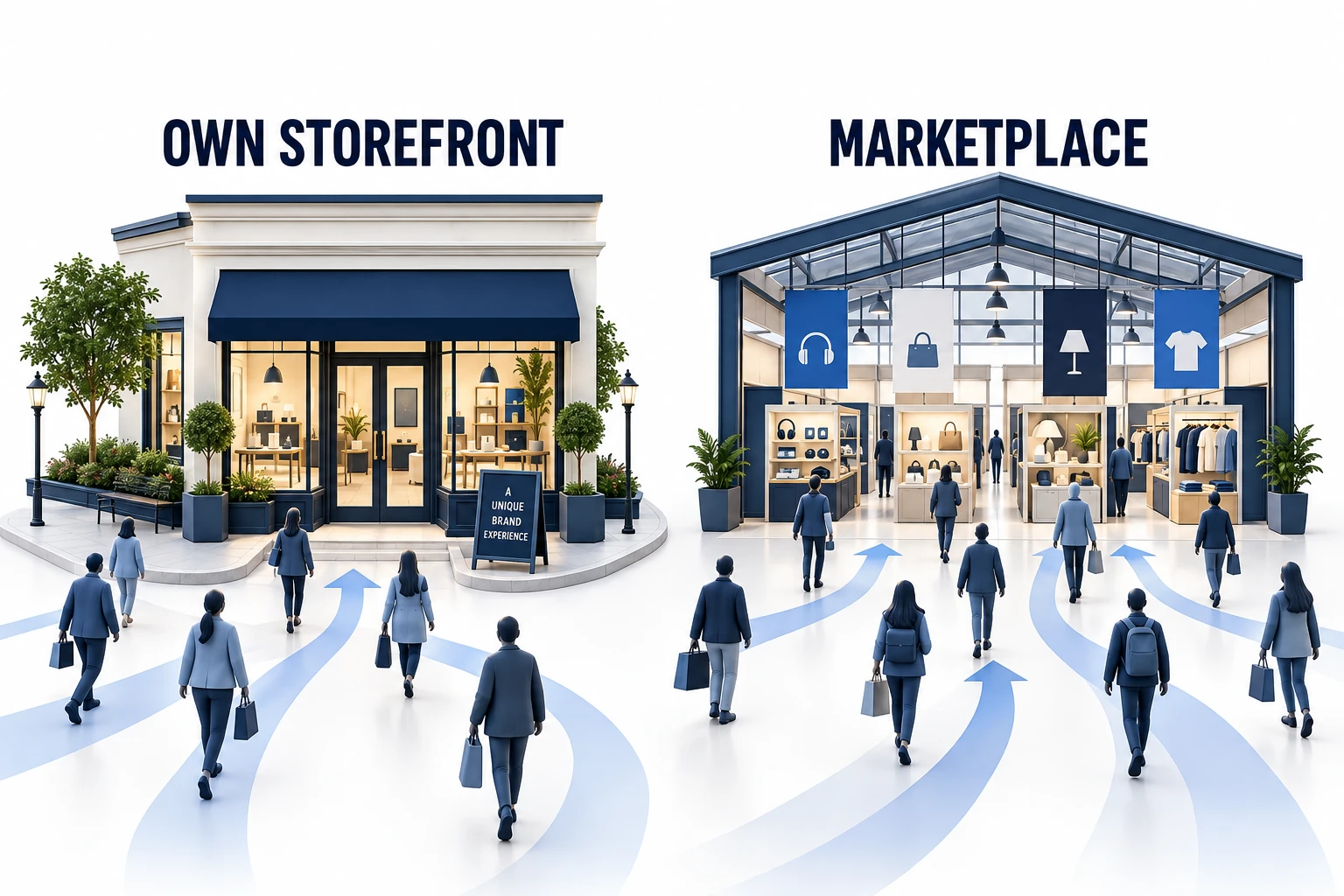
Shopify suits merchants who want to build their own storefront and can bring customers to it. Amazon suits merchants who want to sell within a marketplace and can meet its seller requirements with a suitable supplier. Neither is automatically the better or cheaper dropshipping channel.
The comparison starts with a difference in the selling arrangement. Shopify provides the platform for your store. Amazon provides a marketplace where your offer competes within Amazon’s shopping experience. Your control over presentation, your cost structure, and your route to customers follow from that difference.
If you are still considering other routes, our best dropshipping platforms guide places these choices in the wider market.
01
Shopify and Amazon compared
| Decision | Shopify | Amazon |
|---|---|---|
| Selling environment | Your own branded storefront | A listing and offer within Amazon’s marketplace |
| Route to customers | Your marketing and existing audience | Marketplace search and shopping activity, with competition for attention |
| Presentation | More control over store design, navigation, and merchandising | Presentation follows Amazon’s listing and marketplace rules |
| Main platform costs | Plan, payments, apps, and applicable additional fees | Selling-plan charges and category-dependent referral fees; other services may add costs |
| Dropshipping arrangement | Connect a supplier and manage your store’s promises | Use an arrangement that satisfies Amazon’s dropshipping policy and seller requirements |
| Inventory sent to Amazon | Not part of the basic store setup | FBA is an optional inventory and fulfillment arrangement, distinct from direct supplier shipping |
Marketplace access is not a sales guarantee. Amazon shoppers may already be looking for a product type, but your offer still needs visibility, credibility, competitive terms, and reliable delivery. Shopify gives you a storefront, not a ready-made customer acquisition plan.
02
Start with how your customer will find and choose you
Shopify is attractive when the selling process needs explanation. You can build product pages around a particular use case, arrange collections, publish useful content, and develop an offer for a defined audience. An existing following, relevant search traffic, or a tested advertising approach can make that control valuable.
Without a route to customers, however, a polished store can remain quiet. Include the work and cost of acquisition in your decision. A merchant comfortable creating content or developing an audience faces a different starting point from someone who only has access to a supplier catalog.
Amazon is attractive when customers already search the marketplace for the type of product you can supply. That can shorten the path from discovery to purchase. It also makes your offer easy to compare with alternatives on price, delivery, reviews, and other visible characteristics.
Do not assume a listing will rank or that an existing listing is available for you to sell against. Product, brand, category, and account requirements can affect eligibility. Investigate the actual product and intended marketplace before treating Amazon as a source of demand you can access.
For an ordinary interchangeable item, ask why a buyer would choose your offer after comparing delivered price and timing. For an unfamiliar product that needs teaching or demonstration, ask how you will create that understanding. These are different marketing jobs, and the channel should support the one you can perform.
03
Check whether the supplier fits the selling arrangement
Amazon’s official dropshipping overview says dropshipping is generally allowed when you are the seller of record and comply with its policy. A supplier’s willingness to send a parcel is not sufficient evidence that the arrangement is suitable for Amazon.
Before listing, review the current policy in your seller account and agree how the supplier will support your obligations. Establish who appears on customer-facing materials, who handles returns, and how you obtain timely shipment information. Our Amazon dropshipping policy guide examines these requirements in more detail.
For Shopify, you also need a clear supplier agreement. Your store makes the offer to the customer, and a supplier delay does not automatically resolve the customer’s complaint. The practical task is to make product descriptions, availability, shipping promises, and returns information match what can actually happen.
The difference is that Amazon adds its marketplace conditions to the arrangement. Shopify offers more control over the store, while your obligations still depend on platform and payment terms, the product, and the markets where you sell. Neither route removes the need to verify the goods or handle customer problems.
One supplier can be suitable for one channel and unsuitable for the other. An integration that works for your own store may not provide the information or operational controls you need for marketplace selling. Confirm the proposed channel explicitly when discussing the service.
04
Compare contribution after channel costs
Comparing Shopify’s subscription with an Amazon selling fee does not tell you which order makes more money. Build a separate estimate for the same product in each channel, using the price and customer acquisition assumptions that apply there.
For Shopify, include the selected plan, payment processing, paid apps, any applicable additional transaction fees, and acquisition spending. Allocate recurring store expenses over a realistic order estimate without assuming that volume will arrive. The official Shopify pricing page is the starting point for the current plan offer in your market.
For Amazon, include the applicable selling plan and referral fee for the product category, together with any other services you choose. Amazon’s pricing page explains that referral fees vary by category; a single percentage should not be applied to every product. Check the definition of the amount on which the fee is calculated.
Use this order-level structure for either channel:
- Start with the amount earned from the order after discounts and the refund assumptions you are modeling.
- Deduct the supplier’s product charge and the delivery costs you pay.
- Deduct the channel’s applicable selling or payment charges, without double-counting them.
- Deduct advertising or other variable acquisition costs attributable to those sales.
- Allow for the support, return, and replacement costs the arrangement may create.
Then compare what remains with recurring overhead. Label estimates as estimates and revise them using actual orders. Our Shopify dropshipping costs guide explains the distinction between operating expenses and the working cash needed before payouts arrive.
Amazon’s access to shoppers does not mean advertising is unnecessary. Shopify’s store control does not mean acquisition must always be expensive. The relevant result is what your offer retains after its actual costs, not which platform has the smaller headline charge.
When acquisition cost changes the better channel
Consider the same hypothetical product sold for $40 through either channel. These are assumed dollar amounts, not current Shopify or Amazon fees, an expected conversion rate or a sales forecast. Revenue excludes tax collected for remittance and is after discounts. The $2 allowance below covers expected refunds and replacements once; it has not also been subtracted from revenue.
| Per-order planning input | Shopify store | Amazon offer |
|---|---|---|
| Revenue | $40 | $40 |
| Product and supplier delivery | −$20 | −$20 |
| Expected refunds/replacements allowance | −$2 | −$2 |
| Applicable channel/payment charges combined | −$2 | −$6 |
| Variable acquisition cost | −$8 | −$3 |
| Contribution before recurring overhead | $8 | $9 |
The Shopify proposal has lower assumed transaction charges, yet Amazon retains $1 more because its assumed acquisition cost is lower. The $3 Amazon input still includes an acquisition expense; marketplace access has not been treated as free customers. Use the actual fee calculation for the intended marketplace and category when replacing these assumptions, including its applicable fee base.
Holding everything else constant, reducing Shopify acquisition from $8 to $7 produces the same $9 contribution. At $6 it leaves $10 and reverses the order-level preference. Equally, a rise in Amazon acquisition from $3 to $5 reduces its contribution to $7. These changes illustrate what to measure; they do not predict which channel can achieve those costs.
Recurring expenses can change the monthly answer too. At an assumed 100 completed orders, the original contributions total $800 and $900. If each proposal has $100 in recurring channel expenses, the respective remainders are $700 and $800 before other overhead and income tax. Different subscriptions, apps or service commitments require a different allocation. Keep them out of the per-order fee row if you deduct them here.
Finally, compare cash timing separately. Paying a supplier before proceeds become available can require working funds even in the stronger contribution scenario. Profitability, customer acquisition and available cash each need their own evidence before you commit to a channel.
05
Separate dropshipping from FBA
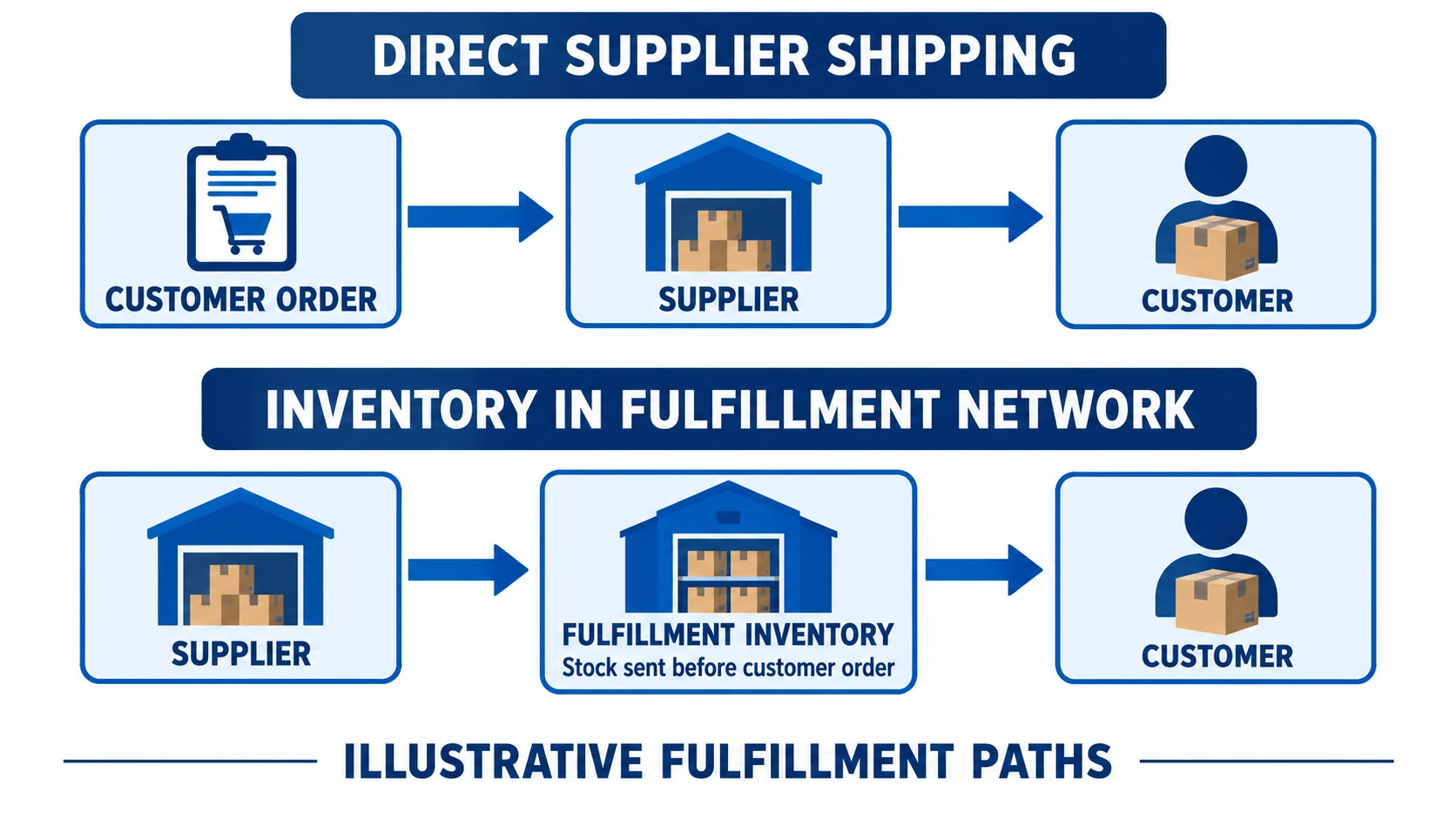
In direct supplier dropshipping, a supplier ships to the customer after an order. Fulfillment by Amazon is a different arrangement: inventory is sent into Amazon’s fulfillment network for Amazon to fulfill eligible orders. Amazon discusses FBA as an alternative in its official dropshipping overview.
That changes the financial and operational decision. Sending inventory into a fulfillment network introduces inventory commitments and the relevant fulfillment and storage charges. Those costs should not be silently added to a basic dropshipping comparison—or omitted from a proposal that actually relies on FBA.
Ask a service provider to describe the physical movement of goods. Where is the product before the customer orders? Who owns or pays for it? Who dispatches it? A clear answer prevents two very different models from being sold under the same loose label.
06
Choose Shopify, Amazon, or a staged combination
Choose Shopify first if you have an audience or a credible way to build one. It is particularly useful when branded presentation, educational content, bundles, or the wider store experience contribute to the purchase. You also need the capacity to run acquisition and store operations. Our Shopify dropshipping guide covers that setup in more detail.
Evaluate Amazon first if there is relevant marketplace demand and your supply arrangement fits its requirements. Check product eligibility, competition, realistic delivered margins, and the supplier’s ability to support customer service before committing. The Amazon dropshipping guide expands on the operating model.
Delay either launch if the supplier cannot confirm stock, product identity, or fulfillment responsibilities. Choosing a channel cannot fix those gaps. Resolve them before collecting orders you may be unable to fulfill as promised.
Selling through both can make sense after one process works reliably. Shopify’s official comparison with Amazon describes marketplace integrations as an option; integration availability does not guarantee that every supplier or order scenario is supported.
Start the second channel with a limited set of products. Decide how inventory is allocated, preserve distinct order identifiers, and confirm how cancellations and returns reach the supplier. A single unit shown as available in two places can otherwise be sold twice. Keep customer communication within the permissions and rules of each channel rather than assuming records are freely interchangeable.
07
Common questions
Is Shopify better than Amazon for beginners?
It depends on the beginner’s starting advantage. Shopify is a stronger fit for someone prepared to build a store and bring customers to it. Amazon may fit someone with a suitable product and compliant supplier who understands marketplace selling. Neither replaces research, fulfillment, or customer service.
Can I use an Amazon listing as my Shopify supplier?
Do not treat a retail listing as a supplier agreement. Before making promises to customers, establish stable product access, stock and price information, shipment presentation, tracking, and returns. A checkout option alone does not establish any of those arrangements.
Does Amazon allow dropshipping?
Amazon says it is generally allowed when you are the seller of record and meet its policy. Check the current policy and the requirements for your account, product, and marketplace before listing. A method promoted online is not evidence of compliance.
Should I launch both at the same time?
Only if you can support both sets of operations. For a small team, establishing one reliable order process usually makes the next launch easier to evaluate. Add the second channel with controlled inventory and a clear process for exceptions.