

Amazon dropshipping means selling through Amazon while a supplier ships orders to your customers. Amazon permits the model subject to its dropshipping policy, including seller-of-record identification and responsibility for returns. Your supplier must support the customer promise and the marketplace rules; outsourcing shipment does not outsource your seller account’s responsibility.
The practical question is whether you can control the item, available stock, packing documents, dispatch and customer remedy without handling every parcel. A cheap product source is insufficient if orders carry another seller’s identity or arrive outside the promised service.
This guide uses Amazon’s U.S. selling resources, checked on September 11, 2026. Confirm the current policy and performance requirements in the Seller Central account for the marketplace where you will sell. Country, category and fulfillment-program conditions can differ.
01
What Amazon dropshipping means
The customer orders from your Amazon offer. You send the approved order information to your supplier, which packs and dispatches the identified product. You keep the order record, provide the necessary shipping information and handle the customer’s issue through the appropriate Amazon workflow.
That arrangement makes Amazon the sales channel and the supplier the fulfillment party. It does not mean buying an arbitrary retail listing after every sale and assuming the retailer’s parcel will satisfy your obligations. Establish the supply arrangement before relying on it.
Dropshipping, merchant fulfillment and FBA
Dropshipping is one way to arrange merchant fulfillment. Merchant fulfillment can also use stock you hold yourself or inventory at a third-party warehouse. A warehouse address alone does not tell you who owns stock or who controls order release.
Fulfillment by Amazon involves a different inventory arrangement: you send eligible stock into Amazon’s fulfillment network and use its services under the applicable program. It can reduce some parcel-handling work while introducing inventory, inbound preparation and fulfillment costs. Amazon explains the arrangement in its FBA overview.
Compare those arrangements for your actual product. A stable product with predictable demand may justify inventory placement, while a low-volume trial may justify a supplier-held arrangement if its service is suitable. Neither choice removes product eligibility or authenticity requirements.
02
Check the policy before choosing products
Amazon’s official dropshipping guide describes an agreement identifying you as seller of record, shipment materials that do not identify another selling party, and your responsibility for returns and customer service. Use those requirements as constraints on supplier selection.
Seller identity must match the arrangement
Review the packing slip, commercial documents supplied to the customer and outer parcel. Require the supplier to explain how your seller identity is applied and how third-party retail documents are excluded. A verbal “blind shipping” promise needs a sample of the actual output.
Distinguish the seller identity from legitimate manufacturer or product information. Do not remove required product, safety, origin or carrier information simply to make a parcel look anonymous. Ask Amazon for clarification when a particular label or document creates uncertainty rather than altering it blindly.
Retail sourcing creates a specific control problem
An online retailer may use its own shipping carton, invoice, promotional insert or substitution process. If that arrangement cannot meet Amazon’s policy, it is not made acceptable by calling the transaction dropshipping. A retailer’s fast delivery service also does not establish your right to sell a brand or your ability to provide requested sourcing evidence.
Read the current Drop Shipping Policy in Seller Central. The public version may require JavaScript or account access; the linked Amazon guide is a useful summary, not a substitute for account-specific instructions or a notice Amazon sends you.
03
Confirm seller and product eligibility
Verify the seller account, marketplace, category and exact item before building a large catalog. A supplier agreeing to ship an item does not establish that your account may list it. An integration successfully importing a listing is also not proof of approval.
Match the product, not just the title
When matching an existing Amazon product page, compare identifiers, brand, model, variant, quantity, included accessories and condition. A similar photograph is not a match. If the supplied bundle contains one unit and the catalog page describes two, the cheaper supplier price is for a different offer.
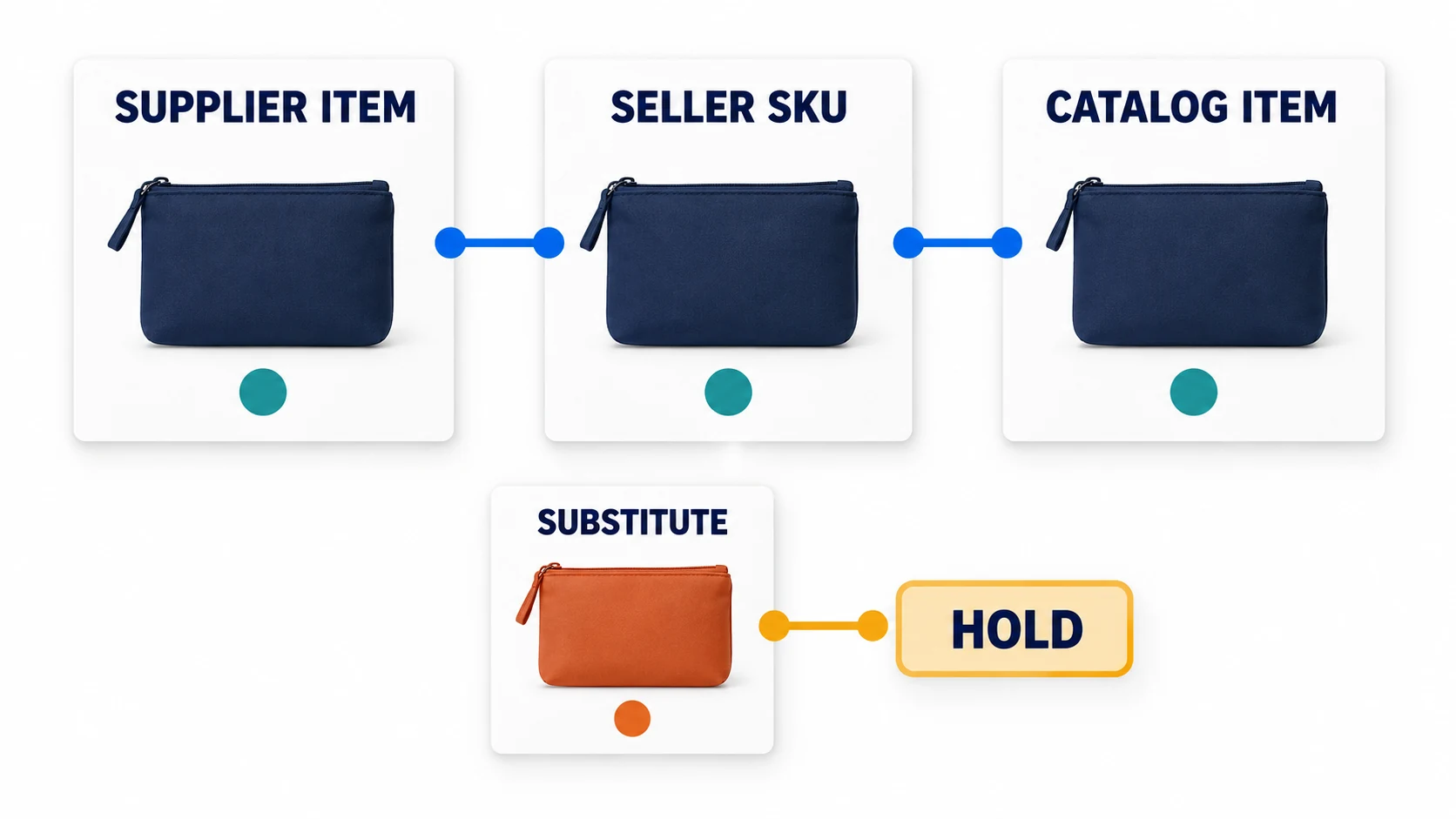
Keep the supplier item code mapped to your seller SKU and the correct Amazon catalog identity. Block unmapped variants from release. If a supplier changes the model or accessory set, review the listing match before using the substitute.
Retain legitimate sourcing evidence
Ask what invoices, product records and other documentation the supplier can provide for the actual goods. Keep authentic documents intact and retrievable. Where Amazon requests specific evidence, follow the request; do not assume an order screenshot or an unrelated certificate is an adequate replacement.
For branded products, verify the supply chain and any permission relevant to your use of names, images and claims. For regulated products, establish the applicable requirements for the product and destination. The copyright and trademarks guide separates several common intellectual-property checks, but those checks do not themselves approve an Amazon listing.
04
Choose a supplier you can control operationally
A useful supplier discussion ends with a defined item and service, not only a discount. Identify the facility, service area, normal cutoffs, stock information, packing process and exception contact. Ask who can stop an order when something is wrong.
Document at least these points:
- The exact products and variants the supplier will fulfill, including a rule against unapproved substitutions.
- How stock becomes available to you, whether it is shared with other sellers and how quickly changes are reported.
- The seller identity and approved packing documents used on customer orders.
- Dispatch and tracking responsibilities, including weekends, holidays and missed cutoffs.
- The return destination, acceptance process and information needed for a supplier claim.
- Who bears an agreed correction cost when the wrong, damaged or nonconforming item is supplied.
Check a complete sample order
Inspect the product and the whole parcel configuration. Review the outer packaging and documents, verify the variant and accessories, and observe the proposed shipping route. A product sample sent by a sales representative may not use the ordinary warehouse packing process.
Record what was actually tested and what remains unproven. One acceptable sample is not a guarantee that every order will match. Use the sample approval workflow to retain an identified reference for later comparisons.
Test the information the supplier sends
Require stable item identifiers and clear stock timestamps. Determine what zero, missing and unavailable mean. If the stock update fails, decide whether to stop sales or use an explicitly limited fallback instead of treating yesterday’s quantity as current.
The supplier also needs a reliable way to acknowledge each order. A successful file upload is not necessarily an acceptance to fulfill. Keep a distinct supplier acknowledgement and an escalation path for orders that receive none.
05
Build the order workflow before scaling
Write the normal sequence and the exception at each handoff. A useful record joins the Amazon order, seller SKU, supplier order, parcel and return case. Without that connection, a tracking number or refund may be attached to the wrong transaction.
Accept and reserve
Confirm the item and destination are supported and stock is available for this order. Reserve or otherwise secure the supplier commitment using the agreed process. Forward only the customer data needed for fulfillment through an authorized integration or controlled channel.
If the item is unavailable, stop additional sales for the affected offer while resolving the existing order. Do not purchase a merely similar item to avoid recording a stock problem. Review the available customer and account actions promptly.
Release and pack
Send the exact variant, quantity, packing requirements and applicable deadline. Require acknowledgement that distinguishes accepted, held and rejected orders. For an unclear submission result, reconcile the supplier record before sending another paid order.
A duplicate submission can create two parcels even when your store contains one customer order. Use a stable order reference, check prior acceptance and give the supplier a rule for repeated requests. Automation should preserve those controls rather than bypassing them.
Dispatch and confirm
Match the carrier and tracking information to the actual parcel. Confirm shipment according to Amazon’s current requirements and the actual shipping event. A created label is not evidence that a carrier has received the goods; do not use inaccurate shipping information to conceal a delay.
Separate the promised dispatch date from the delivery promise. A supplier may meet a warehouse cutoff while the route is still unsuitable for the customer-facing delivery estimate. Check both when setting the offer and reviewing performance.
Watch unresolved orders
Maintain a small exception queue: not acknowledged, not dispatched, tracking not progressing, delivered but disputed, and return awaiting action. Give each case an owner, next action and deadline. Review these cases often enough to act within the applicable marketplace requirements.
For a stalled parcel, retrieve the actual carrier events and ask for a trace where appropriate. Keep customer communication and remedy work moving while the supplier investigates. Internal disagreement about reimbursement should not leave the customer’s case unattended.
06
Calculate margin and the cash needed to fulfill
Use the actual product category, selling plan and service charges in Amazon’s U.S. pricing information. Referral fees and other charges vary; a single percentage quoted in a video is not a complete cost model. Recheck the calculation when price, category or fulfillment changes.
A hypothetical order
Suppose an order produces $40 in revenue before sales tax, with $18 product cost, $6 supplier shipping, $6 in assumed marketplace charges and $2 as a modeled allowance for exceptions. The remainder is $8 before advertising, fixed overhead, financing and income tax. These figures are illustrative, not an Amazon fee quote or a predicted margin.
If advertising attributable to that order costs $7, only $1 remains before those other costs. A lower product price might help, but an extra reshipment or fee difference can erase the remainder. Build a stressed case using plausible changes to your actual inputs instead of relying on the base case alone.
Supplier payments can precede payouts
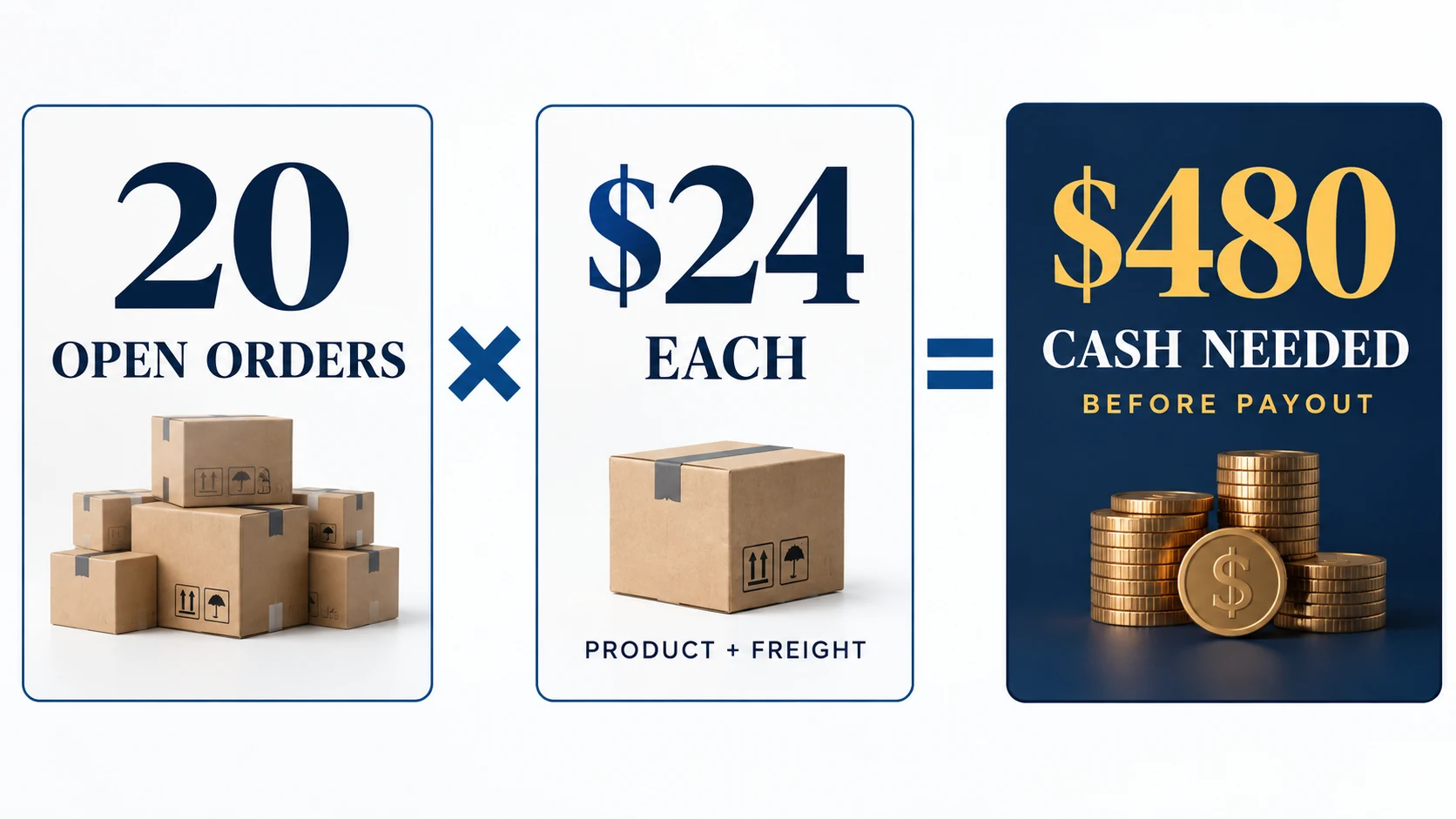
If each order requires $24 for product and supplier freight before dispatch, 20 open orders require $480 of cash for those two items. That cash need exists even if the order-level estimate is profitable. Account for the payout and reserve terms applicable to your account rather than assuming customer payment is immediately spendable.
Keep a separate allowance for refunds, replacements and other charges. A rapid increase in orders can consume cash faster than a slow week, even when the catalog appears healthy. The dropshipping cash-flow guide shows how to connect commitments to payment dates.
07
Monitor performance and returns
Review Account Health and shipping performance in the relevant Seller Central marketplace. Pay attention to the definitions and measurement windows for order defects, cancellations, shipping and tracking, plus any program-specific requirements. Do not treat a threshold from another marketplace or an old article as your current limit.
Use those reports to identify the operational cause. Repeated late confirmation might reflect a warehouse delay, a missing tracking feed or a team that confirms orders too late. The same visible metric can require different corrections.
Returns need an accepted destination
Establish a destination and receiving process that meet the current applicable Amazon rules. Confirm who accepts the parcel, how the returned item is identified and who reports its condition. A supplier street address alone is not a functioning return service.
Keep customer refund decisions separate from the supplier recovery claim. Amazon’s customer-facing workflow and deadlines may not match the supplier’s preferred investigation timetable. The return-address guide helps make the receiving arrangement explicit.
Customer messages need an owner
Use the marketplace’s permitted communication channels and review the applicable response requirements. Give support access to the order’s real status, not just a supplier’s generic shipping estimate. A useful answer tells the customer what is known, what happens next and when the next action is due.
Do not divert a customer to an external seller to solve a problem you accepted as the Amazon seller. Agree how your supplier supports your investigation in the background while your team manages the customer-facing case.
08
Respond to a failure with evidence
If a parcel identifies another seller, a product differs from its listing or repeated orders miss their promises, stop the affected flow and determine its scope. Identify the supplier, facility, item and orders involved. Correct the immediate customer cases and preserve the evidence.
For a packaging error, retrieve the packing instructions and actual parcel photographs. For an inventory error, compare stock timestamps with order acceptance. For a tracking error, reconcile the supplier record with carrier events. These records are more useful than a general assertion that the supplier caused the problem.
If Amazon requests a response or restricts an activity, follow the specific notice and provide authentic, relevant information. A corrected sample can show one correction but does not prove that an entire operation has changed. Verify the process that generated the failure before resuming it.
09
Run a limited launch with explicit stop conditions
Choose a small, identifiable set of offers and supported destinations. Confirm each product, packing configuration, order acknowledgement, cash requirement and return route. Assign someone to review unresolved orders and account notices during the launch.
Set stop conditions before demand rises: wrong identity, unapproved substitute, loss of reliable stock data, repeated missed dispatch or an unresolved compliance issue. Specify who pauses the affected offers and what evidence is required to restart them. The limit should follow your ability to control and fund orders, not an arbitrary industry order count.
Review the complete order lifecycle before broadening the catalog. Fast listing creation is useful only after the goods, information and customer remedy remain connected. The store platforms and operating data section links this Amazon-specific workflow to the wider operating model.
10
Frequently asked questions
Is dropshipping allowed on Amazon?
Yes, subject to Amazon’s dropshipping policy and other applicable requirements. Confirm seller-of-record identification, packing documents, customer-service and return responsibilities in your marketplace’s current rules before launching.
Can I dropship from another online retailer?
Do not assume a retail purchase is a compliant supply arrangement. If another selling party is identified in the shipment or the retailer cannot meet the required controls, the arrangement creates a policy problem. Check the exact sourcing and shipping arrangement against the current policy.
Do I need to buy stock in advance?
That depends on your supplier agreement and fulfillment method. A supplier-held arrangement may support individual orders, while reserved stock or custom materials may require a purchase commitment. Confirm ownership, minimums and payment dates separately.
Is Amazon dropshipping the same as FBA?
No. FBA uses inventory sent into Amazon’s fulfillment network under its program. In the supplier-direct arrangement discussed here, a supplier dispatches customer orders and you retain the merchant-side operating responsibilities.
Can software make the business fully automatic?
Software can transfer product, stock and order information. It cannot make an unsuitable supplier compliant or resolve every exception without a decision. Verify acknowledgement, duplicate protection, tracking and cancellation behavior before allowing unattended order release.