
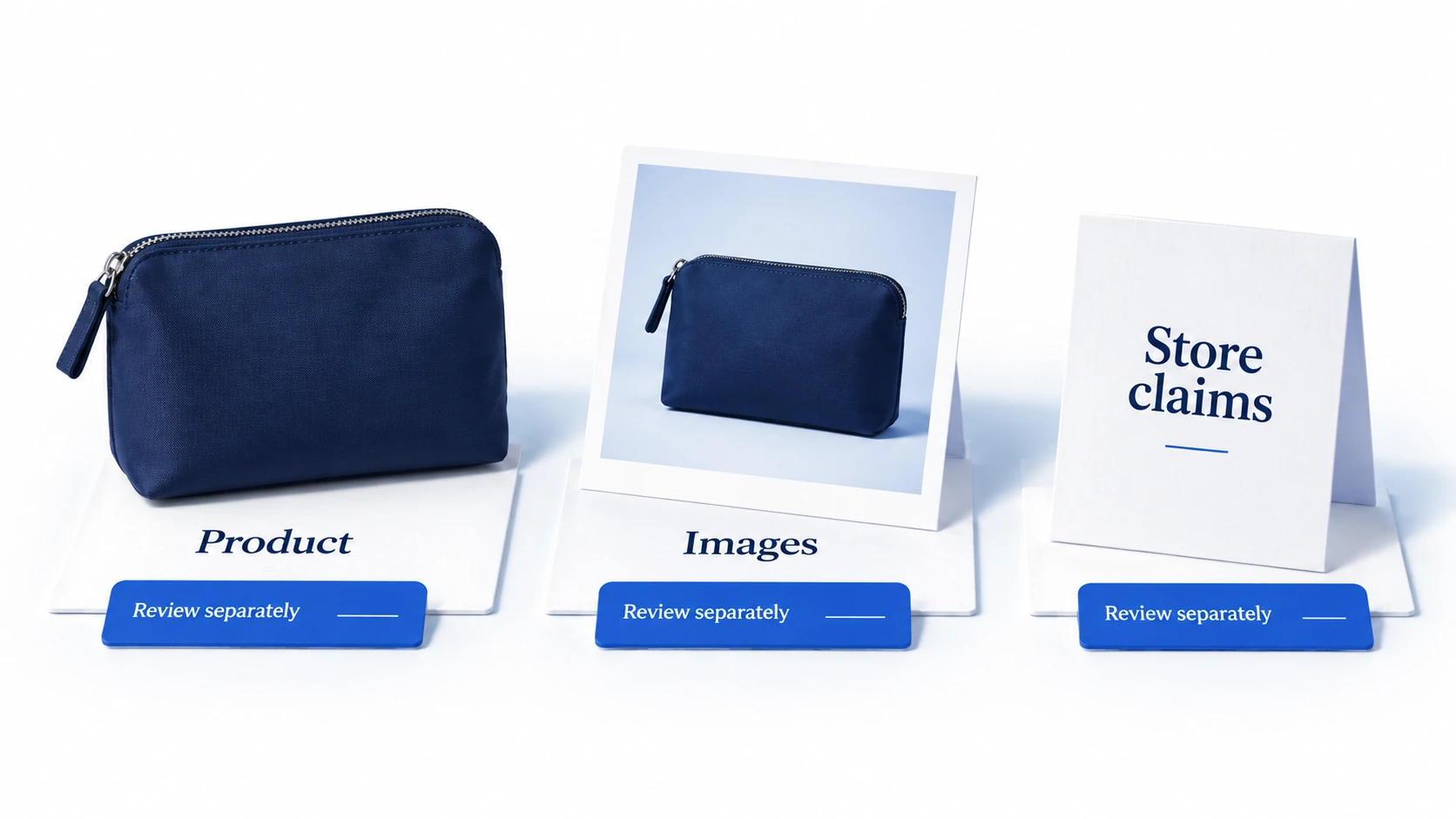
To reduce copyright and trademark problems in dropshipping, check the physical product, the creative assets and your store’s claims separately. Establish who controls the relevant rights and whether the proposed use is supported in the markets and channels you serve. A supplier invoice, an available listing or an image download does not answer every one of those questions.
Start before importing a catalog or paying for custom packaging. It is easier to replace an unsupported photograph before an advertising campaign than to find every copy after it has spread across product pages, shopping feeds and partner accounts. For an actual dispute or uncertain legal interpretation, obtain advice for the relevant jurisdiction; the process below helps you assemble the facts that review needs.
01
Identify which part of the offer needs checking
A dropshipping offer contains several objects. The item can carry artwork or distinctive branding. Its listing can contain photographs, written copy and video. Your store can add a name, logo, compatibility statement or claim of official status. Review those objects individually, even when they arrive in one supplier folder.
Copyright concerns creative expression. Photographs, illustrations, videos and original written content can involve copyright. The U.S. Copyright Office explains that protection arises when an original work is fixed, and distinguishes protected expression from ideas and facts. A missing copyright symbol does not establish that an image is free to use. See its copyright overview.
Trademarks concern identifiers of commercial source. A name, symbol or other identifier can raise a different question from ownership of the photograph containing it. The USPTO distinguishes trademarks, patents and copyright in its intellectual-property overview. Avoid using “copyright” as a catch-all label when the concern is a product logo or confusing store name.
Other rights can matter even without a visible logo. Product appearance, ornamentation or functional features may raise trade-dress, design or patent questions. Removing a word mark does not establish that the remaining product is clear. A photograph you create yourself also does not resolve rights in artwork printed on the photographed item.
Consider a plain pouch sold with a supplier’s lifestyle photo and a store badge reading “official partner.” The pouch, the photo and the badge need separate supporting facts. Treating the entire listing as approved because the pouch passed a quality check would overlook the other two uses.
02
Check the product before paying for stock or branding
Inspect the exact variant you intend to sell. Look at the item, tags, outer packaging, inserts and included accessories. Catalog photographs can omit a branded label or show a different version from the one that will ship. Ask about those differences before treating a generic-looking thumbnail as evidence.
Establish what the supplier is actually supplying
Record the product and variant identifiers, manufacturer or source represented by the supplier, and whether the item is offered as unbranded, branded or made to your artwork. Retain the quotation and the actual description on the invoice. If the answer changes between the listing, conversation and delivered sample, hold the affected variant while the supplier explains it.
For goods represented as branded originals, request traceable sourcing records and any authorization on which the supplier relies. Check the parties, covered goods and dates instead of accepting an unrelated certificate. An invoice can help document a transaction, but it is not automatically a license to reproduce the brand’s marketing materials or describe your business as an authorized dealer.
Do not accept “same factory,” “inspired by” or “we can remove the logo” as a clearance result. Each statement leaves factual questions unanswered. If the supplier cannot identify the source or explain an obvious third-party design, changing the listing’s wording does not resolve the product concern.
Use dropshipping samples to inspect the actual version, including packaging and markings. A sample establishes what was received and checked; it does not prove the supplier owns a design or can grant a license.
Distinguish genuine resale from counterfeit supply
Do not collapse every resale of a branded product into the same rule. Whether genuine goods can be imported and resold without additional consent depends on the applicable rules and circumstances, including territorial exhaustion and parallel-import treatment. It is also a different question from supplying counterfeit goods or falsely claiming endorsement.
WIPO illustrates national, regional and international exhaustion approaches with patent examples in its guide to entering foreign markets. Use that distinction to identify the countries and rights requiring review; the examples do not authorize a particular shipment or settle every copyright or trademark question. Keep the destination, source market, product version and proposed claims together when seeking advice.
A seller considering genuine branded goods should also check the platform’s documentation requirements and the service or warranty statements it intends to make. Avoid promising manufacturer support based only on what a supplier told you. Resolve the actual scope before the customer relies on it.
03
Establish permission for photos, video and written content
An image being easy to download says little about who may use it. The U.S. Copyright Office says the photographer is generally the initial copyright owner, with relevant exceptions such as works made for hire. Its photography guidance is a useful starting point when a supplier, freelancer or agency provides files.
Ask about the specific files and intended uses
Identify the images or video clips by filename, link or an attached reference sheet. Ask who created them, who currently controls the rights and how the person granting permission obtained that authority. A supplier may have created a product photograph but copied a lifestyle image from another source; one answer may not cover the whole folder.
Describe where the content will appear: your website, marketplaces, shopping feeds, paid advertising, email or printed inserts. Also identify the territory, duration and planned edits. These are proposed scope questions to settle in the agreement, not a claim that every license uses the same terms.
For example, a hypothetical license permits an image on your own product page but does not address paid advertising. Mark the product-page use as supported within the stated terms and ask about advertising before uploading the same file to an ad account. Silence about a channel should not be converted into a broad permission in your internal records.

Keep any attribution requirement and restrictions with the file. If an agency or fulfillment partner will use it for you, establish whether that use is covered. When permission expires or is withdrawn under the agreement, you need to know which live placements require attention.
Taking your own photos solves one part of the problem
Original photographs can give you better control over the listing and show the actual product. If a contractor takes them, agree in writing on the ownership or license your business needs; paying for a shoot does not by itself explain the rights transferred. Retain the agreement, delivered files and any required releases or separate permissions.
Check what appears in the scene too. Artwork on the product, a visible third-party logo, recognizable people or licensed props can raise additional questions. A new camera angle does not make those subjects irrelevant. Choose a scene that accurately presents the product without introducing an unsupported affiliation.
For product copy, work from verified specifications and describe the item in your own words. Facts and a competitor’s original presentation of those facts are different things. Copying an entire description and changing a few adjectives is not a reliable content-rights process.
Avoid shortcuts that do not establish permission
For shared or stock-library images, read the actual license and save the applicable terms. Check commercial use, attribution and any restrictions relevant to your placement. An available download does not itself settle permission for a visible logo, embedded artwork or the relationship your page implies. Apply the same separate review to AI-generated visuals; the method used to make an image is not evidence that the depicted product or affiliation is cleared.
Crediting the creator, removing a watermark or editing a file does not establish that you have the necessary rights. There is no general percentage of an image you can change to make every use permissible. A reverse-image search can help investigate provenance, but finding no match does not prove ownership or authorization.
U.S. fair use depends on the circumstances rather than a fixed word count or modification percentage. The Copyright Office’s fair-use FAQ explains why there is no simple formula. Do not build an ordinary commercial asset library around an assumed exception without reviewing the actual use.
04
Review your store name, packaging and affiliation claims
Clearance is also relevant when the supplier provides a genuinely unbranded item. Your chosen store name, product line name, logo or packaging can create its own issue. Check these before ordering printed materials that will be costly to replace.
Search beyond an exact name match
Define the name or design, the goods or services and the intended markets. For U.S. work, the USPTO describes its federal database as one part of a broader search. Related marks and goods require attention; a single exact-match search is not a comprehensive result. See its federal trademark-search guidance.
Save the search date, terms and relevant results so another reviewer can understand what was checked. Include spelling variations and other similarities relevant to the proposed mark. Where a material conflict is possible, get the appropriate review before paying for packaging or building a campaign around the name.
A domain being available, a company name being registered or a social handle being unused does not, on its own, establish trademark clearance. Those checks answer different questions. Do not let the convenience of obtaining a handle decide the legal review of the brand.
Make only the relationship claims you can support
Review phrases such as “official,” “authorized,” “approved by” and “partner,” as well as prominent logos and badges. Ask what a buyer would understand the relationship to be and what document supports that representation. A supply arrangement should not quietly turn into a public endorsement claim.
Product identification and compatibility wording may require a different analysis from branding your store as the rights holder. Describe the actual use and market to the reviewer rather than adopting a blanket rule that every brand mention is forbidden or permitted. The USPTO’s likelihood-of-confusion explanation shows why similarity and related goods matter in its registration analysis; it does not decide an individual listing for you.
For custom dropshipping packaging, freeze the approved artwork version and the responsible approver. Check names, illustrations, claims and third-party assets before printing. If the design changes, review the changed elements rather than assuming approval of the old artwork covers the new one.
05
Build a permission record the team can actually use
Keep the rights review close to the supplier and asset records. A folder of screenshots with no connection to specific products is difficult to act on when a file is reused months later. Add a stable product or asset reference and the person responsible for resolving gaps.
Request answers that can be verified
For each relevant asset or product use, record:
- Object: the product version, artwork, photograph, video or name being reviewed.
- Source and authority: creator or rights holder, supplier or licensor, and the basis on which permission is granted.
- Permitted use: covered channels, territories, duration, edits and any applicable attribution or third-party use conditions.
- Evidence: the agreement, identified files, invoice or other supporting record, with dates and contact details.
- Decision: supported use, replacement required, further review or hold; name the owner and next action.
If the supplier sends a generic “you can use our photos,” ask which files “our” describes and which uses the answer covers. If it points to a marketplace listing as proof, ask who controls the material on that listing. Do not fill an unanswered authority question with a guess.
The purpose is not to collect the largest number of documents. An invoice for one product does not answer who owns a video. A supplier’s promise to reimburse losses may be commercially relevant, but it does not itself grant a third party’s rights. Match each record to the question it can actually answer.
Your supplier data requirements can carry asset identifiers and permission references so that a later catalog update does not overwrite a reviewed image with an unreviewed one. Give the content owner a visible exception when the replacement file lacks the expected record.
Keep a review trigger for later changes
Recheck the affected use when the supplier changes, artwork is revised, a new market or advertising channel is added, or an agreement reaches its review or expiry date. A one-time approval should not become a permanent green status for unrelated changes.
Give a person authority to stop the affected use while the question is resolved. Keep the reason specific enough for others to act: “lifestyle photo permission not established” is more useful than “legal issue.” Limit access to private agreements appropriately while making the approved-use decision visible to the people publishing content.
06
Make a separate launch decision for each unresolved use
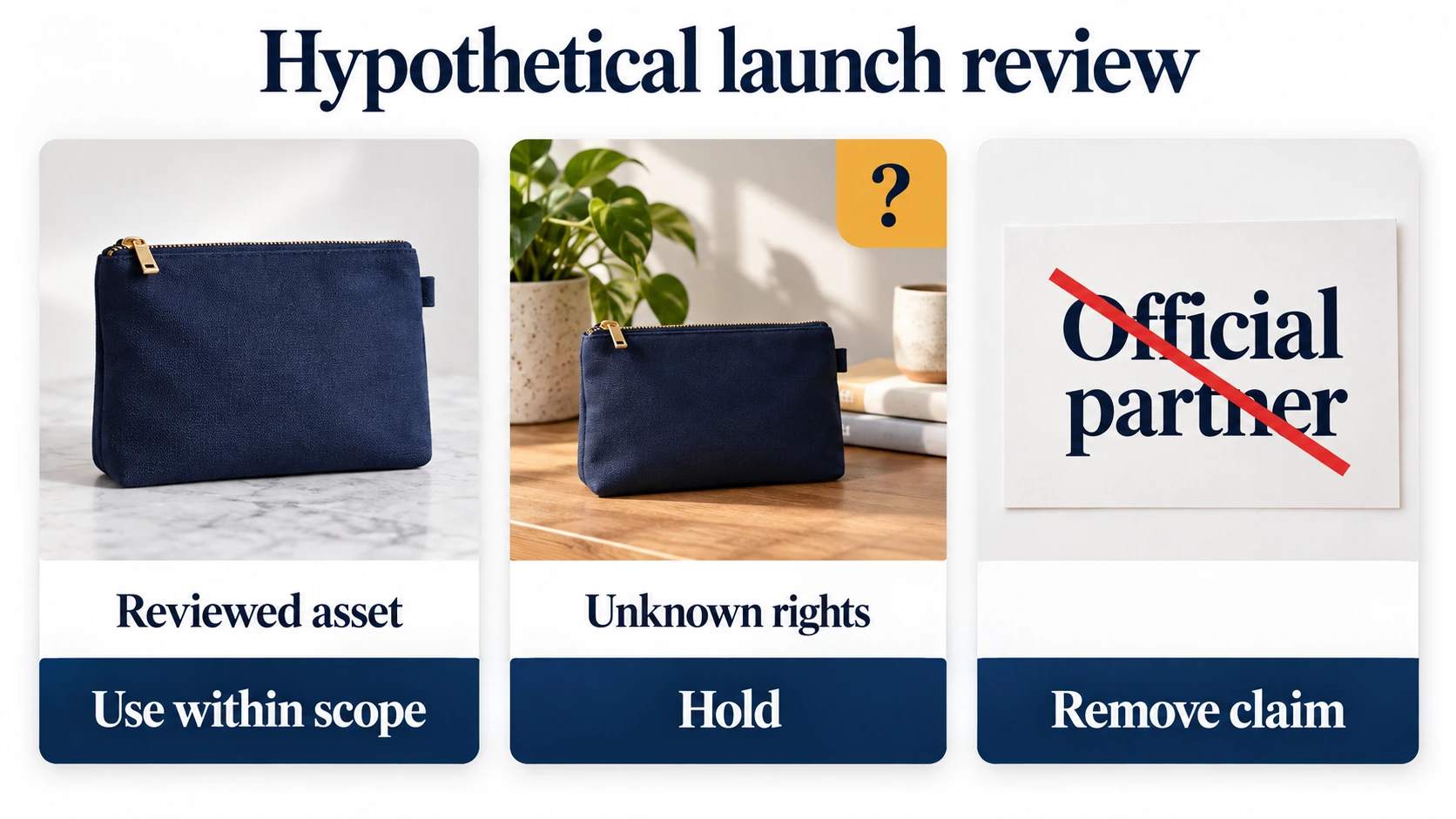
Consider a hypothetical pouch launch. The operator has checked the physical variant and its sourcing records. The supplier has documented permission for one plain product photograph. A lifestyle photograph has an unknown creator, and an “official partner” badge has no supporting agreement.
Product and reviewed photograph: proceed only within the scope of the completed checks and permission. Keep the exact variant and file references in the launch record. This example is an operational decision record, not a legal clearance of any real product.
Lifestyle photograph: hold it or replace it with an appropriately sourced asset. Do not publish it merely because another image in the folder has permission. Record every proposed placement so the replacement reaches the website, feed and campaign together.
Official-partner badge: remove the unsupported claim from the proposed offer. If the business later obtains a relevant agreement, review the actual wording and permitted presentation before using the badge. A purchase invoice is not a substitute for that review.
Now change one fact: the pouch itself carries artwork whose rights are unresolved. Replacing the lifestyle photograph would no longer address the product-level concern. Hold the affected product or obtain the necessary review and support before offering it. A cleaner page cannot settle a question embedded in the item that will arrive.
Before launch, inspect the final product page, ad creative, shopping-feed images and printed material against the approved versions. Check duplicated variants and translated pages too. The person uploading the file should be able to identify the record authorizing that particular use.
07
Respond to an infringement notice without creating a second problem
Preserve the notice, identified URLs or products, dates and the source records associated with them. Verify the communication through the platform’s established support route where applicable, especially if the message asks for credentials or directs you to an unfamiliar payment page. Do not ignore an actual platform notice because a supplier says similar stores are still selling.
Establish the scope before deciding the response
Identify whether the complaint concerns a photograph, product artwork, brand name, claimed affiliation or something else. Find the relevant live placements and outstanding orders. Pausing the affected content or offer while obtaining advice can limit further distribution, but it does not decide the merits of the complaint or complete any customer obligations.
Ask the supplier or licensor for the evidence relevant to that claim, not another general reassurance. Retain communications and the versions that were published. Avoid destroying records, admitting facts you have not established or paying an unsolicited demand without verifying its basis and obtaining appropriate advice.
For Shopify, the copyright-notice procedure explains its reporting and counter-notice process. A counter-notice involves required legal statements and jurisdiction-related consequences; it is not an ordinary button to restore a product page. Use it only when the grounds are supportable and you understand the implications. Trademark complaints follow Shopify’s separate trademark and trade-dress procedure and should not be treated as the same copyright process.
Coordinate the operational work while the issue is reviewed
Assign one owner to the notice response and another, if needed, to affected customer orders. Record which sales or advertisements are paused, what stock is held, and which commitments still need resolution. Do not relist the same disputed content under a new URL simply to evade the notice.
If a replacement asset is appropriate, find all copies rather than changing only the visible product page. Review feeds, scheduled posts, email templates, image libraries and partner placements within your control. Keep the replacement’s permission record so the repair does not introduce another unsupported file.
Close the operational case with an outcome and a corrected control: a missing asset record, an unchecked supplier change, a misleading badge or a review skipped before entering a new market. The broader dropshipping risk-management guide places those controls alongside supplier, product and order risks. The economics and risk resources cover related operating decisions.
08
Frequently asked questions
Can I use photos from an AliExpress or other supplier listing?
Do not assume that the listing grants you permission. Establish who controls the specific files and whether your proposed uses are supported. If the supplier cannot substantiate that authority, use an appropriately licensed alternative or arrange original photography with the necessary rights agreed.
Does changing a logo or editing an image remove the risk?
Not automatically. There is no universal modification percentage that clears an image or product. The remaining artwork, design, identifiers and proposed use still require review. Identify the actual issue rather than treating editing as a substitute for permission or another valid legal basis.
Is every genuine branded resale prohibited without a brand agreement?
No universal answer covers every market and product. Genuine resale, counterfeit supply, import restrictions and claims of authorized status involve different questions. Review the actual goods, source and destination markets, and intended presentation before relying on a resale rule.
Can I rely on a supplier’s guarantee that everything is legal?
A guarantee can be part of the commercial agreement, but it does not establish the rights to every product or asset. Ask for the specific evidence, check the authority and scope, and resolve important gaps before launch. A reimbursement promise is not the same thing as permission from the rights holder.