
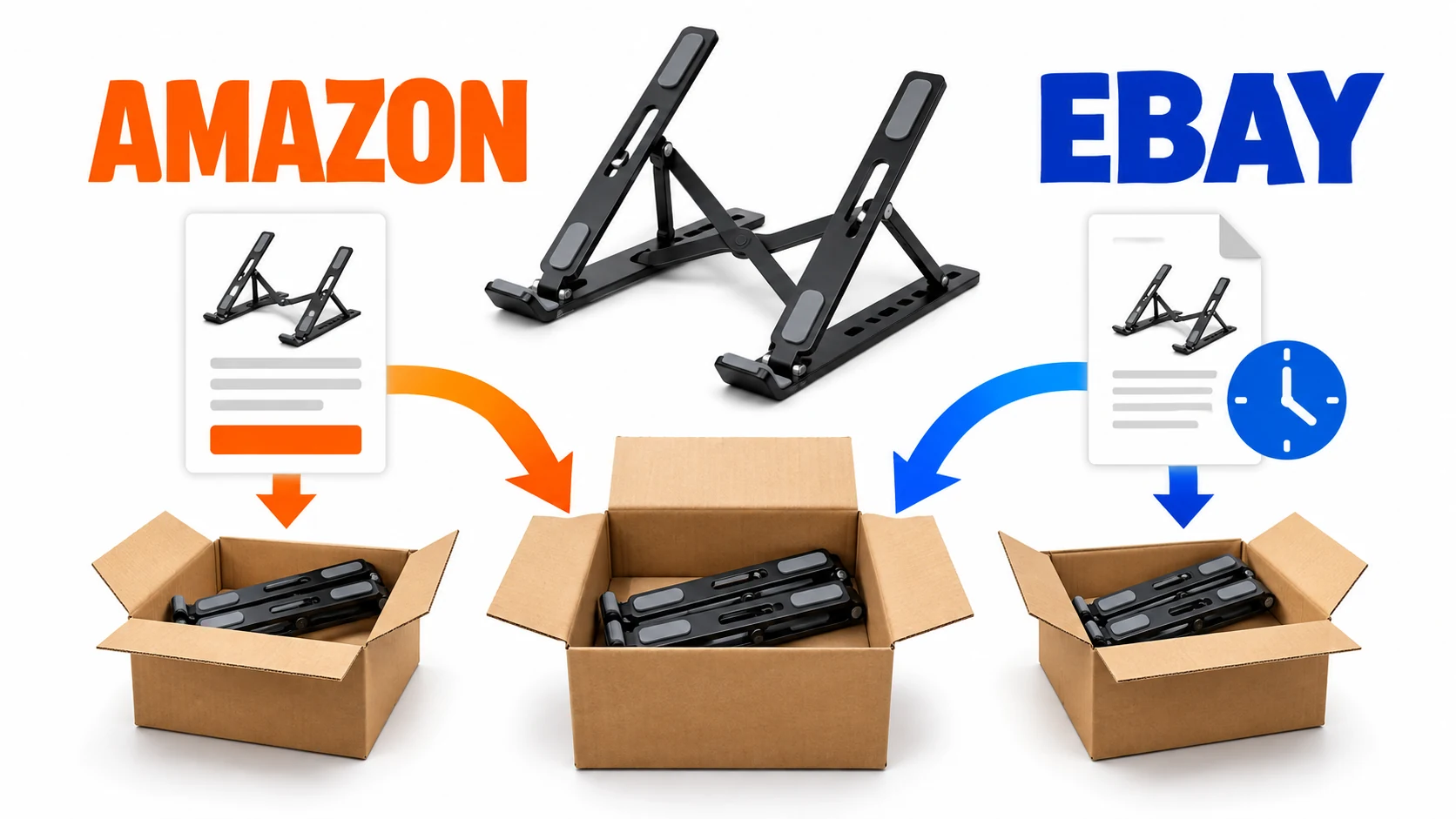
Both Amazon and eBay can support a supplier-fulfilled sale, but they ask for different proof before you should list. On eBay, direct fulfillment from a wholesale supplier is allowed; buying from another retailer or marketplace after an eBay sale to ship straight to the buyer is not. On Amazon, the buyer must clearly see you as seller of record, including on the parcel paperwork and outside packaging, and you remain responsible for returns. The better channel is the one your actual supplier, product and delivery process can support—not the one that sounds larger or easier in a generic comparison.
Use one example throughout: a black folding laptop stand from a supplier with whom you have a wholesale arrangement. You are deciding where to sell that same stand in the US. The supplier can quote the item and shipping charge, but you still need to learn whether it can put the right seller identity on the package, scan the parcel within your promised window and handle a return. Those facts can change the marketplace choice before any fee calculation.
Our Amazon dropshipping guide and eBay dropshipping guide go deeper on each channel. This article makes the Amazon-versus-eBay decision for one wholesale source. If you mean buying on Amazon only after an eBay customer orders, that is a different arrangement; our Amazon-to-eBay sourcing article addresses it, and eBay’s policy is a critical constraint.
Explore the broader topic: Best Dropshipping Platforms: Choose Where You Will Sell.
01
Start with the source rule, before comparing audience or fees
eBay’s drop shipping policy expressly allows an order to be fulfilled directly from a wholesale supplier. It also says you cannot list an item, then buy it from another retailer or marketplace after the sale and have that seller ship to your buyer. A retail site showing “in stock” is not a wholesale supply agreement. If that is your only source, eBay should be a hold, however attractive its search traffic looks.
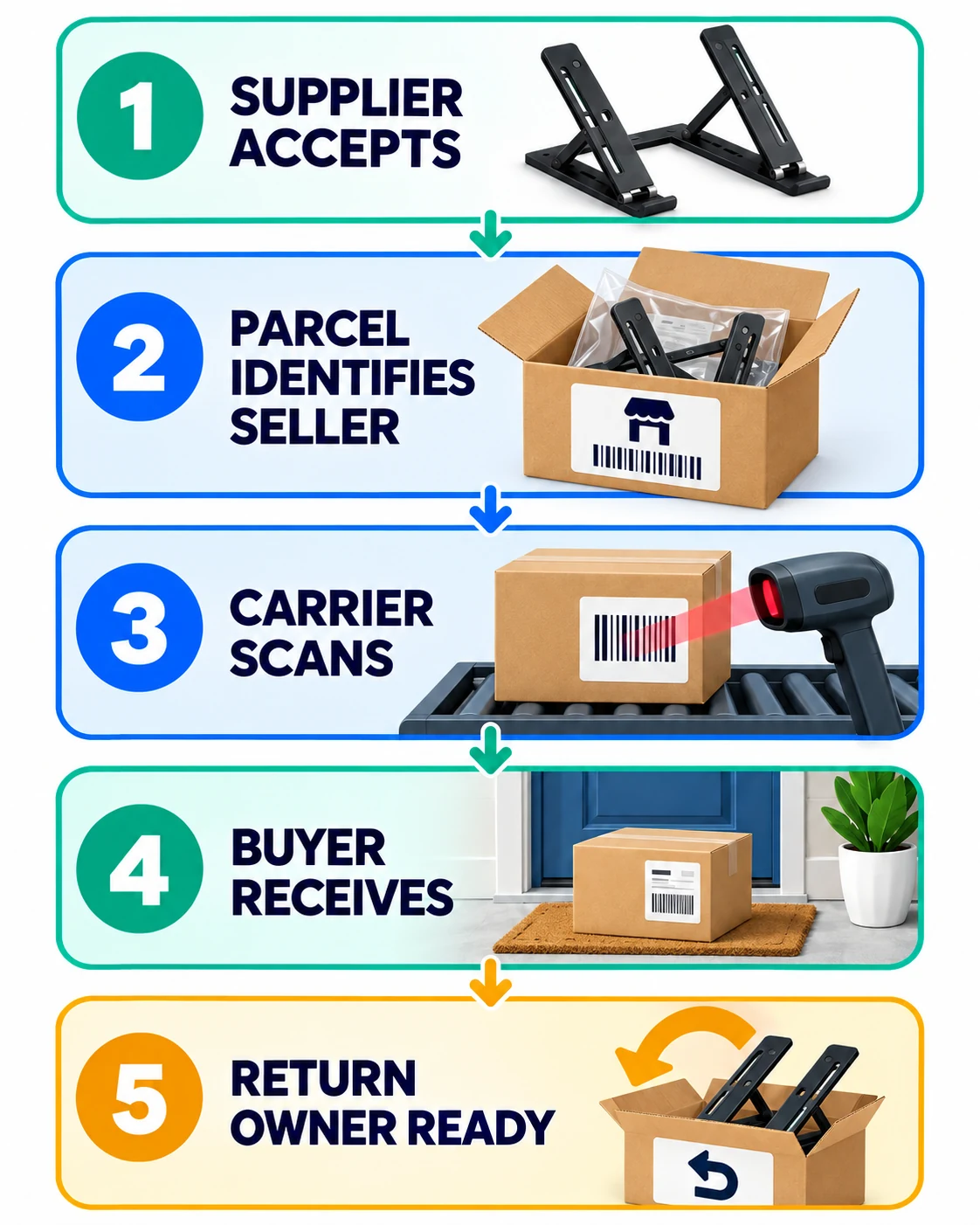
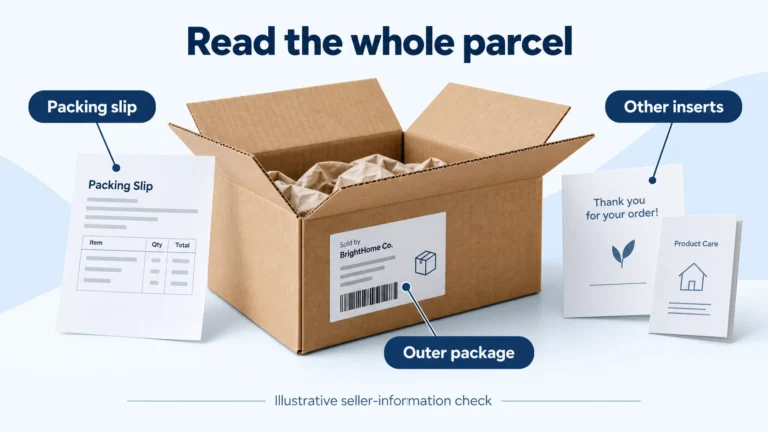
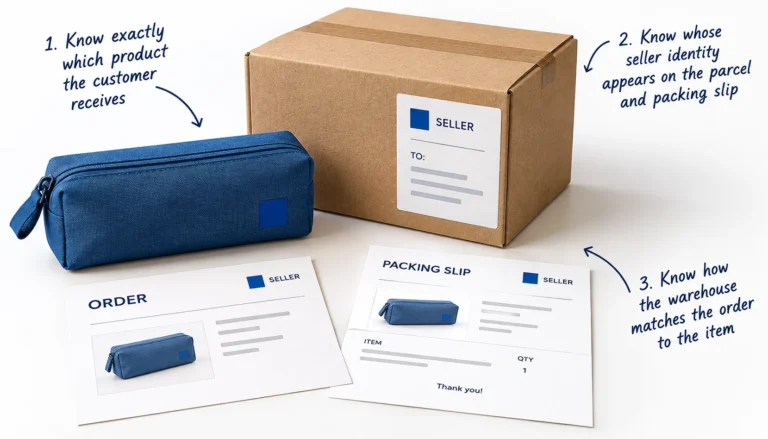
Amazon’s US drop shipping policy takes a different angle: a third party can fulfill an order only if the customer can tell that you are the seller of record. Another seller’s name or contact details on the packing slip, invoice or outside package are identified as violations. You also remain responsible for accepting and processing returns. A supplier’s willingness to mail the stand is therefore not enough; ask it to show the exact carton, inserts and document fields it would use for your Amazon orders.
Neither policy gives you permission to promise delivery you cannot meet. eBay says the seller remains responsible for safe delivery within the listing’s stated timeframe and for buyer satisfaction. Amazon’s merchant-fulfilled model likewise leaves order and customer-service responsibility with the seller. The supplier may do the physical work; the marketplace account carries the consequences of late scans, wrong items and unresolved returns.
Use this comparison with the same stand, supplier and destination:
| Decision for this exact SKU | Amazon | eBay |
|---|---|---|
| Source and identity | Third-party fulfillment must show you as seller of record; check packing slip, invoice and external package | Direct wholesale-supplier fulfillment is allowed; buying after sale from another retailer/marketplace is barred |
| Can you list it? | Check your account and ASIN/brand/category approval, condition and identifier requirements | Check the listing category, item specifics, condition and seller limits for your account |
| Delivery promise | Set merchant-fulfilled handling/ship timing the supplier can meet and confirm actual carrier/tracking | Set handling and shipping policy around supplier cut-off, first scan and service promised in the listing |
| Return and remedy | You own the buyer return process even if supplier shipped | You own safe delivery and buyer satisfaction; agree on return address and supplier recovery |
| Cost test | Use current plan plus category-specific referral/other applicable fees, supplier item/freight and returns | Use current listing/final-value/optional charges, supplier item/freight and returns |
| Decision trigger | Use only after identity, eligibility and service are proven | Use only after wholesale source, listing and service are proven |
That table is a screening tool, not a universal winner score. A supplier that works beautifully for one channel may fail the other because of packing identity, product approval or delivery cut-off.
02
Check the product and parcel that will reach the buyer
Start with the exact stand variant, not a supplier catalog title. Confirm black versus silver, dimensions, accessories, condition and any claimed brand. For Amazon, selling restrictions and approval requirements can apply to an ASIN, brand, category or subcategory. Search the actual product in your Seller Central account. A wholesale invoice or a supplier’s general statement that “Amazon is supported” does not prove your account can list this stand.
Verify the actual wholesale source
On eBay, the supplier arrangement must be wholesale rather than a retailer order placed after your listing sells. Also check whether the listing accurately describes the stand and its origin, condition and delivery service. A fast supplier feed can still map the black listing to a silver stand. Ask for one sample unit or documented product check, and compare the public listing with the item the supplier will actually pick and pack.
Inspect the customer’s seller identity
For Amazon, request a packing mock-up or sample shipment addressed to your test location. Look at the outer label, packing slip, invoice, inserts and any return instructions. Does any other retailer or supplier appear as the seller? If so, fix the process before listing. The Amazon policy is about the buyer’s seller-of-record experience, not merely the name typed into your Seller Central account.
Test the accepted order and handling commitment
For eBay, ask for the supplier agreement and how orders are released. The supplier should accept your stand SKU, shipping address and service level, and provide tracking under a realistic handling schedule. eBay’s policy does not remove your delivery responsibility just because a wholesaler is doing the packing.
03
Compare a real dispatch window, not “fast shipping” copy
Set the promise from acceptance through first scan
Suppose the supplier accepts weekday orders until 2 p.m. in its own time zone, takes one working day to pack and another day before the first carrier scan. Your listing should not promise same-day dispatch just because the supplier emails a label quickly. Write a timeline from customer payment → supplier order acceptance → package handoff → carrier first scan → buyer delivery. Test it on a normal weekday and around a weekend or holiday.
Amazon: confirm the actual carrier handoff
Amazon’s merchant-fulfilled order guide describes unshipped and shipped states and confirming shipment with carrier/tracking. Its handling-time guidance ties handling time to the promised delivery date. If you confirm shipment before the parcel is handed over, a supplier-side delay can become a seller-account problem as well as a customer problem. Use the actual shipping configuration and current Seller Central requirements for your account.
eBay: match the selected service and handling time
eBay’s seller-performance guidance says the seller must ship inside the stated handling time and use the buyer’s selected service. Tracking and carrier scans help it determine late shipment. Its delivery-date help explains how handling schedules and cut-offs affect buyer estimates. A supplier’s marketing phrase “ships in 24 hours” is not a substitute for a first-scan record on this exact product and destination.
Configure a handling promise your supplier can meet
eBay’s delivery-date guide measures handling from payment to the carrier scan in business days. Do not select same-day handling for the stand when the actual first scan takes two working days.
Working-day settings
Where you genuinely offer same-day handling, the documented route is Shipping Preferences → Dispatch and handling → Working days and cut-off time → Edit. Set the actual time zone, working days and supported cut-off, then Save. These controls do not make the supplier dispatch sooner.
Check after saving
Open the affected listing for the target destination and inspect the buyer’s estimate. Follow an authorized sample’s paid time, supplier acceptance and first scan. If the scan cannot meet the configured promise, change the actual handling/service setting before taking more orders. Use Amazon’s own account configuration separately; do not copy this eBay menu into Amazon instructions.
One-day handling is not simply 24 hours. Weekends, the stated working schedule and order cut-off affect the window; the actual listing/account conditions still need checking.
A broken hinge needs a return owner
Returns are another timing test. If the stand arrives with a broken hinge, who gives the buyer a return label, where does it go, and who pays the freight? Amazon requires the seller to handle returns under its policy. eBay holds the seller responsible for buyer satisfaction and safe delivery. Set a supplier recovery route before selling, rather than hoping the supplier will refund you after the marketplace has already refunded the buyer.
One sample order is more useful than a promise: keep the supplier’s accepted order reference, the exact black SKU, dated packing images or documentation, the first carrier scan and a response to a mock return question. A printed label is not proof that the carrier has the parcel.
04
Use actual SKU-level costs to choose, not a fee slogan
It is easy to call one marketplace “cheaper” by comparing a headline percentage while ignoring shipping, category, ads, returns or account-plan costs. Amazon’s US pricing page says selling costs depend on the plan and product category, including referral fees. eBay’s selling-fee page separates insertion and final-value charges and explains that its percentage basis can include buyer-paid shipping, tax and other amounts under the stated rules, plus a per-order component. Store subscriptions, promotions and seller standing can change the result.
Fill the fees for this account and category
For the stand, use a simple line sheet for each marketplace: actual customer price and shipping charged; marketplace charges on the correct basis; supplier stand price; supplier freight; packaging or inspection charge; payment or service charges if applicable; expected return/remedy allowance; and when you must fund the supplier before marketplace payout arrives. Do not put an assumed “13%” or “15%” in the sheet and call it a quote. Take the current category/account fee page or calculator result for that SKU, then add the supplier’s real invoice terms.
Policy and service come before the price pilot
The fee comparison is useful only after policy and service gates pass. A positive margin on one order qualifies a channel for a small pilot; it does not predict which channel will produce more viable orders. If both routes pass, test the same stand and offer in each under a bounded spend limit. Compare actual buyer demand, conversion, returns and retained contribution after ads over the same period, while reserving stock so the two listings do not promise the same last unit. Use our dropshipping profit-margin guide to build the per-order calculation before that pilot.
Keep the same last unit from selling twice
Suppose the supplier has one black stand left and both marketplace routes have passed their own checks. These quantities are an illustrative allocation, not a working integration.
Before either sale
Available supplier stock: 1; allocate Amazon: 1 / eBay: 0, or Amazon: 0 / eBay: 1, unless your actual reservation system can safely coordinate simultaneous orders. Publishing quantity 1 on both can promise two stands when only one exists.
After an accepted sale
Keep the winning store order and supplier acceptance together; reduce other-channel availability to 0. If the supplier request times out, confirm whether it was accepted before buying again. A stock feed refresh and an order acceptance are different records.
Recheck the affected listings after the update. Do not substitute silver for the paid black variant without agreement, and do not call a proposed allocation an implemented stock lock.
Compare both channels on the same order basis. These figures are fictional placeholders, not published marketplace rates or forecasts.
The same stand, buyer receipt and supplier route
- Customer item price: $30; buyer shipping charge: $5; total receipt: $35.
- Stand: $14; supplier delivery: $7; packing: $1; remedy budget: $2.
- Total costs before marketplace charges: $24; remainder: $11.
If the actual all-in marketplace charges entered for the example were $4 for Amazon and $4.50 for eBay, planning contribution would be $7 and $6.50 respectively, before ads, tax and other plan costs. Replace both placeholders with your account’s charge on the correct basis; neither is an assumed fee percentage.
That $0.50 difference does not decide the channel if Amazon’s seller identity fails, eBay’s source is not wholesale, or one route cannot meet its delivery promise. Supplier funding and marketplace payout timing are a separate cash check.
05
Make the decision from a small proof packet
Treat platform rules and parcel identity as gates before you compare fees. Suppose the black stand comes from a genuine wholesale supplier with a tracked sample delivery, but its packing slip and outer carton still name the supplier as the seller. The eBay route may be worth a supervised test if its wholesale, listing and delivery terms pass; the Amazon route stays on hold until the supplier can make your business the seller shown to the customer and the SKU is eligible. A lower hypothetical Amazon fee would not repair the seller-of-record failure. Only after both routes pass their own rules does a fee comparison answer which one is economically better.
Keep the small pilot’s actual evidence
Before a live listing, collect a packet for the black stand. It should include the supplier agreement or purchasing terms; exact stand variant/SKU; proof of your ability to list it in the chosen marketplace; a packing/invoice sample; the supplier’s handling cut-off; tracked sample dispatch to your target market; return address and process; and the current item/freight/marketplace fee inputs. Mark any blank field as a test still to do, not a low-risk assumption.
- Seller-of-record packaging, Amazon listing eligibility and supplier dispatch/returns are proven; eBay wholesale path is also valid: Run bounded same-SKU pilots, then compare observed demand, conversion and retained contribution; either channel may fit
- Supplier intends to buy the stand from a retailer only after your sale: Hold eBay retail-after-sale route; do not assume Amazon is automatically acceptable either
- Supplier cannot commit to the exact variant, first scan or return route: Hold both channels until the operational promise is fixable
Run the same sample through the path you choose: paid marketplace order, supplier acceptance, correct stand, packaging, tracking, delivered parcel and a documented return response. If the supplier changes carrier or warehouse, repeat the relevant checks. The channel choice is a live operating decision, not a one-time comparison of logos.
If your sourcing and fulfillment team is in China, send AIDrop Agent the SKU, packaging requirements and destination you need to serve. We can discuss product checks, packing, supplier acceptance and tracking handoff. We are not promising marketplace account approval or that a particular SKU qualifies on Amazon or eBay.
Questions when choosing Amazon or eBay
Is eBay always better for a beginner?
No universal answer follows from this comparison. An actual wholesale source and achievable listing/service may make an eBay pilot workable; Amazon needs its seller-of-record, listing and service conditions met. Compare observed demand and complete costs after those conditions pass.
Can I sell on eBay and buy the item from Amazon after it sells?
eBay’s current policy bars listing an item and then purchasing it from another retailer or marketplace for direct shipment to the buyer. That is different from an approved wholesale-supplier arrangement.
Does FBA mean Amazon is dropshipping for me?
FBA is a different stock arrangement: you supply inventory to Amazon for fulfillment. This comparison concerns the supplier-fulfilled stand, so do not substitute FBA delivery and fee assumptions for that route.
Which marketplace has lower fees for the stand?
Use your actual category/account and fee basis. The article’s $4 and $4.50 are placeholders, not rates. Include supplier shipment, remedies, ads and relevant plan costs; a $0.50 difference does not repair a policy or dispatch failure.
Can I start on both at once?
Only when each route works and the shared stock, order ownership and returns can be controlled. Pilot within what you can support; one supplier unit cannot become two available units just because two listings show it.

Amazon Dropshipping: Policy, Supplier Control and Order Operations
Check Amazon dropshipping policy, supplier controls, listing identity, fulfillment, returns, fees and cash needs before launching merchant-fulfilled
Amazon Dropshipping Policy: Rules, Examples and Pre-Listing Checks
Understand Amazon dropshipping rules for seller identity, packaging, sourcing records, returns and shipping, with practical examples and
How to Start Dropshipping on Amazon: A Practical US Launch Guide
Start Amazon US dropshipping with a verified account, eligible products, a compliant supplier, accurate shipping settings and
