
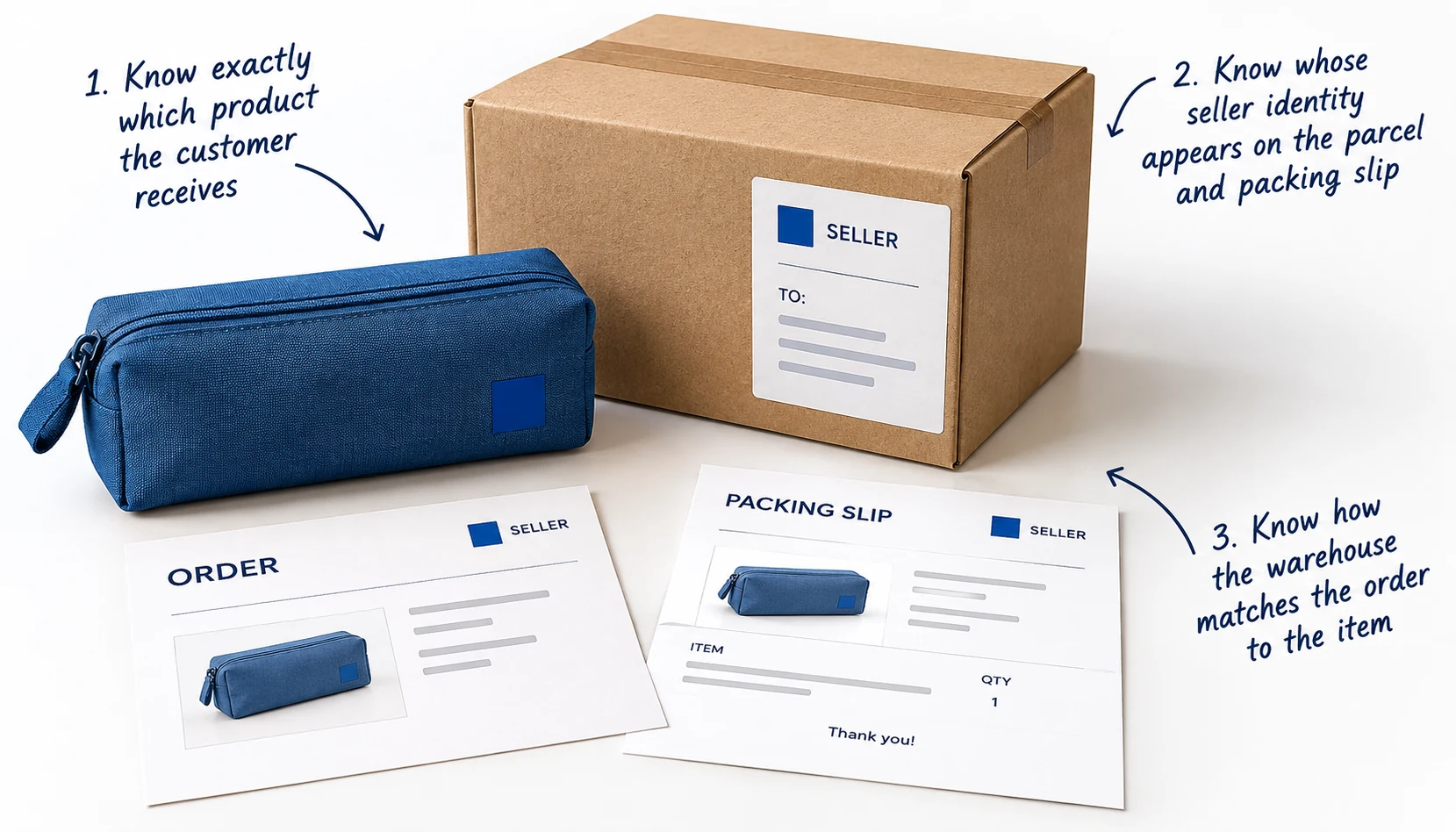
To start dropshipping on Amazon, you need a verified seller account, products you are permitted to list and a supplier arrangement that keeps you responsible as the seller. Configure merchant-fulfilled shipping and returns, fund the supplier payments, and begin with a small catalog whose orders you can actually follow from purchase to delivery.
The account is only one part of the launch. Before accepting an order, know what the customer will receive, whose identity appears on the parcel, when it can leave the warehouse and where a return will go. A supplier’s “Amazon compatible” badge does not establish those facts.
This guide concerns Amazon’s US store. Platform sources were checked on September 19, 2026. It follows the practical setup sequence; the wider Amazon dropshipping guide explains the model and its trade-offs.
01
Confirm the supplier arrangement before you list
Amazon’s own dropshipping explanation permits dropshipping within its policy and applicable law. It requires an agreement identifying you as seller of record, customer-facing materials that do not identify another party as the seller, and responsibility for customer service and returns. Review the current Drop Shipping Policy in Seller Central for the governing wording.
Ask the supplier to describe the actual arrangement, not simply agree that it can remove an invoice. Confirm seller identity on packing slips, invoices and external packaging, who owns and supplies the goods under the agreement, and how the warehouse handles returns. Keep the agreement and an example of the packing materials with your product records.
An order sent directly from another online retailer can arrive with that retailer’s invoice, contact details or packaging. Do not build a launch around ordering from a retail checkout and hoping the parcel will look different. A retail receipt also should not be assumed to satisfy a later request for supply-chain documentation.
Removing another seller’s identity does not authorize removing legally required product information, safety warnings or manufacturer identification. Distinguish transaction materials from the product’s required labeling. If the supplier cannot explain how it will satisfy both, resolve that before listing.
The useful supplier conversation includes the exact product and warehouse. A supplier might support the arrangement for stock it packs itself but not for goods sent by another warehouse. The Amazon supplier selection guide goes deeper into those checks.
02
Register the account using consistent business details
Use Amazon’s seller registration guide to prepare your business and contact details, government-issued ID, bank information, an accepted chargeable card, address evidence and tax information as requested. Enter names and addresses consistently with the documents. A store display name and the registered business name serve different purposes; do not substitute one for the other in verification fields.
Amazon’s guide allows registration as an individual where appropriate; it does not require every seller to form an LLC. That platform option does not settle your local registration, tax or product obligations. Choose the account information that reflects the business you actually operate.
The published US selling-plan prices are $0.99 per item sold for Individual and $39.99 monthly for Professional, plus applicable selling fees. Professional has additional tools and program access. Choose by the functions you need as well as volume; the current pricing comparison shows the differences.
Submit clear, complete verification documents through the official process. If a document is rejected, read the stated reason and correct the mismatch. Do not repeatedly create new accounts to get around a verification problem. Allow for verification work in your launch schedule without promising customers an opening date you cannot support.
Once access is available, review notification settings and user permissions. If a warehouse or assistant needs access, give only the appropriate permissions rather than sharing the main account password. Make sure somebody receives and acts on policy, payment and order notifications every operating day.
03
Choose one product you can document and deliver
Start with a product you can identify exactly. Record the brand, model, variation, quantity in the pack, product identifier and supplier SKU. Confirm that the physical product matches the listing you intend to use. A visually similar generic accessory is not automatically the same product as a branded listing.
Amazon’s selling-policy guidance explains that some products and categories require approval and that restricted products, product compliance, intellectual property and condition rules also apply. Check eligibility for the exact item in your own account before building a large catalog around it.
Request genuine supplier invoices and relevant product documents before selling. Make sure they identify the real supplier and item; keep originals intact. A wholesaler’s willingness to sell an item does not, by itself, establish brand authorization, authenticity or permission to use somebody else’s images.
Then order a sample through the proposed fulfillment arrangement. Compare the contents, condition, packaging, product marks and variation with the offer. Record the dispatch and tracking events. A sample is evidence about that shipment, not a certification of the supplier’s future performance.
Reject an attractive price if you cannot establish what will arrive or obtain the evidence the product needs. Batteries, children’s goods, cosmetics and other regulated products may add documentation and transport requirements. They are poor choices for a rushed first launch when you cannot resolve those requirements.
04
Work out the selling price and order funding
Before publishing the offer, calculate the customer price after any discount, the applicable referral fee, supplier product cost, packing, delivery and likely loss from returns or replacements. Allocate the selling-plan charge and other overhead separately. Do not import FBA storage and fulfillment defaults into an order your supplier ships directly.
For illustration, a $40 sale with a $6 referral fee, $13 product, $6 shipping and handling, and $2 expected exception cost leaves $13 before advertising and fixed overhead. These are assumed figures, not a quote or a universal Amazon fee. If you expect to spend $8 acquiring that order, only $5 remains before those fixed costs and tax.
Use the product’s actual fee category and your own fulfillment inputs in Amazon’s calculator. A fee category can differ from the category customers see in navigation. Confirm the packed dimensions, destination and service on the supplier quote; an average shipping amount can hide expensive destinations.
Also reserve cash for supplier payments. Amazon’s payment explanation describes settlement, reserves and deferred transactions. Money shown as sales is not necessarily available for withdrawal or supplier payment. Do not promise immediate dispatch if you need to wait for the customer proceeds before paying the warehouse.
Keep enough available to fulfill accepted orders and handle customer remedies even if a payout is later than expected. If that limits you to a few orders per day, build the launch around that capacity.
05
Prepare the offer without changing the product identity
Amazon uses shared product detail pages. Where the exact product already exists, add your offer to the correct detail page. Create a new page only when appropriate for a product not already represented; do not create duplicates to avoid an existing listing’s conditions.
Compare more than the main picture. Check brand, model, color, size, included accessories and pack count. If the page describes a two-pack and your supplier price is for one unit, either obtain the correct two-pack or use the correct product listing. Changing your seller SKU does not change what the customer expects from the ASIN.
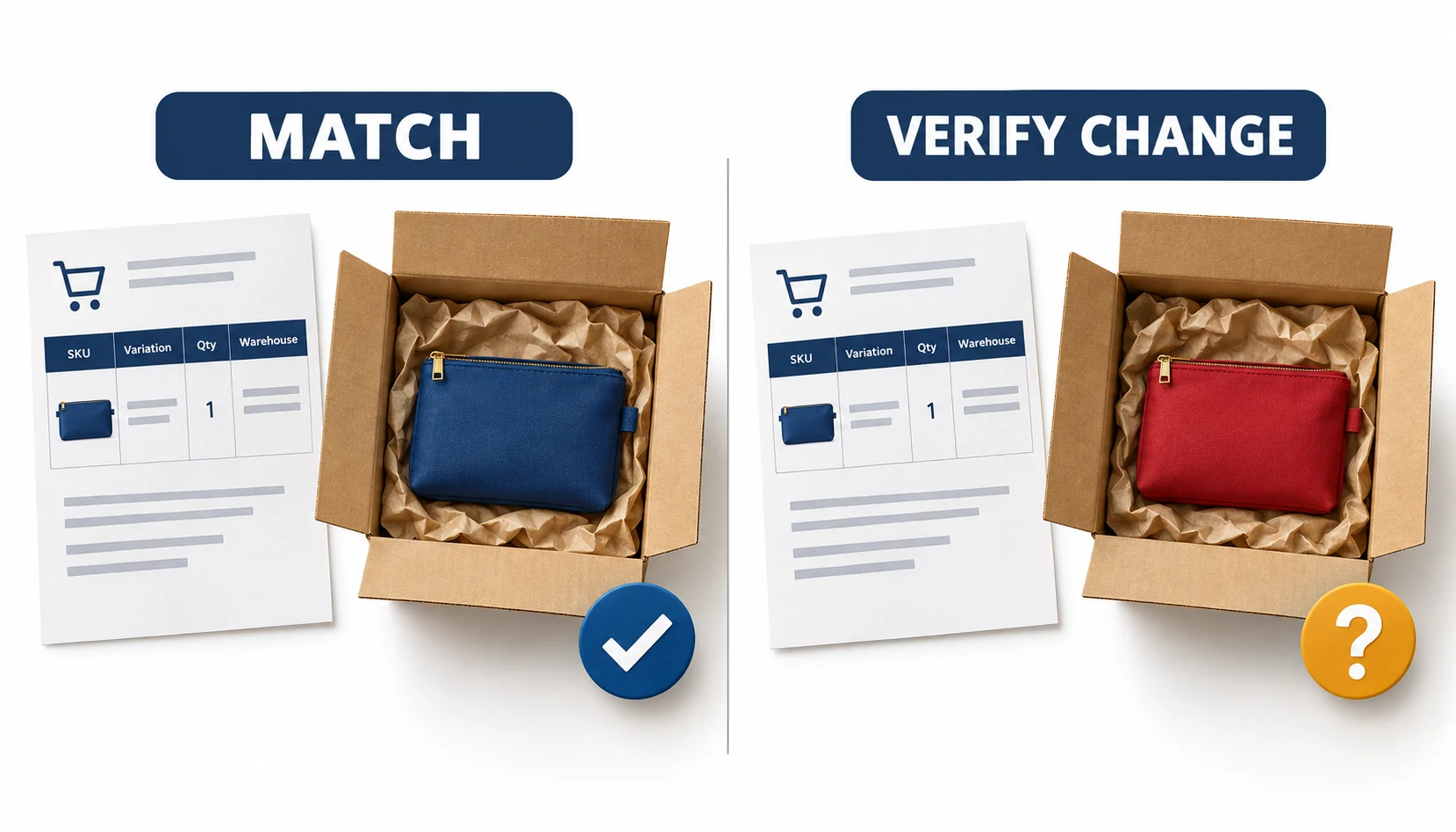
Enter the real offer price, condition, available quantity and merchant-fulfilled arrangement. Use accurate content and images you are allowed to use. Do not import claims such as compatibility, certification or warranty merely because they appear in a supplier catalog.
A simple internal mapping prevents avoidable errors:
| Record | Example of what it must identify |
|---|---|
| Amazon offer | Exact ASIN, seller SKU, condition and pack count |
| Supplier order | Supplier SKU, variation, quantity and warehouse |
| Parcel | Contents, packing instruction and customer delivery address |
| Tracking update | Actual order, parcel, carrier and tracking number |
The example is a record design, not an Amazon interface screenshot. Store the mapping somewhere the person releasing orders can use. If a supplier changes its SKU or product version, pause the affected offer until you confirm the mapping still describes the same item.
06
Configure shipping, inventory and returns together
Amazon’s Fulfilled by Merchant guide describes shipping templates, handling time, transit time and capacity settings. Set them from your warehouse and carrier arrangement. Handling includes the work before dispatch; transit covers movement after dispatch. A supplier’s “five-day shipping” claim is incomplete if it excludes three days waiting for the product.
Confirm the warehouse cutoff, working days and holiday arrangements. Establish which destinations the quoted service supports and how tracking will reach Amazon. If you cannot support a region, restrict the offer rather than discover the problem after checkout.
Show inventory you can reliably supply. If the same supplier stock is sold through several channels, a catalog quantity is not a reservation for your store. Agree how often stock updates arrive, when you stop selling after an update fails, and who handles the last units. Begin with a conservative offer quantity while you establish actual reliability.
Set the return address and process before the first shipment. Amazon’s US merchant-fulfilled guidance describes automatic authorization for eligible returns through its prepaid return-label program and handling of exceptions. Your supplier’s own return window does not replace the customer-facing obligations in your Amazon account.
Find out who receives returned parcels, checks the item and records any recoverable value. Confirm how you will fund a refund before the supplier issues a credit. If the proposed return route is impractical for customers, solve that during setup; it will not become easier once an order is disputed.
07
Rehearse the handoff before accepting customer orders
A supplier sample and an internal order rehearsal can reveal gaps without manufacturing customer transactions or reviews. Use legitimate test facilities where available; do not buy your own Amazon offers to manipulate sales or feedback.
Give the warehouse a representative order instruction with the exact variation and packing requirement. Ask it to show the packing slip and exterior label layout, confirm how the order is acknowledged and explain when cancellation becomes impossible. Check that a retry of the same order instruction would not create a second shipment.
For a small launch, keep one product file containing:
- The exact item and listing identity, plus accepted supply documents.
- A delivered quote and the seller-of-record agreement.
- Sample observations and packing-material evidence.
- Stock-update method, order cutoff and actual shipping service.
- Return destination, customer response owner and refund funding.
Suppose the supplier confirms the item but says a different warehouse may ship during a stock shortage. That is a new fulfillment arrangement to verify, not a harmless substitution. The packing materials, dispatch time and returns process may all change.
Do not activate an offer while an unresolved supplier response could change the item, seller identity or delivery promise. Keep the scope small enough that you can resolve exceptions before they become a queue of customer complaints.
08
Release a small catalog and follow the first orders
For each genuine customer order, confirm its status in Amazon, validate the SKU mapping and release it once through the approved supplier process. Record the supplier acknowledgment and any exception. Follow the account’s order-status requirements; an unconfirmed or pending order should not be treated as an unconditional shipping instruction.
Track the difference between a label being created and the carrier receiving the parcel. Follow the actual fulfillment method’s shipment-confirmation process and provide accurate tracking. A software success message only says that an update was accepted; it does not prove the parcel moved.
Handle failures according to their state:
| What happened | What to do next |
|---|---|
| Supplier cannot confirm stock | Stop new sales of that SKU; resolve the accepted order promptly through Amazon’s permitted cancellation/customer process |
| Customer requests cancellation | Check the request and actual warehouse state before promising a stop; record the supplier’s response |
| Label exists but no carrier acceptance | Investigate with the warehouse before the delivery promise is missed; do not invent a scan |
| Wrong product or damaged parcel | Handle the customer remedy through the appropriate Amazon process, then pursue supplier recovery separately |
The first orders teach you whether the setup works under real timing. Increase available quantity only after you can reconcile the order, supplier payment, shipment and customer outcome. An integration can make bad data travel faster, so automate a stable process rather than using automation to hide unresolved work.
09
Review delivery failures and account health daily
Use Account Health and the relevant fulfillment dashboards to monitor policy notices, order defects, cancellations, late shipments, tracking and on-time delivery. Amazon’s current requirements and the measurement periods shown in your account matter; a supplier’s own dashboard does not replace them.
Look at the individual orders behind a rate. Three cancellations caused by stale stock require a stock-feed and availability fix. Repeated late acceptance scans require a dispatch or carrier-handoff fix. A longer promised transit time will not repair missing seller identity on invoices.
Stop the affected offers while a recurring failure remains unresolved. Retain correspondence, invoices and shipment records, and respond accurately to Amazon’s requests. Do not create documents retrospectively to make a shipment appear compliant.
Ordinary merchant-fulfilled dropshipping does not automatically earn a Prime badge. Amazon describes Seller Fulfilled Prime as a separate program with performance requirements. Faster claims should follow the service and eligibility you actually have.
After the initial orders, review actual contribution and cash availability as well as delivery. A launch is ready to expand when the product can be supplied as described, customer obligations are handled and the order economics remain viable. Refer back to the Amazon dropshipping policy guide when a proposed sourcing or fulfillment change alters those conditions.
10
Frequently asked questions
Can a beginner dropship on Amazon?
Yes, subject to Amazon’s policy, account and product requirements. Being new does not reduce the obligations around seller identity, accurate listings, fulfillment and returns. Starting with a few documented products makes those responsibilities easier to observe.
Do I need a Shopify store?
No. A separate Shopify storefront is not required to operate an Amazon seller account. You may use software or another store alongside Amazon, but confirm what the integration actually controls and keep Amazon orders within the applicable marketplace rules.
Can I use any supplier that offers blind shipping?
No. Blind shipping alone does not establish the seller-of-record agreement, product eligibility, documentation, delivery performance or return arrangement. Verify the complete supply and fulfillment process for the exact products you plan to list.
Should I launch hundreds of products at once?
A large catalog increases the number of stock, listing, variation and supplier problems you must control. Start at a scale you can verify and fund, then expand using actual order evidence. There is no universal product count that makes a launch safe.
Is opening the account enough to begin advertising?
No. First confirm product and advertising eligibility, activate an accurate offer, establish fulfillment and returns, and calculate what acquisition can cost. Advertising an offer you cannot reliably fulfill can create obligations faster than you can resolve them.