

Amazon dropshipping suppliers can include wholesalers, manufacturers and supplier networks that ship individual orders for merchants. Start with candidates that support your product category and destination, then verify the exact arrangement: your seller identity, usable sourcing documents, stock availability, dispatch and returns. A connection to Amazon does not establish that every product or parcel is suitable for your account.
Useful places to investigate include TopDawg for a supplier network, Inventory Source for supplier discovery and automation, and direct trade accounts with manufacturers or authorized distributors. These are different sourcing routes, so compare the work each party actually performs before paying for access or importing a catalog.
01
Where to find Amazon dropshipping suppliers
The quickest route depends on what you already know. A merchant with a specific brand in mind needs a legitimate source for that brand. A merchant exploring a category needs a way to discover candidates without confusing catalog size with product suitability.
Supplier networks: investigate the individual source
TopDawg advertises wholesale products and Amazon connection options. It is a candidate to investigate for a network-based arrangement. Ask which supplier ships your selected SKU, where that stock sits, and which account features cover the paperwork and order services you need.
Evaluate the selected product and shipping route rather than accepting a general network description. A broad catalog can include different dispatch locations, packaging arrangements and return instructions. The provider’s published capabilities are a starting point for questions; this article has not independently tested its fulfillment.
Before subscribing, request the total cost for a small basket of actual products delivered to representative addresses. Include any membership, handling and return costs. Catalog access is useful only if the items you can sell also leave a workable margin.
Discovery and automation: separate software from fulfillment
Inventory Source describes Amazon integrations, inventory synchronization and order automation. Those functions can help merchants connect supplier data and order activity. They do not replace an agreement with the business responsible for the goods.
Ask whether the service introduces suppliers, routes orders, collects payment, handles exceptions, or performs several of those jobs. Also establish who resolves an order that the software transmitted successfully but the supplier never accepted. A successful data transfer is not a parcel dispatch.
This route may suit a merchant who wants to manage several supplier relationships. It becomes less useful when nobody can explain where to escalate a stock discrepancy, missing tracking number or rejected return.
Direct manufacturers and authorized distributors
For a known product or brand, contact the manufacturer or a distributor whose relationship you can verify. Ask whether they accept your business, permit the proposed sales channel and offer individual-order fulfillment. A company can be a legitimate wholesaler while offering only case quantities or bulk shipments.
Request the trade-account requirements before sending a large product list. Then ask about the specific territory, product variants and marketplace you intend to use. An agreement covering one country or product line should not be treated as permission for every catalog item.
Amazon’s own dropshipping guide identifies online research, directories and trade events as ways to meet suppliers. The practical advantage of a direct relationship is a clear person to contact about the product and fulfillment terms. It does not remove the need to verify those terms.
Directories and trade events
A directory or exhibitor list helps you find businesses to contact. It generally cannot answer whether a particular supplier will identify you correctly on an order, reserve stock, accept your return arrangement or provide the records your account may need.
Use discovery sources to build a short candidate list, then move the discussion to a documented product and service proposal. Avoid buying a large list on the assumption that the number of names reduces the work required to qualify one usable supplier.
02
Establish the Amazon requirements before comparing prices
For an Amazon order, supplier selection must account for your responsibilities as the seller. The current Amazon moderator guidance on dropshipping addresses the supplier agreement, your identification as seller, removal of conflicting third-party seller information, and your responsibility for returns.
Turn that requirement into a concrete question: what will this customer receive from this supplier for this order? Request the outer packaging, packing slip and other customer-facing materials that the warehouse will actually use. A sample prepared by a salesperson may not show the warehouse’s standard process.
Keep genuine purchase records separately. Customer-facing seller identification and the original supplier invoice serve different purposes. Do not ask a supplier to disguise who supplied the goods or manufacture documents to fit an application.
If you are still setting up the wider account and operating model, our Amazon dropshipping guide covers that context. The decision here is narrower: whether a candidate can support the orders you plan to accept.
03
Match the product before approving the supplier
A supplier’s product description must match the product you intend to list. Similar photographs can hide a different quantity, material, model, accessory set or regional version. An attractive unit price for a different product is not a comparable offer.
Build a short product record before requesting the final quote:
- Manufacturer and brand, with the exact model or product identifier where available.
- Variant, size, color, pack quantity and included accessories.
- Condition, packaging and instructions supplied with the unit.
- Destination market and any product-specific documents to investigate.
- The listing or proposed listing the product must match.
Check your account’s ability to sell the product before committing to orders. A supplier’s willingness to sell to you does not settle Amazon category, brand or product restrictions. Likewise, the fact that another merchant lists an item does not establish your own eligibility.
If the supplier proposes a substitute, compare it as a new product. Do not permit silent substitutions to preserve an order deadline. The customer bought the listed product, and a different specification can create a problem even when the replacement costs more.
04
Read the quote as a description of the service
Ask for a quote that identifies the product, dispatch location, shipping service, destination, included work and exclusions. A single delivered total can be useful, but you still need to know which assumptions could change it.
For example, a quote may assume one unit per order, a standard address and an unchanged carton size. A bundle, remote address or larger package may require a different cost. Request how those changes are calculated before importing a large number of products.
Compare candidates using the same basket and assumptions:
- Product and any per-order handling charge.
- Packaging or seller-identification work.
- Shipping service and destination restrictions.
- Membership or software charges allocated realistically.
- Cancellation, return, replacement and failed-delivery charges.
- Payment currency, timing and any agreed price-change notice.
Then calculate contribution after the selling fees and other order costs that apply to your account. A lower supplier price can produce a worse result if the route creates expensive returns or requires more support. Keep those assumptions visible rather than burying them in an optimistic margin.
05
Test the parcel and the order record together
An illustrative supplier check follows one selected SKU from the purchase request to the received parcel. Compare the ordered variant with the unit, inspect customer-facing seller information, and match the carrier number to the order. The product, paperwork and shipment record must describe the same transaction.
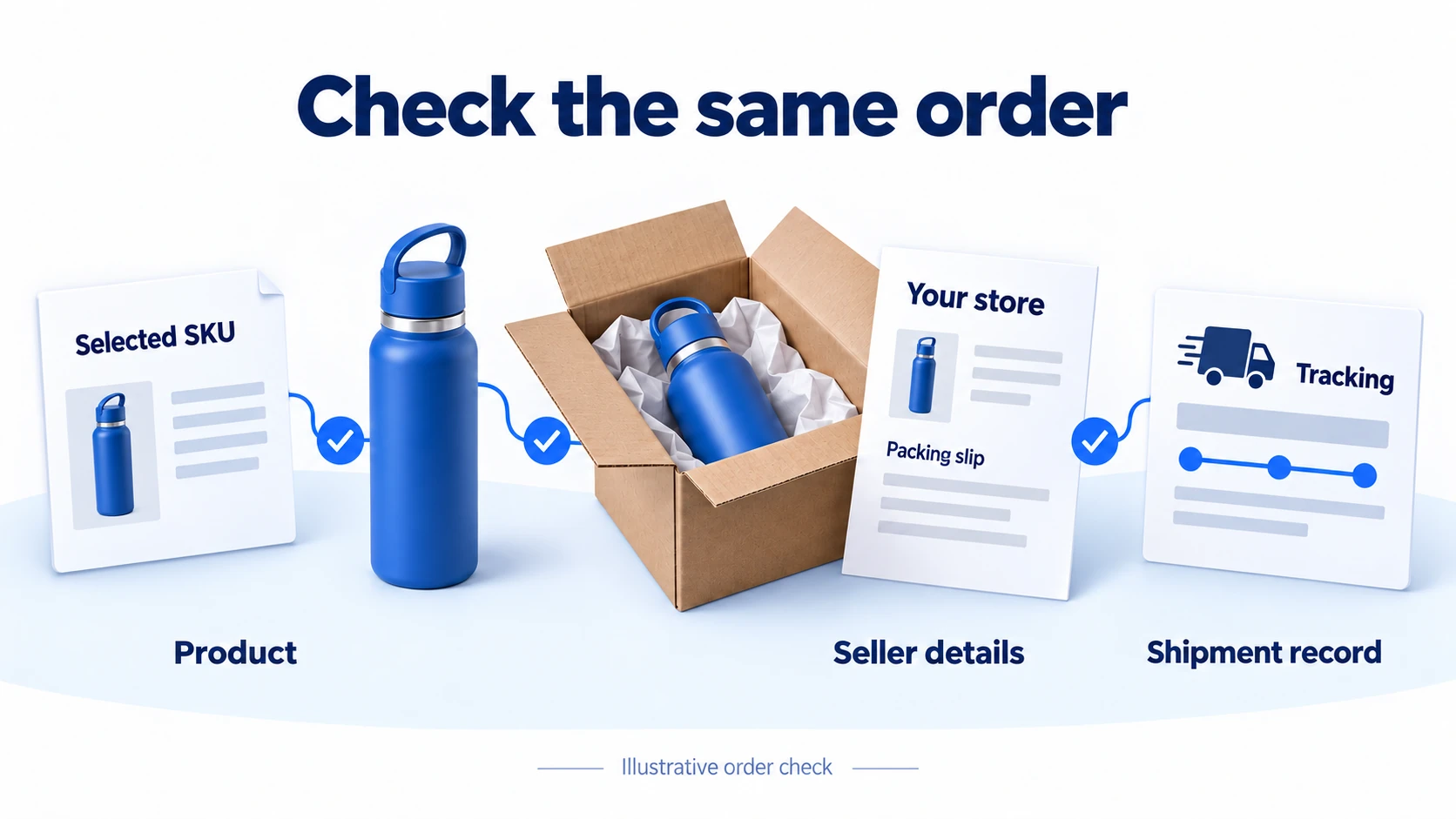
Order a sample through the proposed fulfillment process to an address you control. Explain the test honestly; do not create misleading Amazon purchases, reviews or activity. If a marketplace transaction is involved, follow the applicable rules for that activity.
When the parcel arrives, record the contents before discarding the packaging. Inspect the specification, quantity and visible condition. Read all included paperwork, not just the packing slip. Check whether a promotional insert or receipt introduces another seller.
Keep findings specific. “Packaging wrong” is difficult to fix; “the customer receipt identifies another retailer” names the problem. Ask the supplier which process caused it, what will change, and how the revised process will be checked.
One successful sample is limited evidence. It shows what happened for that item and route on that occasion. It does not establish consistent handling across other warehouses, products or busy periods. Expand only as the actual service provides enough evidence for the scope you need.
06
Ask what happens when stock or dispatch goes wrong
Inventory synchronization should help you decide what can be offered, but an update is not necessarily a reservation. Ask whether published supplier stock is shared with other sellers and when a unit becomes allocated to your order.
If the supplier reports ten units, learn whether those ten are available to everyone using the feed. Ask how quickly a sale, cancellation or stock correction reaches your listing. A buffer may be appropriate, but choose it from the actual update delay and sales pattern rather than an arbitrary percentage.
Dispatch questions should name the events:
- When does the supplier receive and accept the order?
- What cutoff and working calendar apply?
- When is the parcel handed to the carrier?
- When do you receive tracking and any exception notice?
A label can exist before the carrier has the parcel. Ask how the supplier distinguishes those states. If acceptance is missing near your promised deadline, investigate the order rather than assuming that an uploaded number proves dispatch.
Also agree on the response to unavailable stock. The supplier should not silently wait, change the item or choose an unapproved shipping service. Identify who contacts you, what choices you can make and how cancellation or refund handling works.
07
Make returns workable before the first sale
The buyer’s return request and your supplier’s reimbursement are separate matters. Establish how you will meet the applicable customer obligation even if the supplier is still investigating its responsibility.
Ask for the return address, authorization process, accepted conditions and evidence needed for damaged or incorrect goods. Clarify who pays each transport cost and whether a returned unit is inspected, restocked, replaced or discarded.
A route with inexpensive outbound shipping can become unattractive if every return requires costly cross-border transport. Compare the realistic return route with the value of the item. Do not assume that a domestic dispatch address also accepts returns.
Test the communication path with a clearly labeled practice scenario. Ask who would act on a missing accessory or wrong variant and what information they require. You are looking for a workable response, not a promise that problems never occur.
08
Decide which candidates are ready for a limited launch
Separate three decisions when evaluating a candidate. Catalog access tells you that you can see or import products. Product qualification asks whether the exact item and documentation fit your proposed sale. Fulfillment qualification asks whether the supplier can deliver the agreed order with the required customer-facing information and recovery process.
Approve a limited launch only when the important unanswered questions have owners and answers. A polished dashboard should not outweigh missing sourcing records or an unresolved packaging problem.
For each candidate, record one of three practical outcomes:
- Proceed with a defined scope: selected products, destination and service have been checked; start with a manageable order volume.
- Resolve a named gap: request a missing document, revised packing process or clearer return arrangement before proceeding.
- Reject the current arrangement: the supplier cannot provide the required product, identification, service or evidence.
Keep the launch narrow enough that you can inspect actual exceptions. Review cancellations, product mismatches, dispatch evidence, return outcomes and costs. If the supplier changes warehouse, product source or packing process, revisit the affected checks rather than relying on the original sample forever.
09
Frequently asked questions
Is there a universal list of Amazon-approved dropshipping suppliers?
Do not treat a directory, app listing or third-party roundup as approval of your exact arrangement. Investigate the supplier, product and order process against the requirements that apply to your account and marketplace. A provider’s Amazon integration is a capability claim with a different purpose.
Can I use a supplier in China?
Assess the specific source and route. Location alone does not answer whether the product is eligible, documentation is usable, seller identification is correct or delivery and returns are workable. Cross-border handling also needs a clear allocation of responsibilities and realistic customer promises.
Is an unbranded box enough?
No. Inspect the whole customer-facing shipment and establish the required seller identification. A blank outer box does not tell you what is on the packing slip, invoice or insert inside it.
Should I start with thousands of products?
A small qualified selection is easier to control. Bulk import can multiply product mismatches, stock errors and unresolved shipping assumptions before you have tested the process. Increase the catalog after the underlying order service works for the additional scope.
What is the most useful first message to a supplier?
Name your marketplace, destination and selected product, then ask about seller identification, sourcing records, individual-order dispatch, tracking and returns. Include expected order characteristics. A focused request is more likely to produce a useful answer than asking whether the supplier is simply “Amazon safe.”