
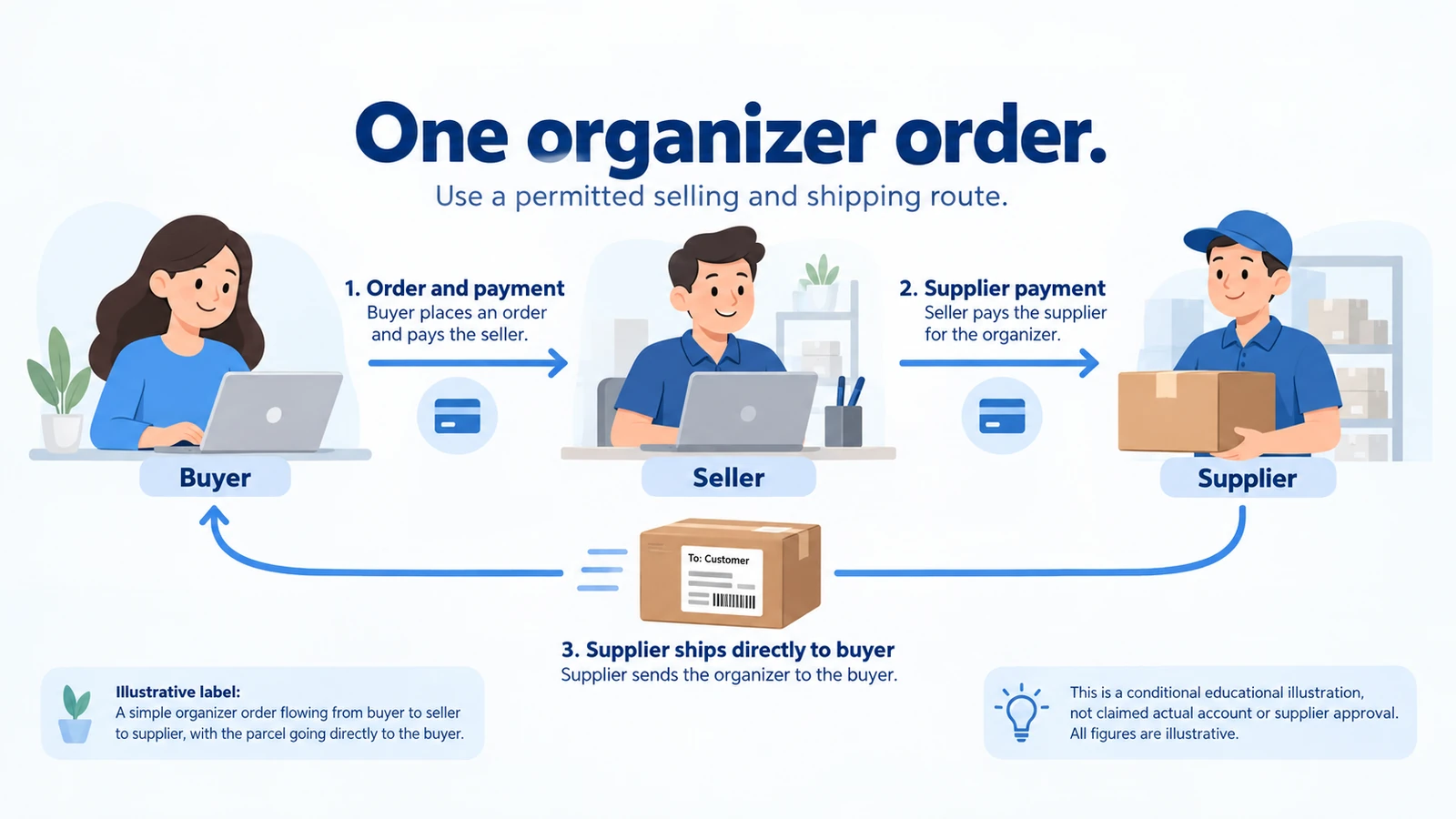
You can use a supplier to send a Marketplace order only when your account, product and selling arrangement meet Meta’s rules and the delivery option actually available to you. A supplier saying “we dropship” does not settle those questions. Start by finding out how the buyer will pay and how the item will reach them.
Meta’s Seller Agreement allows sellers to use compliant third-party service providers, while keeping the seller responsible for their work. That is useful support for outsourcing tasks; it is not approval for every supplier catalog or every Marketplace account. Its Commerce Policies also warn that commercial selling may be restricted in the EEA, the Philippines and India.
Use one exact organizer as the starting point
Imagine you want to sell a grey desk organizer. You need to know the exact item, how the buyer will pay, whether your supplier can send the parcel through that order route and how you will fund the purchase. The dimensions and costs below are illustrative; no seller account or supplier shipment was tested for this guide.
Explore the broader topic: Best Dropshipping Platforms: Choose Where You Will Sell.
01
First find out how your buyer will pay and receive the item
Open Marketplace and begin Create listing → Item for sale, where those options are offered. Add the product details, then look at the delivery choices and any seller-payment setup requested. Finish the required identity, tax and bank information truthfully before relying on a paid-order route. Labels and availability can differ between accounts.
There are three arrangements worth distinguishing:
| What the buyer sees | How the purchase works | What it means for your organizer |
|---|---|---|
| A local listing and a conversation | Buyer and seller arrange payment and a handoff | You need a genuine way to provide the item locally. Receiving and inspecting stock before pickup is local resale, rather than supplier-direct dropshipping. |
| An eligible shipped listing with onsite checkout | The buyer pays through Meta; you manage the order and parcel in the available selling tools | The supplier must fit that exact order, label and dispatch process. The US fees and protection conditions below apply to this route. |
| An eBay or Poshmark partner listing | The buyer leaves Marketplace to pay on the partner’s website | Follow that platform’s seller rules and fees. It is not a personal Marketplace checkout order. |
On a phone, swipe the table sideways to compare every column.
Meta’s November 2025 announcement describes partner redirects. Its March 12, 2026 announcement, rechecked October 11, describes prepaid labels and a shipping dashboard. Neither gives every seller the same features.
The fee, handoff and dispute details below come from Meta policy text retrieved September 28. Those policy pages were blocked during the October 11 refresh. Check your actual account and order terms before relying on the figures.
Location matters too. Singapore’s government Marketplace guide describes local, off-platform transactions. That should not be replaced with US checkout advice. If your listing only offers pickup, do not promise that a remote supplier will mail it as though an onsite shipping order exists.
What to confirm before the organizer goes live
Use the account that will actually sell the organizer. You are checking what it permits, not just whether a listing form opens.
Delivery and payment
Does the actual listing offer pickup, onsite shipped checkout or a redirect to another platform? Read the conditions for that route. If your supplier cannot fulfill it, leave the organizer off sale rather than treating another seller’s shipping option as permission.
Label, deadline and charges
For an eligible shipped route, confirm who buys the required label, where the parcel can originate, the handoff deadline and the fee calculation. Keep the applicable terms and the order’s instructions. If a term differs from the teaching example below, use the actual term and recalculate.
For pickup, receive and check the goods before promising collection. For a partner redirect, follow the platform that takes payment and runs the order. A successful listing draft has not tested checkout, supplier acceptance or carrier handoff.
02
Pick one organizer you can actually send
Start with an item you can explain and a supplier who can dispatch it through your available route. For this organizer, a nearby wholesale supplier with dependable stock and a workable return address may be a better starting point than a cheaper overseas offer with an uncertain dispatch date. “Domestic” alone does not prove either reliability or Marketplace eligibility.
Search comparable Marketplace listings before committing. Compare the total delivered price, size, condition and waiting time. A used organizer available nearby may be a much better deal for the buyer. Your new one needs a real reason to choose it, such as the right compartment size and clear measurements—not a copied “winning product” badge.
Give the supplier the exact variant and order route
Ask the supplier about the exact product choice. Its SKU is the code identifying one version: the grey organizer may have a different code from the black one or a two-pack. Find out whether that version is ready to send, how long packing takes, which carrier receives it and who deals with a damaged or unwanted item. Agree that substitutions need your decision; a similar-looking product should not silently replace the one sold.
Check the organizer and its actual box
Order a sample and check the organizer and its final box. An illustrative listing might say: “Grey desk organizer, 12 × 8 × 5 inches; one organizer included.” Only use those dimensions once your actual product supports them. Show the compartments and material, use photographs you own or have permission to use, and explain the delivery charge and returns. Meta’s Seller Agreement makes accurate listings and listing-asset rights your responsibility.
Find out who can use the required label
The parcel deserves a separate check. Can the supplier print and use the label your order requires? Does the label’s origin match the actual dispatch location? Are the packed weight and dimensions accurate? Meta may charge you for a carrier adjustment caused by underreported measurements. If the supplier insists on its own incompatible label, fix that before offering shipped orders.
A useful sample test ends with the right organizer arriving through the intended carrier route. It can reveal a wrong color, weak box or label mismatch before a buyer pays. Listing software cannot make those physical checks for you.
03
Price the buyer’s whole checkout, not just the item
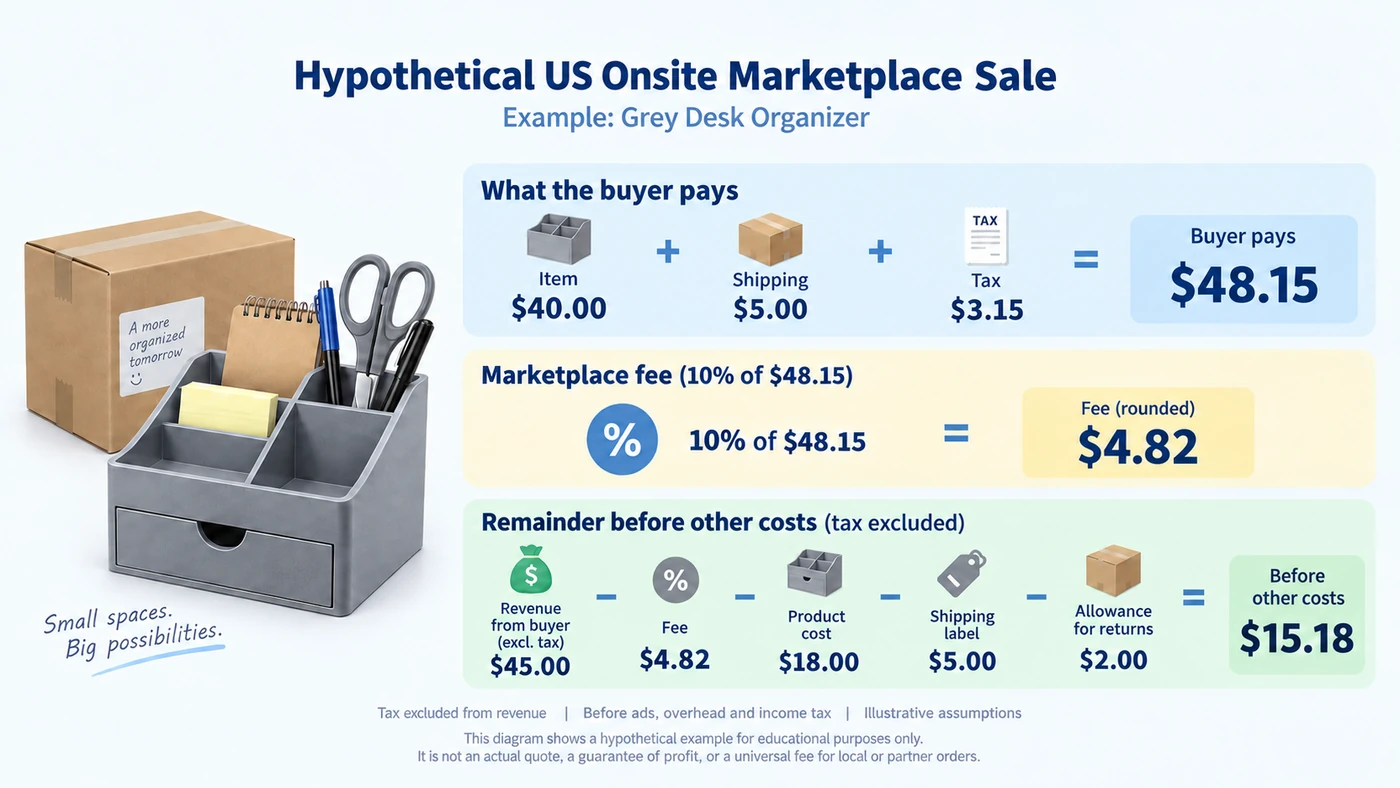
The US onsite Checkout Terms retrieved September 28 list a selling fee of 10%, with a $0.80 minimum, calculated on the item, shipping and tax total. Use the current terms shown for your transaction; this rate does not apply to every Marketplace route.
Here is a hypothetical organizer sale in US dollars. Assume the buyer pays $40 for the item, $5 shipping and $3.15 tax collected and remitted by the platform. Also assume an $18 supplier product cost, a $5 label and a $2 allowance for order problems. These are planning numbers, not a supplier quote, actual tax determination or promised profit.
| Part of the calculation | Amount |
|---|---|
| Buyer’s complete payment: $40 + $5 + $3.15 | $48.15 |
| Selling fee: 10% × $48.15, rounded to cents | −$4.82 |
| Item and shipping revenue; tax excluded | $45.00 |
| Supplier’s organizer, excluding shipping | −$18.00 |
| Parcel label, counted once | −$5.00 |
| Assumed allowance for order problems | −$2.00 |
| Amount left: $45 − $4.82 − $18 − $5 − $2 | $15.18 |
On a phone, swipe the table sideways to compare every column.
That $15.18 still has to cover any advertising, software, overhead and income tax. The collected $3.15 is not your revenue, even though it enters the fee calculation. If you negotiate a lower price in messages, recalculate before accepting it. For a very small transaction, use the $0.80 minimum rather than a smaller 10% result.
Fund purchases before the payout
Now separate that calculation from your bank balance. The supplier may need payment before Meta releases the customer money. If you must pay the $18 item and $5 label upfront, ten orders need $230, even while the sales look profitable. If your actual label is deducted from a later payout instead, change the cash forecast accordingly; do not pay or subtract the same label twice.
We did not confirm a fixed payout day for every account. Use your actual payment setup and order disclosures, allow for holds or disputes, and keep refund money available. A $2 planning allowance does not mean a full $40 customer refund costs only $2.
04
Follow the first paid order all the way to the carrier
A message saying “I’ll take it” or an image of a payment is not an order ready for dispatch. For an onsite sale, find the actual order in your selling tools and follow its payment and shipping instructions. Then move the organizer through these steps:
- Match the order. Confirm the grey variant, quantity and usable delivery address. Keep the buyer’s order reference with the supplier purchase so that two similar orders do not get mixed up.
- Confirm supply and pay. Make sure the promised version is available and the supplier accepts the dispatch requirements. Send the necessary order details and payment through the agreed process; avoid sharing unrelated customer information.
- Prepare the required label. Give the supplier the label accepted for that order, with accurate packed measurements and the correct dispatch information. Decide who prints it and hands the parcel to the carrier.
- Look for a real handoff. A tracking number can exist while the organizer is still on a packing table. Follow the carrier’s receipt or acceptance event, rather than treating “label created” as shipment.
- Follow delivery. Watch for movement or exceptions and give the buyer useful updates. An accepted parcel can still arrive late or damaged.
- Close the right case. Keep delivery and any refund, return or supplier claim connected to that same order. A refunded customer order is not automatically a canceled supplier purchase.
The shipping-performance guidance retrieved September 28 says the carrier must receive the parcel within seven calendar days and describes a 90% timely-handoff target. Check the actual order deadline and current account conditions. Buying a label alone is not carrier receipt.
Seven days is an outer handoff requirement, not permission to ignore a faster promise. If your listing says the organizer arrives by Friday, a Thursday carrier scan followed by five days of travel does not fulfill that promise. Add the supplier’s preparation time to the carrier’s travel time when setting expectations.
An unavailable color needs a buyer decision
If the grey organizer sells out, pause that choice and contact the buyer about a supported alternative or cancellation. Do not send black without consent. Before retrying a failed supplier request, find out whether the first purchase succeeded; otherwise you could buy twice. Meta’s performance help distinguishes seller cancellations from buyer-requested cancellations, so follow the real reason and available process rather than relabeling a seller failure.
05
Handle a cracked organizer before it becomes a bigger dispute
Suppose the buyer opens the box and finds a cracked compartment. Reply, identify the order and ask for proportionate details that help explain the damage. Arrange the appropriate customer remedy and any authorized return. Separately, send the damage details to the supplier and pursue reimbursement. The buyer should not have to wait for your supplier dispute before receiving a remedy you owe.
Meta’s Seller Protection Policy has several different clocks. For the onsite purchase process described there:
| Event | Time stated in the policy |
|---|---|
| Buyer contacts the seller about a delivered purchase problem | Within 3 days of delivery |
| Seller responds and tries to resolve the issue | Within 2 days of the buyer’s request |
| Buyer submits a claim to Meta | Within 7 days of delivery; a separate 60-day period applies to unauthorized claims |
| Seller supplies supporting documents after a Meta buyer-claim notice | 48 hours |
| Seller responds to a card chargeback with relevant evidence | 10 calendar days |
On a phone, swipe the table sideways to compare every column.
These are different steps, not a universal return window or a reason to disregard applicable customer rights. Follow the notice for the actual case, your listing’s return terms and local law. Before asking the buyer to mail anything, provide the approved return destination and instructions; the supplier’s factory address is not automatically a customer return address.
Protection has transaction conditions
Seller protection is conditional: the policy covers eligible US items priced at $500 or less when buyers use onsite checkout and sellers use Meta-issued prepaid labels, among other requirements. Valid tracking, timely handoff and the correct address matter. A local transfer or third-party payment does not inherit that protection.
Keep a card dispute separate from the return
A chargeback is a separate card dispute. Meta says it may deduct the disputed amount and a $20 fee while the issuer decides, then credit those amounts back if the seller wins. Respond to Meta’s notice with the matching order, listing, messages and shipment evidence; individual sellers cannot file the card dispute themselves. A supplier refund does not close the buyer’s bank case.
Act on a late shipment before the buyer complains. For covered US merchandise orders, 16 CFR Part 435 requires a reasonable basis for the shipping promise and a delay-consent or prompt-refund process when you cannot meet it. Marketplace’s shorter carrier-handoff rule still applies.
06
Fix the actual obstacle before adding more listings
Use the failed step to decide what to fix next:
| What stopped the sale or shipment? | Next check |
|---|---|
| Shipping is missing from your selling options | Check the account country, item eligibility and restriction shown in Marketplace → Sell → Insights. Use the review or support route where offered. An app cannot grant an unavailable selling feature. |
| Shipping is available, but the supplier cannot use the required label | Confirm the real origin, packed size and weight, label and carrier instructions. Choose a compatible supplier or another legitimate sales channel; do not upload unrelated tracking. |
| A label exists, but the carrier has not received the parcel | Ask the supplier whether that order is waiting for stock, packing or collection. Update the buyer and address any missed promise before adding more listings. |
On a phone, swipe the table sideways to compare every column.
For a product you plan to source in China, AIDrop’s product-sourcing service can help discuss the exact item, samples, quality checks, packaging and a feasible shipping arrangement. Send us the product link, destination, expected order count and the dispatch or packing problem you need help with. We can assess the supply questions; we cannot approve your Marketplace account or promise a route that meets its deadline before the details are known.
07
Questions before you list
Can I buy from an overseas supplier after each sale?
Only if the product and arrangement are permitted and the supplier can meet the actual label, carrier-handoff and customer-delivery requirements. A cheap overseas product with a long processing period is a poor fit for a seven-day carrier deadline. Do not advertise a domestic dispatch location if the parcel really starts elsewhere.
Do I need money if the customer pays first?
Usually you need some working cash: money available for supplier purchases, labels and refunds while receipts are unavailable. In the illustrative order above, goods and label total $23. The money collected from a buyer and the money available in your bank are different amounts at different times.
Can I use the supplier’s product photos?
Only with permission to use those images and a listing that accurately depicts the item you will send. Ask for rights to the specific photos, compare them with a sample and show the exact variant and included pieces. A supplier’s photo library does not establish that the parcel or shipping route meets Marketplace requirements.
What if Marketplace cannot support my offer?
Choose a channel whose rules and order process fit it, or receive suitable stock before offering a genuine local handoff. The store platforms and operations hub compares the wider decisions. Keep the first product small enough that you can understand its listing, payment, parcel and customer remedy before repeating it.

Etsy Dropshipping: What You Can Sell and How to Fulfill It
Check Etsy dropshipping rules, eligible supplies, production partners, listing details and the real costs of fulfilling an
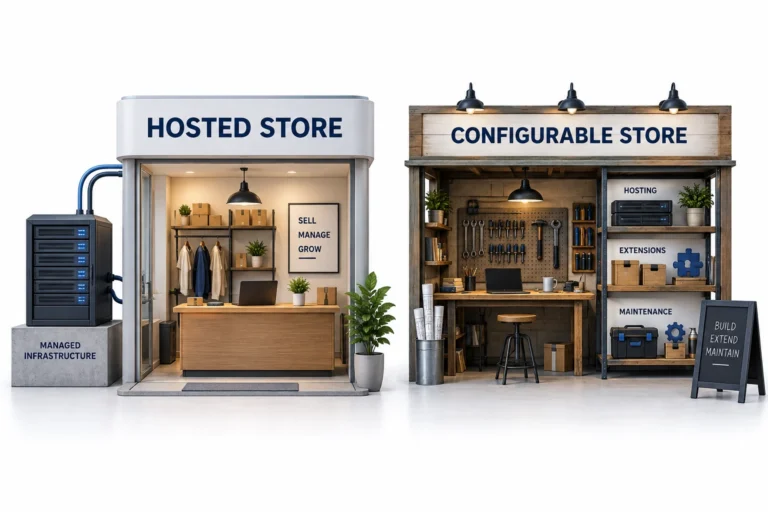
Shopify vs WooCommerce for Dropshipping: Which Fits Your Team?
Compare Shopify and WooCommerce for dropshipping: hosting, maintenance, supplier integrations, operating costs, and the best fit for

Shopify vs Amazon for Dropshipping: Choose Your Selling Channel
Compare Shopify and Amazon for dropshipping by customer acquisition, fees, supplier requirements, brand control, and the selling
