
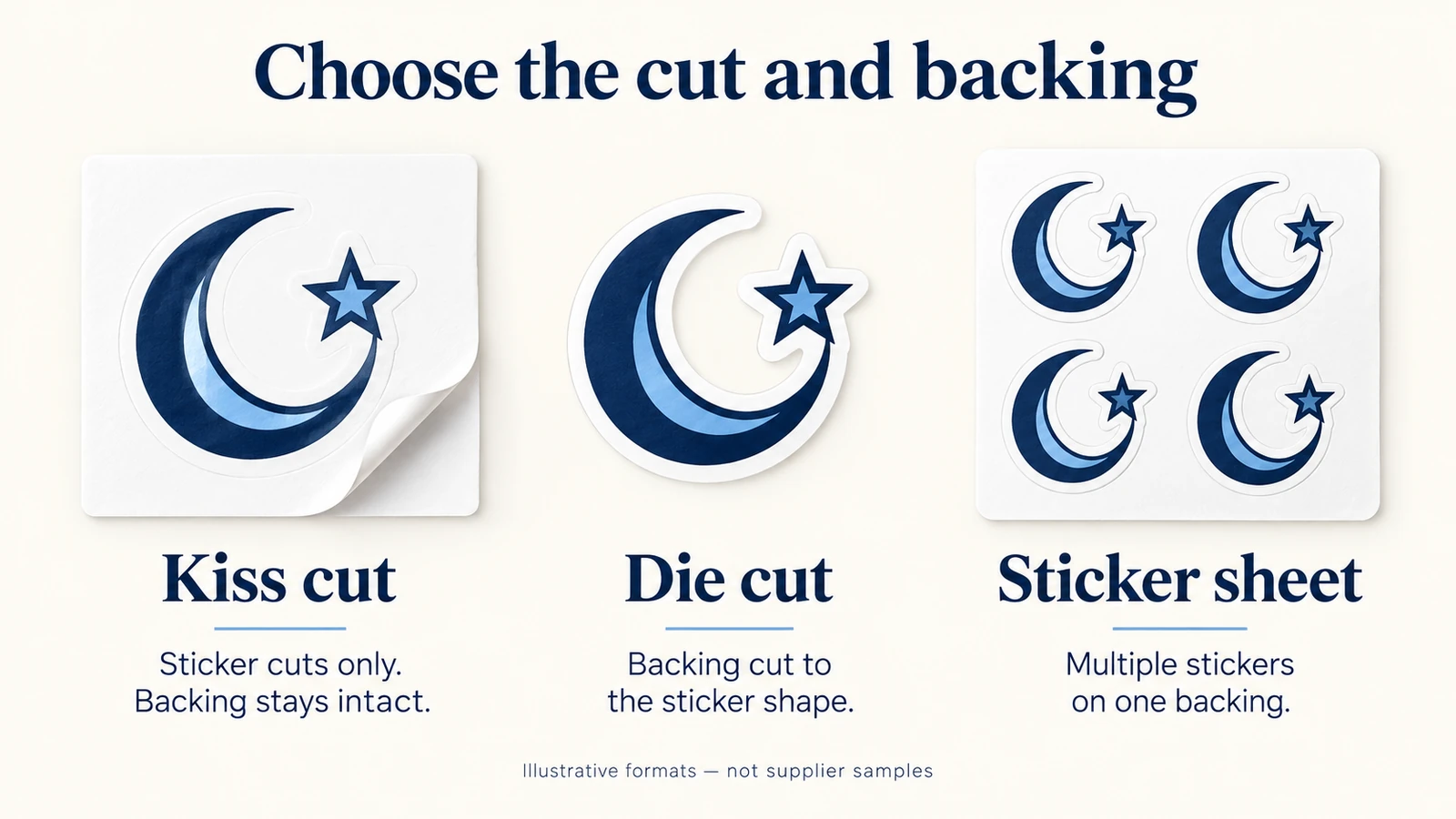
Yes, a supplier can print, cut and ship your sticker design after a customer orders it. Start with where the buyer will put it. A notebook, bottle and outdoor sign can call for different material and adhesive, so “custom sticker” is not a complete specification. Choose the surface, finish, cut and quantity, approve the matching artwork template, inspect a sample and calculate the price of the delivered order.
Suppose you want to sell a small illustrated moon sticker for laptop lids. That hypothetical product needs a clean cut, readable artwork and an adhesive suitable for the stated surface. It does not automatically need an outdoor-life claim, and a good-looking mockup does not establish one.
A buyer may instead want to put the same picture on a bottle, bicycle or delicate painted surface. Those are different uses. Water exposure, curvature, coating and removal can change whether the sticker is suitable.
Your store owns the design offer and the customer relationship; the supplier handles the agreed printing and dispatch. The general print-on-demand guide explains that arrangement. The practical task here is to select a sticker that does what your listing actually promises.
01
Choose the cut, backing and sale quantity
The cut determines what the customer peels and what arrives in the parcel. It also affects whether a small design can keep its fine details.
| Format | What the customer receives | Check before selling |
|---|---|---|
| Kiss-cut sticker | The sticker is cut while surrounding backing remains. | Printed shape, backing size and any white border. |
| Die-cut sticker | The backing is also cut around the shape. | How close the cut can follow narrow points or small details. |
| Sticker sheet | Several peelable designs on one backing sheet. | Sheet dimensions, design spacing and number of stickers. |
| Pack | A stated quantity of singles or sheets. | Exact contents and whether they travel in one parcel. |
On a phone, swipe the table sideways to compare every column.
Product size and printed picture size can differ
A two-inch product option may describe the product’s bounding dimensions rather than a two-inch-wide moon. A wide border or surrounding backing can make the printed illustration smaller. Show the actual design size when that distinction affects the buyer.
Opaque white vinyl gives your picture a white base. Clear material lets parts of the surface show through, but the printing and white-ink options depend on the provider. A transparent digital file does not automatically mean a physically transparent sticker.
A useful first product request
For the moon design, a starting brief could say:
One indoor laptop sticker, opaque white vinyl, kiss cut, approximately two inches across the finished design. Keep the moon and star together as one peelable piece. Confirm the printed dimensions, white border, backing size, adhesive description and accepted file. Quote one sticker to the target postal code, plus an alternative pack with its exact contents and parcel count.
One moon and star need the intended cut
The dimensions in this request are proposed, not a confirmed supplier specification. Ask for a cut preview showing the actual shape. A detached tiny star can become a separate peelable sticker when the provider’s cut system treats disconnected artwork as separate pieces.
Keep the sale quantity explicit. “Four stickers” could mean four singles, one sheet with four designs, or four sheets. The design file, customer photograph and order quantity should all describe the same product.
02
Check adhesive and weather claims on the exact product
The exact sticker’s specification controls the offer. Printify’s broad custom-sticker page describes waterproof vinyl, but its product 400 kiss-cut sticker explicitly says it is for indoor use and is not waterproof. You cannot borrow the category claim for that product.
For the illustrative laptop sticker, that means describing an indoor sticker on a suitable smooth, flat surface. If the buyer wants a bottle sticker exposed to washing, choose a product whose actual specification supports that use and investigate the relevant conditions. Changing the wording alone does not change the adhesive or material.
Three questions need separate answers:
- Will it stay attached? Check adhesive type, application surface and conditions. Curved or textured surfaces can behave differently from a flat laptop lid.
- Will the picture withstand the stated exposure? Water, sun and rubbing are different conditions. A water-resistant material is not proof of dishwasher durability.
- What happens when it comes off? Permanent, removable and repeatedly reusable are different descriptions. Age and the surface coating can affect removal.
Printful’s kiss-cut guidance calls for a clean, flat surface and notes that reapplication weakens adhesion. That does not support a promise that customers can move the sticker between devices indefinitely.
Removal advice needs the surface too
3M’s removal bulletin explains that adhesive removal depends on conditions such as age, UV exposure and substrate integrity. Its techniques concern the relevant 3M systems; they are not universal instructions for every laptop, painted wall or third-party sticker.
Do not tell a buyer to use a solvent or heat simply because another sticker shop suggests it. Check the device or surface manufacturer’s guidance and the actual sticker provider’s instructions. If the surface is delicate or damage would be costly, the product may be unsuitable for that use.
Your listing can be precise without claiming more than you know: “Indoor kiss-cut sticker; apply to a suitable clean, smooth, flat surface. Follow the surface and sticker manufacturer’s instructions.” Add a stronger weather or removal claim only when its evidence matches the product and conditions.
03
Choose a route and prepare the artwork
Compare the route as well as the sticker. A one-piece POD order and a bulk print run have different costs, packing and commitments.
| Named option | Useful distinction |
|---|---|
| Printify product 400 | Four size options from two to six inches; white or transparent choices, permanent acrylic adhesive and an indoor-use limitation. |
| Printful kiss-cut singles | Opaque white vinyl with its own size, border and application instructions. The sheet product is a different selection. |
| Prodigi GLOBAL-STI | A removable-vinyl kiss-cut route with no minimum order and UK/EU production locations stated on its product page. |
| Stickerbeat custom kiss cut | A bulk route with a 50-sticker minimum; do not describe it as a confirmed automatic one-customer POD order. |
On a phone, swipe the table sideways to compare every column.
Sources checked September 28, 2026 show starting components such as $1.42 plus shipping from $4.29 for Printify product 400, and $2.34 plus shipping from $4.49 for Printful singles. Those are not complete quotes for your variant, destination or pack.
Build the actual sample order
- Open the provider account and select the exact sticker product, size, material/backing option and available production provider. Confirm the destination is supported.
- Download or inspect that product’s artwork template. Check the printable area, border and safe area where important artwork must stay away from cuts.
- Export in its accepted format and review the actual cut shape. For Printify’s stated sticker workflow, use a transparent PNG and remove stray pixels or unintended detached elements.
- Confirm how many stickers or sheets are in the item, then request the shipping price for that exact quantity and address.
- Place a sample order and inspect it before publishing the final product. Connect an available store route or prepare manual order submission only after confirming what the provider supports.
Printify’s artwork guidance includes size-specific spacing. Do not apply one pixel gap to every option. A detached star, tiny speck or unconnected letter can affect cutting even if it seems harmless in the large preview.
Check whether the moon and star peel together
In Printify’s Product Creator, use Preview to inspect the cut outline for the selected size. Its current sticker guidance, rechecked October 11, explains that disconnected artwork can become separate cuts.
The intended one-piece sticker
Check whether the preview gives the moon and star one connected peelable outline. If it shows two cuts, revise the composition within the provider’s rules—for example, move the elements closer or use a permitted connecting design—then check the new outline. Do not promise one piece from two unintended cuts.
Two deliberately separate pieces
For separate cuts, the guide gives minimum gaps of 65 pixels for the 2 × 2-inch option and 110 pixels for 3 × 3 inches. Those values answer the separate-cut question. They do not guarantee that a detached star will join the moon.
After changing size or artwork
Reopen the selected size and Preview, check for stray pixels and count the intended peelable pieces. A gap checked at 2 × 2 inches is not automatically adequate at 3 × 3 inches. Save the final file and size with the approval.
When the sample arrives
Compare the cut, design and backing dimensions with that record. Confirm that the actual sticker peels as promised. The digital outline helps catch a mistake; it does not establish adhesion or waterproofness.
These are proposed preview and sample checks, not a Product Creator or sticker test performed for this article. The sheet-spacing guidance is separate from the individual-sticker values above.
Prodigi’s product page recommends 300 DPI and accepts 200 DPI, with its own padding instructions. DPI describes how many image pixels occupy an inch of print. It does not rescue an image with too few pixels when enlarged.
StickerApp’s editor can generate a cut outline, or its preparation route can use a separately supplied cut line. Follow its instructions rather than adding a colored outline that accidentally becomes printed artwork. For a name or other customer-specific design, keep the approved spelling and file with the order; the personalized-product guide covers that approval relationship.
04
Make a single sticker or a pack worth shipping
Low product cost does not guarantee a profitable order. For a small sticker, postage can exceed the printing charge. Include processing, promotion, packing and likely customer remedies before deciding the price.
Single versus pack: a hypothetical quote
Assume an indoor moon sticker costs $2 and shipment costs $4.50. A supplier separately quotes a four-single-sticker pack at $8 with one $4.50 shipment. This pack is an illustrative quoted arrangement, not a claim that Printify product 400 automatically offers that bundle. Assume the quoted supplier amounts include packing and all charges assigned to the seller; verify taxes, duties and exceptions in a real quote.
| Component | Single sold for $9 | Four-pack sold for $20 |
|---|---|---|
| Printed stickers | $2.00 | $8.00 |
| Quoted shipment | $4.50 | $4.50 |
| Payment processing | $0.55 | $0.90 |
| Advertising | $1.20 | $2.50 |
| Expected remedy allowance | $0.25 | $0.60 |
| Total listed costs | $8.50 | $16.50 |
| Contribution before other bills | $0.50 | $3.50 |
On a phone, swipe the table sideways to compare every column.
The pack earns more in this example because its one parcel carries more product value. If it ships as four separately charged items, the comparison changes. Obtain the actual pack’s shipping and packing terms before building your offer around that saving.

Printify’s pack guidance describes particular bundle options and recommends packs as a way to improve the shipping-to-product-cost relationship. It does not establish that any arbitrary mix of providers will combine into one parcel.
One $6.50 sample costs thirteen single-order contributions at $0.50 each to recover, before other expenses. Ten illustrative pack orders leave $35 contribution; subtracting that sample leaves $28.50. Neither amount includes every business bill or pays you for your work.
Keep money available before the payout
With $250 available after the sample purchase, ten pack orders need $125 in supplier payments and $25 in ads, leaving $100 while customer receipts are pending. A $20 refund for one customer’s pack order and a $12.50 replacement for a different customer’s pack order would reduce that balance to $67.50. Processing charges and other bills still need funding.
An allowance is not a refund already paid
The remedy allowance above is an estimate, not a second refund payment. Track actual losses separately, and count a supplier credit only when it is approved and usable. A pack can suit themed designs or gift sets, but the price still needs to make sense to the buyer; adding unrelated stickers solely to increase order value can weaken the offer.
05
Use the sample to set the listing and packing
Inspect the moon sticker before sticking it anywhere. Does the cut follow the intended shape? Are the star and moon one piece? Is the border even enough for the design? Measure the printed sticker and the backing separately, and compare the quantity with the order.
Then check the declared use on a suitable surface you own and can safely use for that purpose. Record the surface, preparation and observation period. Looking at one sample on a laptop does not establish years of outdoor life, dishwasher resistance or damage-free removal from every coating.
Save an approval the next order can use
Keep the actual provider product/variant, size, file version, cut preview, accepted sample photos and packing description. The print-file and sample guide explains why these references should stay together.
The customer-facing product description should state:
- Actual design and dimensions, including an important border or backing distinction.
- Single, sheet or pack contents and the number supplied.
- Material/backing option and the supported indoor or outdoor use.
- Suitable application surface and provider instructions.
- Production period and shipment estimate for the selected route.
Use artwork you own or have permission to reproduce commercially. If a customer supplies a name or image, confirm the final file and spelling before production. A mockup showing your design on a device is an illustration of placement, not evidence of device-maker endorsement or long-term adhesive performance.
At order time, match the store SKU to the supplier product, size, file and quantity. Check the postal address and shipping selection. If the provider changes material or becomes unavailable, confirm the replacement and update the offer rather than silently substituting it.
Ask how singles are protected from bending and whether a pack stays together. Production time and parcel transit are separate. A shipping label created today does not establish carrier collection today, so use actual dispatch and tracking events when answering the buyer.
06
Handle a misprint, damaged sticker or wrong expectation
Find the actual cut or quantity fault
Ask for the order number and photos of the sticker and backing; add packing photos for bending or transit damage. Compare these with the approved file and listing. A missing star, short sheet count and an indoor sticker used outdoors have different causes.
If the supplier misprinted the moon or cut through an essential part, request its defect remedy with the reference and photos. If your listing incorrectly promised dishwasher-safe use, correct the listing and address the buyer’s problem; supplier refusal does not fix an inaccurate customer promise.
Choose the remedy for that order. Refund and replacement are usually alternatives. Record whichever response you give and its cost; do not assume the supplier will pay it.
Check the supplier’s claim terms separately
Printful’s supplier policy describes 30-day claim windows for defects, damage and misprints, and separate timing for lost parcels. It normally excludes buyer remorse or wrongly selected variants. Your obligations to a customer also depend on your promises and applicable consumer rules; the upstream policy is not a universal “custom products cannot be returned” rule.
A pending supplier credit is not cash for today’s customer refund. A wallet credit may only pay for future supplier purchases.
For a China-side custom sticker or pack supplier, AIDrop’s product-sourcing service can help clarify the material, dimensions, sample and packing request. Send the product/supplier link, intended surface, destination and the question through contact. That coordination does not certify an adhesive or establish a waterproof claim.
07
Frequently asked questions
Can a supplier ship just one sticker?
Some named POD routes accept individual orders; other printers require a batch. Compare the delivered price and packing, not only the minimum. A cheap sticker with a separate shipping charge may leave little room for promotion or a replacement.
Is a sticker sheet the same as a pack?
A sheet holds multiple designs on one backing. A pack contains a defined number of singles or sheets. Specify both the sale quantity and the physical contents, and obtain the actual parcel arrangement.
Are vinyl stickers automatically waterproof?
No. The selected product and its stated conditions matter. Printify product 400 explicitly lists indoor use and says it is not waterproof, despite broader category language. Check the SKU you intend to sell before making weather or washing claims.
Does removable mean reusable or residue-free?
Those are separate claims. Adhesion can weaken after reapplication, and removal may depend on age, surface and conditions. Use the actual provider’s instructions and avoid universal promises about painted or delicate surfaces.
Why does the provider want a transparent PNG?
In the applicable workflow, transparency helps the system identify the artwork shape rather than a surrounding rectangle. Stray pixels and disconnected elements can still affect cutting. Follow the exact product’s file instructions; another provider may use a supplied cut line or a different accepted format.
What is a sensible first offer?
A clear design for a defined surface and a stated single, sheet or pack can be easier to describe and sample than a sticker advertised for every use. Proceed when the accepted sample, complete delivered cost and customer promise agree.
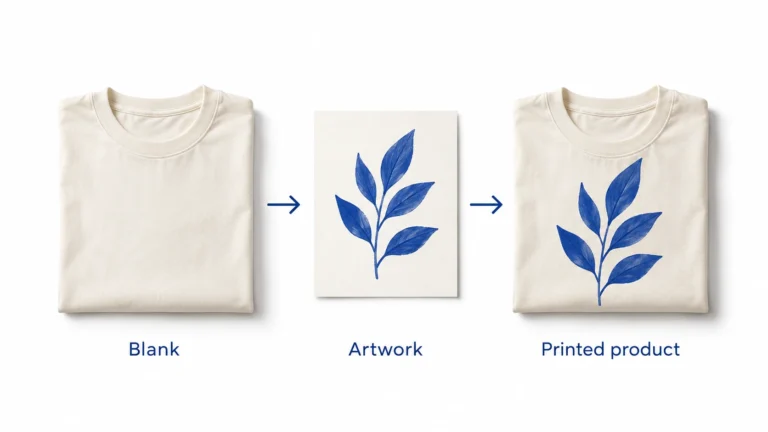
Print on Demand Dropshipping: From Design to a Fulfilled Product
Understand print-on-demand dropshipping, approve designs and samples, calculate full order costs, and manage production, delivery and customer
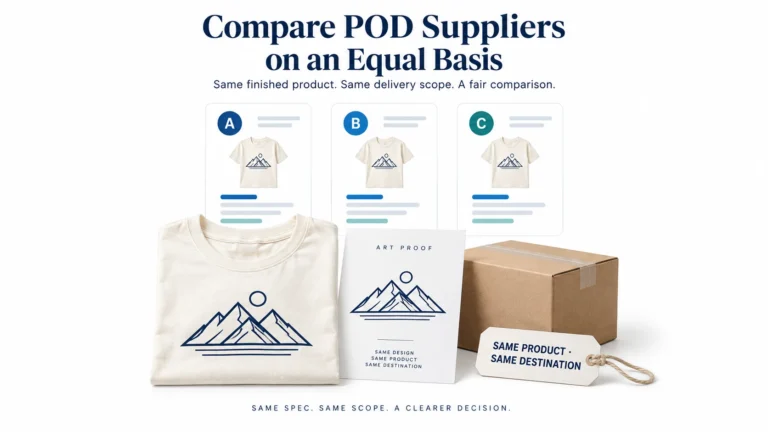
Print on Demand Suppliers: Compare Production, Proofs and Fulfillment
Compare Printful, Printify and Gelato by product, routing, samples, complete order cost, integration and returns before choosing
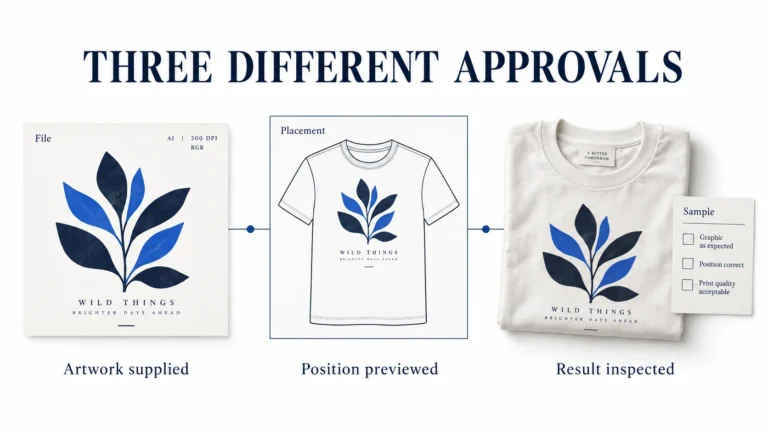
Print-on-Demand Files and Samples: Approve the Actual Print
Prepare each print file for the exact provider, product and print area, using its current template and
