
Dropshipping is a retail fulfillment method in which a store sells a product and a supplier ships it directly to the customer. The store usually buys the item for that order instead of holding its own stock beforehand. The customer buys from the store, so the store still has to make the offer accurate, arrange fulfillment and resolve problems.
That arrangement can reduce the money tied up in unsold inventory. It does not remove product costs, customer acquisition, delivery problems or the work of running a retail business. A useful way to assess dropshipping is to follow both the customer’s order and the money: who has promised what, who can verify it, and what remains after the order is finished?
This guide follows that whole process, from choosing a product and checking a supplier to calculating contribution, handling refunds and deciding whether to scale. The examples use a hypothetical desk organizer, so you can see how the decisions connect without treating the numbers as a forecast for your store.
01
Dropshipping models explained
Ecommerce describes selling online. Dropshipping describes how an order is fulfilled. An online store can dropship some products, hold stock for others and change the arrangement as demand develops. A marketplace can be a sales channel, subject to its seller policies; it is not itself a fulfillment method.
Compare dropshipping with other ecommerce fulfillment choices before deciding how much inventory to hold.
The important distinction is the commitment you make before a customer orders. With conventional stocked retail, you purchase inventory first and arrange storage and dispatch. With supplier-held dropshipping, you depend on stock you may not own or control. A product can be available to several sellers at once, unless your supplier has actually reserved units for you.
| Arrangement | What changes for the merchant | What still needs checking |
|---|---|---|
| Supplier-held dropshipping | Supplier ships individual orders from its stock | Available variants, dispatch evidence and customer remedies |
| Stocked inventory with a warehouse or 3PL | Merchant commits to goods before individual sales | Replenishment, storage charges, picking and aging inventory |
| Print on demand | An item is produced after the order | Production time, print quality and the exact customization offered |
| Private-label or branded supply | Product or packaging carries an agreed brand treatment | Minimum commitments, specifications and version control |
| Affiliate marketing | Publisher refers the buyer to another seller | Accurate promotion and the terms of the referral relationship |
Print on demand can use a dropshipping arrangement, but manufacturing time adds a stage. Private-label products can also be shipped per order, while still requiring an upfront purchase of packaging or goods. Neither label proves that there is no inventory commitment.
A supplier provides the goods; an agent may coordinate suppliers and order operations; a 3PL stores and fulfills inventory. Actual contracts matter more than job titles. Use the agent, supplier and 3PL comparison to identify which responsibility you need someone to take.
02
How dropshipping works: follow one order
Imagine a customer pays your store $45 for a desk organizer. Your supplier charges $18 for the item and $6 to ship it on the agreed route. You send the correct variant, quantity and delivery details to the supplier, pay according to your agreement and receive fulfillment information back.
The order and the parcel take different routes: the order passes through your store, while the supplier sends the parcel to the customer through a carrier. You may never handle the organizer, but your product page and delivery promise still shaped the purchase.
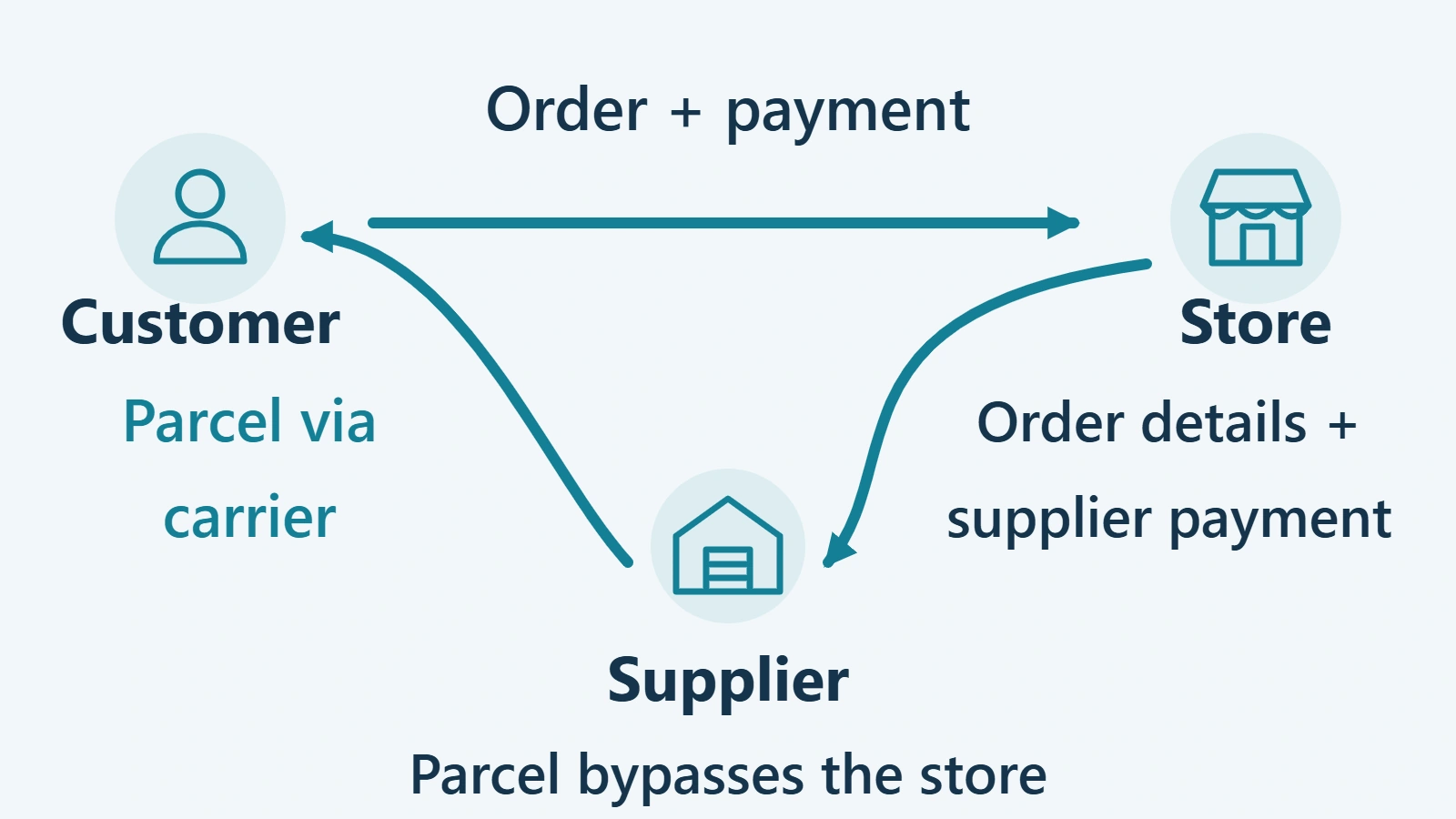
- The customer places an order. Your checkout records the item, address, payment state and any promises made at purchase.
- The order is checked and accepted for supply. Confirm the variant, usable address, payment conditions and stock before release. An integration sending a request is not the same as the supplier accepting it.
- The supplier prepares the parcel. The item and packaging should match the approved version. A missing part or unapproved substitute needs a decision before dispatch.
- A carrier receives the shipment. A generated tracking number may only mean that shipment data or a label exists. Look for the appropriate handoff evidence.
- The store follows the result. Send useful updates, investigate exceptions and handle a remedy if the order fails.
The store needs a record that connects all five stages. Otherwise, customer service may see “fulfilled” while the supplier is still waiting for stock, or a cancellation may reach the supplier after dispatch. Payment, fulfillment and return states should be checked separately; Shopify’s order-status documentation explains that separation within its platform.
For the detailed handoffs, responsibilities and decision points, use the dropshipping operating-model guide. Start with the flow you can actually verify, then automate it.
03
How dropshippers make money
A dropshipper earns money when the revenue retained from customers exceeds the costs of acquiring and completing their orders, plus the wider costs of running the business. The difference between the retail price and the supplier’s product price is only the beginning of that calculation.
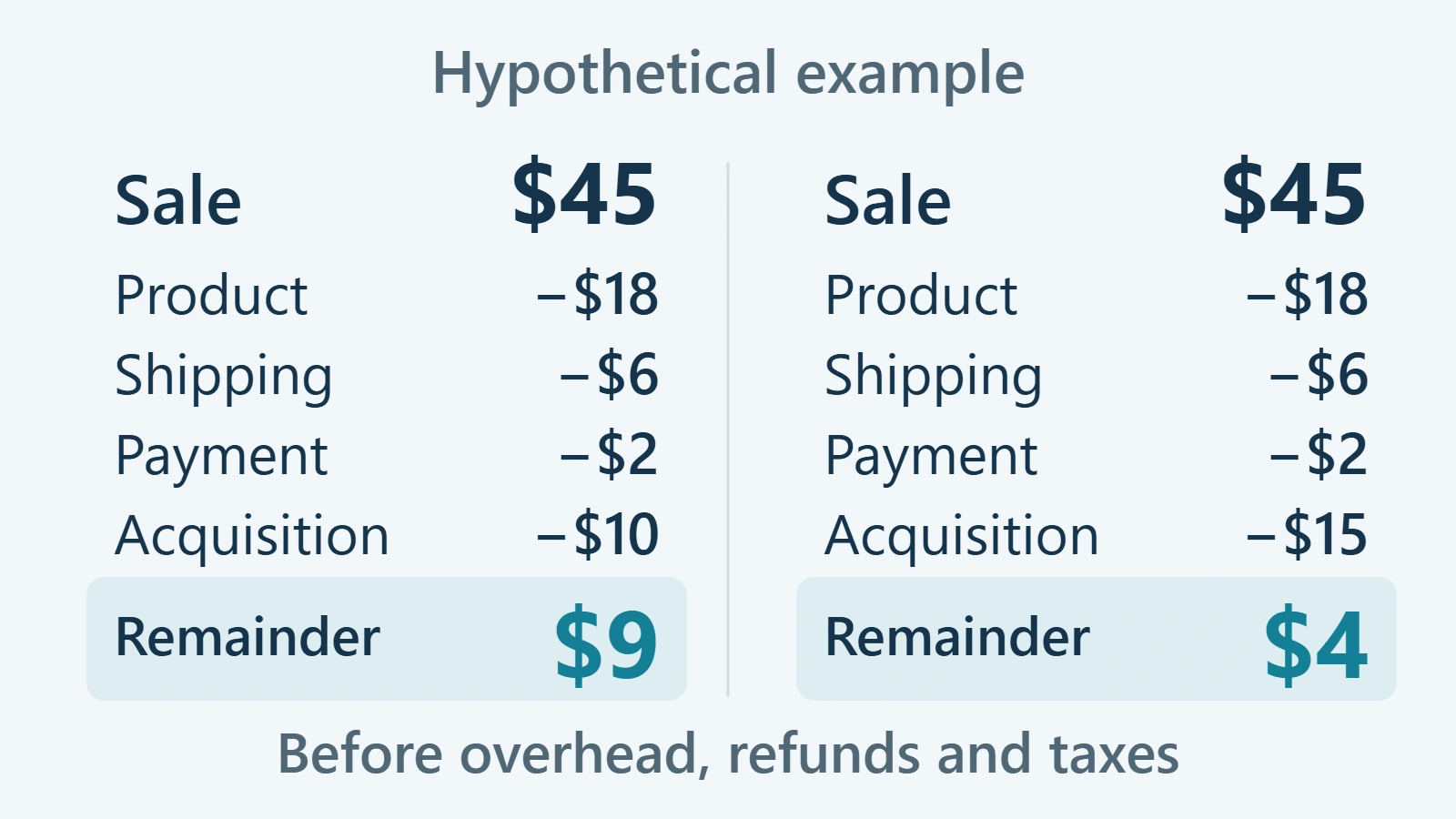
For the hypothetical $45 organizer, assume the following costs. These are illustrative amounts, not supplier quotes, platform fees or typical results.
| Item | Amount per order |
|---|---|
| Customer sale | $45 |
| Product cost | −$18 |
| Shipping cost | −$6 |
| Payment cost assumed for this example | −$2 |
| Customer acquisition cost | −$10 |
| Contribution before overhead, refunds and taxes | $9 |
The same sale can leave a different amount. If acquisition costs $15 instead of $10, the contribution falls to $4. The selling price has not changed, and neither has the supplier quote. The economics changed because it cost more to produce the sale.
Work backward from the contribution you need
If your order leaves $19 before acquisition and you want $9 left after acquisition, the corresponding acquisition-cost ceiling is $10 under those assumptions. That is a planning constraint to test, not proof that customers can be acquired at that price. Include discounts, duties you bear, packaging, marketplace charges and other applicable variable costs before using the ceiling.
Refunds can change the result again. Suppose 100 identical orders initially contribute $900, then five receive full $45 refunds. If their already-counted costs remain spent, with no supplier reimbursement, fee recovery or additional return cost, contribution becomes $675. Five refunds is an assumption for this example, not an expected refund rate. Any actual recovery or extra expense changes the calculation; do not subtract the original product cost a second time.
Profit and available cash answer different questions
The example requires $24 for the product and shipping on each order. If that must be paid before the customer payment reaches your bank, orders create a funding requirement even when their expected contribution is positive. Payment-provider timing, reserves and refunds can widen that gap. Check your own payout terms; Shopify Payments describes its payout process here.
For higher-priced products, assess high-ticket dropshipping through cash exposure, repair support and the cost of a failed order.
Keep an order contribution calculation and a cash forecast. The first helps decide whether the offer works; the second helps decide whether you can fund it. The dropshipping profit-margin example and unit-economics guide take those calculations further.
04
Benefits, drawbacks, and who the model suits
Dropshipping can make it easier to test a product without purchasing a large quantity first. It can also let a small team offer products that would be difficult to warehouse internally. Those benefits are strongest when the supplier already has dependable stock and a suitable route to the customer.
The corresponding tradeoff is control. You may have less influence over stock allocation, dispatch, packing and product changes than a merchant holding approved inventory. The work moves toward specification, evidence and exception handling.
Review the benefits and drawbacks of dropshipping against the control your offer needs.
| Potential benefit | The condition that makes it useful |
|---|---|
| Less cash committed to unsold goods | No hidden minimum purchase, packaging or stock-reservation commitment |
| Easier assortment testing | Accurate product evidence and a supplier able to fulfill small orders consistently |
| Less internal warehouse work | Clear handoffs, dependable packing and useful fulfillment updates |
| More flexible sourcing | Alternatives that have been checked before they are needed |
This model may suit a merchant with a clear customer need, realistic acquisition economics and time to manage suppliers. It is a poor fit for an offer whose appeal depends on a delivery speed the chosen route cannot support, or for products whose safety and performance cannot be adequately verified.
Before choosing it, describe your advantage in one sentence. Perhaps you understand a particular workspace problem and can demonstrate a better-fitting organizer. “The supplier has a large catalog” does not explain why a customer would buy from you rather than an established local seller.
05
Choose a product with a credible customer need
Start with a buyer and a problem. For the organizer, “people buying home-office accessories” is broad. “A buyer whose narrow desk cannot fit a conventional organizer” suggests dimensions to check, photographs to take and competing products to compare.
Demand research should reduce uncertainty about that specific offer. Search interest can help reveal language and seasonality; marketplace listings can show competing offers; reviews can expose repeated complaints. None of those observations alone tells you what your store will sell at a profitable acquisition cost.
Build a short product brief before asking for quotes:
- Customer and use: who uses it, where it fits and what problem it should solve.
- Required specification: dimensions, material, parts, variants and any performance claim you intend to make.
- Delivered comparison: what the customer can already buy, at what total price and with what delivery or return terms.
- Feasibility questions: weight, packing size, breakage, restrictions and the cost of an unusable order.
- Test: the uncertainty a sample, customer conversation or limited sales test should resolve.
Translate complaints into checks. “Too small” becomes measured dimensions shown in the listing. “Arrived cracked” becomes a packaging and route question. “Looks different” becomes a check that photographs, finish and the supplied version agree. This gives research a practical result beyond a list of trending products.
Then estimate the delivered cost and the contribution available for acquisition. A product with obvious demand can still be unsuitable if competitors already deliver it faster and cheaper. The product-research method explains how to compare demand evidence without confusing attention with purchases.
06
Find and audit a dropshipping supplier
A supplier audit should answer several different questions. Does the business exist? Can it supply this exact item? Can it execute the agreed order? Will it cooperate when something goes wrong? A business credential may help answer the first question while saying little about the others.
Ask competing suppliers to quote the same specification, destination and service assumptions. A low product price is not comparable if one quote excludes packing, uses a slower route or allows unapproved substitutions.
| Audit area | Evidence to request or test | Decision it supports |
|---|---|---|
| Business and transaction identity | Verifiable company details, contact and contracting/payment entity | Who you are dealing with and who owes the agreed performance |
| Exact product | Variant reference, current specification and a sample | Whether the product can match the offer |
| Stock and processing | Meaning of “available,” reservation terms and dispatch process | Whether you can make a supported delivery promise |
| Shipping | Route, charges, restrictions and a destination test | Whether fulfillment is feasible for your customer |
| Exceptions | Written terms for shortages, defects, substitutions and reimbursement | What happens when an order cannot proceed as expected |
Use a test order to examine the actual handoff: acknowledgment, picking accuracy, packing, first carrier evidence and arrival condition. Ask who will respond to an order stuck between systems. A salesperson’s fast pre-sale reply does not establish an operational escalation process.
Keep supplier approval limited to what you tested. Passing one organizer sample on one route does not approve a new material, an electrical product or every destination. Recheck changes that affect the customer promise. The supplier-selection checklist gives a fuller investigation sequence; the agent-selection guide helps when you need coordination across several suppliers.
07
Approve product quality and packaging
Define “acceptable” before a disagreement occurs. For the organizer, a reference could include outside dimensions, compartment layout, finish, edge condition, included parts and the approved packaging. Record which version the sample represents and which checks someone must perform before release.
A pre-launch sample shows what that sample is like. A batch inspection examines a defined set of goods about to move. Neither automatically proves that every future unit will pass. ASQ’s explanation of acceptance sampling describes plans with sample sizes and acceptance criteria; a few convenient photos are not a substitute for an agreed inspection method.
Give each failure a consequence
For an agreed inspection, name the lot or order scope, the checks, how units are selected, where findings are recorded and which findings stop release. A wrong variant should not be shipped simply because the box looks intact. A defect that affects safe use needs different treatment from a minor cosmetic difference that is within the agreed standard.
Visual checks also have limits. Product testing and documentation required for a regulated item cannot be replaced by a photograph or a general assurance of “good quality.” Match the verification to the claim and the product’s requirements.
Packaging belongs in the same approval process. Test whether the product moves inside the pack, whether the parts remain together and whether the final parcel dimensions alter the shipping cost. A branded insert can introduce another version to control. Use the quality-control guide and packaging article to turn the approved reference into repeatable checks.
08
Build a store and an offer people can trust
Choose a sales channel by where the customer shops, what evidence the product needs and whether you can fulfill that channel’s requirements. An independent store gives you room to explain the product and manage the customer journey, while leaving you responsible for generating demand. A marketplace offers its own shopping environment, fees and seller rules. Verify the chosen channel’s current policies before listing.
The product page should make the purchase understandable. For the organizer, show the dimensions in a usable context, the actual variant, what is included and any limitation that could cause a mistaken purchase. Use photographs or demonstrations you are entitled to use and that match the supplied item. Avoid promises the supplier’s materials do not substantiate.
Before accepting orders, check these customer-facing details together:
- The displayed price, additional charges and variant choices agree with checkout.
- Processing and delivery information reflects the destination and actual route.
- Returns, refunds and contact information are accessible and consistent.
- Confirmation messages identify the ordered item and explain what happens next.
Then place a test order on a phone as well as checking the desktop page. A persuasive listing cannot compensate for a broken variant selector or an address that disappears in the supplier export. Treat the offer, checkout and fulfillment data as one connected purchase.
09
Attract customers and test the offer
Choose a marketing approach that fits the reason to buy. A space-saving organizer can benefit from a measured before-and-after demonstration. A comparison article can answer a buyer researching sizes. Paid advertising can test a specific message, but the resulting traffic still needs an accurate offer and reliable fulfillment.
Make the first test answer a question. For example: do buyers respond to the narrow-desk use case at a delivered price that leaves enough contribution? Keep the product version and promise stable while testing the message. Changing the price, audience, product and route simultaneously makes the result difficult to interpret.
Follow the whole purchase rather than stopping at clicks:
- Did the right visitor understand the product and reach the purchase decision?
- Did checkout complete, and what did acquisition cost per actual order?
- Was that order accepted, delivered and retained without an avoidable remedy?
- What contribution remained after the recorded costs and recoveries?
An inexpensive click is not necessarily an inexpensive customer. A strong initial conversion rate can also conceal a misleading claim that later creates returns. Compare marketing results with support reasons and delivery outcomes before increasing spend.
Search content, useful demonstrations and customer follow-up can support the business over time. Each needs accurate claims, appropriate permissions and ongoing work. Do not build a forecast on assumed free traffic, repeated purchases or a guaranteed advertising return; measure what your own offer produces.
10
Manage inventory and automate carefully
A supplier’s stock number needs a definition and a timestamp. It may include units promised to other buyers, goods held for inspection or incoming stock that is not ready to ship. Ask what is actually available for your new orders and whether acceptance reserves it.
Shopify, for example, separates available, committed, unavailable and incoming inventory in its inventory-state system. Those labels only help when the underlying data and configuration reflect the operation. They do not independently verify a supplier’s physical stock.
Check variant mapping, fulfillment location, update frequency and behavior at zero stock. If you intentionally accept a preorder, the customer promise must reflect that arrangement. An unnoticed setting that continues selling after stock runs out is not a stock plan. The inventory-management article covers reservation and reconciliation in more detail.
Automate a known decision
Define the event, required conditions, action and evidence of success. An order may be released only after the required payment and product checks, while an unknown variant is held for review. Shopify Flow uses triggers, conditions and actions, but the available data and supported integrations still need checking.
Plan for uncertainty. If a supplier request times out, check whether the order was accepted before sending it again. Otherwise a retry can create duplicate supply. Keep a person responsible for held orders, failed updates and mismatched quantities. Automation can move information; it cannot physically inspect a product. See automated dropshipping fulfillment for a more detailed release-and-recovery workflow.
11
Control fulfillment, shipping, and tracking
Separate processing from transit. Processing includes the time needed to accept, prepare and hand over the order. Carrier transit starts at the relevant handoff, not when the customer first paid. A quoted transit estimate that excludes processing can create an unrealistic customer promise if it is presented as total delivery time.
Evaluate the actual destination, parcel size and product restrictions. A route that works for an ordinary organizer may not accept a battery product, oversized parcel or remote address on the same terms. Seasonal congestion and supplier cutoffs can also affect what you can credibly promise.
Use each tracking stage to answer a specific question:
| Evidence | What it helps establish | What to do when it is missing |
|---|---|---|
| Supplier acknowledgment | The order entered the supplier’s process | Check stock, data and acceptance before assuming dispatch |
| Carrier acceptance event | The parcel entered the carrier network | Investigate an aging label with the fulfillment owner |
| Movement and exception events | How the shipment is progressing | Identify the next action and update the customer when relevant |
| Delivery evidence | The carrier’s reported delivery outcome | Investigate a customer dispute using the actual evidence |
Set escalation windows from the agreed service and route evidence rather than inventing one universal deadline. Customer updates should explain what is known, what is being checked and when the next update will come. The shipping-times article helps build realistic promises; the tracking guide separates a printed label from an actual carrier handoff.
12
Handle returns, refunds, and customer support
Plan three decisions before orders arrive:
- Customer remedy: determine the appropriate refund, replacement or other resolution under the applicable terms and rights.
- Physical item: decide whether a return is needed and establish a usable destination and handling process.
- Supplier recovery: record what the supplier owes and follow the reimbursement separately.
Waiting for a supplier dispute to end does not by itself justify delaying a remedy owed to your customer.
Work through the reported problem
For a damaged organizer, record the item and variant, the reported problem, relevant dates and proportionate evidence. Decide whether a replacement, refund or another agreed and lawful remedy fits the case. If a replacement is appropriate, verify stock and the reason for the original damage before repeating the same shipment.
Do not improvise a return address after the customer has paid postage. Establish destination, authorization and handling responsibilities in advance, then apply the terms and legal requirements relevant to the case. A supplier’s policy does not automatically become a valid customer-facing policy. The returns workflow explains how to separate the remedy from supplier recovery.
Track card disputes separately
A normal support refund, an inquiry and a chargeback can have different states and deadlines. Shopify’s chargeback guidance explains the platform’s process and the card issuer’s role. Preserve transaction and fulfillment evidence, monitor the actual deadline and avoid assuming that a conversation with the customer closes a bank dispute.
Support reasons are also product evidence. Repeated “wrong size” complaints may call for a clearer listing; repeated missing parts may require a packing check. Record the cause and the corrective action, not only whether the ticket was closed.
13
Check product rules and selling obligations
Requirements depend on the product, customer market, sales channel and your role in the transaction. Check those before publishing an offer. Supplier-held fulfillment does not remove the store’s obligations. Shopify’s merchant guidance addresses shipping disclosures, refund policies and product responsibilities for merchants using its platform.
Shipment promises: a United States example
For orders covered by the FTC’s Mail, Internet, or Telephone Order Merchandise Rule, a seller needs a reasonable basis for its stated shipment time. If no time is stated, the general default is 30 days from a properly completed order. This concerns shipment, not arrival, and the clock is not simply postponed until a bank payout arrives. If shipment will be late, follow the applicable delay-consent and refund requirements. The FTC also explains that the seller remains responsible when a dropshipper causes a violation. See the FTC business guide for scope, exceptions and the required process.
Consumer rights and product safety: EU examples
For covered EU consumer distance sales, the usual withdrawal period is 14 days after delivery, subject to applicable information requirements and exceptions. Clearly personalized goods and certain other products have exceptions; not every print-on-demand item is necessarily personalized. Withdrawal is also distinct from remedies for faulty goods. Your Europe explains the distance-selling rules.
Check the safety rules applicable to the product, including the GPSR where relevant and the required EU economic-operator arrangements. The European Commission’s GPSR overview provides context, but a general overview or a supplier certificate does not establish that your particular SKU complies.
For your actual offer, also establish who handles applicable taxes, customs and import charges; whether product names and images can be used; and how customer data is shared with fulfillment partners. These are market-specific checks. Use the current rules and qualified advice where needed instead of copying another store’s policies.
14
Common failures and how to reduce them
Many failures begin with an assumption that no one checks. A catalog listing becomes an assumption of stock; a sample becomes an assumption of batch quality; a successful checkout becomes an assumption of profit. Attach an owner and an observable check to each material assumption.
| Failure pattern | Early evidence to examine | Practical response |
|---|---|---|
| Orders sell after stock is exhausted | Old feeds, delayed acceptance or variant mismatches | Reconcile availability, hold affected orders and correct the promise |
| Product changes without approval | New finish, dimensions, packaging or supplier reference | Stop release of the changed version until it is reviewed |
| Delivery promises become unreliable | Longer processing or labels without carrier acceptance | Investigate the affected route and update offers supported by new evidence |
| Sales rise but cash tightens | Supplier payments preceding payouts and growing refunds | Reforecast cash and contribution before increasing spend |
| Replacements repeat the same defect | Matching complaint reasons across orders | Correct the product or packing cause before reshipping |
An alternative supplier can reduce dependence only after it has been checked. Sending orders to an untested backup may introduce a different product, package or delivery route. Keep the approved reference and customer promise visible when switching supply.
Prioritize issues by likely customer impact and the decisions still available. An unsafe product concern needs different action from a delayed tracking update. The risk-management guide connects recurring failures to controls and recovery responsibilities.
15
Audit the launch, then review before scaling
A launch audit should produce evidence that the promised purchase can be completed. “The store is finished” is too broad. Test a real journey from listing and checkout through supplier acceptance, delivery updates and the cancellation or refund path. Record the configuration and destination tested so the result is not mistaken for approval of every future order.
| Review | Evidence before release | Hold or investigate when… |
|---|---|---|
| Product and offer | Approved reference matches the listing and chosen variant | A claim, dimension or included item cannot be verified |
| Supply and quality | Named supplier, available stock and agreed checks | Stock, substitution or release responsibility is unclear |
| Money | Complete cost assumptions and a fundable payment timeline | Acquisition capacity or required cash depends on unsupported assumptions |
| Delivery | Tested data handoff and a supported destination promise | Processing or route evidence does not support the offer |
| Customer recovery | Reachable support, clear policy and a tested remedy path | Staff cannot determine the next action on a failed order |
After launch, review retained contribution, cash requirements, late orders, defect reasons and unresolved cases together. A supplier may cope with a test but struggle with a larger release. A profitable-looking channel may generate complaints that have not yet become refunds. Use completed-order evidence rather than revenue alone when deciding to expand.
Change one important dimension at a time where practical: volume, variant, destination or supplier. That makes it easier to identify what changed the result. Holding your own inventory or using a 3PL may improve control after demand is established, but it adds purchasing and stock risk. Branded dropshipping introduces further specification and packaging commitments.
If you need help coordinating the China-side operation, AIDrop Agent can review sourcing, quality checks, packaging, fulfillment and recovery requirements. Bring a product brief, destination, present costs and the part of the order that is failing. You can request an operating review or use the dropshipping knowledge hub to work through the relevant specialist guides first.
16
Frequently asked questions
Is dropshipping a business or just a fulfillment method?
It is a fulfillment method used within a retail business. The merchant still needs a viable offer, customers, supplier arrangements, working capital and a way to resolve unsuccessful orders. Choosing the method does not supply those things automatically.
Do I need money to start dropshipping?
Usually, you need money for some combination of samples, store operations, acquisition, supplier payments and recovery. The amount depends on the offer and payment timing. Less money committed to unsold stock does not mean that incoming orders fund themselves immediately.
Do dropshipping suppliers have to be in China?
No. The defining feature is the supplier shipping directly to your customer. Compare suppliers by product, total cost, destination service and accountability. Location matters to those decisions, but it does not determine whether the arrangement is dropshipping.
Can a dropshipping store be fully automated?
Many information-handling tasks can be automated. Product approval, unclear supplier responses, quality failures and customer remedies still require reliable decisions and ownership. Judge automation by whether it completes and verifies the intended action, including exceptions.
Is dropshipping legal?
The fulfillment method does not by itself make a particular offer compliant. The product, claims, customer rights, taxes, data handling and channel rules still have to meet the requirements that apply. Check the actual market and SKU before selling, particularly for regulated products.
Should I start with a supplier, an agent or a 3PL?
Start with the job you need done. A supplier may be sufficient for one verified product and route. An agent may help coordinate several suppliers and operational checks. A 3PL is relevant when you need inventory stored and fulfilled. Compare the proposed scope and evidence rather than assuming one title guarantees better service.