
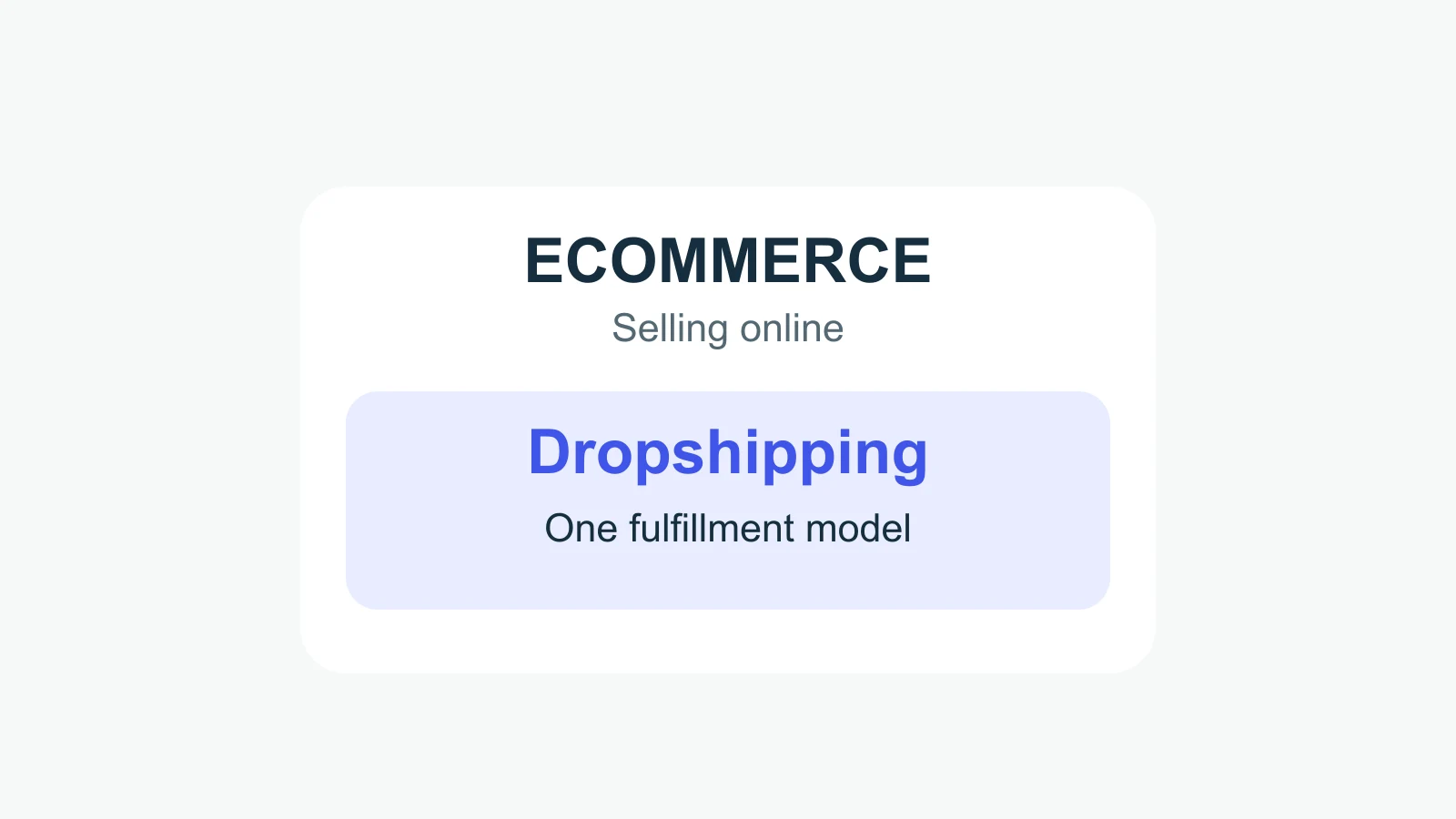
Dropshipping is a fulfillment model within ecommerce. Ecommerce describes buying and selling online; dropshipping describes an arrangement in which a supplier ships a product to the customer after the store receives an order. The practical choice is between supplier-direct shipping and inventory you acquire in advance, which you can fulfill yourself or through a third-party logistics provider.
That distinction matters because “switching to ecommerce” does not describe a specific operational change. Buying stock, moving it closer to customers, changing suppliers, and hiring a fulfillment warehouse are different decisions. Each changes a different part of the cost, cash requirement, or customer experience.
This comparison focuses on physical products sold online. It helps you choose how to supply and deliver them without confusing the selling channel with the inventory model.
01
Dropshipping is part of ecommerce
An ecommerce transaction can happen on your own website, a marketplace, or another online selling channel. What makes it ecommerce is the online transaction, not whether a box passes through your office.
A stocked store and a dropshipping store can use the same website platform, payment provider, and advertising channel. Both need accurate product information, a working checkout, customer support, and a way to resolve problems. Their main operational difference occurs behind the storefront: how the goods are acquired and released to the customer.
Keep three decisions separate when planning the business:

| Decision | The question to answer | Examples |
|---|---|---|
| Selling channel | Where does the customer buy? | Independent store or marketplace |
| Inventory commitment | When and on what terms do you acquire the goods? | Purchase for each order or buy stock in advance |
| Physical fulfillment | Who stores, picks, packs, and dispatches? | Supplier, your team, or a 3PL |
Shopify’s ecommerce and dropshipping comparison explicitly describes dropshipping as a fulfillment method within ecommerce and notes that stores can combine models. A comparison table that labels one column simply “ecommerce” is usually using the word as shorthand for a stocked retail business.
Ecommerce also includes digital goods and services, where no parcel needs shipping. Those businesses make the inclusion relationship even clearer, but they are outside this article’s inventory comparison. For the complete store-to-supplier explanation, see what dropshipping is.
02
Compare three ways to fulfill a physical product order
The most useful comparison separates supplier-direct shipping from two ways of operating a stocked business. Outsourcing warehouse work does not automatically make a store a dropshipping business.
| Operating arrangement | Typical stock commitment | Physical work | Main dependency |
|---|---|---|---|
| Supplier-direct dropshipping | Product purchased for an accepted customer order | Supplier or its fulfillment partner picks, packs, and ships | Supplier availability and per-order service |
| Stocked, self-fulfilled store | Goods acquired before the individual sale | Your team stores and dispatches | Your inventory accuracy and operating capacity |
| Stocked store using a 3PL | Goods acquired and placed with a warehouse | 3PL stores and dispatches to agreed instructions | Your stock planning plus the 3PL agreement |
These are common operating patterns rather than universal rules about legal ownership. Consignment, credit, reserved inventory, and other contracts can change when payment or title transfers. Read the agreement instead of inferring ownership from who physically holds the box.
For example, a merchant may buy 200 units and store them at a fulfillment partner. The merchant never touches the parcels, but it has still committed money to stock. That is materially different from buying one unit after a customer orders it.
A supplier may also manufacture a product while a separate business handles fulfillment. The names of those businesses do not remove the need to identify who controls availability, who accepts an order, and who authorizes a remedy. The agent, supplier, and 3PL comparison covers those provider roles in greater detail.
03
Inventory commitment changes the cash risk
Buying stock in advance ties up cash before the individual customer order arrives. You may need to pay for goods, inbound transport, receiving, and storage. If demand is lower than expected, some of that money remains in inventory that has not sold.
Supplier-direct shipping can reduce this initial exposure because the purchase is connected to a customer order. That makes it useful for testing uncertain products or offering variants that sell infrequently. It does not eliminate all cash requirements or all inventory risk: deposits, reserved goods, or custom packaging can create commitments even in a largely dropshipped operation.
Payment timing also matters. A customer’s successful checkout does not necessarily make the money immediately available to pay a supplier. Shopify’s Payments account-hold guidance documents situations in which payouts stop while many stores can still accept orders. Supplier payment and processor payout are separate events.
For a stocked model, examine how much cash you can commit to the purchase and how long it might remain tied up. For a supplier-direct model, examine how many orders and refunds you can fund before usable receipts arrive. Neither question is answered by the store’s sales total.
Lower upfront stock exposure and lower total operating cost are different advantages. You may reasonably accept a higher cost per order to avoid committing to uncertain inventory. Once demand becomes more predictable, the balance may change.
04
Compare total costs before choosing a model
Compare the same product, customer destination, service level, and sales period. Otherwise, a cheaper quote may simply exclude work included in the other offer. Ask for product, inbound freight, receiving, storage, pick-and-pack, packaging, outbound shipping, and exception charges where applicable.
The following hypothetical USD example holds the $50 selling price constant. It compares supplier-direct shipping with stock acquired in advance and fulfilled through a warehouse. These are invented calculation inputs, not market rates, quotes, or a forecast.
| Supply and fulfillment cost per sold unit | Supplier direct | Stocked with fulfillment |
|---|---|---|
| Product | $22 | $15 |
| Inbound freight allocated per unit | Included in supplier arrangement | $2 |
| Pick-and-pack | Included in supplier arrangement | $2 |
| Outbound shipping | $7 | $4 |
| Total listed variable supply cost | $29 | $23 |
| $50 sale minus listed supply costs | $21 | $27 |
The stocked option saves $6 per sold unit under these assumptions. Neither the $21 nor the $27 is net profit: acquisition, payment processing, refunds, taxes, owner labor, and other expenses are not deducted. Assume packaging is included in the stated handling arrangements and that the purchased stock is suitable to sell; real quotes need those details checked.
Now assume the stocked option adds $300 in fixed expenses for the comparison period. It takes 50 sold units at $6 savings per unit just to cover that additional $300. At 40 units, the savings total $240 and fall $60 short. At 80 units, the savings total $480 and exceed that charge by $180.
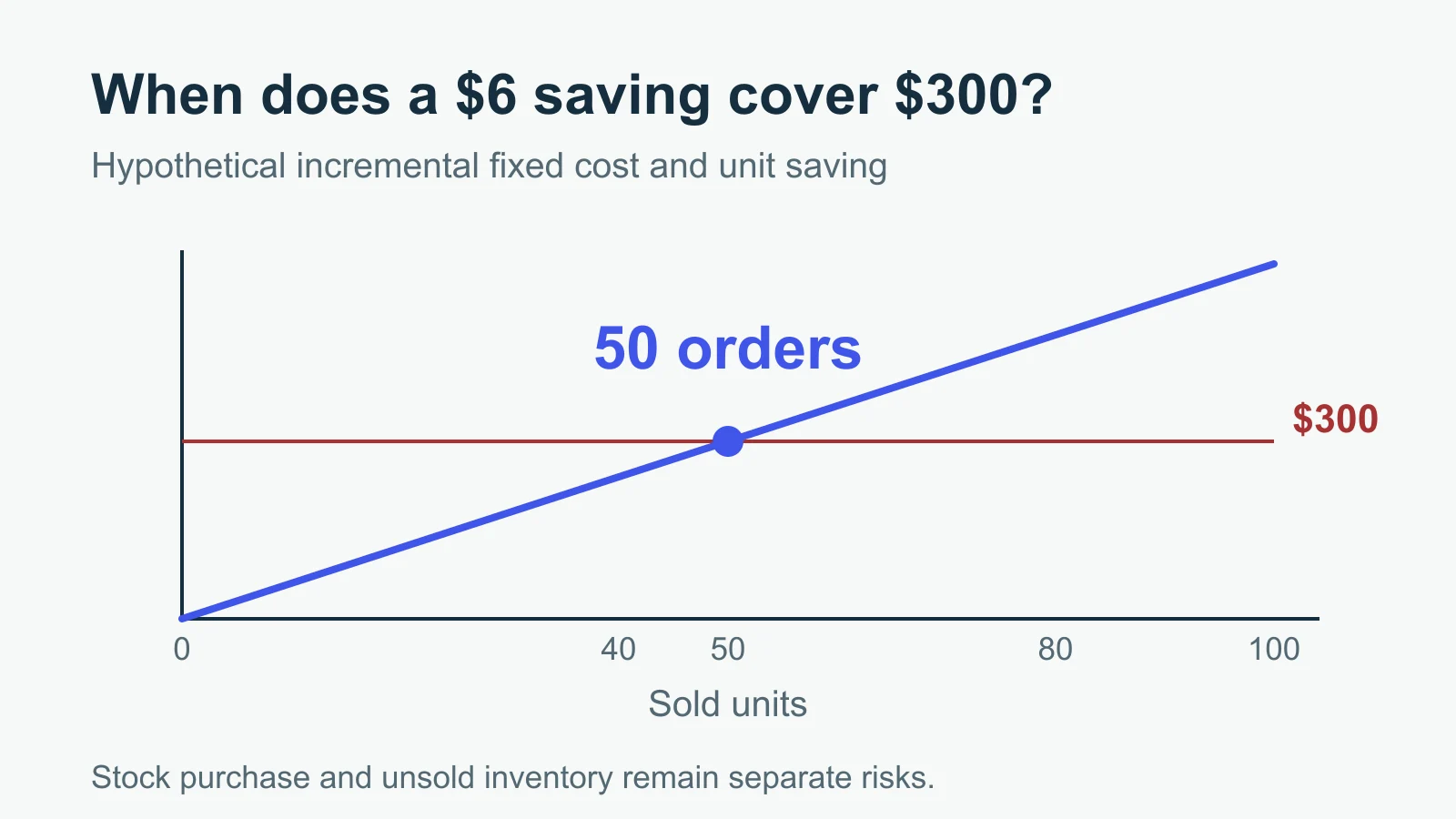
This threshold is useful, but it does not tell you how much inventory will sell. Nor does it fund the original stock purchase. If the supplier requires a purchase larger than the sales you expect, the unsold units still consume cash and may later incur storage, discounting, or disposal costs.
A per-order saving does not prove that buying the required stock is affordable. Compare the order economics and the inventory commitment separately. Use the unit economics workbook to build a complete calculation with your actual quotes.
05
Control depends on stock location and instructions
Stocked inventory can make it easier to inspect goods, assemble bundles, control inserts, or choose when an order leaves. A 3PL may carry out those tasks for you, but only within the services and instructions you agree. A box in a nearby warehouse does not automatically receive a quality check or custom packaging.
Supplier-direct shipping can support some of the same requirements when the supplier agrees to them. You might request a neutral package, specified documentation, or an inspection before dispatch. Confirm the cost and feasibility rather than assuming that all dropshipping lacks branding or that every branded service is included.
Delivery speed depends on where the product actually is, processing capacity, order cutoff, the carrier service, and the destination. A domestic dropshipping supplier may be closer to a buyer than a stocked merchant shipping internationally. Conversely, moving dependable stock nearer to customers can improve a route that previously crossed borders for each order.
Write the service promise first, then ask each provider how it would deliver it. For example, an offer involving a coordinated three-item kit needs confirmation that the three items can be assembled and dispatched together. Three independent supplier orders do not create that service merely because they appear in one checkout.
Returns deserve the same treatment. Establish where a customer should send an authorized return, who can inspect it, and who decides the refund or replacement. Stocking may make some inspection decisions easier; it does not remove customer rights or guarantee that returned goods can be resold.
The fulfillment guide follows the order through these handoffs. For a deeper operational walkthrough, use the existing dropshipping guide.
06
The storefront and marketing still need the same work
Buying inventory does not automatically produce demand. A stocked business still needs customers to understand the product, trust the seller, accept the delivered price, and complete a purchase. A dropshipping business faces those same tasks.
The product page should explain the actual item, not an idealized version from a supplier photograph. Customers need dimensions, compatibility, contents, limitations, available variants, and accurate delivery information where relevant. A different fulfillment model does not compensate for a page that leaves those questions unanswered.
Customer acquisition costs also need to be compared on the same basis. An established stocked brand with repeat buyers is not a fair earnings benchmark for a newly launched dropshipping store buying its first visitors. Differences in audience, product, marketing, and retention may explain more of the result than fulfillment alone.
Platforms are another separate choice. Shopify provides store software; selling on Amazon involves marketplace rules and services. Neither name tells you, by itself, whether you own stock or how every order is fulfilled. Select the platform for the selling experience and operating requirements, then configure it for the inventory arrangements you actually use.
If you are choosing your first setup, the startup guide explains the sequence from offer to completed delivery. It includes marketing and customer service as operating work, alongside supplier selection.
07
A store can combine stocked and dropshipped products
A hybrid catalog can make sense when different products have different demand patterns. You might stock a frequently ordered item while keeping uncertain sizes or specialist accessories available through supplier-direct shipping. The decision belongs at the product or assortment level, not necessarily at the level of the entire store.
Imagine a store that sells a main organizer and several compatible accessories. Repeated demand may justify holding the organizer, while a rarely requested accessory remains supplier direct. The arrangement can reduce stock commitment, provided the store handles the mixed delivery experience clearly.
Before operating both routes, decide:
- Which location or supplier owns each order’s fulfillment task.
- How the store updates availability and prevents an unsupported substitution.
- Whether a mixed basket has separate shipping charges or arrival dates.
- How each parcel is linked to its items in customer messages.
- Where support sends an approved return for each product.
The customer should not have to discover those differences after opening the first parcel. Explain expected split deliveries before purchase and provide useful item-level tracking afterward. A single checkout can contain several fulfillment tasks; it is still one relationship with your customer.
Change models gradually when the evidence supports it. A small stock purchase for a reliable seller can test the new route without committing every product to it. Do not move an entire assortment into inventory merely because a few orders arrived during a promotion.
08
Choose according to the promise you need to keep
Supplier-direct dropshipping is a reasonable candidate when uncertain demand makes an advance stock purchase unattractive and the supplier can meet the product and service requirements. Stocked fulfillment becomes more attractive when reliable demand, complete cost comparisons, and the required customer experience justify the extra cash commitment.
Write down the promise the customer is buying: the correct product, the expected presentation, the shipping arrangement, and the available support. Then compare providers against those requirements using complete quotes and samples. You may discover that changing the supplier is enough, or that holding stock is necessary for the service you want to offer.
Use dropshipping pros and cons to examine the ongoing tradeoffs, and is dropshipping worth it? to test the return on your budget and time. The decision is how to operate an ecommerce store that can keep its promises, with an inventory commitment you can afford.