

Dropshipping lets you sell products without purchasing and storing a full assortment in advance. Its main advantages are lower initial inventory commitment, less warehouse work, and more freedom to test products. Its main disadvantages are reduced direct control over stock, quality, packaging, and delivery, plus the coordination work needed when something goes wrong.
Those tradeoffs are connected. The supplier can take packing off your hands because the product stays with them. That same arrangement makes it harder for you to inspect each order or change its contents at the last moment. Whether the exchange is worthwhile depends on the offer you want to sell and the customer promise you need to keep.
For the full explanation of who does what, see what dropshipping is. Here, the useful question is what you gain, what you give up, and which disadvantages you can realistically reduce.
01
The main pros and cons at a glance
Compare each benefit with the work or restriction that accompanies it. Counting the number of advantages and disadvantages will not tell you whether the model fits: one non-negotiable delivery requirement can outweigh several convenient features.
| Advantage | What you gain | Corresponding disadvantage |
|---|---|---|
| Less inventory bought in advance | Lower exposure to unsold initial stock | Per-order supply costs may leave less room for margin |
| Supplier handles storage and packing | Less physical fulfillment work | More dependence on another business’s processing |
| Easier assortment changes | A way to test demand before a larger stock purchase | More variants and suppliers still require accurate information |
| No need to operate a warehouse yourself | More flexibility in where you work | Support and supplier communication still need reliable coverage |
| Access to existing products | A shorter path to offering a product | Other sellers may offer the same item |
Shopify’s description of dropshipping features identifies related inventory, quality, branding, and split-shipping tradeoffs. The degree of control varies by agreement. A supplier that accepts written packing instructions is different from a marketplace seller offering an unmodified parcel, even though both may ship directly to your customer.
02
Lower stock commitment makes testing easier
The clearest financial benefit is avoiding a large stock purchase before you know whether customers will buy. If an item attracts little interest, you can stop offering it without being left with the same unsold quantity you would have purchased under a stocked model.
That matters when you are testing a new category, a seasonal accessory, or variants with uncertain demand. An established store can also use dropshipping to extend its range without buying every size and color. The benefit is smaller commitment to unproven inventory, not exclusive access to a profitable product.
You still need money for samples, store operation, customer acquisition, and service problems. Depending on payment and supplier terms, you may have to pay for orders before customer receipts reach your bank. A “no inventory” launch can therefore run short of cash while it is making sales.
Product testing also has limits. A store might discover that buyers want an item but reject its delivery time. Another might get clicks because of an attractive photograph, then receive complaints because the dimensions were unclear. Neither result establishes that the category itself is bad; it identifies a different part of the offer that needs work.
Use the flexibility to investigate a small number of coherent offers. Uploading a vast catalog creates a maintenance burden: inaccurate variants, discontinued products, and unsupported claims can remain live long after the initial import. The product research guide helps narrow what deserves a real test.
03
Less physical work does not remove operating work
A supplier that stores, picks, and packs your orders removes tasks you would otherwise perform or pay a warehouse to perform. You do not need to spend each afternoon printing labels and assembling parcels. For a small team, that can free time for product presentation, customer support, and marketing.
The remaining work is less visible in a promotional video. Someone still needs to reconcile order records, notice an unaccepted order, update a product that is unavailable, answer delivery questions, and decide what to do when the supplied item is wrong.
Consider a routine day after launch. Two customers ask whether a product fits their equipment. One order has an incomplete address. A supplier reports that a color is out of stock, and a parcel has no carrier movement. None of these tasks requires owning a warehouse, but all require attention and a decision.
Automation can transfer product details, route orders, and send notifications when the systems support those actions. It does not establish that the data is correct or that the message is appropriate for an exception. A delayed order can receive an automatic “shipped” email if the trigger is badly configured.
Location flexibility therefore comes with an operating condition: you need dependable internet access, a way to monitor orders, and support coverage that matches the expectations you set. You can work away from the parcels, but disappearing while customers need answers is a different proposition.
04
Margins depend on the entire basket
Buying products one order at a time may cost more per unit than a negotiated bulk purchase. However, the useful comparison includes the costs that stocking adds: inbound freight, storage, handling, unsold inventory, and the cash committed in advance. A cheaper product invoice does not automatically produce a better business result.
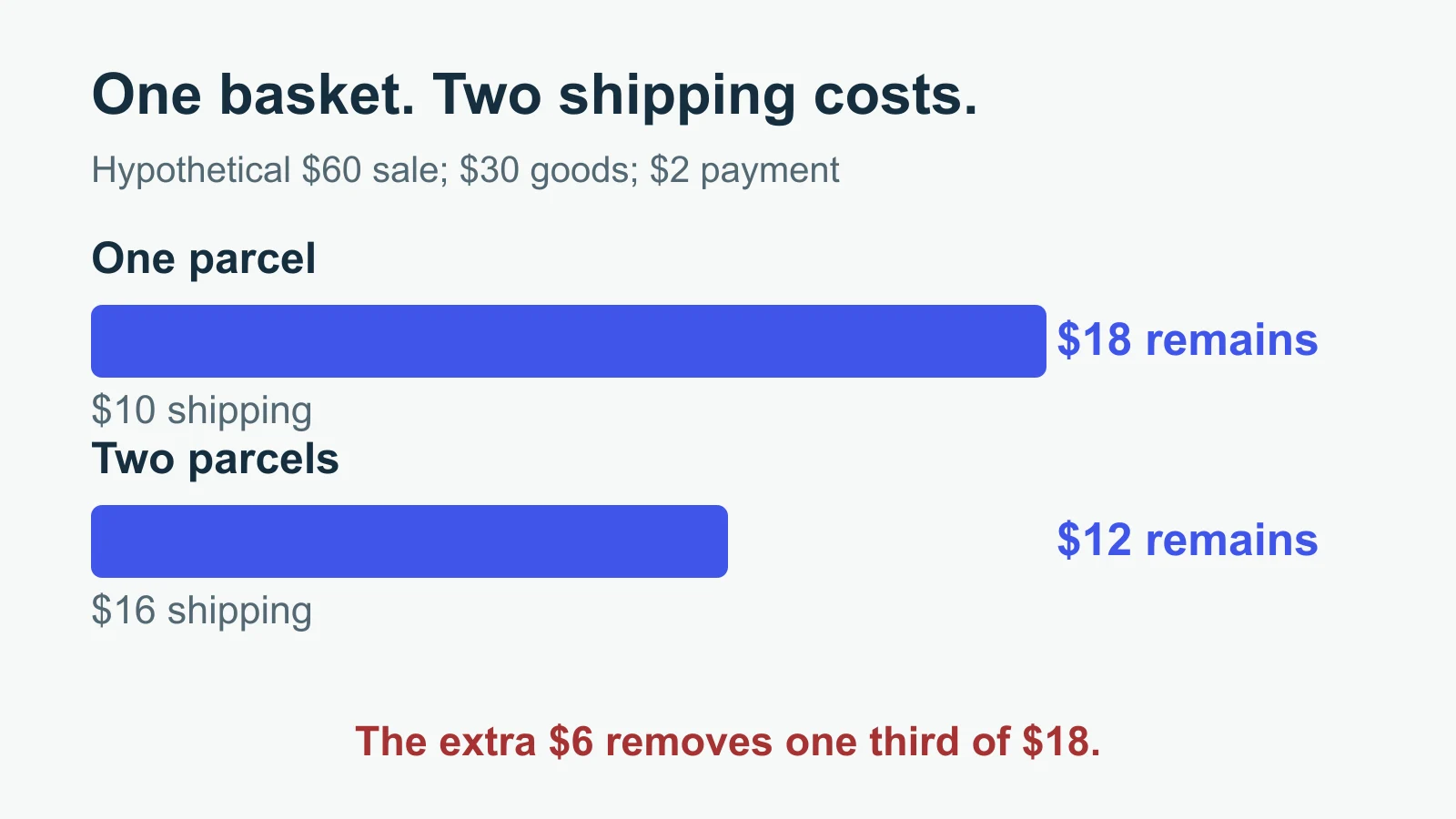
Shipping can change the economics of a basket even when the product prices stay the same. Suppose a customer buys two items for a total of $60. The combined product cost is $30 and payment processing costs $2. All figures below are hypothetical USD assumptions; they are not supplier quotes.
| Two-item basket | One parcel | Two supplier parcels |
|---|---|---|
| Customer payment | $60 | $60 |
| Combined product cost | −$30 | −$30 |
| Payment fee | −$2 | −$2 |
| Outbound shipping | −$10 | −$16 |
| Contribution before ads, refunds, and overhead | $18 | $12 |
The extra $6 of shipping removes one third of the original $18 contribution. If acquisition costs are $10 for either basket, the remaining amount falls from $8 to $2 before refunds and overhead. The same revenue can leave very different room for error.
A split shipment does not always cost more by that amount, and combining items is not always possible or cheaper. Product dimensions, origin, destination, carrier service, and warehouse handling all affect the quote. Ask about the likely baskets your customers will buy rather than evaluating every SKU as an isolated order.
For a stocked comparison, include the cost of getting both products into the same location. Moving parcels through an extra warehouse solely to combine them can add expense and time. The unit economics guide helps compare the complete cost, while dropshipping profit margin explains why gross margin is different from what the business finally retains.
05
Quality and branding need an agreement
With direct supplier shipping, you normally have less immediate access to the goods before they reach a customer. You cannot open every box at your desk or replace an insert after the parcel leaves the supplier. This is a real limitation when precise presentation or product consistency matters to the offer.
It is still possible to request samples, define acceptance criteria, agree packaging instructions, and arrange inspections. Those measures depend on the supplier’s actual services and terms. They should not be assumed because a platform listing uses words such as “premium” or “verified.”
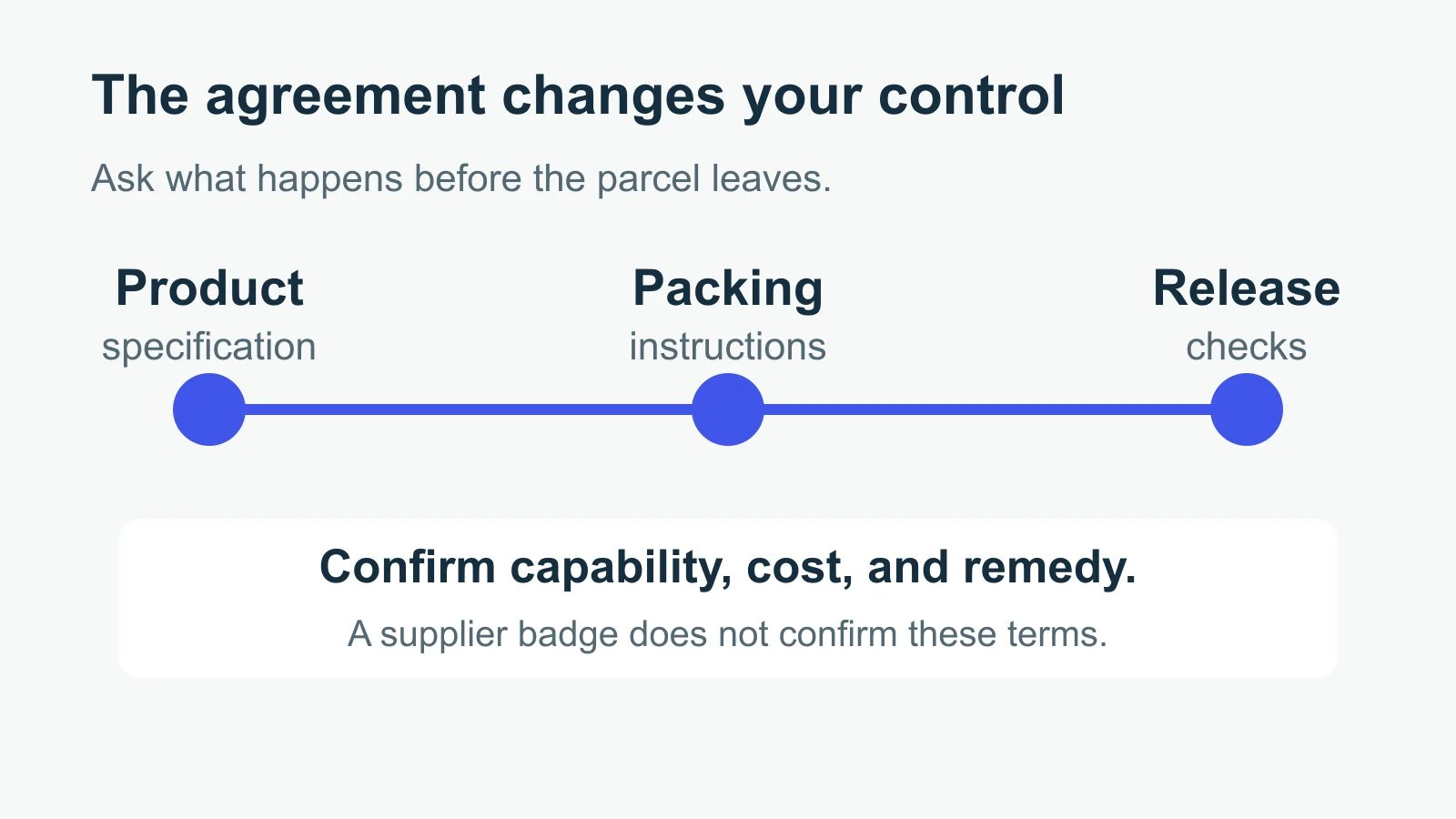
Ask for confirmation of the details that affect your customer:
- The exact product and acceptable variation in its important specifications.
- Which packaging, instructions, labels, and promotional materials will be included.
- How product or packaging changes will be communicated before shipment.
- What happens when an item fails an agreed check.
Custom packaging may require an initial purchase, storage, a minimum quantity, or extra handling. Those commitments can reduce the low-inventory advantage. If your brand depends on a specific unboxing experience, price and test that experience before advertising it.
Holding stock can make inspection and presentation easier, but possession alone does not ensure quality. A merchant can still buy the wrong product or skip an inspection. The meaningful difference is your ability to detect and correct a problem before release, supported by the process you actually use.
The quality-control article explains how to set checks that match the product rather than relying on a generic promise of inspection.
06
Stock and delivery are harder to promise
A dropshipping store needs current availability even though it does not store the product. Supplier stock can serve several retailers, so yesterday’s quantity may no longer be available when an order arrives. An integration can reduce manual updates, but its usefulness depends on the feed, refresh timing, and how unavailable variants are handled.
Start by agreeing what order acceptance means. Does the supplier reserve the unit when the order is submitted, when payment clears, or at another point? If stock is unavailable, who receives the notice, and what happens to the customer order? These questions turn an apparently automated process into something you can operate responsibly.
Delivery depends on several stages: supplier processing, carrier handover, transit, and any border or local delivery steps. A supplier-created label is not evidence that all those stages have begun. Use the tracking guide to distinguish an assigned number from meaningful carrier movement.
Two suppliers also create the possibility of two arrival dates. Explain split shipments before purchase when they are expected, then associate each tracking record with the right items. Otherwise, a customer who receives half an order may reasonably think something is missing.
Some suppliers ship domestically and some stocked merchants dispatch internationally. Compare the actual route and service agreement, not the word “dropshipping” or the country name alone. Local stock can shorten a route, but inaccurate stock records or slow processing can still undermine the promise.
07
Customer service stays with the store
Customers buy from your store and normally come back to you when the product is late, damaged, or unsuitable. Asking them to negotiate directly with an unfamiliar supplier adds friction and may not satisfy your obligations.
Supplier cooperation matters, but it is a separate relationship. You may need to resolve a customer complaint while you investigate whether the supplier will credit the product cost. An agreement that gives the supplier several days to review evidence does not automatically extend a customer deadline.
For covered US merchandise orders, the FTC’s Mail, Internet, or Telephone Order Merchandise Rule addresses shipment representations and the handling of shipment delays, including consent and refunds. That is a specific US rule; the rights relevant to a particular return or sale require the appropriate jurisdiction and circumstances.
A supplier reimbursement is not the same transaction as a customer refund. Keep both records, and do not describe an unapproved supplier credit as money you have recovered. Confirm the return destination for the case instead of sending every customer to an overseas address by default.
Clear product information and realistic delivery expectations can prevent some avoidable complaints. They cannot remove defective goods, lost parcels, or all changes of mind. Budget time and money for handling the cases that still occur, and follow the returns process when a request arrives.
08
Who benefits most, and when to choose stocked inventory
Dropshipping is especially useful when you want to test an uncertain assortment, can work within a supplier’s confirmed fulfillment capability, and have a credible way to reach customers. It can also complement an established store that stocks its main sellers but offers additional products through suppliers.
It becomes less attractive when the offer depends on tight control that the available suppliers cannot provide. Examples include a precisely assembled multi-item kit, a dispatch promise the route cannot support, or product presentation that requires substantial preparation before every order.
| Your situation | Practical direction |
|---|---|
| Uncertain demand and a suitable direct-shipping supplier | Test a narrow dropshipped offer with a capped commitment |
| Repeated demand and a better fully costed stocked option | Compare buying a small quantity and fulfilling it yourself or through a 3PL |
| Strong marketing interest but unverified product or delivery | Resolve the supply problem before adding traffic |
| No capacity to fund orders or handle customer requests | Wait or choose a different activity until those constraints change |
You do not need to make one permanent choice for the entire catalog. The ecommerce model comparison explains how stocked and dropshipped products can coexist. If you are deciding whether the likely return justifies your own time and budget, continue with is dropshipping worth it?.
Choose the model whose limits you can manage while keeping the promise customers are buying. Low inventory commitment is valuable when it helps you learn or serve a wider range; it is less useful if the resulting service and coordination costs consume that advantage.