
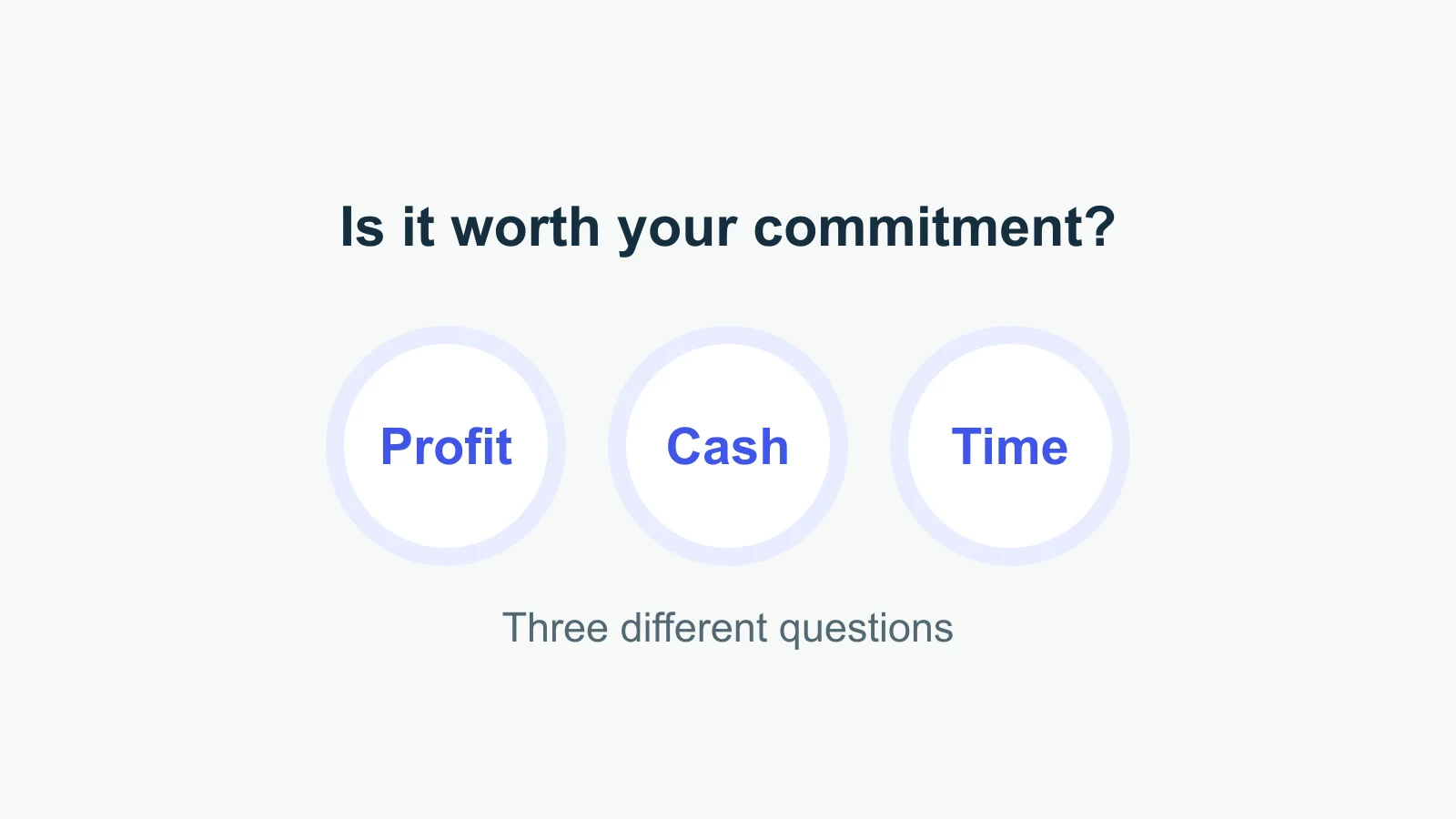
Dropshipping can be worth testing if you have a credible reason customers will buy from you, enough contribution left after acquisition and service costs, cash to fund orders before payouts, and time to operate the store. It is a poor fit if you need predictable income soon, cannot afford a failed test, or expect suppliers and software to handle every customer problem.
The absence of a large inventory purchase makes the model easier to try. It does not establish that the return will be worthwhile. A store can generate sales, show positive gross profit, and still leave too little money for the owner’s time.
You need three separate answers: does the offer earn enough, can the business fund its commitments, and is the work worth doing for you? The hypothetical examples below show why those answers can differ. They are planning calculations, not AIDrop Agent results or estimates of typical merchant earnings.
01
When dropshipping is worth considering
Dropshipping is worth considering when the reduced commitment to inventory solves a real problem. You might want to test an uncertain product, offer additional variants without stocking each one, or sell items through a supplier whose direct-delivery service matches what your customers need.
The model leaves you responsible for finding customers, presenting the product accurately, setting a sustainable price, and handling the sale. If that division of work suits your skills, outsourcing physical fulfillment can be useful. If you dislike customer support and supplier coordination as much as packing parcels, it may not remove the work you most want to avoid.
There is no useful universal verdict that dropshipping is either “dead” or guaranteed to work. Two stores using the same fulfillment method can serve different customers, pay different acquisition costs, and receive very different supplier support. Market growth and revenue screenshots cannot settle whether your specific offer makes sense.
Consider the model a candidate when you can answer these questions concretely:
- What does your offer help a particular customer do?
- Why would that customer choose your store over a readily available alternative?
- What evidence supports the product and delivery promise?
- What amount of money and time can you commit without needing the test to succeed?
If you are still learning the relationship between customer, store, and supplier, the main dropshipping explanation provides that foundation. This article focuses on whether the commitment is worthwhile once those roles are clear.
02
Check whether customers have a reason to buy from you
Access to a supplier catalog is an input, not a customer advantage. Other stores may be able to list the same product. You need a reason for a buyer to prefer your explanation, selection, service, product, or overall offer.
Look for a problem you can understand well enough to help someone choose. A store selling equipment accessories, for example, might provide accurate compatibility information and a clear demonstration. That information only creates value if it is correct; copying an unsupported compatibility claim creates a future support problem instead.
Compare the delivered price and the service promise with the alternatives a customer can already find. Include marketplaces and local retailers, not just other dropshipping stores. A higher price may be acceptable when the offer adds something the customer values, but decide what that something is before paying to promote it.
Demand evidence also needs interpretation. Search interest suggests people care about a topic. Ad engagement suggests a message attracted attention. A paid order is stronger evidence of willingness to buy, but even that does not tell you whether the customer will keep the product or whether the sale was profitable.
Your first investigation should therefore cover both interest and delivery. Read customer questions, compare offers, obtain product details, and order a sample. The product research article explains those checks. If you find no plausible advantage after doing this work, pause that offer rather than assuming a larger advertising budget will create one.
03
Calculate what 100 orders could leave
Use an order-level model that includes the expenses needed to earn and support the sale. Product markup alone is not enough. Shopify’s profit-report documentation, for example, explains product-cost-based reporting; that figure should not be mistaken for complete business profit after advertising, overhead, and tax.
Here is a hypothetical group of 100 orders, using USD. Each customer initially pays $50 for one item, with no discount, separate shipping charge, or sales tax included. All orders ship. Five customers later receive a full refund, and each refunded order adds $8 of unrecovered handling expense.
Assume every original order costs $20 for the product, $6 for outbound shipping, $2 for payment processing, and $12 to acquire. The processor returns none of the assumed payment fee after a refund. There are no supplier credits or recoverable inventory proceeds. Fixed overhead attributable to this period is $300.
| Item | Calculation | Amount |
|---|---|---|
| Initial sales | 100 × $50 | $5,000 |
| Customer refunds | 5 × $50 | −$250 |
| Net sales | $5,000 − $250 | $4,750 |
| Product costs | 100 × $20 | −$2,000 |
| Outbound shipping | 100 × $6 | −$600 |
| Payment processing | 100 × $2 | −$200 |
| Acquisition | 100 × $12 | −$1,200 |
| Additional refund handling | 5 × $8 | −$40 |
| Contribution after variable costs | $4,750 − $4,040 | $710 |
| Fixed overhead | Assumed period expense | −$300 |
| Remaining result | $710 − $300 | $410 |
The $410 is before owner labor, income tax, and any costs excluded from the assumptions. It is not take-home pay or a projected net profit for a real store. Replace every input with your actual quotation, contract, or observed expense before making a business decision.
The refunds have already reduced sales by $250. Product and shipping costs remain for all 100 shipped orders because the example assumes no recovery. Subtracting another $250 as a “refund expense” would count the same refund twice. The additional $40 is a different cost: the assumed handling associated with those cases.
This distinction matters when comparing a dashboard with a bank balance. A report can omit costs, include only products with recorded cost data, or cover a period before all refunds are known. Keep the orders and related expenses together when reviewing the outcome. For detailed definitions, use dropshipping profit margin.
04
Test the result against higher acquisition costs
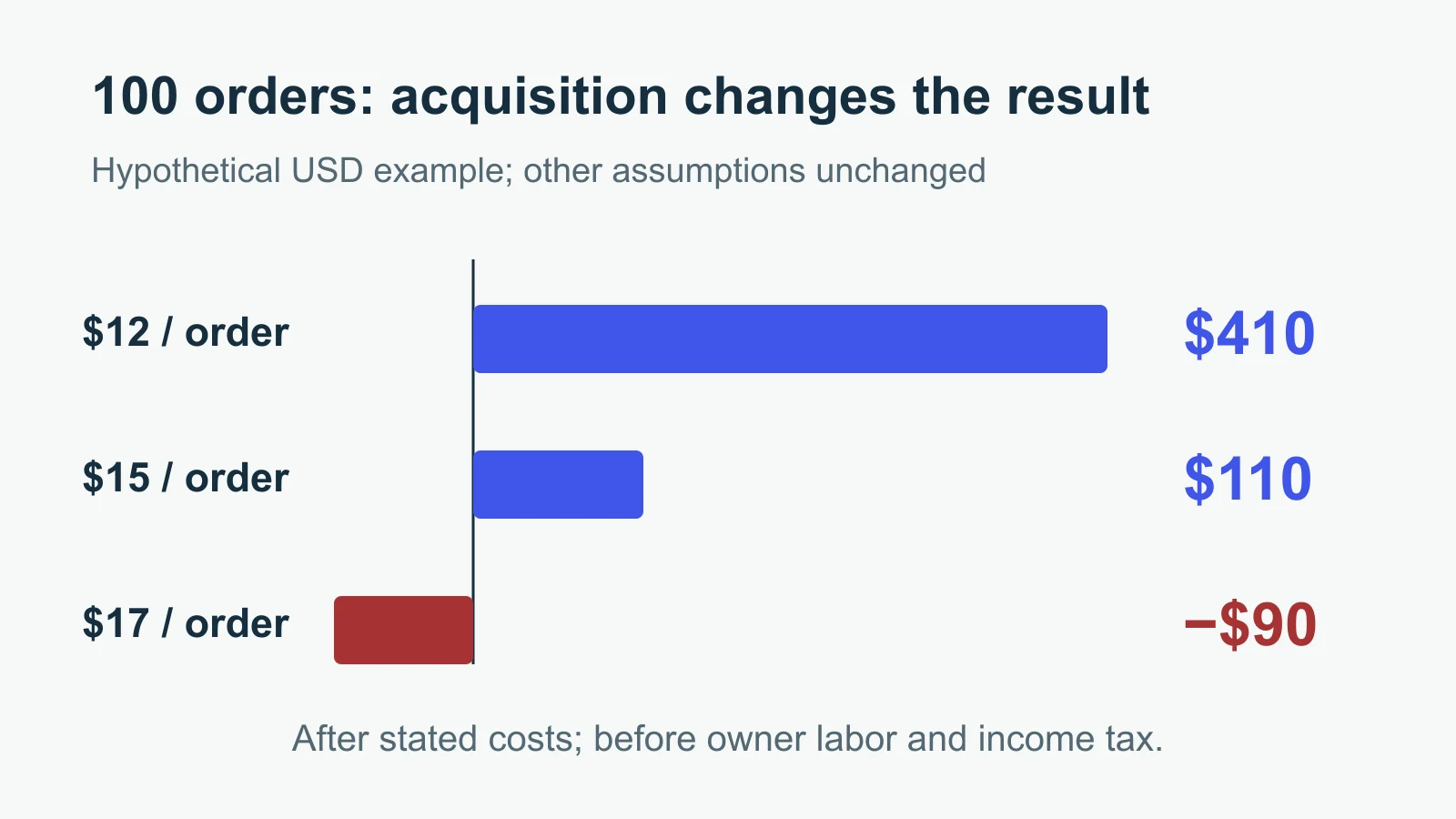
The same offer can become unattractive if the cost of getting an order rises. Keep all the previous assumptions unchanged and increase acquisition from $12 to $17 per original order. The extra $500 turns the $410 remaining result into a $90 loss, still before owner labor and income tax.
| Acquisition cost per original order | Total acquisition spend | Result after stated overhead |
|---|---|---|
| $12 | $1,200 | $410 |
| $15 | $1,500 | $110 |
| $17 | $1,700 | −$90 |
Under these exact assumptions, the acquisition budget that leaves a zero result after the stated overhead is $1,610, or $16.10 per original order. The calculation is $4,750 net sales minus $2,000 product, $600 shipping, $200 processing, $40 handling, and $300 overhead.
A break-even acquisition cost is a limit, not a sensible spending target. At $16.10, this model leaves nothing for owner labor, income tax, or an adverse change that the assumptions missed. A business that needs to pay its owner must retain more.
Acquisition should include the costs you decide belong in that measure, consistently. For a first-order advertising test, this may be direct ad spend divided by first orders. A fuller customer acquisition cost can include creative production and other acquisition work. Do not compare those different measures as though they were identical.
Organic traffic does not remove this question. It changes the mix of money and time spent getting customers. Record the time used to make content and the cost of any production help. An established audience can be an advantage; a new store should not assume it has free access to one.
Test another uncertain input as well. More refunds, a lower realized price, or a shipping surcharge can alter the answer. The purpose is to find which assumption needs evidence before you spend more, not to manipulate a spreadsheet until the result looks attractive.
05
Check the cash needed before payouts arrive
A profitable order can still require money before its customer payment reaches your bank. Suppliers may require payment before dispatch, while a processor pays out later. Shopify’s account-hold documentation also explains that many stores can keep accepting payments during a payout hold, although some cannot; the account’s own notice determines the situation.
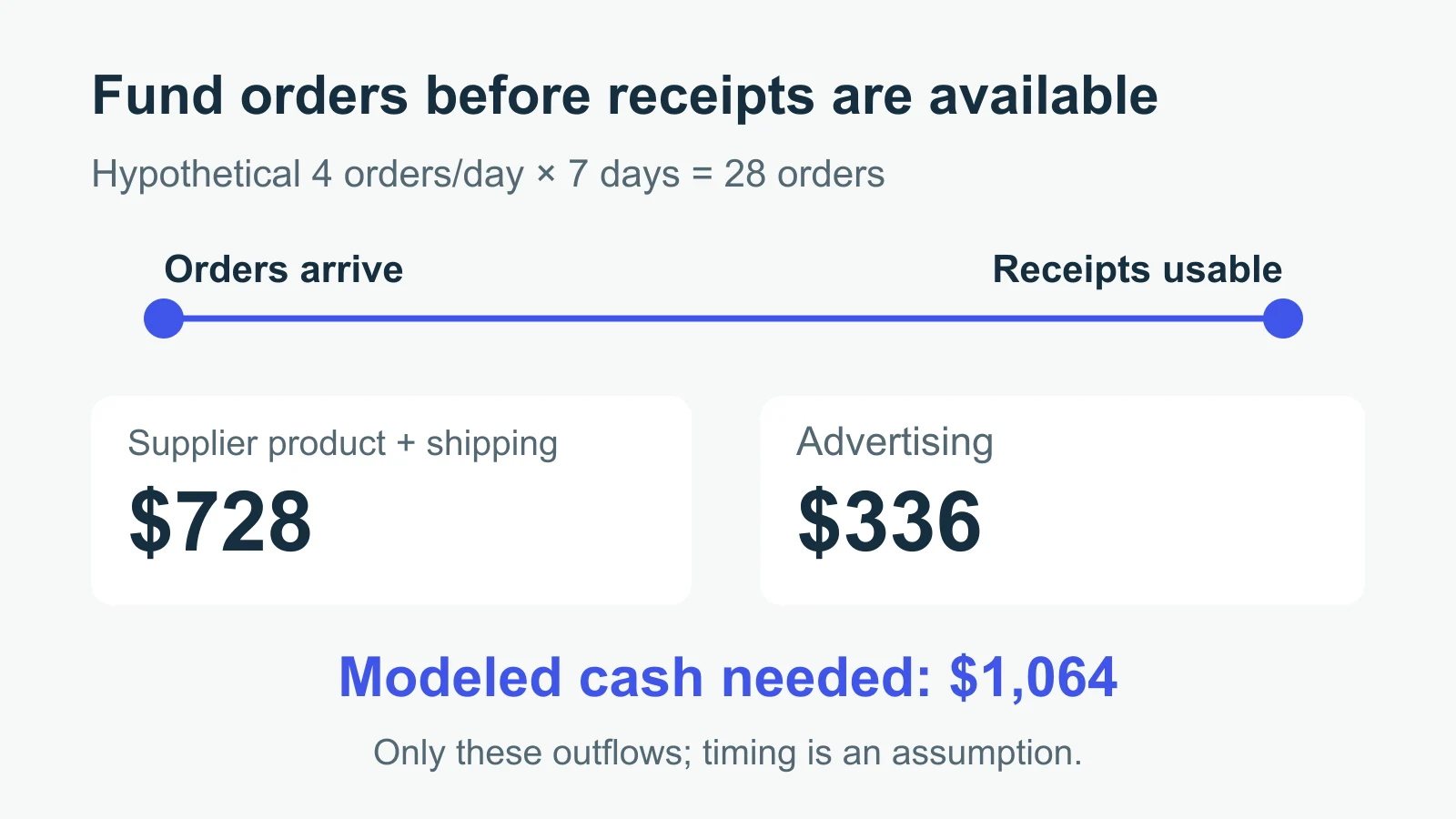
To illustrate the gap, assume four orders arrive each day and customer receipts remain unavailable for seven days. This is a modeling assumption, not a stated Shopify or other provider payout schedule. Supplier product and shipping charges are $26 per order, payable immediately, and advertising cash is spent at $12 per order during the same period.
| Cash paid before receipts are available | Calculation | Amount |
|---|---|---|
| Supplier product and shipping | 4 × 7 × $26 | $728 |
| Advertising | 4 × 7 × $12 | $336 |
| Combined modeled cash requirement | $728 + $336 | $1,064 |
The $1,064 covers only those two outflows for 28 orders. It does not include samples, setup, fixed expenses, separately billed fees, taxes, refunds, or a further payout delay. It is not a sufficient universal starting budget. Whether processing fees are deducted from receipts or charged separately also changes the timing.
Map the dates on which cash must leave and the dates on which you can actually use incoming money. Keep any customer taxes collected for remittance separate from money available to fund the business. If the gap exceeds what you can safely finance, reduce the proposed order volume or wait until the funding problem is resolved.
More orders can increase the cash you need before they increase the cash you can use. Do not scale a campaign merely because its first few orders show positive contribution. Confirm how the next group of supplier payments and possible refunds will be funded.
06
Price your own time honestly
Return to the 100-order example and assume it takes 40 hours of owner work during the modeled period. With $410 remaining before owner pay and income tax, the result works out to $10.25 per hour. That is a way to examine the return on your time, not an employee wage calculation or a predicted hourly income.
One illustrative allocation of those 40 hours is:
- Product content and demonstrations: 8 hours.
- Advertising and audience work: 8 hours.
- Customer support and returns: 8 hours.
- Supplier and order coordination: 6 hours.
- Store maintenance: 6 hours.
- Accounts and reconciliation: 4 hours.
Your workload could be higher or lower. Record actual time, including the work done before the first sale. A later month may benefit from earlier content and setup, while an initial test may involve much more work per order. Neither period should automatically be treated as representative of the whole business.
If you value those 40 hours at a hypothetical $15 per hour, their opportunity cost is $600. Against the $410 remaining result, that leaves a $190 shortfall relative to your chosen time value. This is a personal decision comparison, not an additional accounting wage expense unless the business actually records such a wage.
Learning can be a legitimate part of the return. You may gain useful experience in product research, copywriting, acquisition, and operations. Decide in advance how much you are willing to spend for that learning, so it does not become an unlimited explanation for continuing an unpromising offer.
07
Run a test you can afford to stop
Set the test boundary before spending. Choose a narrow offer, a maximum money commitment, an available block of work time, and a date for review. Base those limits on what you can afford and what you need to learn; a generic online budget does not know your obligations.
Complete a product sample and a store checkout test before bringing in customers. They answer different questions: the sample helps assess the physical product and route, while the checkout test checks configuration. Shopify’s test-order guidance supports the latter; a simulated payment does not demonstrate actual delivery or payout availability.
During the test, keep records that can distinguish a marketing problem from a fulfillment problem. If nobody reaches the product page, you have not learned much about its ability to convert a qualified visitor. If people buy but complain about what arrives, bringing in more visitors is unlikely to fix the cause.
Review these outcomes together:
| Evidence from the test | What to investigate next |
|---|---|
| Relevant visits, few purchase attempts | Product fit, explanation, total price, and credibility |
| Purchase attempts, failed transactions | Checkout, payment availability, charges, and errors |
| Orders with inadequate contribution | Price, acquisition, supply costs, and service costs |
| Profitable-looking orders with repeated delivery failures | Supplier performance and the advertised promise |
| Good completed-order results but insufficient working cash | Payout timing and the pace of expansion |
Wait for enough delivery and refund information to judge the group of orders honestly. Early revenue is incomplete evidence. At the same time, do not increase spending just to reach an arbitrary sample size when a serious product, funding, or service problem is already clear.
08
When another model is a better choice
Stocking a proven product may be more attractive when you can fund inventory and need control that the supplier-direct arrangement does not provide. That could mean assembling a kit, inspecting goods before dispatch, or locating stock closer to customers. Compare the full costs and unsold-stock exposure before making the change; a bulk discount alone does not settle it.
You can also combine models. Keep a reliable seller in stock and dropship uncertain variants, provided you can explain and operate the different delivery arrangements. The dropshipping versus ecommerce comparison separates those choices without treating them as different kinds of online retail.
If you already have a skill clients pay for, providing a service may let you sell that existing capability without also learning product sourcing and parcel operations. If you need dependable near-term income, an uncertain product test may be a poor use of the cash and hours you have available. Neither alternative guarantees an easier result; compare it with your actual skills and circumstances.
09
Decide whether to start, revise, or wait
Start a limited test when the product and supplier evidence support the offer, the modeled economics leave room for your needs, and the cash and work commitments are affordable. Use the step-by-step startup guide to turn that decision into a functioning store and first delivery.
Revise the offer when the customer need appears credible but one input makes the result unattractive. A clearer product selection, different supplier arrangement, or better-matched acquisition channel may change the calculation. Treat that as a new hypothesis to check, not a reason to assume success is close.
Wait when you cannot fund existing commitments, verify the product, provide customer support, or absorb the test failing. A smaller test is useful only if it still lets you serve its customers properly.
Dropshipping is worth doing when the actual return and responsibilities fit what you want from the business. The decision becomes much clearer once sales, available cash, and owner time stop being treated as the same measure. The business fundamentals resources cover the model choices and launch decisions that follow.