
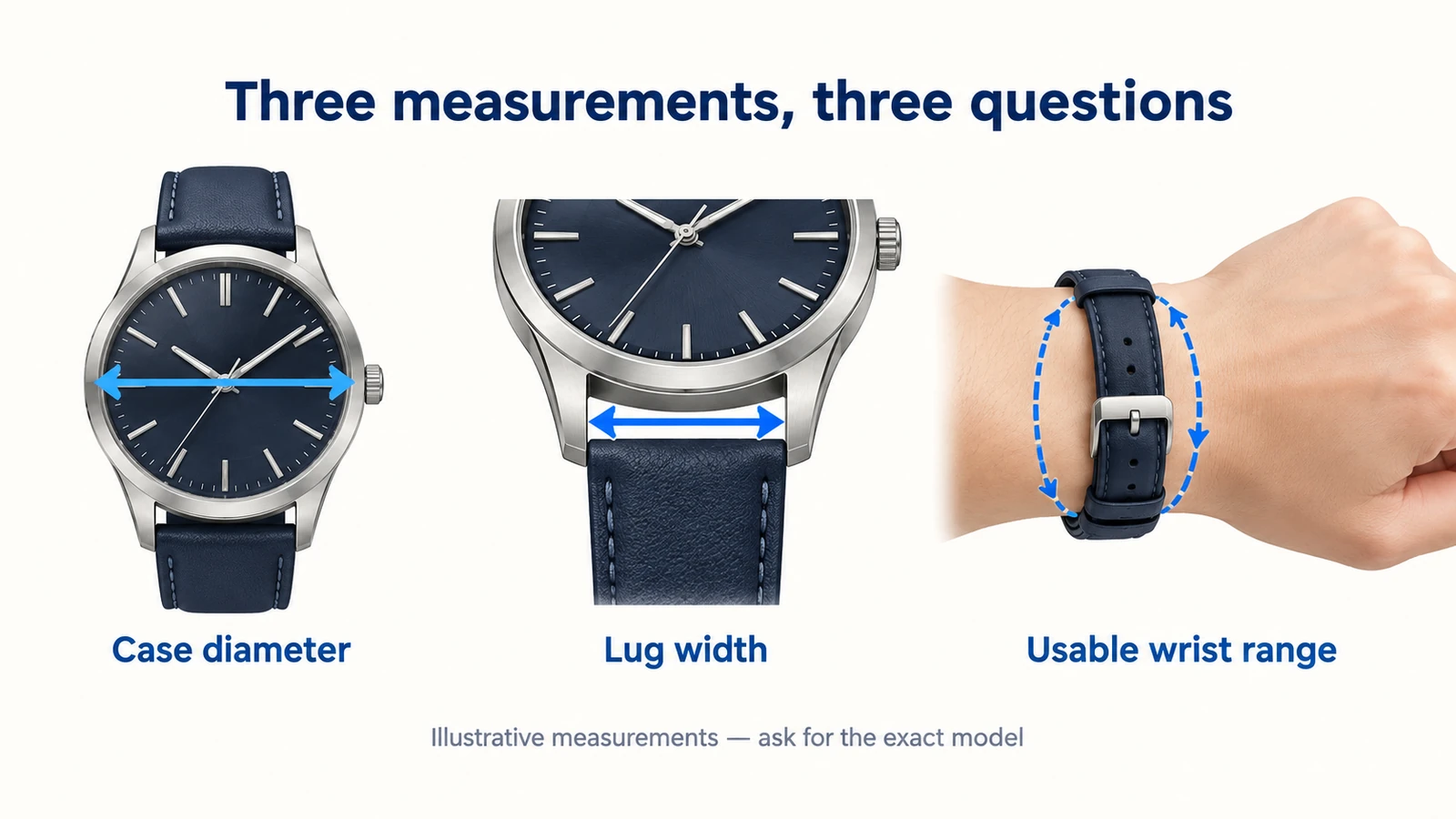
To dropship watches, choose a small range with an identified movement, usable wrist-fit details and a supplier permitted to send those models to your market. Price the boxed delivery and agree how faults, batteries and warranty service will be handled before listing. Your store takes the order and supports the customer while the supplier holds and dispatches the stock.
Start with the use: an everyday watch with an easy-to-read dial, a dress watch, or a gift with a firm delivery deadline. Those customers need different photographs, fit information and service answers. A watch that resembles an expensive brand does not automatically offer that brand’s quality or warranty.
This guide covers ordinary watches with hands on a dial, including quartz and mechanical movements. Smartwatches have additional electronics, connectivity and feature questions covered by the electronics guide. The products guide helps compare watches with other categories.
A $65 everyday quartz watch will be our working example. Its numbers are illustrative. The goal is to describe and support one model well enough for a buyer to decide, before adding dozens of catalogue designs.
Explore the broader topic: Jewelry Dropshipping: Materials, Product Claims and Supplier Evidence.
01
Explain the movement and the fit
The movement is the mechanism that keeps time and drives the hands. Quartz watches use an electronic quartz timekeeping system powered by a cell; a solar quartz model uses light to replenish stored energy. Mechanical watches use a wound mainspring. An automatic mechanical watch adds a winding mechanism powered by wrist movement, but its winding and setting instructions still belong to the particular model.
A stopped watch may need setup
Those differences affect what buyers must do and what you must support. Read the model’s instructions for setting, winding, charging and expected accuracy. A mechanical watch stopping after being left unworn is a different question from a fully powered watch failing to run. Do not promise an accuracy figure borrowed from another movement.
Case diameter tells the buyer about the watch head, not the wrist it fits. Lug width is the gap where the strap attaches. Strap length, clasp adjustment and the usable wrist range answer different questions.
Citizen’s AW1231-07E page provides a useful real specification example, checked on September 28, 2026. It describes an Eco-Drive analog quartz J810 movement and these measurements:
| Field | Manufacturer’s displayed information | What it helps answer |
|---|---|---|
| Case | 40 mm diameter, 9 mm height | How large and thick the watch head is |
| Lug width | 21 mm | Which strap width attaches to this case |
| Strap | Listed as leather; bracelet length displays 0 mm | The wrist range remains unanswered; 0 mm is not a usable fit instruction |
On a phone, swipe the table sideways to compare every column.
Case dimensions do not give wrist fit
This is a manufacturer example, not a claim that a dropship supplier has the model or that we tested it. Ask your selected supplier for the actual minimum and maximum usable wrist circumference, adjustment method and included strap or bracelet. For a metal bracelet, find out whether the buyer needs link removal and who can perform it.
A useful inquiry for our everyday-watch example is: “Please identify the movement, case diameter and thickness, lug width, usable wrist range, clasp, included box and instructions for this exact item.” Obtain the missing fit answer before writing “fits all wrists.”
02
Choose the supply arrangement, not just the catalog
Branded distribution, ordinary unbranded stock and private-label production create different work for the retailer. Private label means selling a product under your own brand; it can involve buying a batch rather than ordering one watch after each sale.
The inspected programs offer these starting points for an inquiry:
| Public option | What its own pages describe | What to settle for your order |
|---|---|---|
| Swiss Watch Network | A partner catalog, direct dispatch and supplier-handled two-year warranty | Its pages conflict on UK versus Germany dispatch; confirm the model’s warehouse, destination, condition and actual warranty terms |
| Watches of Dubai | Approved-partner catalog access, photos and a stated Synctec connection for Shopify stock/pricing and fulfillment | Confirm approval, model and market availability, permitted channels, actual connection and warranty issuer |
| Peregrine’s watch sourcing options | Different levels of generic stock, packaging, strap or dial customization and reserved inventory | Obtain the exact product, quantities, ownership of committed stock, individual dispatch terms and a complete destination quote |
On a phone, swipe the table sideways to compare every column.
Verify the source and actual sales permission
These are provider descriptions, not independent proof of authenticity, reliable delivery or authorization. Ask for the agreement covering your selected model and sales market. A famous brand in a catalog does not establish your right to sell through every channel or use every photograph; the rights guide explains those separate permissions.
Watches of Dubai’s FAQ distinguishes authorized stock from parallel-market stock, sourced outside the local authorized distribution arrangement, carrying supplier rather than manufacturer warranty. It also distinguishes its wholesale arrangement from its stated import-inclusive dropship setup. Ask who issues the warranty and who pays each import or delivery charge. A general “warranty” or delivered-duty-paid (DDP) pitch is insufficient for your particular order; the agreement must identify coverage and included charges.
For a first order, request the actual partner or buying account, selected catalog item, condition and destination availability. Obtain the item price, box and packed weight, processing estimate, delivery service, import-charge arrangement and return address. Then order the same sample or test parcel you intend to sell. When an app connection is offered, verify that it transfers the right model and condition and establish how you fund the order.
If the supplier cannot resolve dispatch location or coverage, choose a different model or arrangement before listing. For gift buyers, a stated processing estimate such as 24–48 business hours is only one part of the wait; it does not establish arrival before their occasion.
03
Keep water-use and battery claims specific
Describe what the watch may be used for
Use the manufacturer’s instructions for the exact model, including the crown and any servicing conditions. Citizen’s water-resistance FAQ, rechecked October 11, treats 30 m as protection from light splashes such as rain. It says not to swim or submerge the watch. A depth number is not a swimming instruction for every watch.
Write the permitted activity in ordinary words rather than copying “waterproof 30 m.” If you intend to sell a swimming watch, obtain the particular model’s supported water-use instructions and evidence before making the offer. Trying a sample under a tap cannot establish its rated pressure resistance.
Check the actual battery and US import responsibility
Identify the actual cell
Ask which cell the watch uses, whether it is replaceable and how the compartment opens. Quartz is a movement type, not a battery chemistry or carrier classification. Give the exact battery and product information to the selected carrier; do not apply a generic lithium shipping charge to every quartz watch.
Check the actual cell and compartment before listing a US watch. For products containing or designed to use button or coin cells, the CPSC FAQ describes compartment-access tests, warnings and applicable certification. Selling to adults or removing the cell does not automatically create an exemption. A covered general-use product needs the relevant General Certificate of Compliance (GCC), not a children’s CPC.
Match certificate data to the imported watch
For an imported watch requiring CPSC certification, identify the importer and broker and obtain certificate data matching the actual model. Current eFiling guidance gives July 8, 2026 as the general implementation date, with January 8, 2027 for the specified foreign-trade-zone entries. Required certificates do not gain an eFiling exemption simply because the parcel has a low value.
Registration does not file the certificate
The importer can provide the broker the required certificate data for a full submission, or the correct certificate identifiers for a reference submission. Entering information in the Product Registry does not send it automatically to Customs. If stock is already in the US, clarify the upstream importer and records rather than assuming every retailer is personally performing a new import.
Also request the movement and case origin markings. CBP’s current origin guidance treats watch movement and case markings specifically. Supplier location, brand headquarters and dispatch warehouse are not interchangeable “made in” facts. A broker needs the actual product information; a historical watch guide or an attractive retail title cannot supply a current tariff quote.
04
Order a sample you can describe and support
Use the model’s instructions to set, wind or charge the sample. Check the dial and hands, crown, clasp, strap edges, adjustment, finish and included box. Compare its identifiers and accessories with the supplier order. Observe timekeeping using the model’s stated method and period; one quick look is not an accuracy test.
Try the intended wrist fit and record what you actually measured. Photographs should show scale, dial readability, the side profile, clasp and received condition. Use your own or licensed images. We have not examined these watches physically, so the checks here describe what to do with your sample.
Put the movement, dimensions, fit, water-use instructions, condition, box contents and delivery estimate on the product page. Separate your store’s return procedure from the written warranty. A buyer should be able to find these answers before paying:
- Who provides the warranty: the manufacturer, supplier or your store?
- Which country and purchase conditions qualify, and when does coverage begin?
- Which faults and parts are covered, and which are excluded?
- Where does the buyer request service, what documents are needed, and who pays transport?
Five years still has eligibility and exclusions
Citizen’s written terms show why the duration alone is inadequate. Its five-year coverage requires authorized purchases in listed territories, including the US, and covers specified movement defects and timekeeping. It excludes the power cell and various case, bracelet and strap components; service transport and purchase documentation have their own conditions. Do not attach that coverage to a parallel-market watch without establishing eligibility.
Make applicable written terms available before sale
The FTC’s US warranty guidance requires applicable written warranty terms on consumer products costing more than $15 to be available before purchase. It does not require every seller to create a written warranty. Whatever coverage you advertise, make its real terms and service path accessible rather than promising an unexplained “five years.”

05
Count the boxed order and the service cost
Get the quote for the watch as it will travel: box, protective packing, actual parcel weight and size, destination and battery details. Ask which charges are included and which could fall to the customer or importer. A bare-watch price or a provider’s generic battery multiplier cannot establish your delivered order cost.
Here is a hypothetical US-dollar sale, with all amounts invented to explain the calculation. Sales tax, income tax and unallocated expenses are outside this example; any tax collected from the buyer needs separate treatment.
- Customer payment: $65
- Watch: −$24
- Outbound delivery and packing: −$8
- Payment fee: −$2
- Advertising for the order: −$10
- Allocated store expense: −$1
- Amount left after the listed costs, before tax: $20
Service uses part of the order contribution
The listed expenses total $45. If your store then pays $12 for an agreed service remedy, $8 remains from that order before the excluded expenses. This is one reason a low item price can be less useful than a clearly funded service arrangement.
A refund needs cash before a supplier credit arrives
Suppose the same order instead receives a full $65 refund and you recover none of its $45 expenses. The customer payment and refund cancel out, leaving a $45 loss. You need $65 available for the refund even if the supplier is still considering your claim.
Do not count a promised supplier reimbursement twice: once as though it avoided the original expense and again when the credit arrives. A wallet credit may help buy future stock while doing nothing to fund today’s refund. Record cash recovery, usable credit and any returned watch separately.
Compare the actual quote and remedy with your intended selling price. If a gift-box upgrade adds freight or a warranty requires overseas postage, put those costs into the decision. Start with a range whose product, delivery and service terms you can maintain, then review the reasons for returns before increasing promotion.
06
Keep dispatch and service connected
On each sale, match the exact model, strap or bracelet, finish and condition to the supplier item code. Confirm current stock and the destination charge, fund the supplier order and check acceptance before treating it as ready for dispatch. Follow the parcel and communicate changes to the buyer.
Stop an unavailable choice rather than allowing a similar-looking substitution. A changed movement, case size, refurbished condition or different warranty can make the substitute a different offer. Give the customer confirmed alternatives, a supported wait or cancellation through your store.
When a watch stops or arrives wrong
Ask for the model, what the buyer observed and which setting, winding or charging instructions they followed. Obtain useful photos or a short video where appropriate. Then choose the response based on the actual problem:
Watch does not run
Follow the model’s setup or charging instructions; if unresolved, arrange the agreed battery check or fault service
Strap, finish or condition differs from the order
Compare the supplier order and received identifiers, then arrange the correct product remedy and upstream claim
A fault appears during advertised coverage
Check issuer, eligibility, exclusions and documents; direct the buyer through the promised service procedure
Avoid opening a new watch without instructions
Citizen’s battery guidance explains that conventional batteries installed for checks can be partly discharged by the time of sale. It also warns that opening the back can affect sealing and dust protection. Do not tell every customer to pry open a new watch, or promise that a battery is included in every manufacturer’s warranty.
Keep your store as the buyer’s clear contact. A supplier-handled warranty is your upstream arrangement; the buyer should not have to negotiate an unidentified wholesale account. Process any customer remedy you owe while recording supplier recovery separately.
Confirm the service before the buyer posts the watch
Before asking the buyer to send the watch anywhere, put the actual claim and recipient together. “Two-year warranty” does not identify who can receive this particular watch.
Match the coverage
Record the model, purchase date and proof of purchase, seller, territory and reported fault. Check those against the issuer’s actual terms, including covered parts and exclusions. A manufacturer warranty and a supplier warranty may cover different purchases.
Confirm the recipient and cost
Obtain the claim or return authorization where required, the authorized service address and packing instructions. Confirm who pays each journey and what remedy has been agreed. Give the buyer those details through your store; do not send them to a generic wholesale address.
Keep the acceptance or case reference. If the named service will not accept the model or purchase, resolve that mismatch before postage is paid and explain the supported next step to the buyer. This is a procedure to use with your actual agreement, not a service claim we have tested.
If a China-side watch supplier cannot answer movement, strap, sample or packed-parcel questions, AIDrop’s product-sourcing service can help clarify the specific product and fulfillment inputs. Send the supplier link, destination and unanswered question through contact. This is operating help; brand authorization, required certification and repair coverage still need their own supporting records.
07
FAQ
Can watch dropshipping be profitable?
It can be viable when the selling price covers the actual product, boxed delivery, acquisition, store and service costs. Use the complete-order calculation rather than a supplier’s markup claim. A repair or refund can consume the money left from several ordinary sales.
Can I sell a branded watch listed by a supplier?
Establish the source, actual model, condition, selling-channel permission and warranty eligibility first. A catalog listing or supplier authenticity claim alone does not establish an authorized relationship with the brand.
Does a 30 m rating mean the customer can swim with it?
Use the exact manufacturer’s activity instructions. Citizen’s inspected guidance treats 30 m as light-splash protection and excludes swimming or submersion. Do not advertise a generic watch for swimming by borrowing a depth number.
Who helps a customer when the watch arrives stopped?
Your store should provide a clear response: check the model’s setup instructions, then use the agreed battery or fault-service route if it still does not run. Determine coverage and transport costs rather than automatically promising a free battery or asking the buyer to open the case.

Clothing Dropshipping: Sizes, Variants, Samples and Returns
Verify apparel sizes, variants, samples, labels and returns before launch. Build a clothing dropshipping offer around accurate
Clothing Dropshipping Suppliers: 5 Options for Different Stores
Compare Trendsi, Printful, Printify, Apliiq and BrandsGateway by clothing model, fit information, stock, shipping and return costs.
Shoe Dropshipping: Sizing Evidence, Variants and Return Exposure
A shoe listing needs model-specific fit evidence, exact size-color stock and a workable exchange route. Compare one
