
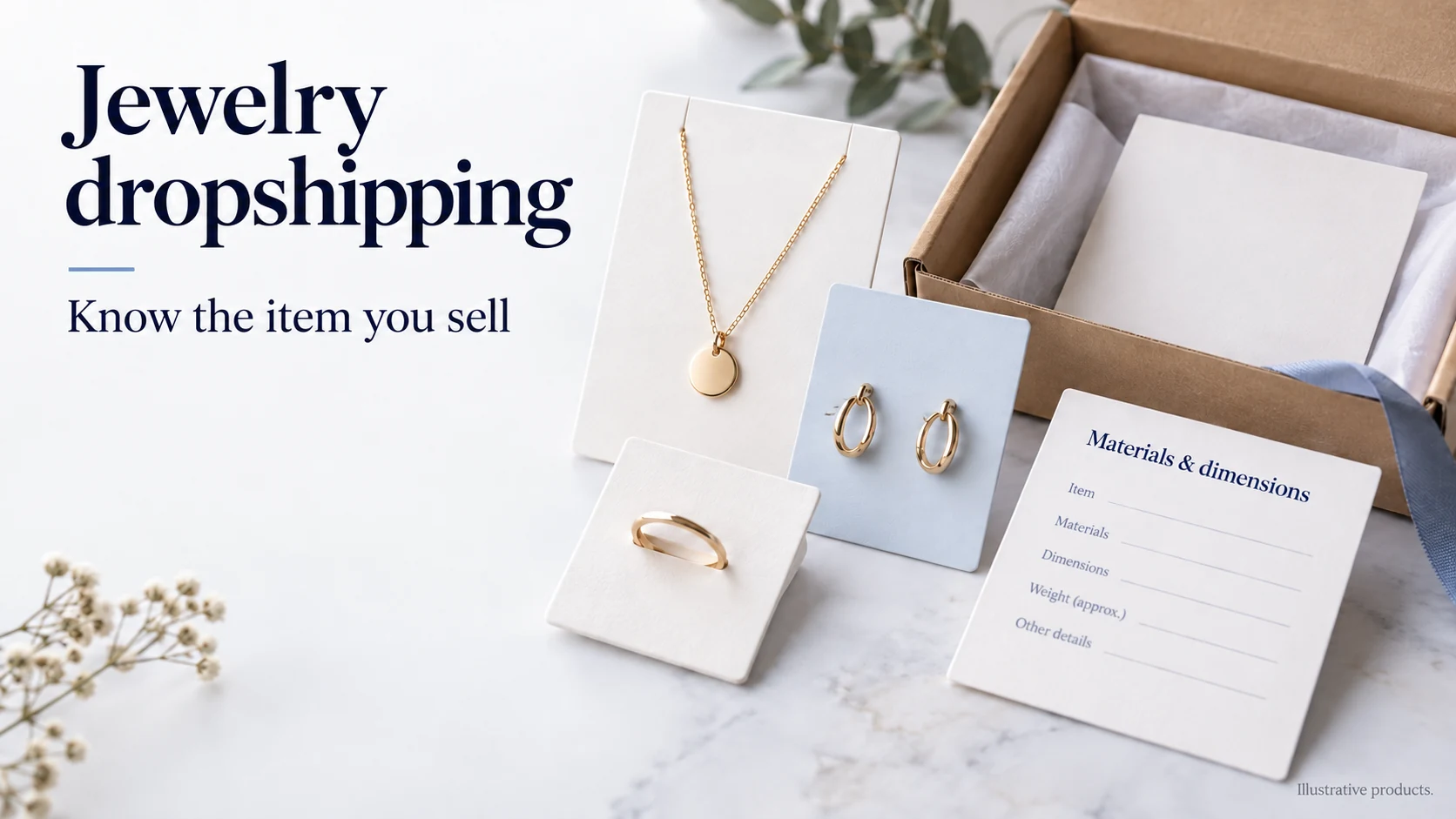
Jewelry dropshipping lets you sell a selected range while a supplier stores the products and ships customer orders. Choose a clear audience, verify the materials and descriptions, sample the actual items and agree on fulfillment and customer remedies before launch. Small parcels can simplify handling, but they do not make the product claims or after-sales work simple.
Sell only the material and performance claims you can support for the exact item. A convincing photograph, a metal stamp or a supplier’s general certificate does not establish everything a customer might infer from “silver,” “waterproof” or “hypoallergenic.”
The dropshipping products guide explains broader product selection. This guide focuses on ordinary jewelry offers and the evidence needed to describe, deliver and support them. Children’s jewelry, piercing products and high-value fine jewelry need additional specialist assessment.
01
Choose a range with a clear product promise
Decide which customer you serve and why they would choose the range. Minimalist everyday accessories, occasion jewelry and personalized gifts create different expectations about appearance, durability, delivery and returns. Avoid combining them under promises that the supplier has never substantiated.
Specify the starting product types, materials, dimensions, price position and intended market. A few necklaces with documented components can be easier to evaluate than a broad assortment whose base metals, coatings and stones change from item to item. That narrower scope also makes the first customer feedback easier to interpret.
Understand the differences between product types
- Rings require a clear sizing system and accurate dimensions.
- Earrings need an unambiguous statement of whether the price is for one piece or a pair.
- Necklaces need chain length, pendant dimensions and any extender length.
- Bracelets may need an internal measurement or usable adjustment range rather than an outer dimension.
For personalized items, confirm the characters, font, placement and approval process. A name necklace can become unsellable if the order details are wrong. Do not assume that a standard jewelry supplier also supports reliable personalization or that a generic return policy covers the production process.
Describe the offer before seeking suppliers. “A gold-colored necklace” and “a necklace made from a specified gold alloy” ask for different products and evidence. If the commercial idea depends on a material claim, resolve that claim before investing in the storefront and advertising.
02
Find a supplier who can document the actual item
You can source through a specialist wholesaler, a manufacturer, a supplier marketplace or a fulfillment partner. Establish which business owns the stock, which one ships the parcel and which one can answer technical questions. The company operating an app is not necessarily the manufacturer.
Send a short specification that identifies the product, destination and required order service. Ask for a response tied to a product identifier rather than a catalog-wide assurance. If several sellers use the same images, do not assume they supply identical goods.
Request the following before treating a candidate as ready for a sample order:
- A stable product and variant identifier, including finish and size.
- The base material and coating information for the relevant components.
- Stone identity and any disclosed treatment where applicable.
- Actual dimensions, weight and package contents.
- Available supporting documents and what product or component they cover.
- Dispatch location, stock information and a usable tracking service.
- The process for wrong items, damage, defects, cancellation and returns.
Ask whether components can change without the product code changing. A replacement clasp or chain can alter the substance of a material or skin-contact claim. Require notice of changes that affect your listing, and decide which changes need renewed review.
Separate a sample purchase from approval
Ordering a sample is a way to collect evidence. Approval is a decision about a defined specification, supplier and product version. Keep those records distinct so a later batch is not automatically accepted because the first sample looked attractive.
If the supplier cannot identify the material, you cannot repair that gap by using more cautious photography. Either obtain the information and evidence needed for the offer or choose another product. Uncertainty about the substance of a jewelry item matters to the buying decision.
03
Describe the base material and surface separately
A gold-colored surface does not establish gold content. A coating description does not identify the underlying metal unless it says so. Ask for both the substrate and the surface finish, and carry that distinction into the product description.
The FTC’s precious-metal jewelry guidance explains terms including karat gold, plating and sterling silver. It identifies sterling silver as 92.5% silver and distinguishes silver plate from the underlying product. Use the applicable definition when reviewing a US-facing claim; the appearance of a “925” mark alone is not independent verification of your shipment.
Treat the whole item as several possible components
In an illustrative necklace, the pendant, chain, clasp and jump rings are separate components. Evidence identifying the pendant’s material does not automatically identify the other parts. Ask what each relevant component is made from before describing the entire necklace with one material claim.
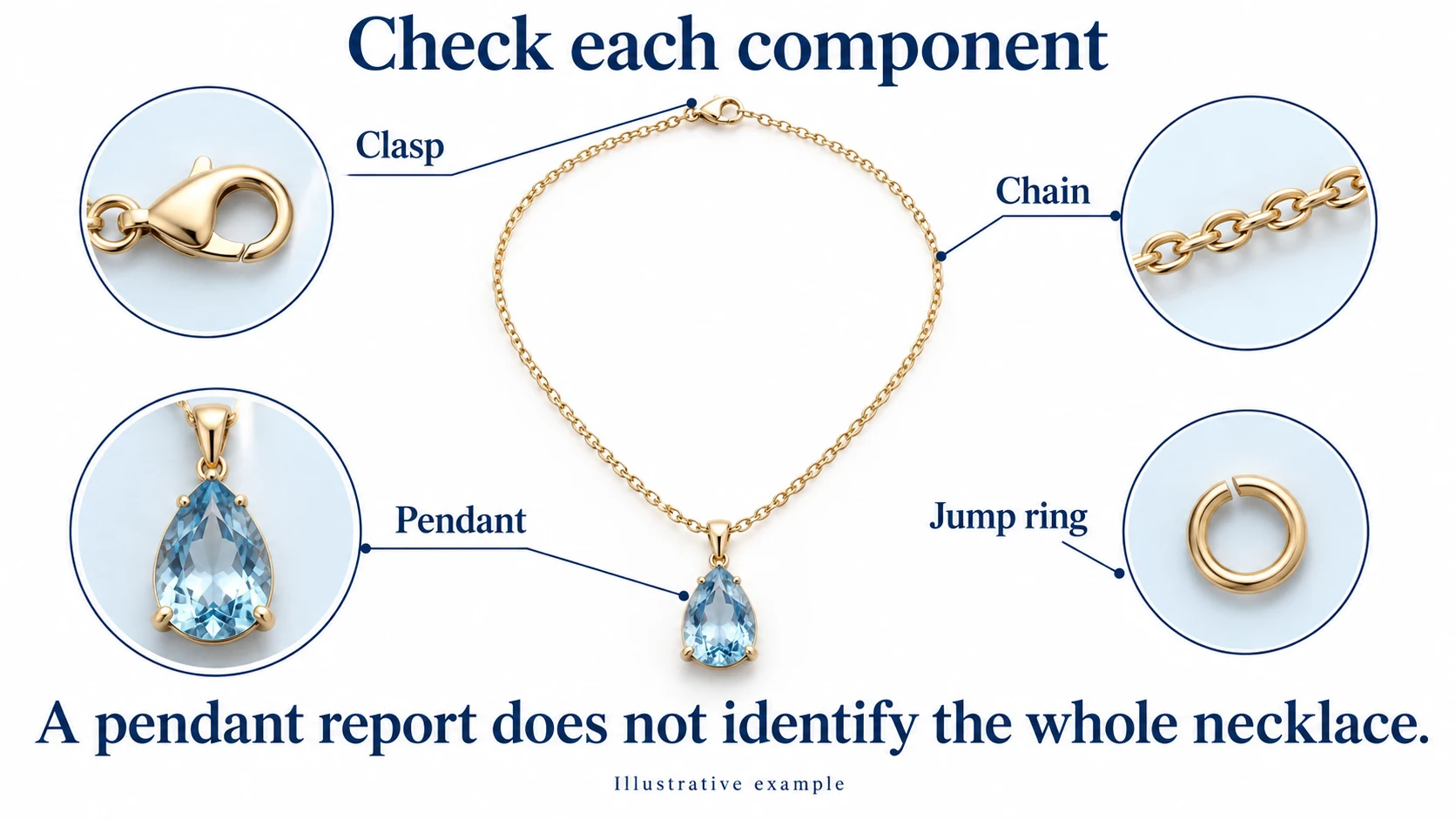
A supplier may use a documented pendant with a less clearly specified chain. You can ask for evidence for the chain, request a documented alternative or reconsider the offer. Do not silently extend a pendant-only description to the complete item.
Keep durability claims within their support
Terms such as waterproof, tarnish-free, sweatproof and lifetime color can imply a performance promise beyond the composition. Ask which conditions were evaluated, for how long and against what acceptance criterion. A composition statement is not a wear test.
Care instructions should match the evidence and actual product. Do not pair an unrestricted water-exposure promise with fine print telling the buyer to avoid all moisture. If ordinary use has important limits, disclose them clearly before purchase rather than only inside the parcel.
Avoid a general “hypoallergenic” promise based on the supplier’s adjective. Skin-contact questions need an appropriate assessment of the relevant materials, components and destination requirements. A sample that caused no reaction for one person does not demonstrate that a product is suitable for everyone.
04
Identify stones accurately and disclose relevant treatments
Keep mined stones, laboratory-created stones and imitations distinct. Those terms describe different products, and a buyer should not have to inspect a hidden specification to understand which one is offered. A resemblance to a diamond does not make a stone a diamond.
For US advertising, the FTC’s gemstone and diamond guidance explains prominent disclosure of laboratory-created and imitation products. It also addresses treatments that affect permanence, require special care or significantly affect value. Bind the description to the actual supplied item and retain the evidence behind it.
Ask for the document that answers the claim
A document called a certificate may identify a particular stone, a sample, a material result or simply a seller’s description. Read its scope. Do not advertise every unit as independently certified when the document applies to a single sample or a different product.
For higher-value items, establish how the stone or item is tied to its report and how that identity is preserved through fulfillment. If the supplier cannot maintain that link, the document may not provide the assurance the buyer expects. Avoid high-value claims that exceed your ability to verify and deliver them.
Use precise dimensions and item quantities alongside the material description. Clear product facts often answer a customer’s immediate question better than a list of unsupported premium adjectives.
05
Check whether the evidence matches your sale
Review the report issuer, date, product identification, sample description, method and conclusion. Check whether the tested material or finish matches the variant you will sell. If a report is important to the offer, verify its authenticity through an appropriate channel rather than relying on a cropped screenshot.
For a hypothetical evidence check, a report naming a pendant supports only the findings within that report’s scope. It does not automatically cover a different chain, a later material substitution or a claim that the necklace will remain unchanged for life. Match each proposed statement to evidence that actually answers it.
Ask four questions before using a document
- Does it identify this product, component or a demonstrably applicable sample?
- Does its method address the property or requirement in question?
- Does the result support the wording you intend to publish?
- Is the supplied product still consistent with the assessed version?
An unanswered question is a reason to investigate, narrow the claim or hold the product. It is not a reason to invent a badge. A genuine document can still be irrelevant to a particular assertion.
Review the market and intended user
Children’s products can have requirements beyond ordinary adult jewelry. The US CPSC jewelry guidance specifically points to children’s-product requirements, including lead content and lead in surface coatings. Do not market an adult item for children without reviewing the resulting obligations.
Other destinations may impose additional restrictions and obligations. Define where you intend to sell and obtain the relevant review for that market, product and use. A statement that an item is “compliant worldwide” does not replace that work.
For UK sales, review the applicable hallmarking requirements and exemptions when describing items as precious metal. The British Hallmarking Council’s business guidance also addresses explanatory hallmark information on online retail sites. A supplier’s material statement is not a substitute for checking whether the offered item and online presentation meet those requirements.
06
Sample the item, packaging and ordinary order route
Order the exact finish and variant through the intended fulfillment process. Record what arrives, the product identifier and the package contents. A supplier’s presentation sample may answer appearance questions while leaving ordinary packing and dispatch untested.
- Inspect dimensions, visible finish, edges, closure operation, attachment points and whether the contents match the listing.
- For earrings, verify the quantity and matching components.
- For chains, inspect the clasp and connections as well as the pendant.
The dropshipping samples guide helps define an approval record. Keep photographs of observed details and record limitations. Visual inspection cannot establish an alloy, a chemical restriction result or a gemstone’s identity by itself.
Check how the item moves inside the package
For an illustrative packing check, a necklace is secured on an insert with the chain restrained and the pendant separated from loose movement. Compare that arrangement with a loose necklace in an oversized pouch. The question is whether the actual packed sample arrives tangled, scratched or damaged, not whether one packaging style looks more expensive.
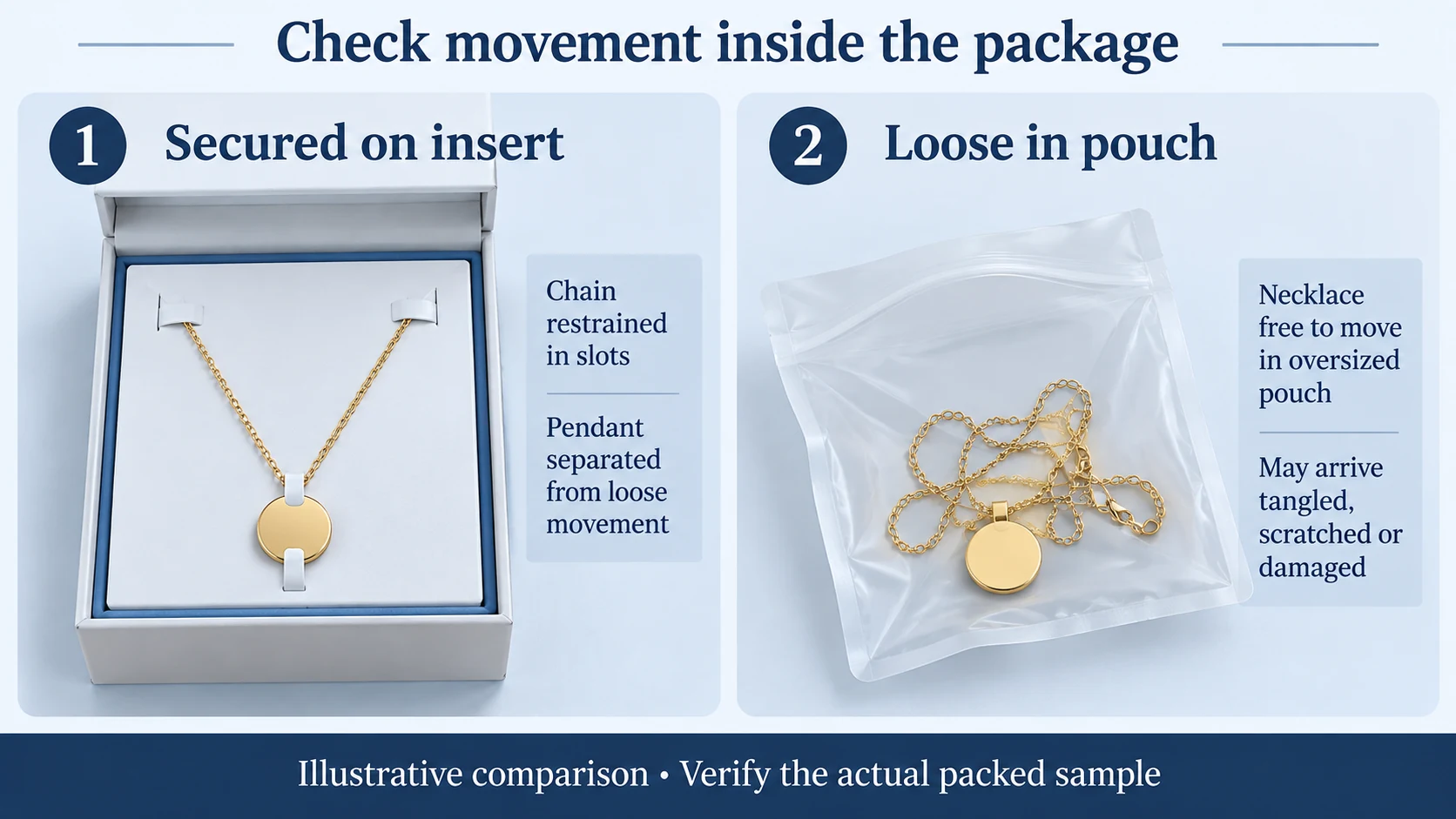
Test the proposed packaging with the actual product and route. A gift box can improve presentation but also add weight and volume. Ask who replaces packaging damaged in transit and whether the gift presentation shown in the listing is included in every order.
Avoid putting a supplier’s invoice, unrelated promotion or another brand’s card into a parcel that promises your own presentation. Confirm the actual contents. If branded inserts require a minimum purchase, record the stock commitment and replacement process.
Recheck after a material change
Link the approved sample to its identifier, finish and date. A later change to the supplier, coating or component calls for review of the affected evidence and listing. The quality-control guide explains how approval and shipment checks fit together without treating a single sample as proof of every unit.
07
Create a product page that shows scale and substance
Show the jewelry at a useful scale and include close detail of the relevant parts. Publish measured dimensions, the chain or bracelet length, the ring sizing system and exactly what the buyer receives. Make any adjustable range clear.
Use photography you have permission to publish and confirm that it depicts the supplied variant. Keep generated concept imagery labeled as illustration; it cannot prove the actual finish, stone quality or construction. Do not smooth away a material detail in a way that changes the product representation.
Put important qualifications beside the claim
- Place a plating description where the customer sees the material claim, not only in a policy page.
- State whether a price covers one earring or a pair beside the purchase choice.
- If the pictured chain is optional, make that distinction visible before checkout.
Check every option combination after importing products. A ring size and finish must map to the correct supplier variant. If a material description differs by color, update the selected variant’s information rather than leaving one general sentence above all choices.
Product copy, advertisements and shopping feeds should tell the same story. Removing an unsupported statement from the main page is incomplete if it remains in the image text or an imported feed title.
08
Calculate what remains after an imperfect order
Price the product together with shipping, handling, packaging, payment charges, acquisition cost and a realistic allowance based on your own remedy experience. Small jewelry can still create a costly replacement when the original outbound charge is not recovered.
In a hypothetical $32 order, assume $7 for the item, $4 shipping, $1 packaging, $1.50 payment charges and $9 customer acquisition. The $22.50 total leaves $9.50 before overhead and tax. A replacement costing another $7 item, $4 shipping and $1 packaging would turn that order’s remainder into a $2.50 loss if no costs were recovered.
This is an illustrative calculation, not a supplier quote or expected defect rate. Use it to decide which costs to ask about and how much room the offer has for a remedy. Supplier reimbursement, payment-fee treatment and salvage value change the result and should be recorded separately.
Watch cash as well as margin
You may pay the supplier before receiving a store payout, and a refund may be due before a supplier claim is settled. Keep funds available for those gaps. Do not rely on the next batch of sales to fund all unresolved customer problems.
Track the reason for each remedy by item and component where possible. Several broken clasps require a different response from size confusion or a missing parcel. Aggregate revenue cannot show which problem needs attention.
09
Launch with a defined after-sales process
Agree who receives a claim, which reasonable evidence is needed and what happens when the item is wrong, damaged or inconsistent with the description. Confirm a real return route and the handling of items that cannot be economically resold.
Do not assume that every earring is automatically nonreturnable everywhere. Product type, packaging, the reason for return and the market’s rules can matter. Separate a change-of-mind policy from obligations relating to defective or misdescribed goods, and review the applicable requirements before publishing the policy.
Treat a safety complaint as more than a refund request
If a customer reports an injury or a possible material problem, retain the product and order identifiers and escalate to the appropriate responsible party. Review whether the affected product should be held while the issue is investigated. Avoid diagnosing a reaction or advising the customer to continue wearing the item.
Start promotion only when the listing, sample, evidence, order mapping and remedy process agree. Continue with a manageable order volume, examine actual complaints and deliveries, and expand the range when you can support the additional variants. There is no need to turn a poorly documented item into a live experiment on customers.
For a gift-focused range, test an offer around a specific recipient or occasion while keeping the material description unchanged across the advertisement and page. Record which creative and item produced the sale, then compare acquisition cost with the amount retained after remedies. Do not promise arrival before an occasion unless the supported production and delivery arrangement allows it.
10
Frequently asked questions
Is jewelry a good dropshipping category?
It can suit a focused offer with documented products and reliable fulfillment. The decision depends on the material claims, acquisition cost, delivery promise and remedy cost. A lightweight parcel alone does not establish profitability or product suitability.
Does a 925 stamp prove sterling silver?
A stamp is a representation about the product, not independent proof that the supplied item matches it. Review the relevant documentation, product identity and verification appropriate to the claim. Do not extend evidence about one component to the whole piece.
Can I call plated jewelry waterproof?
Only use a performance claim when appropriate evidence supports its wording and conditions for that product. Plating information alone does not establish unrestricted water resistance or lifelong appearance. Clear care limits should agree with the sales promise.
Do I need inventory to start?
The supplier may hold the saleable stock, but you still need resources for samples, evidence review, store operation and customer remedies. Custom packaging or personalized production can introduce additional commitments. Confirm those terms before treating the offer as inventory-free.