

For streetwear dropshipping, start with Tapstitch or PODpartner for print-on-demand garments, Apliiq for decorated blanks and branding, or WEIV for ready-made styles. They offer different ways to build a collection. Choose the garment and selling arrangement before comparing their prices.
The graphic can look perfect on screen while the delivered tee hangs completely wrong. Perhaps you wanted a wide, short body with dropped shoulders and received a long T-shirt in a larger size. Spending more on a neck label will not fix that shape.
You can catch this before launching. Put the supplier’s garment measurements next to a shirt whose proportions you like, get a quote for the finished design, and approve one complete sample. That gives you something more useful than another folder of mockups.
Supplier pages checked November 5, 2026. The measurements and advertised prices below are published references. We have not ordered, washed or worn these suppliers’ garments.
01
Streetwear suppliers to investigate
| Source | Useful starting point | Check before committing |
|---|---|---|
| Tapstitch | Streetwear-focused POD catalog with boxy, washed and heavyweight styles | Exact garment, production location, decoration and available variants |
| PODpartner | POD garments, including a published 280 GSM boxy tee example | Included print placement and the finished design’s shipping and extras |
| Apliiq | Blank selection, decoration and garment-branding options | Which blank produces your intended shape and which services apply to it |
| WEIV | Ready-made men’s streetwear | Current selling approval, connection and stock arrangement |
For your own graphics
Tapstitch’s streetwear catalog and PODpartner are starting points when you want a garment produced after a customer orders. Both advertise single-piece ordering. You still need the exact style: one provider’s washed boxy tee and another’s regular-fit tee are different products, even with the same artwork.
Apliiq’s dropshipping catalog includes options such as the 1301 classic streetwear tee and SHMHO heavyweight oversized tee. Its appeal is the combination of blanks, decoration and branding choices. Our Apliiq dropshipping guide covers the provider’s setup and buying decisions in more detail.
For an existing collection
WEIV’s current dropshipping page directs new partnerships toward Shopify Collective, with store and business-document review. It also describes Spocket and Syncio access during the transition. An old marketplace listing is not enough to establish how you can sell its range today.
Ready-made resale can suit a shop curating complete outfits. Your own graphics may suit POD better. Neither choice by itself proves garment quality or predictable delivery; those require checking the selected items and route.
For a broader shortlist beyond streetwear, use our clothing dropshipping supplier comparison.
02
Choose resale, decorated blanks or a new pattern
“Private label” can describe several very different purchases. Ask the supplier what you can change.
| Arrangement | What you choose | What generally stays fixed |
|---|---|---|
| Resell a ready-made style | Products and variants from an existing range | The supplier’s garment design and authorized branding |
| Decorate a blank through POD | An available garment, artwork and supported additions | The blank’s pattern, fabric and available colors |
| Develop a garment | Agreed pattern, measurements, fabric and construction | Changes depend on development, sampling and production terms |
A neck label can make an existing blank part of your brand presentation. It does not make the garment your own cut. Likewise, a manufacturer willing to produce a new pattern may require development fees and a minimum batch. Its service should not be described as one-piece POD without confirmation.
WEIV advertises private labeling as a separate service. That is a reason to ask about the appropriate program, rather than assuming every ready-made item can have its original branding removed.
Choose by what must change: if the available blank already has the right shape, decoration may be enough. If your design depends on a different shoulder seam, body length or pocket construction, discuss garment development before advertising it.
03
Specify the shape with garment measurements
“Oversized” and “boxy” help describe a look, but they do not tell a customer what will arrive. Width, length and shoulder placement make that description usable.
For example, Tapstitch’s RT0027 washed boxy tee has this published size-chart information:
| Garment measurement, centimeters | M | 2XL |
|---|---|---|
| Flat chest width | 63 | 69 |
| Body length | 64 | 70 |
| Shoulder width | 59 | 65 |
| Sleeve length | 24 | 27 |
Its chest measurement runs side to side under the armpits. A flat chest width is not a person’s chest circumference. The chart is the supplier’s published specification, not our measurement of a sample.
Notice what happens between M and 2XL: the shirt becomes longer as well as wider. Buying the larger size may create a roomier look, but it cannot guarantee the short, wide proportions you wanted.
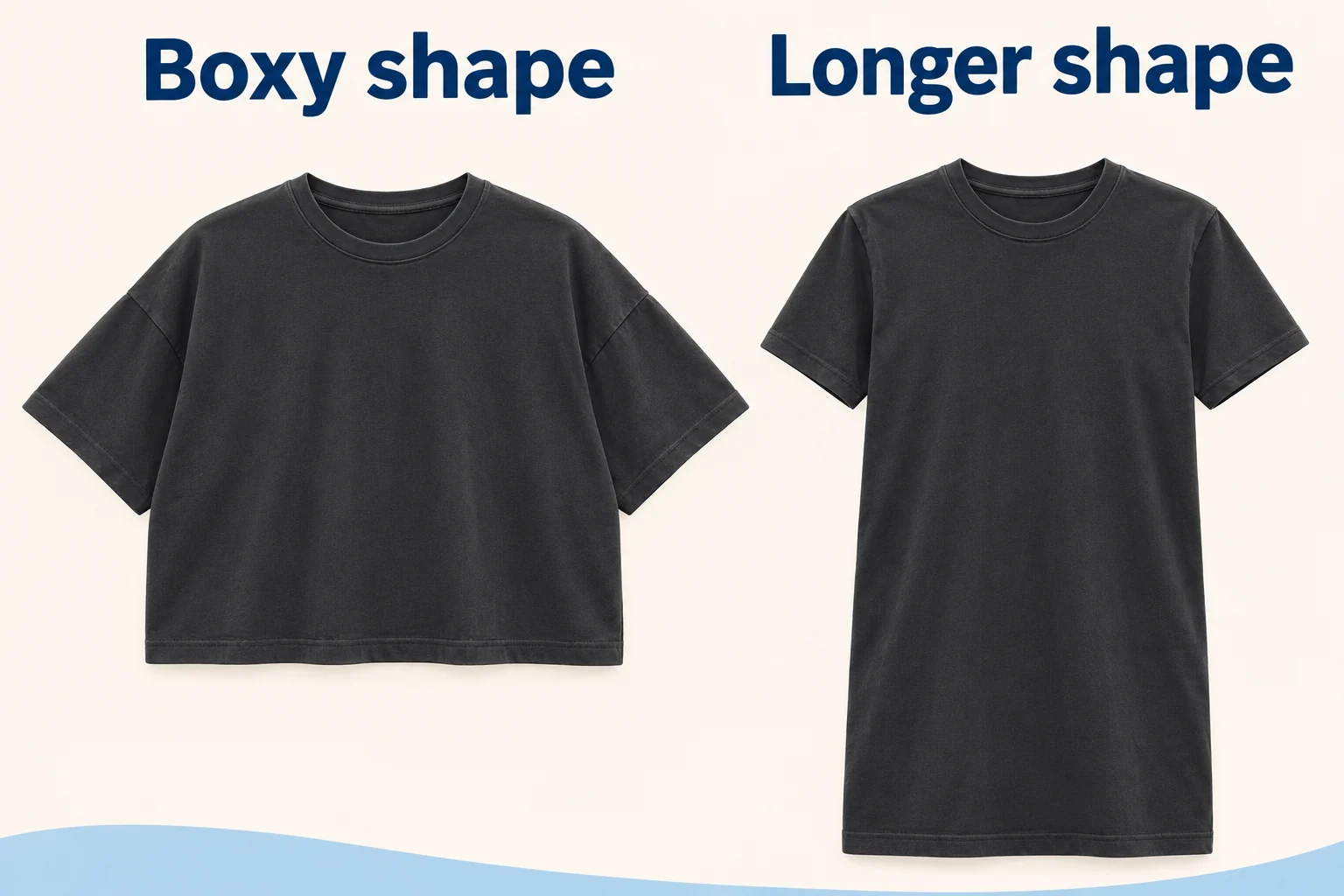
Lay a reference tee flat and measure it the same way. Compare the body length and width first, then shoulder and sleeve placement. A reference garment helps you describe the silhouette; it does not establish that a supplier’s size will fit every customer who wears that reference size.
Read GSM as fabric weight
GSM means grams per square meter of fabric. A 260 GSM fabric weighs 260 grams for a square meter; the finished T-shirt does not necessarily weigh 260 grams.
The RT0027 reference above is listed as 100% cotton at 260 GSM. PODpartner’s pricing example uses a 280 GSM boxy tee. The heavier figure does not, on its own, establish a better collar, softer hand feel, greater opacity or better washing performance.
Order the fabric and fit you want to sell. Check how the actual garment hangs, how the collar sits and whether the material feels suitable for the season. Treat “heavyweight” as a starting specification rather than a substitute for those observations.
04
Place the artwork after choosing the garment
A chest graphic that works on a long, narrow shirt can look low or crowded on a short, wide body. Save the actual garment variant before finishing the placement.
For the first design, settle these details together:
- Garment: supplier style code, color, size range and production location.
- Artwork: your approved file version, actual print dimensions and placement on that garment.
- Decoration: the supported printing or embroidery method, including any restrictions on seams or fabric finishes.
- Branding: exact neck label, hangtag or packing option, its position and whether that location supports it.
Ask how placement is handled across your size range. A mockup is useful for discussing a design, but it cannot establish print texture, embroidery stiffness or the appearance of the smallest physical size.
Use artwork you own or have permission to sell. A recognizable brand logo or character does not become available for resale because a printing service accepts the upload.
If you are deciding between print methods, the custom T-shirt dropshipping guide explains that choice. Here, the immediate task is to make your chosen design work on this specific garment.
05
Price the finished garment rather than the catalog thumbnail
PODpartner’s published pricing explanation gives a $13.23 USD base price for its 280 GSM unisex boxy tee, including the garment, one print placement, quality check and packing. Additional customization, shipping and applicable taxes or duties are separate. Use its design tool for the actual configuration.
The selected international-fulfillment view of Tapstitch’s RT0027 showed a $13.99 product price when checked, with shipping determined at checkout. That is not a matched quote for the same garment, artwork and destination as PODpartner’s example.
Comparing $13.23 with $13.99 therefore does not establish which provider will deliver your finished design for less.
Request one comparable quote
Send each candidate the same completed description. For example:
One black boxy cotton tee, selected supplier style and size M, one authorized front graphic at the stated dimensions, one supported neck label, and delivery to the same US postcode. Please separate the garment, decoration, branding, packing, shipping and any other payable charges. Confirm the production location and estimated production time.
This is an example request, not an actual supplier quote. Replace “selected style” with each candidate’s real garment and record the differences instead of hiding them under “premium tee.”
Repeat the quote for a larger size if its price changes. Ask about a second print area only if you intend to sell it; a large back graphic and a small front print may produce a different total from one included placement.
Once you have an actual parcel profile, our shipping cost calculator can help compare a China-side fulfillment option. Its estimate does not replace a POD provider’s own shipping quote or establish that the provider will use that route.
06
Plan a small collection that can ship as promised
A “drop” usually means a collection release. Dropshipping describes how orders are fulfilled. You can release a small streetwear drop without holding stock, provided the supplier can produce the advertised variants when orders arrive.
Consider this illustrative first collection:
One tee shape × two designs × two colors × three sizes = 12 sellable variants.
That is a count of customer choices, not a purchase of 12 physical units. It also means you must maintain 12 correct combinations of artwork, garment color, size, price and supplier connection.
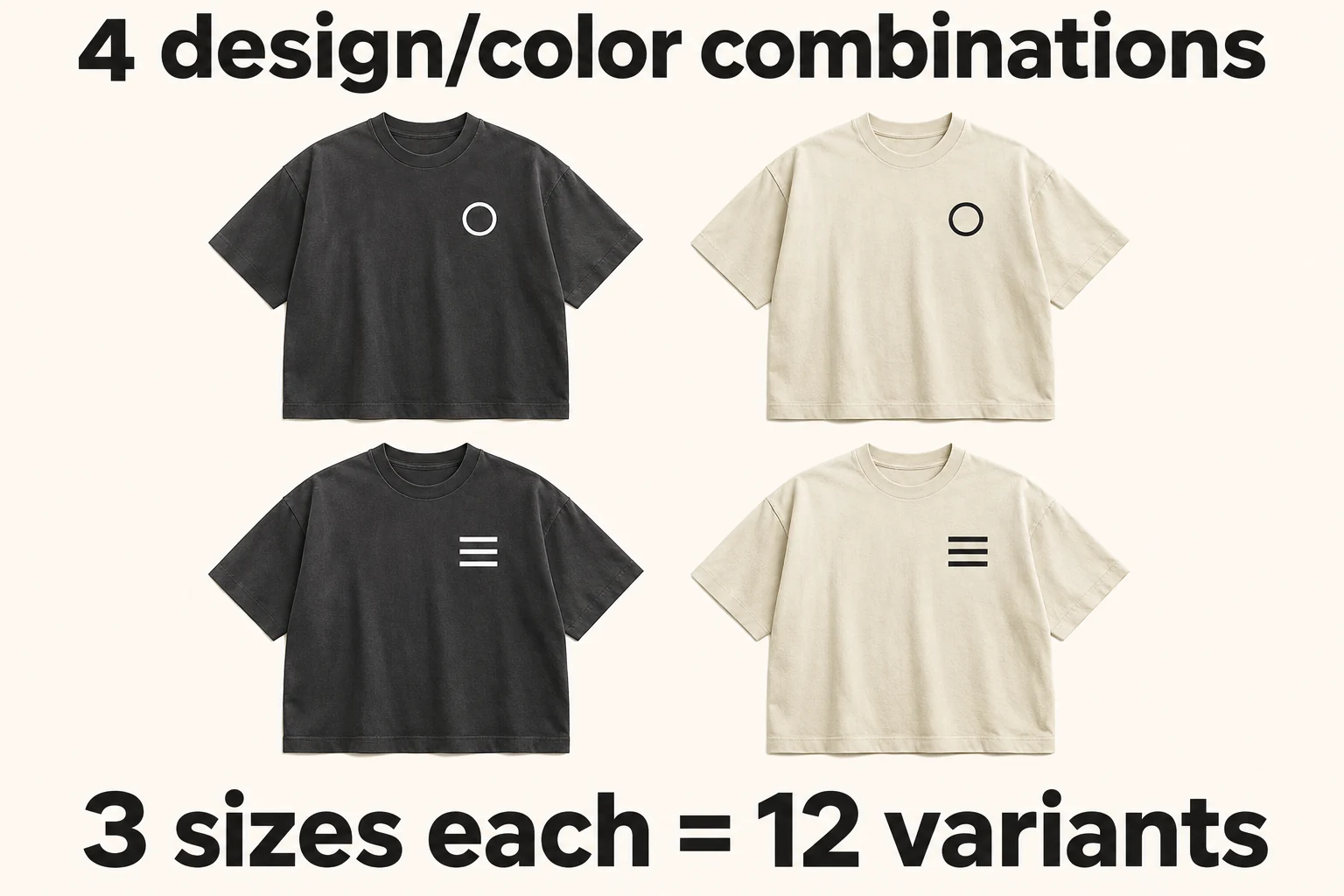
Starting with one well-chosen shape makes it easier to spot an incorrect size chart or print file. A large catalog can conceal those mistakes until someone pays for the wrong combination.
Check the basket, too
A tee and hoodie may be produced at different locations or finish on different days. Check the actual combined-order arrangement before promising one package. If the supplier splits the order, show customers how they will receive separate tracking and deliveries.
Add production time and transport time when setting the delivery expectation. “Five-day shipping” is not a five-day order-to-door promise if production happens first. Confirm the estimate for the selected garment, decoration and destination; do not copy a general shipping headline onto every item.
07
Approve the garment and decoration together
Order the finished design you intend to sell. A plain blank cannot show whether your printed back graphic sits too low or your embroidery makes the chest panel stiff.
| Look at the sample | What to compare | What a problem changes |
|---|---|---|
| Shape on arrival | Garment measurements against the published chart and agreed tolerance | Correct the listing or resolve the garment mismatch before launch |
| Worn proportions | Body, shoulder and sleeve relationship on the intended wearer | Choose another pattern if the silhouette is wrong |
| Artwork and branding | Approved file, dimensions, placement, label position and surface appearance | Correct the production instructions and approve the revision |
| Care trial | Follow the garment’s care instructions; record measurements and print appearance before and after | Investigate an unacceptable change before taking more orders |
These are proposed checks, not test results. Agree on the measurement method and acceptable variation with the supplier. One sample also cannot prove that every future batch will match it.
For washed garments, ask how normal shade variation is described. Tapstitch notes possible variation between production batches. Your product photos and description should set a reasonable expectation without excusing a materially different item.
Keep the approved sample’s style, size, color, artwork version and photos together. If a later delivery differs, you can describe the specific mismatch instead of sending “quality is bad” and waiting for the supplier to guess.
08
Agree on cancellations and customer remedies
Tapstitch’s returns policy has a 180-day request headline. Its exceptions matter: accurately produced customer designs that are later unwanted and sample orders are among the listed non-returnable situations. The page also ties a full cancellation refund to an order still being in the “In Review” stage.
Do not turn that headline into “every custom tee has free 180-day returns.” Read the conditions for your order. Your obligations to your retail customer are a separate question from what the production partner will reimburse.
Three complaints need different responses:
- The wrong blank or size arrived: compare the supplied item with the order and approved specification, then request the applicable correction.
- The graphic differs from the approved file: send the file version, placement instructions and clear photos showing the difference.
- The correctly produced item is no longer wanted: follow your stated customer policy and applicable obligations; do not assume the POD provider will fund that preference change.
Resolve an order while its status is clear. If a customer asks to cancel after production begins, check the live order and provider terms before offering a refund funded by the supplier.
09
Streetwear dropshipping questions
Can I start without buying a batch of clothing?
Single-piece POD can avoid a finished-garment batch purchase. You still need money for samples, production payments, store costs and customer remedies. A new cut developed specifically for you is a separate agreement and may involve a minimum production quantity.
Can I build a brand using an existing blank?
Yes. Your design, product selection, consistent fit descriptions and supported branding can make a coherent collection. Be accurate about what is original: a custom graphic and label do not mean you developed the underlying garment pattern.
Should I move a successful design into stocked production?
Compare the actual repeat demand, finished cost, lead time and cash commitment. A cheaper unit price can still leave money tied up in unpopular sizes. Use your size-and-color sales history and remake or return reasons before choosing a batch mix.
Can AIDrop help source a different silhouette?
Send the silhouette reference, garment measurements, fabric requirements, authorized artwork, intended quantities and destinations through a product sourcing request. We can review the sourcing and fulfillment work that needs quoting. A new pattern, sample, print process or custom packing requires its own confirmation; it is not automatically a zero-minimum POD service.

Clothing Dropshipping: Sizes, Variants, Samples and Returns
Verify apparel sizes, variants, samples, labels and returns before launch. Build a clothing dropshipping offer around accurate
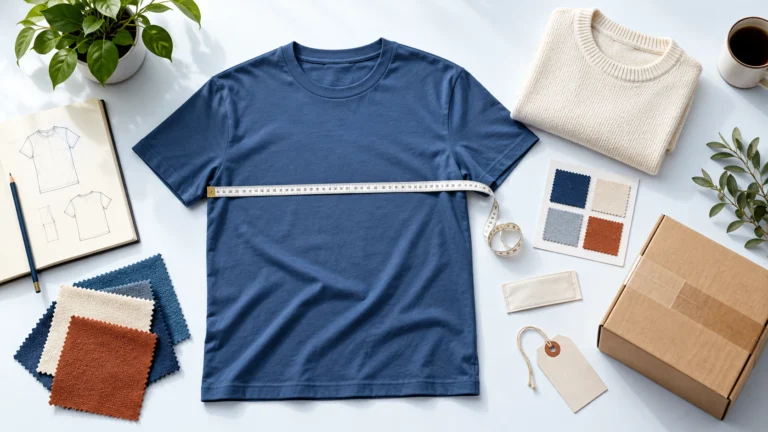
Clothing Dropshipping Suppliers: 5 Options for Different Stores
Compare Trendsi, Printful, Printify, Apliiq and BrandsGateway by clothing model, fit information, stock, shipping and return costs.
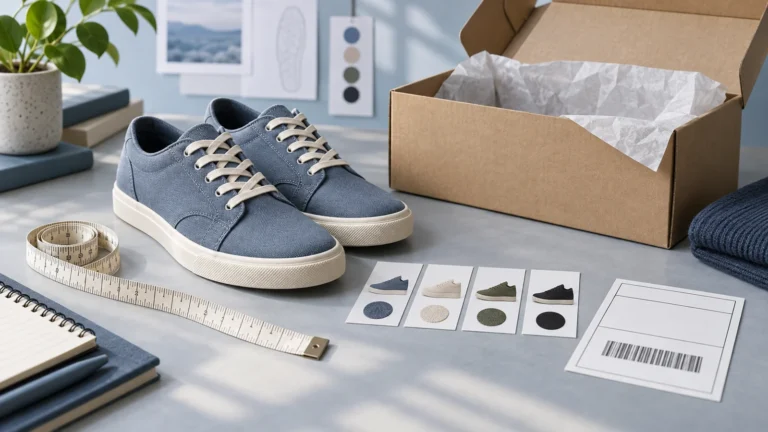
Shoe Dropshipping: Sizing Evidence, Variants and Return Exposure
A shoe listing needs model-specific fit evidence, exact size-color stock and a workable exchange route. Compare one
