
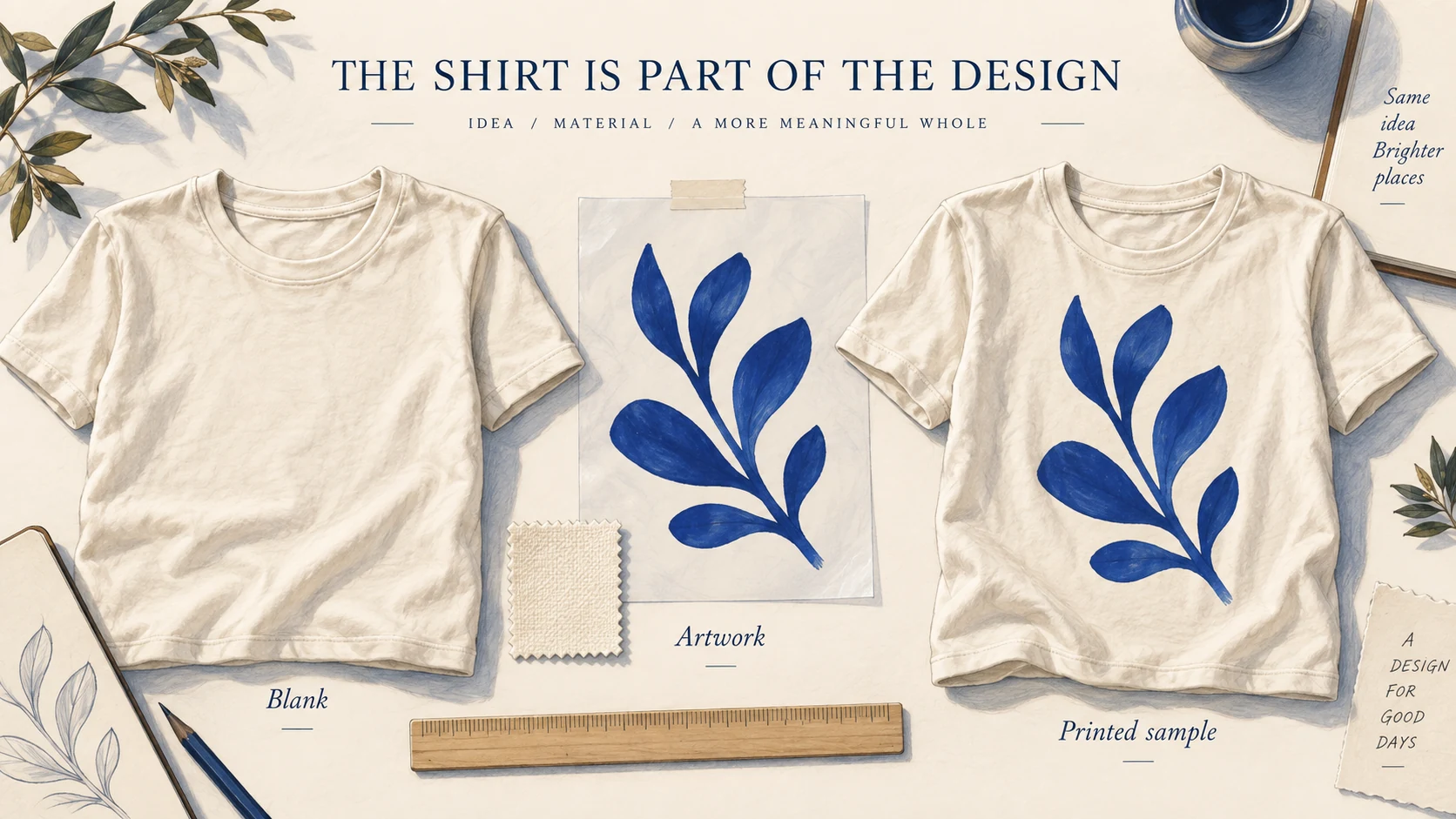
Custom T-shirt dropshipping lets you sell a design while a print provider decorates and ships each order. To make it work, choose an exact blank, fabric color, decoration method and print placement; approve the physical result; then price the complete sale. A convincing mockup cannot establish fit, print feel or consistency between orders.
The shirt is part of the product, not just a surface for the artwork. A loose, heavyweight tee and a lightweight fitted tee create different customer expectations even with the same graphic. Your sourcing and product page need to describe the one you actually sell.
01
Start with the shirt the customer expects
Decide who will wear it and why. An event souvenir, everyday illustrated tee, oversized streetwear piece and running shirt require different fits, fabrics and delivery promises. This choice narrows the blanks and print methods before you spend time importing a large catalog.
Record the blank’s brand and style number, supplier SKU, color, fiber composition and size range. Do not assume every color of a style uses the same blend. Heather variants can differ from solid colors, which matters for both the description and the printed result.
Familiar styles such as Bella + Canvas 3001, Gildan 5000 and Comfort Colors 1717 can be starting points for comparison. They are not interchangeable substitutes. Confirm the exact version available from your chosen provider and use its current product measurements and decoration options. This article is not a hands-on ranking of those blanks.
Fabric weight in GSM is useful when comparing the feel you want, but it does not prove overall quality. Examine opacity, stitching, collar recovery, drape and how the fabric behaves after its stated care routine. A heavier shirt can still have the wrong fit or an unsuitable surface for your design.
If you are still choosing the business model, the print-on-demand dropshipping guide explains how production after purchase changes inventory, cash flow and fulfillment.
02
Choose the blank and print method together
Start with a combination your provider actually supports. Do not select a method from an abstract “best quality” ranking and assume it works on every fabric.
| What you want to sell | A method to investigate | What the sample needs to establish |
|---|---|---|
| Detailed artwork on a cotton-rich everyday tee | Direct-to-garment, or DTG | Detail, opacity, surface feel and the effect of the garment color |
| A bold graphic on an approved cotton or blended blank | Direct-to-film, or DTF | How the transferred area feels, flexes and survives the stated care routine |
| An all-over design on suitable light polyester fabric | Sublimation | Color, seam placement and the finished garment’s fit |
| Repeated simple artwork at a predictable batch quantity | Screen printing | Setup cost, ink treatment, approved colors and inventory commitment |
DTG applies ink directly to the garment. DTF transfers a printed design to it. Sublimation uses a different process suited to compatible synthetic materials. These differences affect which blanks and artwork can be used; a provider’s own printing-method guidance is a useful starting point, followed by the exact product specification.
For DTG, the same artwork can look different on cotton and blends. Printful’s fabric guidance describes how blended fabrics can produce a more muted, vintage effect. That may suit the design, but it should be an intended result rather than an unexplained customer surprise.
There is also a commercial distinction. A screen-printed batch may lower unit cost at sufficient quantity, but you then need stock and fulfillment for those finished shirts. Buying 100 units to obtain a better print price is a different commitment from producing one after each sale. Compare the cost of unsold sizes as well as the printing quote.
03
Make the print placement specific
“Centered on the front” leaves several decisions unresolved. Specify the printed width, the intended vertical position and the reference used to measure it. The artwork’s bounding box can include transparent space, so centering the file does not always center the visible design.
For a hypothetical placement, “front graphic 10 inches wide, top of visible artwork measured from the agreed neckline reference” is more useful than a screenshot alone. Have the provider confirm the achievable position and its normal tolerance. Do not promise perfect millimeter alignment across every sewn garment.
Check the smallest and largest sizes you intend to offer. An identical print width occupies more of a small shirt’s chest. Some systems resize automatically: Printify states that apparel designs are scaled down for smaller sizes and are not scaled up beyond L in its design-dimensions guidance. Inspect the product’s actual behavior before writing a universal size claim.
Dark and light colors deserve separate attention. A design that looks clear on white can lose contrast on a dark shirt, and the printing treatment can change its appearance. If your launch includes both, a sample of only one color leaves a material question unanswered.
04
Select a provider for the whole order
Printful, Printify and Apliiq represent different routes worth investigating. The right comparison is the finished shirt and its delivery arrangement, not the number of products in the catalog.
Printful supplies product-specific decoration and file requirements, with production, shipping and applicable extras forming the order cost. Printify offers products through print providers; keep the selected provider tied to the sample you approve. A change of provider may change the available blank, method, location or result even when the storefront design looks identical.
Apliiq is relevant when garment branding or additional decoration matters. Its dropshipping pricing explanation separates the blank and decoration and lists a $1 fulfillment fee per item, with shipping and relevant extras charged separately. Two shirts in one customer order therefore need two item fees under that stated structure. Verify the complete current quote for your chosen configuration.
Then test the ordinary operational details: how the store variant maps to the provider’s SKU, how a personalized name reaches the print file, when payment is taken and when production becomes difficult to cancel. For more provider options, use the POD supplier comparison alongside the exact product you want to make.
05
Approve a sample you can sell honestly
Order the decorated item, not just a blank. Use your final artwork at the intended size and position, with the provider and route you plan to use for customers. A sample from one print facility cannot establish the result from another.
On arrival, inspect it in ordinary light. Compare the actual shirt with the product description, measure the agreed garment dimensions and examine the print’s edges, coverage and placement. Wear or handle it sufficiently to understand the fit and feel you will describe. Keep notes and photographs rather than relying on memory.
Follow the specified care instructions for a practical wash check, recording the process and observations. Measure the same points before and after. A small home check can reveal a problem worth investigating; it is not a laboratory durability certification or proof of performance over dozens of washes.
For personalized products, test the retail path too. Printify’s sample-order instructions say personalized products should be ordered through the sales channel for testing. This can expose a misspelled name, missing personalization field or wrong variant mapping that a manually created sample would bypass. Its samples are paid orders; a free account does not mean free samples.
Save the approved blank, color, size, method, file version and order reference. The sample approval guide explains how to retain that evidence for later comparisons.
06
Price a complete sale
The difference between retail price and the printed shirt’s base cost is not your final profit. Shipping, payment fees, advertising and customer problems all draw from that difference.
Here is a hypothetical $30 sale in USD. It assumes no shipping charged separately to the customer and excludes tax collected on behalf of authorities. These numbers are illustrative, not supplier quotes or a recommended selling price.
| Item | Modeled amount |
|---|---|
| Customer revenue | $30.00 |
| Blank and printing | −$14.00 |
| Shipping | −$4.50 |
| Transaction and payment costs | −$1.20 |
| Advertising allocated to the order | −$6.00 |
| Expected exception allowance | −$0.50 |
| Modeled contribution before fixed expenses and tax | $3.80 |
That leaves $3.80 to help pay fixed expenses and other costs, before income tax. Changing the design to include a back print or inside label can reduce it further. Price larger sizes, extra locations, additional items and different destinations individually instead of assuming the headline base price applies to every sale.
Now consider a real replacement within this hypothetical example. Before the expected exception allowance, contribution would be $4.30. If you fund another $14 shirt and $4.50 shipment without supplier reimbursement, that order’s contribution becomes −$14.20. For this realized calculation, replace the $0.50 planning allowance with the actual $18.50 cost; do not count both as the same exception expense.
This makes the return arrangement important before launch. Printful’s return and refund policy distinguishes manufacturing issues from situations such as a customer choosing the wrong size. The supplier’s remedy does not automatically match the policy you choose—or are required—to provide your buyer.
07
Build the product page and order handoff
Publish the garment measurements and explain how to use them. A body measurement and a flat garment measurement are not the same thing. If the chart reports chest width with the shirt laid flat, label it that way and show the measurement points. Avoid “true to size” as a substitute for usable measurements.
Use approved sample photography to show the actual print and fit when available. Mockups can help display choices, but they should not imply a different material, print size or finish. Describe relevant fabric composition, care instructions and whether a design has a noticeable transferred surface.
Set a delivery estimate that includes production as well as transit. A shirt that takes several days to make cannot honestly be sold on the carrier’s transit window alone. An event date makes this especially important: the buyer needs the finished shirt before the event, not merely a tracking number.
Use artwork, fonts and other assets you have permission to use commercially. Supplier acceptance of a file is not a rights clearance. Branding changes also need care: the FTC’s apparel-labeling overview describes US textile and care-label requirements. Removing a manufacturer’s label to add yours must not erase required information without a compliant replacement.
For personalized orders, make the handoff unambiguous. Retain the buyer’s submitted text, the chosen variant and any approved proof. If you offer proof approval, specify when it must happen and how it affects production timing. Do not release an order with unresolved spelling changes simply because the customer liked an earlier preview.
08
Launch a small range and track the failure
A small, coherent range is easier to validate than dozens of combinations. Start with the designs, colors and sizes you can describe accurately and support. Add variants when you have addressed the new print or fit questions they introduce.
Watch for distinct causes of complaints. Wrong-size selection suggests measurement or fit information may need improvement. The wrong blank points to sourcing or mapping. Blurred text may come from the file or print process. An incorrect personalized name can arise in the customer form, order transfer or production file. Each needs a different correction.
Confirm how stockouts and substitutions are handled. An available shirt with the same size letter can have a different cut, material or print surface. Require approval before replacing the tested blank or print provider. Otherwise the sample you approved stops describing the product your store sells.
09
Common custom T-shirt questions
Can I start without buying a batch of shirts?
Yes, if the chosen provider supports single-order production. You still need money for samples, production, shipping and the period before sales proceeds become available. Custom labels or packaging may introduce separate minimums.
Which printing method is best?
Choose by fabric, artwork, quantity and intended feel. DTG on a suitable cotton-rich blank is different from a DTF transfer or sublimated polyester shirt. Approve the combination you will sell rather than choosing a method by name alone.
Can customers return print-on-demand shirts?
That depends on applicable consumer rules, the nature of the product and your policy. Do not assume every standard design printed after purchase counts as legally personalized. Keep your buyer-facing obligations separate from the supplier’s willingness to refund you.
When does bulk printing make sense?
When repeat demand and size distribution justify the inventory and the complete cost is better. Include storage, picking, delivery and unsold stock; a lower printing price alone is insufficient.