
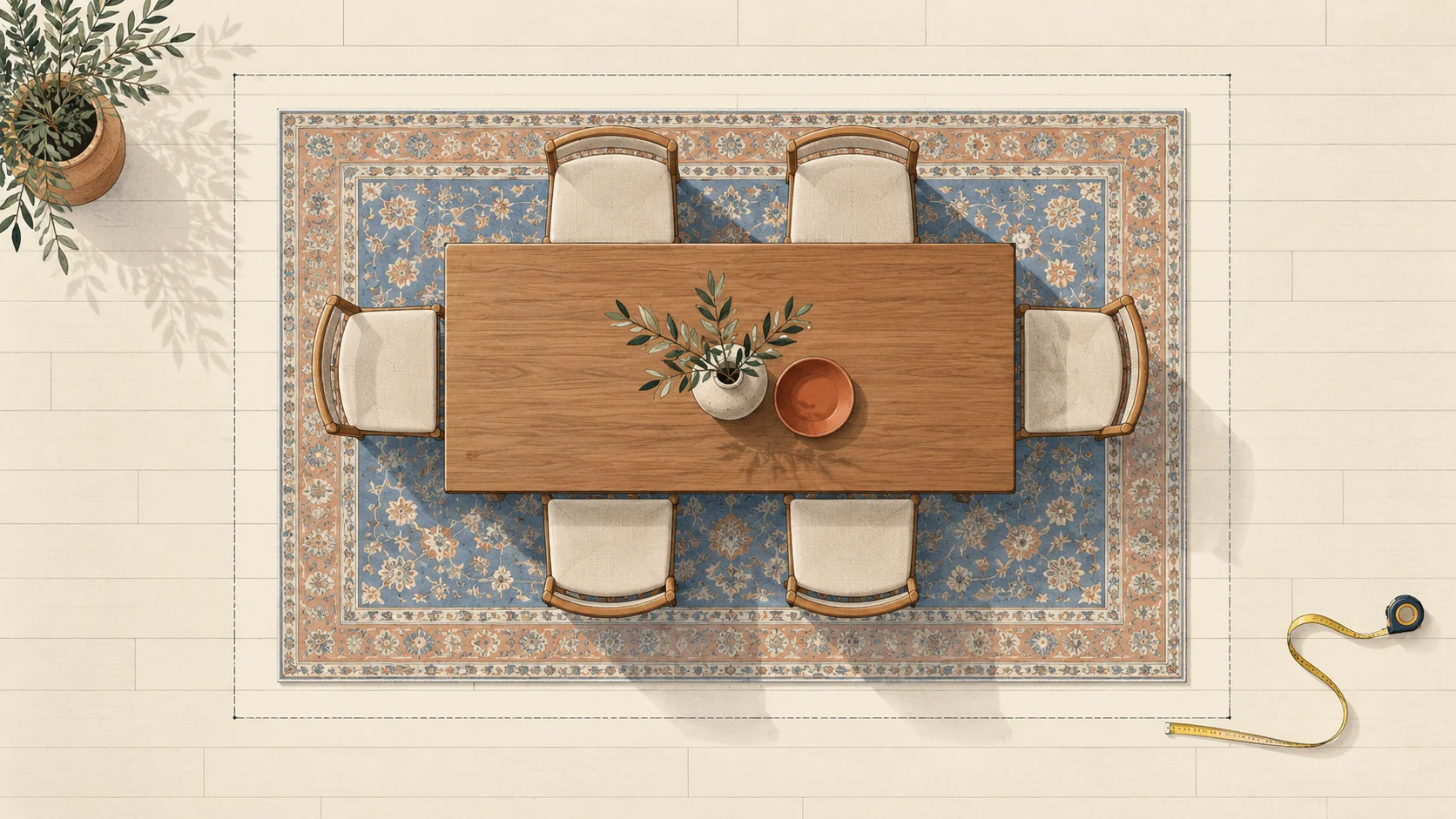
Yes, you can dropship rugs. Some rug trade programs let a store sell one rug and have the supplier send it straight to the customer. The difficult part is the promise you make between those two events: will this exact rug fit the room, arrive at the quoted cost, and have a workable path back if it is wrong or damaged?
Picture a customer looking at an “8×10 dining rug.” She is deciding whether chairs will catch on the rug’s edge. You are deciding whether the supplier has that particular size in stock and what happens if she needs to return a large rolled parcel. Both questions belong on the product page before you take her money.
01
What a rug dropshipping order actually looks like
The customer buys from your store. You place an order with an approved rug source, pay its trade price, and give it the customer’s delivery address. The source packs and ships the rug; you remain the seller the customer contacts about the listing, tracking and problems.
This is a real model, not just a theoretical “find a wholesaler” suggestion. Rugs.com’s trade program says a business can order one rug with no minimum and ship it directly to a client. Tradition Rugs also says it can ship to a customer in the continental US. Nourison Home describes dropship capability for its trade partners, though its public page does not give a quote for any particular rug or address.
Ask for the retailer terms
The programs are not interchangeable. A trade account, a retail checkout and a marketplace catalog can display the same picture while giving you different product data, shipping charges and remedies. Ask for the one-unit retailer terms before importing a catalog. Our dropshipping suppliers guide explains the wider source-model comparison.
Order eligibility
Ask the source for: Can an approved retailer buy this SKU one at a time and ship it to a US customer?
Why it changes the sale: “Wholesale” can still mean case or account restrictions.
Current item
Ask the source for: Exact SKU, color, size and stock available now
Why it changes the sale: An image of a collection is not a reserved rug.
Customer address
Ask the source for: Packed dimensions, destination-level freight and dispatch terms
Why it changes the sale: A large rolled rug can price differently from a small mat.
After delivery
Ask the source for: Damage-photo deadline, return eligibility, label and refund process
Why it changes the sale: The customer will contact your store first.
Bella is not currently opening new dropship partnerships
One page can even contradict itself. Bella Rugs promotes a dropshipping program in its heading and FAQ, yet the same page says it is currently not accepting new dropshipping collaborations. Treat an application as open only when the company confirms it. A search result or a product feed cannot do that for you.
02
Describe the rug the buyer will really receive
“8×10, beige, washable” is too little information for a rug a customer must live with. A useful listing identifies the actual dimensions for the SKU, shape, material, pile and care directions. Pile is the visible surface fiber; a deep pile may feel plush but can make dining chairs harder to move and crumbs harder to remove. Rugs.com’s dining guide makes that use-case distinction.
Care and construction belong to the exact SKU
Start with the source’s item sheet, not a generic description you copy across a collection. The same supplier may sell washable, indoor/outdoor, and made-to-order rugs. Nourison’s partner page explicitly separates those types. A care statement that fits one construction may be wrong for another; a made-to-order size may also have a different lead time or return rule. Ask for each SKU’s written details.
Show the dimensions in inches as well as the familiar size name. A customer will use the listed measurements to plan a room. If the source supplies only “8×10,” request the finished size and any stated tolerance before claiming a precise fit. For vintage or one-of-a-kind pieces, request actual-item photos and a current stock confirmation rather than a pattern-family image.
Check the pad and photos
Also check what the picture silently suggests. Is the rug pad shown but sold separately? Is a close-up of the texture available? Do the photos show the actual color or only a styled room under warm lighting? A pad is not a free accessory just because it appears in the scene. Rugs.com’s trade terms, for example, price pads and accessories differently from rugs.
03
Test the room before recommending a size
The fastest useful test is a tape measure, not a sizing slogan. For a dining room, the chairs need to stay on the rug when pulled back. Rugs.com’s dining-room sizing guide suggests roughly 24 inches of rug beyond each side of the table as a rule of thumb. It is guidance for planning, not a guarantee that a particular room or chair will work.
Take an illustrative six-seat table measuring 72 by 36 inches. Add 24 inches on both ends and both long sides:
| Direction | Table | Chair clearance | Needed rug footprint |
|---|---|---|---|
| Length | 72 in | 24 + 24 in | 120 in = 10 ft |
| Width | 36 in | 24 + 24 in | 84 in = 7 ft |
On a phone, swipe the table sideways to compare every column.
Candidate size is not confirmed room fit
A nominal 8×10 rug might cover that 10-by-7-foot footprint with the 10-foot side running along the table and the 8-foot side across it. But that is only a candidate. Check the rug’s actual finished dimensions, the chair movement in that room, the walls and doors around it, and the buyer’s preferred exposed floor. If the rug measures shorter than its name suggests, the arithmetic changes.
For a store, the product-page lesson is simple: name the room and use case that the rug can honestly support. “Fits most six-seat dining tables” is broader than this measurement proves. An annotated dimensions image and a clear “measure your table and pulled-out chairs” note help the buyer make a better choice.
Write a size note the buyer can use
For the fictional 72×36-inch dining table, turn the calculation into a proposed listing note only after confirming the real SKU. Do not publish the blank fields as finished product data.
Dimensions and contents
“Finished rug size: ___ × ___ inches; nominal size: 8×10; pile/material: ___; pad: included / sold separately.” Use the source’s actual measurements and care instructions, not the styled photo.
Room check
“Measure your table and chairs when pulled back. This example needs about 120×84 inches; check doors and walls too.” If the finished rug is too short or a chair leaves its edge, suggest another confirmed size rather than claiming a universal six-seat fit.
Before publication, compare the item sheet with the phone page and actual-item photos or an approved sample. After any size or construction change, recheck the note and return eligibility. No rug sample was measured for this illustration.
04
Price the parcel and the way back
Rug economics are more than “retail price minus wholesale price.” Your order may include the rug, any pad, packing or handling, shipping to the exact ZIP code, payment fees and a reserve for a return or damage claim. A rolled 8×10 parcel can be expensive to move twice. Get an address-level quote and the packed measurements rather than borrowing a rate from another size or destination.

Here is a made-up calculation for the same proposed rug. It shows the questions, not a supplier rate or AIDrop quote:
| Illustrative line | Amount |
|---|---|
| Customer selling price | $260 |
| Rug purchase | −$145 |
| Outbound shipping and packing | −$35 |
| Payment cost | −$8 |
| Return/damage allowance set by this seller | −$22 |
| Contribution before ads, overhead and taxes | $50 |
On a phone, swipe the table sideways to compare every column.
Another $20 freight reduces contribution by $20
If the actual outbound quote rises from $35 to $55, that contribution falls to $30. If a fit return is at the store’s expense, one two-way parcel can use more than the allowance. Reprice or change the offer after you learn the real policy; do not publish a margin based on a sample figure.
The $22 allowance is a planning reserve, not a supplier charge or a known return rate. Ten successful sales under the assumed costs would set aside $220 and leave $500 of modeled contribution after that allowance.
Replace the allowance with the actual claim cost
Replace the allowance with the actual claim cost
If actual claims cost $320, replace the $220 allowance with that real cost: $500 + $220 − $320 = $400 before ads, overhead and taxes. Do not subtract $320 from $500 again without adding back the allowance; that would count the reserved cost twice.
The figures do not predict how often rugs come back. A costly reverse shipment or refund loss can reduce the result further. Use the actual credits, freight and non-recoverable fees for the orders you are reviewing.
Try the actual costly-return case
To use the idea for a real SKU, ask who pays the outbound and return labels, whether the rug can be resold, what credit the supplier gives for damage or fit returns, and which fees remain after a refund. Then test a quiet month and a costly-return month using your rates. The decision is whether the price still works in the plausible costly case. If you cannot state the return route or the cost of one reverse shipment, a published “easy returns” promise and a thin margin are both guesses.
Free-return and final-sale programs differ
Now compare what happens if the buyer sends the rug back. Rugs.com currently advertises free shipping and free 30-day returns in its trade program. Tradition Rugs says its sales are final, even though it can ship directly to a continental-US customer. Those are their terms. Check the current account and SKU before telling your own customer what you will accept or pay for.
Wrong fit and transit damage need separate remedies
Damage needs a separate route from “the color looked different.” Ask the source who supplies a return label, how soon the customer must photograph the packaging and rug, whether a replacement exists for a one-of-a-kind item, and who pays for the second shipment. Record the answer before there is a damaged rug leaning against someone’s front door.
05
Release or hold one proposed rug listing
Return to the fictional 72×36-inch table. A supplier feed offers a nominal 8×10 low-pile rug, but the feed has no finished measurements, no current stock confirmation, no packed-size data and no written answer about fit returns. The room calculation is promising. The listing is still on hold.
Table and chair footprint: 120×84 in
Status in the example: Calculated
Decision: Candidate size only
Actual rug length, width, shape and pile
Status in the example: Missing
Decision: Request item sheet or measurement
Available SKU and color
Status in the example: Not confirmed
Decision: Request current stock/actual photos
One-unit ship-to-customer quote for buyer ZIP
Status in the example: Missing
Decision: Price after written quote
Damage and fit-return path
Status in the example: Missing
Decision: Write buyer promise after supplier answer
Copy and complete the supplier request
Send the source this request: “For SKU [item code] in [color], please send finished dimensions, pile/material details, current stock, packed dimensions, total shipped cost to ZIP [destination], dispatch terms, and the damage and fit-return procedure for a one-unit client shipment.”
If the source cannot answer, choose another confirmed SKU or keep this one off the site.
Compare the answer with the buyer’s page
If it can answer, compare its details with your photos, size note, delivery estimate and return policy. Only then decide whether this rug is ready to sell. The broader dropshipping products guide helps with product choice; the home decor dropshipping article covers the larger decor category. This rug decision stays at the level of one item and one buyer promise.
If you want to explore sourcing or packaging for a specified rug program, tell AIDrop Agent what the item and destination require. The team can assess whether the requested scope is feasible; this is not a claim that a rug dropshipping service or a particular supplier account is already available.
Questions before selling one rug
Can I dropship just one rug?
Some programs, such as the current Rugs.com trade offer, allow one rug sent to a client. Confirm your account, the exact SKU and destination. A wholesale heading or a closed partner application is not approval.
Does an 8×10 rug fit every six-seat dining table?
No. The worked 72×36-inch table needs a 120×84-inch planning footprint with the suggested chair clearance. Match the actual rug dimensions and orientation, then check the pulled chairs, doors and walls.
Can I call every rug washable?
Use the exact item’s care instructions and construction. A supplier selling some washable rugs does not make the whole catalog washable, and a made-to-order rug can have different lead times and returns.
Should I promise free fit returns?
Only if your store can honor the published promise for that SKU and address. The suppliers above have different terms. Confirm who pays the label, whether the item is eligible and which refund costs remain; damage needs its own procedure.

Furniture Dropshipping: Product Data, Delivery Scope and Damage Recovery
Furniture dropshipping needs more than a supplier quote. Verify the exact piece, cartons, drop-off service and damage

Home Decor Dropshipping: Fragility, Dimensions and Presentation
A decor listing needs more than a room photo. Compare appearance, packed dimensions and the recovery path

Candle Dropshipping: Choose the Jar, Scent and Shipping Plan
Build a small candle offer, compare individual dispatch with wholesale batches, price a complete order, and plan
