
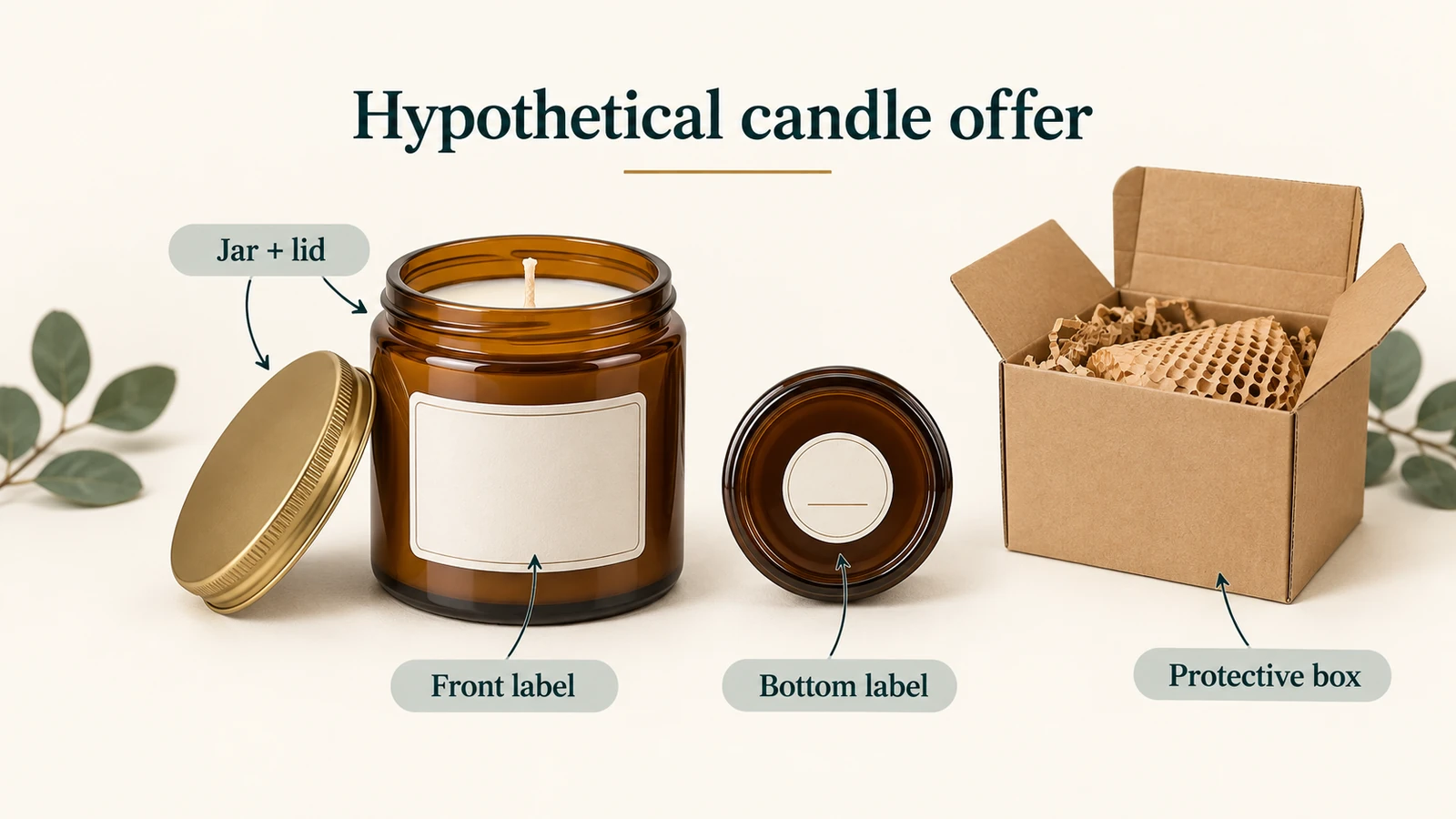
Candle dropshipping means selling finished candles through your store while a supplier packs and ships each customer’s order. Start with a small range of jars and scents, then confirm that a supplier can send the exact candle, with the right labels and protective packaging, to your customers.
A birthday buyer cares whether the scent, jar and delivery date match the gift they chose. A broken jar leaves the store with a customer problem even if a supplier packed it. Let those two moments shape the product page and the supplier agreement.
This model suits a seller who wants to develop a focused candle brand without pouring wax or renting storage. It still requires product review, funded orders and customer service. A supplier’s large catalog is useful only when its individual-order service fits your market.
01
Choose the candle your customer is buying
A jar candle can make a straightforward gift offer because the vessel, label and scent form one recognizable product. A tin may suit a different price or packing plan. Pillar candles need their own use instructions and suitable holders; wax melts need a warmer and should not be presented as ready-to-light candles.
Choose an occasion you can serve
Choose a specific buyer and occasion: a small housewarming gift, a refill for an existing favorite scent, or an unscented decorative candle. Avoid promising sleep, anxiety relief or other health effects because a fragrance description sounds appealing. Soy wax, a cotton wick or an expensive vessel does not by itself establish safer burning.
Contents of the proposed parcel
For this hypothetical offer, the customer receives one amber jar with 9 ounces of wax, a lid, cotton wick, selected scent, printed front label, appropriate bottom safety label and protective box. These are proposed contents, not a tested supplier product. Confirm the actual finished version and packing.
Measurements to request
Wax weight and jar capacity are different. A vessel’s fluid-ounce capacity does not establish its wax content. Get wax weight, jar height and width, and packed weight separately. They affect both the product description and delivery quote.
Keep the first range manageable. Two scents in one confirmed vessel are easier to keep available than a mix of jars, tins, lids and custom fragrances. Give each combination its own product code so an order for amber vanilla cannot be mistaken for clear lavender.
Send a request for the whole offer
Ask for the finished candle and its protected parcel in one request:
Please quote individual US customer dispatch for one 9-ounce wax candle in an amber jar with a lid. We want two existing scents, our printed front label, the required product/safety labels and protective packaging. Please send the jar dimensions, wick and wax details, scent codes, artwork size, sample price, production time, destination shipping charges and damage procedure.
Also ask whether the price covers label printing and the shipping box, who approves artwork, and whether your logo appears on anything besides the front label. Request both the single-order price and any minimum stock purchase. The answer should describe a finished parcel, not just a jar available from a factory.
For broader category choices, compare the candle offer with other dropshipping products. If the buyer mainly wants a decorative object rather than a burning product, the home decor guide covers a different set of choices.
02
Find a supplier who can handle that order
Search for the service you need as well as the product. A manufacturer selling cases of candles may offer excellent products while leaving storage, picking and customer shipping to you. “Private label” means a product carries your brand; it does not automatically mean the supplier sends one candle to one customer.
These real options illustrate different commitments. We rechecked selected Candle Builders prices, rates, label instructions and direct-order policies on October 11, 2026. The other providers retain their September 2026 review date. Confirm the selected product, destination and current terms before paying.
| Supplier or route | What the public offer supports | What you still need to settle |
|---|---|---|
| CandleBuilders | Printed-label candles and individual customer dispatch; its guide lists a 9-ounce candle at $9.25–$9.75 before shipping | Exact variant, artwork, destination charge and current availability; full branded packaging and inserts are not currently offered in this program |
| Printful | Print-on-demand candle products within its fulfillment catalog | The exact candle SKU and destination; its scented and unscented products have different specifications and must not be combined into one description |
| Lumient | Private-label candles with a stated 120-unit minimum and a sample/customization process | Batch cost, vessel and scent choices, storage and whether a separate individual-order dispatch arrangement exists |
| Silver Dollar Candle Co. | Wholesale candles in 12-unit cases; a displayed 9-ounce amber case is $116.28, or $9.69 per candle | Freight, stock commitment and fulfillment; its stated 2–3-week production period is not customer transit time |
On a phone, swipe the table sideways to compare every column.
For a first small offer, an individual-order program is usually the simpler route when it serves your destination and supports the candle you want. A 120-unit batch can make sense once you can fund stock and have a way to send customer orders. It should not be treated as a no-inventory offer.
The CandleBuilders seller guide also explains the limits of its branding and artwork service. A printed front label does not imply custom inserts, custom vessels or a made-to-order fragrance. The broader private-label guide explains those different levels of branding.
Quote the basket, not just the first candle
CandleBuilders announced US shipping rates effective October 1, 2026: $7 for a 4-ounce candle, $8 for a 9-ounce candle and $9 for its larger listed sizes, with $2 for each additional candle. Under that announced rule, a basket containing one 9-ounce and one 4-ounce candle has $10 shipping: the larger candle’s $8 base plus $2.
Confirm the actual basket charge
That is a calculation from an announced public rate, not a completed checkout test or a promise that every destination qualifies. Older rate cards on the guide show lower amounts. Confirm the currently charged basket price before offering free shipping, and keep product price separate from freight.
03
Review the sample, label and US responsibilities
Order the same jar, scent, wick and label combination you intend to sell. Check whether the lid fits, the print is legible, the scent matches the description and the jar arrives intact. Photograph the finished contents and packaging with the supplier’s permission. A sample helps you describe the product; it does not by itself establish safe burning or substantiate a burn-time claim.
A burn-time claim needs the exact product
Ask the manufacturer for the product’s use instructions, applicable warnings and the basis for any stated burn time. Keep that information tied to the actual vessel, wax, wick and fragrance combination. If the supplier changes the wick or jar, do not assume an earlier review covers the changed candle.
Fit the artwork to the actual jar
Candle Builders’ label instructions, rechecked October 11, specify a 3 × 2-inch front label for its 9oz clear or amber jar. The minimum 900 × 600 pixels gives 300 pixels per inch in both directions: 900 ÷ 3 and 600 ÷ 2. Its guide requests a transparent PNG at 300 dpi, with no added bleed.
Choose the front or wrap file first
For the separate 7 × 2-inch wrap label, the guide specifies at least 2100 × 600 pixels. Choose the actual label option before exporting; the front-label file is not the wrap file. Check the saved image dimensions, scent spelling and placement in the provider’s preview, then approve a physical sample. These instructions are for these listed formats, not every candle jar.
Keep decorative and safety labels separate
Approve spelling, scent name, placement and the final preview. Your decorative front label must not cover or replace the candle’s necessary product and safety information. Avoid copying another maker’s photographs or making unsupported “non-toxic,” “clean-burning” or health claims.
Understand which candle rules apply
For US sales, the CPSC candle guidance distinguishes specific rules from voluntary standards. Metal-cored candle wicks cannot contain lead exceeding 0.06% of the metal core’s weight. CPSC describes certification requirements for products subject to that rule; it does not impose the same metal-core certificate requirement on every cotton-wick candle.
The Federal Hazardous Substances Act can require cautionary labeling where the actual product meets its hazardous-substance criteria. Ask who has assessed the finished product and which labels apply. A supplier’s “natural soy” description is not an answer to that question.
CPSC also identifies voluntary ASTM candle standards. These address matters such as fire-safety labeling, glass containers and candle fire safety. Ask what evaluation supports the actual candle and obtain relevant information from the manufacturer. A standard’s name in a listing is not proof that the product was tested, and this guide has not reviewed a supplier’s test reports or the full standards.
If you import the candle into the US
A GCC must match applicable product rules
A US manufacturer or importer must arrange any required General Certificate of Conformity, or GCC: the document connecting the exact product to the applicable rules and supporting testing. First establish which rules actually require certification for your candle; do not buy a generic “candle certificate” solely because a supplier offers one.
For US imports covered by CPSC certification requirements, arrange the electronic certificate-data submission with the importer and customs broker. The general eFiling compliance date was July 8, 2026; specified foreign-trade-zone entries have a January 8, 2027 date. Low parcel value, including Section 321 treatment, does not exempt an otherwise covered product. CPSC’s initial warning-only enforcement approach does not remove testing or certificate duties. Its current eFiling FAQ explains the data and filing routes; emailing a GCC to a customer is not the import filing process.
This US example does not settle another country’s requirements. A seller using a domestic finished-candle program and a seller importing their own candle line may have different responsibilities. Identify your actual role and destination before setting up the offer.
04
Price the complete parcel and fund the first orders
The difference between a $36 selling price and a $10 candle cost is not your profit. Packaging, delivery, payment fees and customer acquisition can use much of that difference.
Here is a completely hypothetical one-candle order, separate from the supplier prices above. In this fictional quote, packaging is charged separately. If your real supplier includes packing in its candle price, do not charge it twice in your worksheet.
- Customer revenue, excluding collected sales tax: $36
- Finished candle: −$10
- Protective packaging: −$2
- Customer delivery: −$8
- Payment processing: −$1
- Advertising attributed to the order: −$8
- Remaining after these variable costs: $7
The amount left still covers overhead
The $7 left on this order still has to cover the store, apps and other overhead. It is not take-home profit. If the actual delivery quote is $11 instead of the assumed $8, only $4 remains before those expenses. That $3 change matters more than a small difference in jar price.
Add any actual import duties, tax obligations, registration costs, product evaluation and insurance costs in the appropriate place in your budget. Check your real payment and advertising charges rather than assuming this example’s $1 and $8 apply to your business. Keep collected sales tax separate from money available to spend.
Have money available before the payout
In this example, the supplier-side product, packing and delivery total $20 per order. Ten orders require $200 for those bills if they must be paid before the store’s customer-payment payout arrives. Advertising and other bills may also fall due during that gap.
Refund cash must be available
Keep additional accessible cash for refunds and replacement parcels. A cash buffer is money available for a problem; setting it aside is not automatically an accounting expense. Record the actual expense or revenue reversal when it occurs, and record any later supplier credit only when it is received or appropriately recognized in your accounts.
05
Know what happens after the customer pays
Follow one order through the supplier rather than treating an imported catalog as a working store. An app connection can transfer an order, but it does not establish that the correct scent is available or that the parcel has left the building.
Fixed labels and personalized labels take different routes
If you use Candle Builders’ App 2.0, its current guide distinguishes two kinds of order. This describes the provider’s documented behavior, not an app we tested.
The same label on every order
Its POD candle uses a label design that does not change. The guide says incoming orders go straight to production. Approve that saved design before using the route; a later personalization request cannot be assumed to stop production.
A different label for this customer
Its customizable candle stays pending until the order’s custom label file is uploaded. Check the buyer’s approved text and correct scent before attaching that file. Then confirm the order has moved out of the pending-file stage. An imported catalog has not completed that job.
An order placed through Printify has a separate business relationship and order process. Use the terms and support for the route through which you actually bought, rather than applying Candle Builders’ direct-order workflow to every Printify order.
- Check the product code, scent, jar, artwork version and customer address.
- Confirm the supplier accepted the order and has the required materials or finished stock.
- Record the promised production or packing period and the separate carrier estimate.
- Check for carrier acceptance after the shipping label is created.
- Send useful tracking updates and deal with an exception before the customer has to chase it.
Ask which peak dispatch estimate applies
The current Candle Builders shipping policy, rechecked October 11, gives average dispatch of 1–2 business days, rising to 3–4 during peak holidays. Its sellers’ guide gives a different peak estimate of 2–4 and a separate US transit estimate of 2–5 business days. Ask for the applicable current estimate rather than choosing the shorter one.
A gift date needs the full journey
Dispatch and arrival are different dates. Before promising a birthday or gift delivery, confirm the production cutoff and the carrier’s estimate for that address. Neither published range guarantees arrival on a named date.
Agree who handles hot-weather routes and damaged parcels. Ask how the jar is cushioned, whether the lid and labels stay secure, and whether packing information differs by size. A supplier’s protective-box description is useful, but it does not prove that your particular parcel can withstand every route.
Hold an unavailable amber jar
Keep available scents and vessels synchronized with the store. If amber jars run out, hold the affected order rather than silently sending a clear jar. Explain the changed timing or available alternative and obtain the customer’s appropriate choice under the sale terms and applicable rights.
06
Replace a broken jar without waiting for supplier credit
When a customer reports broken glass, tell them not to use the candle or handle the damaged contents to produce extra photographs. Obtain the order details and whatever photos they can safely provide. Resolve the damaged order under the customer’s rights and your terms; a supplier’s claim form should not become an excuse to leave the customer without an answer.
The current Candle Builders policy, rechecked October 11, asks for contact within 10 days of receipt. Its direct dropshipping terms offer refund or replacement for damage, defects, loss in transit or an incorrect item caused by its error.
Find whether the problem came from the supplier
The policy excludes several problems not caused by the supplier, including poor artwork, an incorrectly ordered product, dislike of the scent and address errors that require paid reshipping. These upstream terms do not decide your customer’s legal rights. Identify the cause and agree a supported buyer remedy while pursuing the supplier case.
Keep the remedy and reimbursement separate
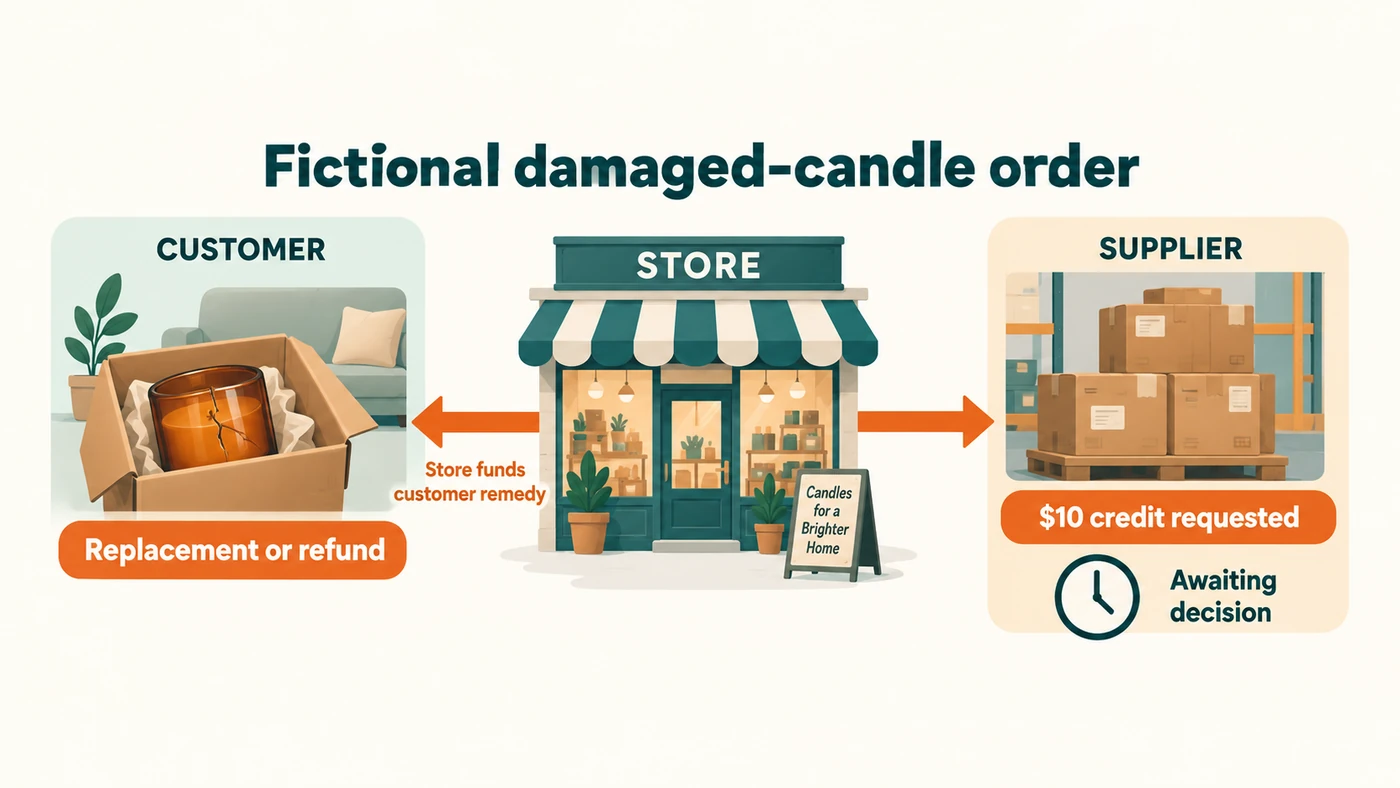
In our fictional $36 order, a replacement costs another $20 for the candle, packing and delivery. If the customer agrees to that remedy and no other cost changes, the original $7 contribution becomes a $13 loss. If instead you issue a full $36 refund after all original $29 costs have been spent and cannot be recovered, the order result is a $29 loss. The original expenses are counted once in each alternative.
Suppose the store separately requests $10 from the supplier for the damaged candle. That is a pending credit request, not $10 already recovered. The store must still fund the agreed replacement or customer refund while awaiting the supplier’s decision.
Find whether the wrong code came from your store
A wrong scent needs a similar distinction: check whether the supplier sent the wrong code or your store transmitted it incorrectly, then offer an appropriate customer remedy and address the cause. For a simple change of mind, explain the applicable return conditions before sale, including personalized-product restrictions where lawful. A provider’s refusal to accept a custom-printed return does not remove the customer’s applicable rights.
A safety report needs a different response
If the report concerns an unexpected fire, injury or another product-safety problem, stop treating it as ordinary buyer remorse. Pause the affected sales and dispatch, preserve the exact product and batch information, and arrange the appropriate investigation and reporting with the responsible parties. Do not offer another unreviewed candle as a quick fix.
07
Start with a small offer you can repeat
Before taking a live order, you should have a clearly described candle, a confirmed supplier and destination quote, reviewed product information and labels, a complete cost sheet, and an agreed delivery and remedy routine. A successful sample order is useful preparation; it does not guarantee future stock, parcel condition or safe performance.
If you want to explore a China-side candle sourcing route, AIDrop’s product-sourcing service can help coordinate supplier options, the agreed jar and scent specification, sample review, packaging and shipment arrangements. Send an inquiry with the product link, vessel and wax size, scent and label requirements, destination and expected order quantities. The operating scope needs confirmation; candle testing, product claims and legal duties remain separate responsibilities.
Questions before selling your first candle
Does private label mean I can order one candle?
Not always. A single-order finished-candle program and a wholesale private-label batch are different offers. Confirm the exact jar, scent, label, packing and destination for one customer order. A custom label does not remove a batch minimum.
Does a 9oz candle tell me how long it will burn?
No. In this example, 9oz describes the wax weight. Obtain the maker’s supported burn-time information for that exact vessel, wick and formula. The amount of wax and a good-looking sample do not establish the result.
Can I promise delivery for a birthday?
Only with a supported commitment for the actual order. Check production time, cutoff and transit separately. Published estimates leave uncertainty, so do not turn an average into a guaranteed gift date.
Should the customer wait for my supplier claim after a broken jar?
Keep the customer’s remedy moving separately. You may need to fund a replacement or refund before supplier credit is decided. Obtain available safe evidence and open the applicable supplier case promptly; never ask the buyer to handle damaged glass for photographs.

Furniture Dropshipping: Product Data, Delivery Scope and Damage Recovery
Furniture dropshipping needs more than a supplier quote. Verify the exact piece, cartons, drop-off service and damage

Home Decor Dropshipping: Fragility, Dimensions and Presentation
A decor listing needs more than a room photo. Compare appearance, packed dimensions and the recovery path
