
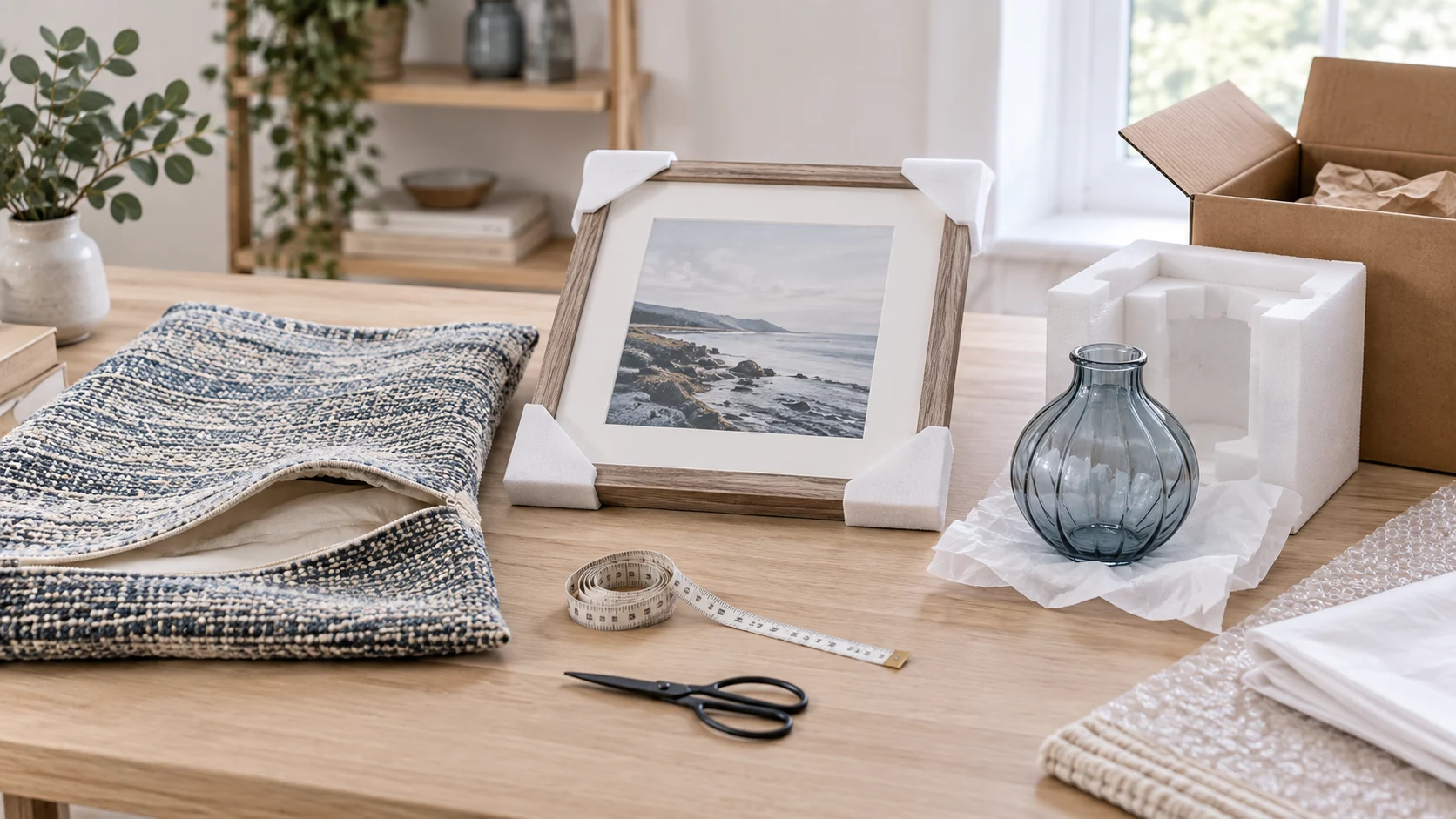
Home decor dropshipping means a supplier stores and ships the decor while you sell it through your store. Start with a small range whose appearance, dimensions, contents, packing and return arrangements you can explain. Buyers need to know what will arrive, how it will fit their room and what happens if it arrives broken.
A cushion cover and a glass vase need different packing. The cover can fold; the vase needs protection that keeps it from moving and breaking. Both may look attractive in a styled room, but their delivery costs and remedies can be quite different.
This guide builds on the dropshipping products guide. It covers choosing a decor range and supplier, making the product page accurate, pricing the parcel and handling damage or the wrong item.
Find a guide for your next question
- Coaster Dropshipping: Sell the Right Material and Set Size
- Candle Dropshipping: Choose the Jar, Scent and Shipping Plan
- Kitchen Dropshipping: Choose Products That Fit the Customer's Kitchen
- 3D Lamp Dropshipping: Choose the Lamp Behind the Glowing Photo
- Bathroom Accessories Dropshipping: Choose Products That Actually Fit
- Doormat Dropshipping: Choose the Material Before the Message
- Pillow Dropshipping: Covers, Inserts and the Cost of the Parcel
- Rug Dropshipping: Check Fit, Shipping and Returns Before Listing
- Bedding Dropshipping: Make the Size and Set Contents Clear
- Curtain Dropshipping: Get Panel Size and Window Fit Right
- Beach Towel Dropshipping: Print, Absorbency and the First Wash
01
Choose a room and a style before filling the catalog
Choose a customer and setting: compact apartments, a calm home office or a particular room style, for example. Then select a few products that belong together. You can explain their colors, sizes and uses more clearly than a catalog of unrelated decorations.
Textiles, unframed prints, framed art and glass pieces give you different starting points. A cover needs fabric, size and care information; a framed print adds frame dimensions and protected corners; a vase adds material, finish and breakage questions. None is automatically a profitable or risk-free choice.
Choose a home decor dropshipping supplier
You can source from a manufacturer, a stocked distributor, a sourcing agent or a print-on-demand provider. Print on demand means a provider prints your design after the order, which can suit wall art or textile accessories. Confirm the actual product, production location and single-order arrangement.
Ask whether the supplier can ship directly to your customer, which destinations it serves and how it handles faults or returns. Check stock by the selected size and finish. A large catalog or a convenient import button does not show that every item has suitable packing or current information.
For named program research, compare Sagebrook Home’s account and fulfillment questions with Infinity Instruments’ application and product checks. Each guide separates the public information from terms that need confirmation for your item and route.
Get permission to use photographs, artwork and brand names. If you supply a design, make sure you have the right to reproduce it. A picture found online is not automatically available for a cushion or print business.
02
Show what arrives, not just how the room looks
Use room photographs to help the buyer imagine the piece, then include a clear view of the product itself. Show its size, material, color, finish and included parts. The buyer should not have to work out which objects in the room photo are for sale.
Show what the photograph does not include
A cushion cover may not include the insert. A print may arrive without a frame. A lamp photograph may show a bulb that is sold separately. State those differences beside the product choice, rather than leaving them in a distant FAQ.
For a real example, Prodigi’s cushion-cover page identifies the cover, material, dimensions, care and packing, and says the insert is not included. Those are that provider’s product details; another supplier’s cover needs its own information.
Describe supported color or finish variation without using it to excuse a wrong item. A handmade vase may have the variation its maker documents. That does not mean the buyer should accept a completely different finish from the one ordered.
Order a sample and compare it with the proposed page: color in suitable light, fabric or surface, stitching, attachments, dimensions, care label and parcel contents. Keep dated photos and the supplier’s item code. That code identifies the particular size, color or finish you will order.
A sample describes one unit
A sample helps establish what you observed on that unit. It does not prove every batch or shipping route. If the supplier changes the finish, factory or material, obtain the new details before continuing to use the old photographs and description. The sample approval guide explains how to retain a useful reference.
Powered decor, flame-related items and products intended for children need their own product and destination review. An attractive room photo or a sample cannot establish all applicable requirements. Keep the actual intended use clear and resolve those questions before offering the item.
03
Measure the artwork, the frame and the parcel
The artwork, outside frame and packed carton need separate measurements. A buyer choosing wall art needs the first two; the shipping quote needs the last one.
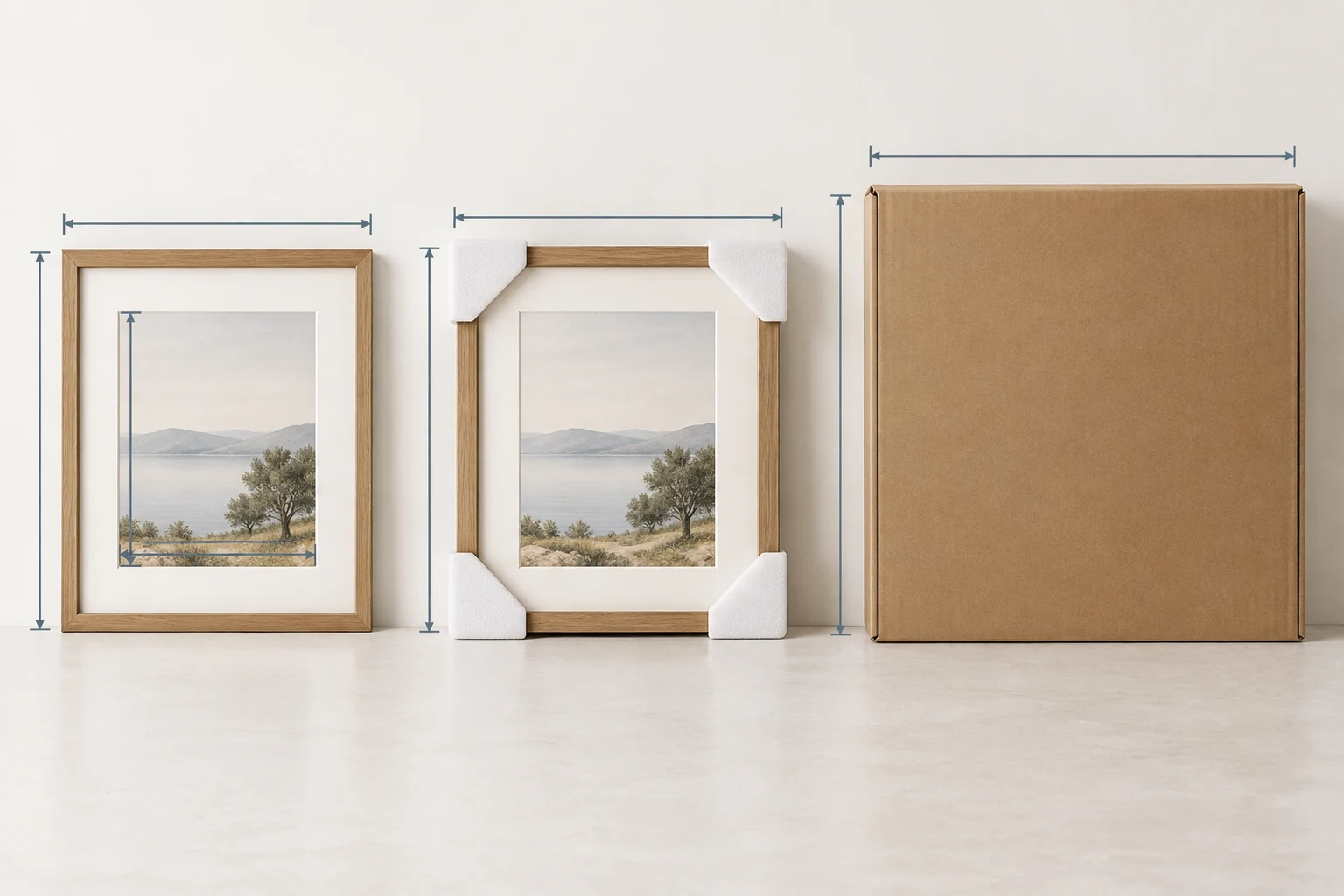
Imagine a 40 × 50 cm print. That might describe the artwork, while the frame makes the finished piece larger. Protective corners and cushioning make the parcel larger again. Do not put the artwork size into a shipping calculator and expect a reliable quote for the framed parcel.
Explain which measurement the size selector uses. Show the outside frame dimensions where they matter to the buyer, and obtain the final protected carton dimensions and weight from the supplier. Check whether the chosen frame, glazing and hanging hardware are included.
Fill three sizes into three different records
Use this fictional framed print to see the difference. The numbers are teaching inputs, not dimensions measured from a product we sell. Ask for the actual item’s figures and measurement method before listing it.
Buyer’s size option
Artwork: 40 × 50 cm. Outside frame: 44 × 54 cm. If the selector says “40 × 50 cm artwork,” put the outside size nearby so a buyer can judge the space the finished frame occupies.
Supplier and freight request
Record the exact frame finish and item code. Protected carton: 50 × 60 × 8 cm; actual packed weight: 2 kg in this illustration. Request the quote for that carton, destination and service, not for a flat 40 × 50 cm sheet.
After editing, select that size on a phone and check the cart: does it still describe artwork size, with the outside frame size available? Compare the supplier order’s finish and dimensions with the same record. Get a fresh parcel quote if the packing changes; these numbers do not establish protection or a carrier charge.
Packing should follow the item. A textile may crease or lose presentation if packed poorly; a framed print needs its corners and surface protected; a glass vase needs suitable cushioning and restraint inside the box. Ask to see the actual packing for single customer orders, not only a bulk carton used between warehouses.
The UPS packing guidance explains approaches for protecting fragile goods. It can guide the discussion, but it does not prove the supplier uses that packing or that a particular vase has been tested on your route.
Use the protected parcel for the carrier quote. The FedEx dimensional-weight explanation shows why the space a parcel occupies can affect its charge. The relevant service can compare actual weight with a charge based on package dimensions; confirm the calculation and final price for the service you use.
Requote the protected carton
If better protection makes the carton larger, get a new quote. Good packing and affordable delivery need to work together. Removing necessary protection to keep an old shipping price is not a sound fix.
04
Compare the money left after product and delivery
Compare complete product formats at the same destination, with the packing they need. A bare supplier price can make a fragile item look cheaper than it is.
Here is a hypothetical comparison. “Product and delivery” covers only those stated inputs:
| Product | Selling price | Product and delivery | Amount left after those costs |
|---|---|---|---|
| Cushion cover | $32 | $14 | $18 |
| Framed print | $58 | $29 | $29 |
| Glass vase | $49 | $25 | $24 |
On a phone, swipe the table sideways to compare every column.
The arithmetic is $32 − $14 = $18, $58 − $29 = $29 and $49 − $25 = $24. These figures do not rank the products by profit. Payment fees, advertising, store costs, applicable taxes or import costs, damage and customer remedies still need to be included.
Ask what a second shipment, matching replacement or refund would cost. A vase with $24 left after the stated costs can still be a poor offer if damage handling is unclear or an overseas return is expensive. Obtain the terms and fund the remedy before spending to acquire orders.
Put a broken vase into the full calculation
Continue the invented $49 vase with $25 in product and first delivery. Add a $1.77 payment fee and $10 to attract the order: $49 − $25 − $1.77 − $10 = $12.23 before fixed bills, tax and any remedy.
A second $25 shipment uses more than the $12.23 left
If a replacement adds another $25 for the item and shipment, that order now leaves −$12.77. No supplier recovery is assumed. Add return postage or other fees if the chosen remedy needs them.
The fee and advertising figures are illustrative, not quoted rates. This does not predict how often a vase breaks. It shows why you need both a remedy cost and cash to pay it before treating the $24 in the earlier table as profit.
Marketing should help the buyer make an informed choice. Room styling, size comparisons and close-ups of the finish can be useful organic content. They still take work to produce. Paid acquisition needs its own cost in the order calculation; a visually popular product does not guarantee affordable customers.
A coordinated set may arrive separately
Also check whether a coordinated set really ships together. A cover and vase from different suppliers may leave different warehouses, arrive in separate parcels and have different tracking numbers. A set photograph should not imply one box or one arrival date unless that is supported.
State the parcel count and expected dispatch information clearly. For a US-facing store, the FTC’s internet-order rule guide explains the seller’s shipment-promise and delay-handling duties. Using several suppliers does not remove them.
If you are comparing China-side decor suppliers, AIDrop’s product-sourcing service can help coordinate variant details, samples, packing and supplier options. Send the product link, destination and your current problem, such as uncertain frame dimensions or inadequate vase protection. Confirmed quotes and the appropriate product review remain necessary; sourcing coordination does not guarantee profit, safety or damage-free delivery.
05
Give a clear answer when something arrives wrong
Before launch, agree on handling for transit damage, the wrong size or finish, a fault and a change-of-mind return. Ask for the return address, required authorization, condition requirements, postage and available remedy. Supplier terms and applicable customer rights need to be considered separately.
If a vase arrives broken, request useful photographs of the item, outer carton, inner packing and shipping label. Follow the actual supplier or carrier reporting process and window; do not invent a deadline that applies to every order.
Match the report to the exact item and finish. Is the same version available for replacement, and how soon can it ship? If the buyer ordered a coordinated pair, a different replacement finish may not solve the problem. Explain the available remedy rather than silently sending the nearest alternative.
Agree a usable fragile return
Clarify whether the physical item must be returned. A fragile return needs suitable packing and a usable address; if return is unnecessary, give clear agreed instructions. Work out who funds the replacement, return or refund.
A supplier’s credit after inspection is your recovery process, not the customer’s entire remedy. Keep the buyer informed and act under your policy and applicable rights while handling the separate supplier or carrier claim. The returns guide explains that distinction.
Wrong items need a different investigation from broken ones. An oatmeal cover shipped as white may indicate a picking or item-code problem. The wrong frame finish may indicate inaccurate variant information. Inspect the order and current supplier record rather than treating every complaint as transit damage.
Use the packaging guide when the physical protection needs more work. A replacement sent in the same unsuitable box can repeat the original problem.
06
Start with the products whose details are complete
Consider this hypothetical first range. The cover has clear fabric, size, care and contents, plus a confirmed parcel quote and remedy. The print’s outside frame dimensions are missing. The vase has no demonstrated single-order packing or written damage handling.
The cover has a clearer route to a first listing. Wait on the print until the dimensions are resolved, and on the vase until packing, quote and remedy are defined. This is a preparation decision, not a prediction of sales or a blanket approval of textiles.
Keep one current record for each item: model, size, finish, photographs, contents, care, protected parcel, dispatch location, shipping service and remedy contact. Make the relevant information visible on the buyer’s page.
A changed frame can change the quote
Recheck when the finish, carton, warehouse or route changes. A new finish may need new photography; a new frame may change both wall dimensions and packed cost. A supplier change should not leave the old page selling an item that no longer arrives.
Review repeated buyer questions and complaints. Unclear dimensions need a better explanation; wrong variants need corrected ordering; repeated breakage needs packing or route work. Pause the affected offer while an unresolved problem continues, rather than adding more traffic to it.
Once the first range stays accurate and supportable, expand into another format or room. Give the new products their own measurements, packing and remedies rather than inheriting the first item’s assumptions.
07
FAQ
Is home decor dropshipping easy for beginners?
A narrow range can be manageable, especially when the dimensions, contents and packing are clear. Fragile, powered or bulky items can add shipping, product-review and support work.
Should I avoid all glass and framed art?
No universal rule applies. Obtain suitable packing, a confirmed quote and a workable damage remedy. Wait if those answers are missing.
Can I use print on demand for decor?
Yes, for suitable designs and products through a provider that supports your destination. Confirm artwork rights, production time, contents, packing and returns for that specific offer.
Does the amount left in the cost table equal profit?
No. It subtracts only the stated product and delivery inputs. Fees, acquisition, overhead, applicable taxes and customer remedies still affect the result.
Dropshipping Products: Practical Ideas and How They Compare
Compare concrete dropshipping product ideas, from pouches and phone stands to apparel and wall art, with shipping,

Furniture Dropshipping: Product Data, Delivery Scope and Damage Recovery
Furniture dropshipping needs more than a supplier quote. Verify the exact piece, cartons, drop-off service and damage
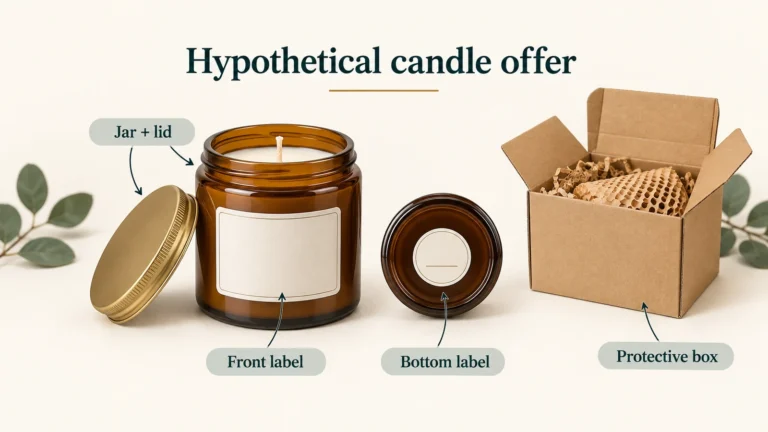
Candle Dropshipping: Choose the Jar, Scent and Shipping Plan
Build a small candle offer, compare individual dispatch with wholesale batches, price a complete order, and plan
