

Coaster dropshipping lets you sell stocked or custom-printed drink coasters while a supplier ships each order. Choose the material, backing and number of pieces first. A ceramic four-pack and a single cork-backed hardboard coaster are different offers, even when they show the same artwork.
A botanical four-pack should arrive as four matching pieces that sit flat under the buyer’s mugs. The design, quantity and everyday use need to be clear before you ask the supplier to send that set.
The broader home decor dropshipping guide helps you choose a coherent range. Here, we will work through the coaster itself, including the small details that change its cost and suitability.
01
Choose what the coaster actually does
A coaster can protect a surface, display artwork or absorb condensation. Those are different jobs. Do not promise all three because a supplier photo shows a cold drink on an attractive printed square.
Start with the top material and the underside. A printed hardboard top with a cork backing is not a solid cork coaster. The top controls the visible finish and how liquid behaves; the backing affects contact with the table.
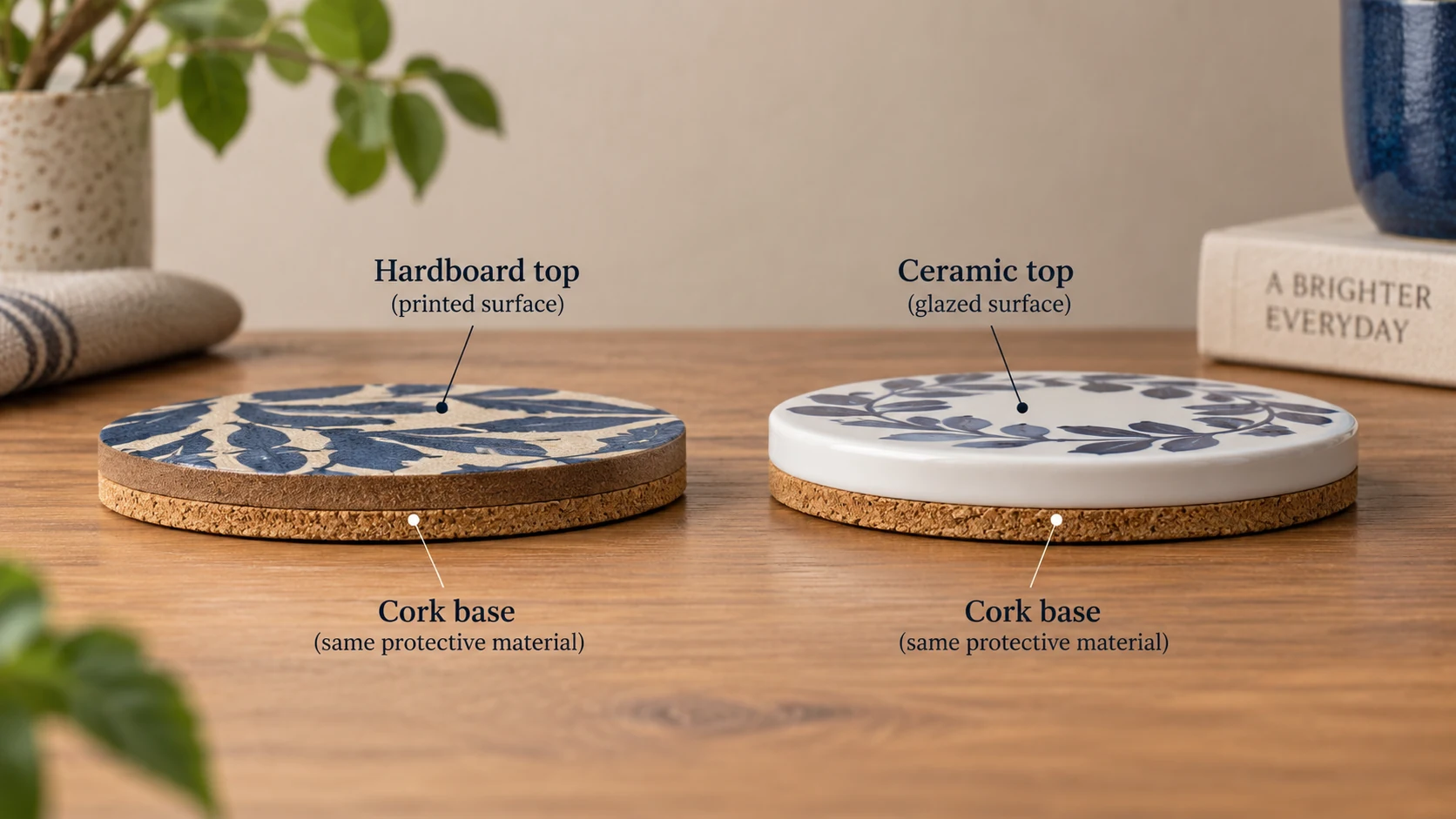
| Construction | Detail to describe | Question to settle before selling |
|---|---|---|
| Printed hardboard with cork underside | Top, coating and backing separately | What care and temperature limits does the exact product have? |
| Ceramic with protective base | Surface finish, base and thickness | How are edges protected during shipment? |
| Solid cork | Material and actual decoration | Does the design remain clear on the natural surface? |
| Other materials, such as PVC or fabric | Actual composition and cleaning instructions | What happens during the intended ordinary use? |
Prodigi’s wooden coaster page describes 4 mm medium-density fibreboard with a glossy surface and cork underside. That is a useful, specific description to preserve. “Wooden coaster” alone tells the buyer less about what arrives.
Get the exact dimensions, shape and care instructions. A broad claim such as “waterproof” needs support for the complete product, including its edges. The fact that a glossy top can be wiped does not tell you whether the item should be soaked or put in a dishwasher.
For the botanical offer, choose a square hardboard four-pack with a protective underside. Leave absorbency and high-temperature claims out unless the selected product’s documentation supports them.
02
Find a supplier for the material and set you want
There are two main routes. A print-on-demand provider decorates the product when you order it. A stocked supplier picks an existing design; custom bulk production adds a stock commitment before individual fulfillment begins.
The supplier’s unit of sale matters immediately. A listing priced “from $4” may describe one piece, while the store you want to build sells a four-piece set.
| Route to investigate | What the current public offer establishes | What your quote still needs |
|---|---|---|
| Prodigi | Wooden coasters sold individually and in several pack sizes | Exact format, artwork arrangement, destination and complete cost |
| Gooten | Cork-backed hardboard sets of four or six | Selected product, production location, pack and shipping charges |
| Printify | A network of providers and custom coaster products | Actual provider, configuration and fulfillment conditions |
| Papello | Ceramic coasters with single and set options | Selected shape, quantity, print template and destination |
These are starting points, not a ranking of received quality. Gooten’s coaster page describes its construction and set formats. Its product-specific terms are more useful for your comparison than a category-wide promise about margins.
Ask each candidate to quote the same order: one botanical four-pack, the chosen material and dimensions, shipped to one postcode. Then ask for two sets in the same order. This reveals whether a bundle can share shipping or becomes two separately priced parcels.
If you want a custom material, unusual shape or branded presentation box, ask about minimum production quantities and storage. Those requirements can make stocked fulfillment a better fit than a standard POD product.
03
Prepare one design or four coordinated designs
Decide whether all four coasters repeat one image or each uses a different botanical illustration. Do this before preparing files. A provider may support a repeated-design set without supporting four separate uploads in the same product.
Use the selected product’s template. The safe area keeps lettering and important details away from cutting or print boundaries; bleed extends background artwork beyond the intended visible edge. They serve different purposes.
For an illustrative 4-inch square face at 300 pixels per inch, the visible image needs 1,200 pixels across. That is face-only arithmetic. The provider’s bleed, safe area and export rules still control the complete file.
Papello’s ceramic coaster instructions specify PNG or JPEG, sRGB and a minimum of 300 DPI. They also tell users to keep important graphics in the safe area and remove guide layers. Other products can have different requirements, so do not apply those instructions to every coaster provider.
Prepare the botanical set as a small, repeatable file record:
- Save the exact product template and its revision or download date.
- Name the finished designs A, B, C and D if mixed artwork is supported.
- Check each piece at its actual size, especially fine stems and small text.
- Remove template guides before exporting the production file.
- Compare the exported file with the preview, including all four edges.
A matching preview does not prove that four different designs will be packed together. Get that ordering arrangement confirmed and retain the supplier’s product or set reference alongside the files.
04
Price the set and the second set separately
The useful comparison is the amount left from a completed order. Divide charges by the thing you actually sell: pieces, sets or customer orders.
The figures below are a worked example, not a supplier quotation. Assume a four-pack sells for $28 and two four-packs sell together for $48.
| Per customer order | One four-pack | Two four-packs |
|---|---|---|
| Sales collected | $28.00 | $48.00 |
| Product cost | $10.00 | $20.00 |
| Supplier shipping | $5.50 | $7.00 |
| Payment cost | $1.10 | $1.70 |
| Customer acquisition | $5.00 | $5.00 |
| Allowance for remedies | $1.00 | $2.00 |
| Remainder before fixed costs and tax | $5.40 | $12.30 |
The second set adds $10 of product cost, but only $1.50 of assumed postage. That helps the bundle. If the supplier instead sends two $5.50 parcels, its shipping becomes $11 and the two-set remainder falls to $8.30.
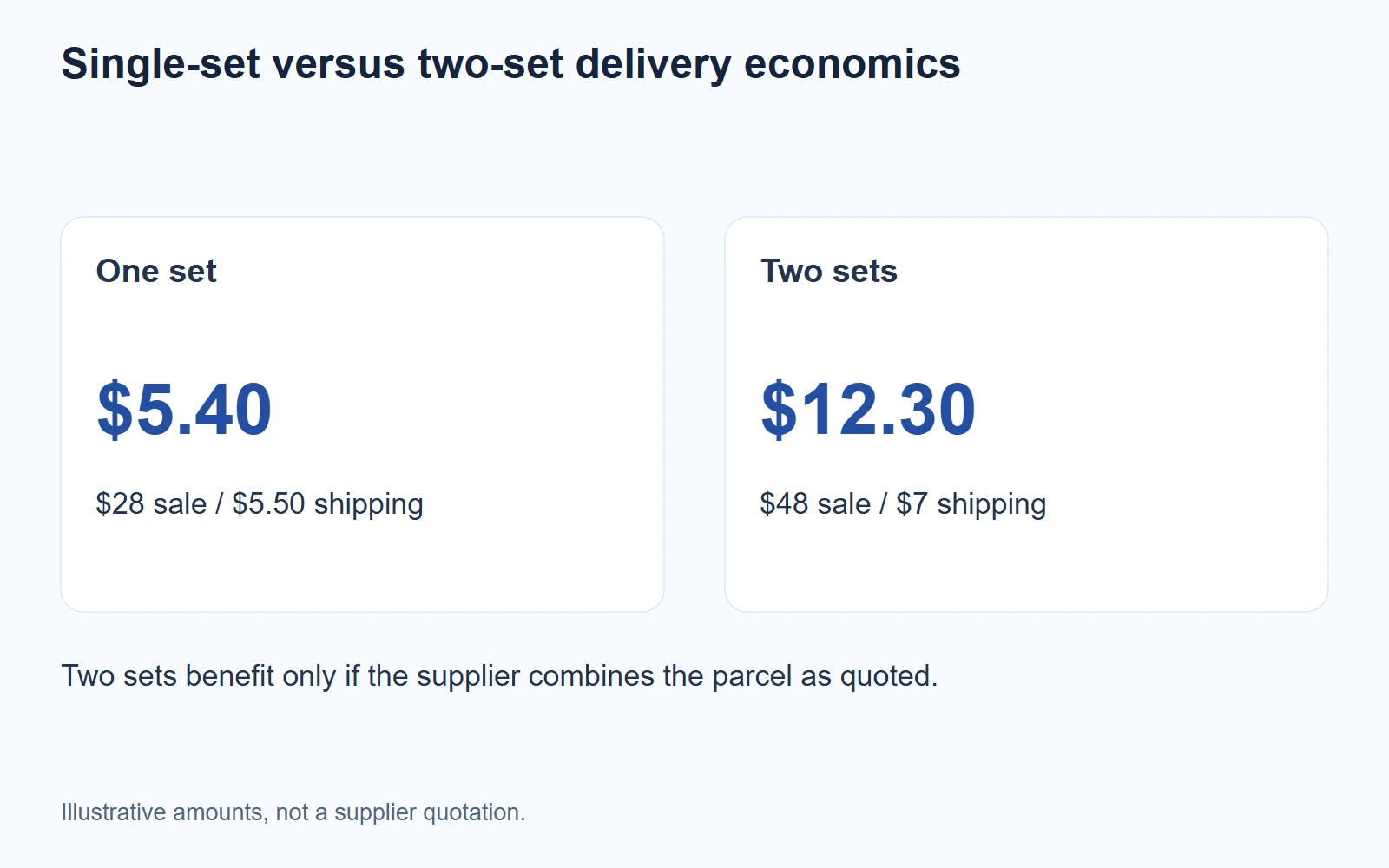
This is why a bundle discount should follow a basket quote. It should not come from simply doubling the single-piece catalog price and guessing at delivery.
Include any plan charges, artwork setup, special boxes and relevant taxes in your real calculation. A monthly fee also needs to be covered by completed orders. The table’s remainder is not net profit, and the remedy allowance is not a promise that the supplier will refund damaged goods.
For stock sourced in China, the shipping cost calculator can help compare the confirmed parcel inputs. Use the actual set’s packed size and weight. A coaster dimension is not the parcel dimension, and the calculator does not replace a third-party POD provider’s quote.
05
Check the surface, backing and complete pack
Order a sample of the configuration you intend to sell. Do not approve a four-pack from a photograph of one piece.
The following is a proposed inspection, not a test we performed. Use ordinary intended use and the supplier’s care instructions; do not invent a soak or temperature test and turn it into a performance claim.
| Check | What you can observe | What it does not establish |
|---|---|---|
| Piece count and artwork | Four correct pieces and the approved design arrangement | That every future order will be packed correctly |
| Table contact | Whether each piece sits flat or rocks | A universal slip-resistance rating |
| Top and edges | Print clarity, coating defects and exposed edges | Waterproofness or dishwasher suitability |
| Underside | Backing coverage, raised areas or loose adhesive | Long-term durability |
| Packed arrival | Corner protection, movement and received damage | A certified transport-test result |
Photograph the top, underside and complete set together. Retain the exact product, file revision and packing arrangement that produced the sample.
If a mug lifts a lightweight coaster with it or the backing marks a surface during intended use, record the condition and ask the supplier about the cause. A different top material, base or finish may be the appropriate change. Do not cover the problem with a vague “premium quality” description.
Your final product page should state the useful findings you can support: material, dimensions, count, design arrangement and care. A generated room image can show a possible setting, but label it as a mockup; received-product photos answer different questions.
06
Make the store order mean one complete set
Use a store record such as BOTANICAL-HARD4-v2. In this example, storefront quantity one means one set containing four coasters. It must not become four sets or one individual piece at the supplier.
Keep the mapping simple enough to inspect:
| Store field | Matching supplier detail |
|---|---|
| Product and variant | Exact material, shape and pack reference |
| Quantity one | One four-piece set |
| Artwork revision | Approved repeated image or supported A–D arrangement |
| Delivery destination | Same postcode used in the quote |
| Buyer inclusion | Four coasters; holder included only if confirmed |
Place a controlled paid storefront order after the listing and mapping are ready. Compare the customer receipt, supplier order reference, product charge and shipping charge. Then check the packed arrival against the same record.
A manual sample proves the physical offer; it does not prove store synchronization. If a paid store order does not appear at the supplier, locate the last confirmed state before resubmitting it. Sending another order while the first is already accepted can create a duplicate set and duplicate charge.
07
Replace a missing piece without guessing the fault
A cracked ceramic coaster, missing fourth piece and wrong artwork need different evidence. Keep the customer order, supplier reference, contents photo and approved artwork together.
Ask about partial replacements before launch. Some providers can remake one piece; others treat the set as the replaceable product. That difference changes both the customer’s wait and your cash requirement.
For a missing piece, confirm the original pack count and received contents. For breakage, request photographs of the outer package and damaged item. For wrong artwork, compare the production file and order mapping before blaming the print process.
Offer the buyer a clear next step while you pursue the supplier claim. A provider’s refund decision does not automatically resolve your obligations to the customer. Pause the affected set or file revision if the cause is still unknown.
If you need a stocked custom set packed and fulfilled from China, send AIDrop the product specification and destination. Include the pieces per set, material, artwork arrangement and presentation pack. Those details make a sourcing and shipping review useful.
08
Coaster dropshipping questions
Can I sell one coaster instead of a set?
Yes, where the selected supplier supports singles. Compare the complete order cost: postage and payment charges can leave little room on a low-priced single. A single may still fit a replacement, collectible or personalized offer, but it needs its own price and checkout test.
Can every piece in a set use different artwork?
Only when the product and ordering process support it. Confirm how each file is assigned and how the supplier packs the complete arrangement. Four uploaded images in your store do not prove that the supplier receives four different production files.
Should I offer a holder with the set?
If it suits the buyer and the provider can supply it, quote it as a separate inclusion. Check that the complete set fits, that the holder is actually packed and that it does not turn the order into an unexpected second shipment.
Sources and scope
This guide uses public product documents checked on October 14, 2026. The cost examples and inspection steps are illustrative or proposed. Original product illustrations explain construction and do not show samples we received.

Furniture Dropshipping: Product Data, Delivery Scope and Damage Recovery
Furniture dropshipping needs more than a supplier quote. Verify the exact piece, cartons, drop-off service and damage

Home Decor Dropshipping: Fragility, Dimensions and Presentation
A decor listing needs more than a room photo. Compare appearance, packed dimensions and the recovery path
Candle Dropshipping: Choose the Jar, Scent and Shipping Plan
Build a small candle offer, compare individual dispatch with wholesale batches, price a complete order, and plan
