
Mutual Dropshipping offers product sourcing and order fulfilment, with an app that connects to your store. Installing the Shopify app is free. The goods, delivery and applicable handling or custom work still cost money. Its public FAQ lists handling charges of $0.50, $0.75 or $1 per shipped order, depending on the product.
Before moving orders, get the complete cost of a representative shipment and the refund or credit terms in writing. If you plan to buy stock, also agree on storage and the treatment of unsold units before paying.
A tempting next step is to buy stock so orders leave faster. But quick access to inventory and the ability to get your money back are different things. Stock that remains on a warehouse shelf is still your commitment, even when the app has no subscription fee.
We checked the public app listing, selected FAQ answers and detailed shipping and refund pages on October 30, 2026. We have not opened an account, obtained a private quote, bought stock or tested a shipment. The desk-organiser examples below show how to assess the arrangement; they are not reported customer results.
01
What Mutual Dropshipping does for your store
Mutual’s Shopify app listing describes product imports, order management and fulfilment. Think of the store as where your customer buys, and Mutual as the proposed source and physical order handler behind it. Those are connected jobs, not the same transaction.
You still decide what to sell, describe the item accurately and handle your customer relationship. Importing a product does not establish that its current stock, dimensions or delivery route suit your offer. An order appearing in an app also needs the correct item, payment and fulfilment decision before it becomes a shipment.
Find the connection route you actually need
The public tutorial index includes Shopify, WooCommerce, Lightfunnels, manual orders, sourcing requests and payment topics. It is a useful starting point for the supported route you need. We have not watched every video or verified a connection in a merchant account; ask for the current instructions for your platform.
If your main question is how much responsibility to give an agent, use our guide to choosing a dropshipping agent . For Mutual, confirm who purchases the selected item, checks it, authorizes substitutions and handles a failed delivery.
02
Price the order, not just the free app
Free installation removes an app-access fee. It does not remove the purchase you are asking someone to fulfil. Mutual’s FAQ separately lists product and shipping costs, with the handling tiers mentioned above. The exact tier depends on the product.
| Quote item | What to ask for | Why it matters |
|---|---|---|
| Product | Exact variant, quantity and current purchase price | A similar photograph can hide a different size or included part |
| Handling | The tier applying to this item and order | Do not automatically use the lowest advertised tier |
| Shipping | Packed size, weight, destination and method | Product-only weight may not price the parcel |
| Extra work | Branding, unusual packing, samples or customisation | Optional work can change the finished cost |
| Storage | Free period, start date and later charges, if any | Broad “free warehousing” wording is not a complete storage agreement |
Here is an invented order quote, all in USD: a desk organiser costs $6, handling is $0.75 and the selected delivery costs $4.50. That adds to $11.25 before any other applicable cost. It is not a Mutual quotation or a typical shipping rate.
Put that figure beside your selling price, then account for payment or marketplace fees, advertising, taxes or duties where applicable, and customer problems. A $20 sale less an $11.25 supplier bill does not automatically leave $8.75 profit.
Ask what the included work actually covers
The FAQ describes the app and quality checks as free and says branding or customised packaging can add service fees. Define the checks for your product: colour and part count, opening and closing the drawer, or any other agreed action. Confirm which of them the service includes.
The warehousing wording is broad. Obtain the duration and any conditions in your own stock agreement before planning to leave inventory indefinitely. A price comparison is useful only when both quotes include the same item, checks, packing and route.
03
Decide what happens if the stock does not sell
Buying stock can reduce the wait for sourcing. It also ties up working capital: money spent on goods cannot pay bills or refunds while those goods remain unsold.
Consider a hypothetical purchase of 50 grey desk organisers at $6 each. You pay $300 for the goods. Later, 20 sell and 30 remain. The remaining units have a purchase cost of $180.
That $180 is not automatically a loss; you still own goods. It is also not $180 available to pay tomorrow’s advertising or refunds. Selling the stock, returning it under an agreed arrangement or finding another use is what could release value.
| Stock position | Units | Purchase cost represented |
|---|---|---|
| Bought in advance | 50 | $300 |
| Sold from that batch | 20 | $120 |
| Still unsold | 30 | $180 tied up in goods |
Mutual’s FAQ says refunds for unwanted or unsold purchased inventory are generally unavailable unless the factory accepts the return. If a factory accepts at a discounted value, recovery can also be discounted. Do not budget as though unsold stock can always be converted back to its purchase price.

Make the commitment smaller before making it cheaper
Before approving a batch, record the exact quantity, acceptable specification, ownership, storage terms and what happens to unsold units. Ask whether you can start with a smaller quantity and how the dispatch time changes if you buy only after each customer order.
Run a slow-sales case as well as your launch forecast. In this example, selling only 20 of 50 units leaves 30 units to fund and store while bills and refunds still need cash. A smaller commitment at a higher per-order cost can be easier to manage if the larger batch would exhaust those funds.
Use the same caution for printed boxes or branded inserts. A design proof confirms an agreed appearance; it does not establish that the finished goods will sell. Get the cancellation and remaining-material arrangement before commissioning them.
04
Use one sample and one controlled store order
Use a sample to assess the item you plan to sell. Use a store-order test to check that the connection sends the same item to the customer. A product import alone does not establish either result.
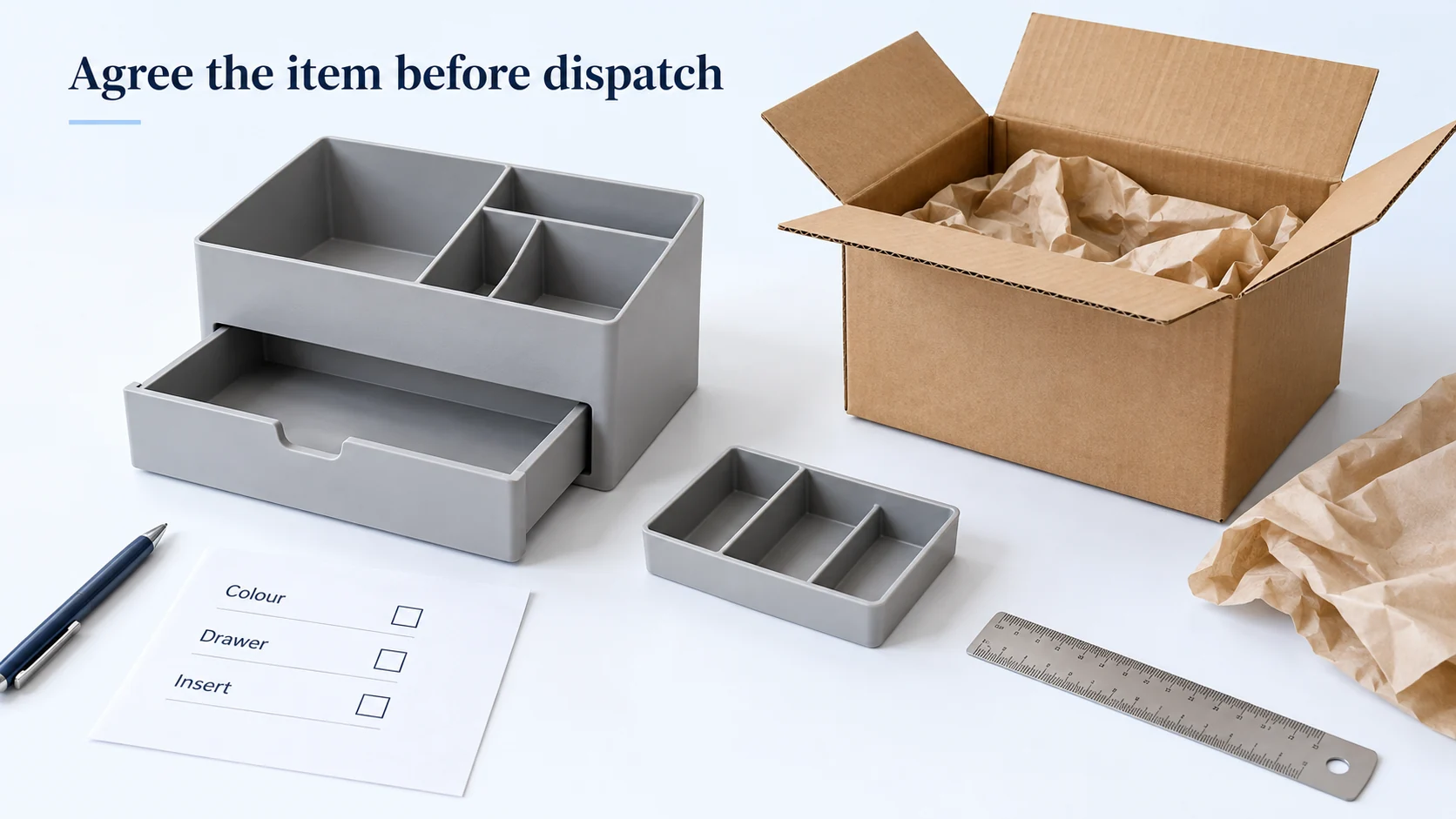
For a proposed test, call the grey desk organiser ORG-G1. It should include a small drawer and one removable insert. These labels and product details are fictional. Use your actual supplier item and store variant when performing the check.
Give the item check an observable result
Send a request along these lines before paying for the sample:
Please quote the grey organiser with one drawer and one removable insert. Confirm the external dimensions and included parts. For the sample, compare the colour and parts with the agreed item, check for visible cracks, and open and close the drawer to check that it moves normally. Report a missing insert, crack or sticking drawer before dispatch. Please also provide the packed dimensions and weight for the proposed route.
This is a proposed instruction, subject to the provider agreeing to perform it. A photograph can show whether the insert is present. It cannot prove that a drawer moves smoothly; that needs the agreed functional action. Neither check establishes how every unit in a later batch will perform.
| Item to check | Record to keep | Stop and resolve if… |
|---|---|---|
| Store/source match | Store variant and exact source item | Grey maps to another colour or design |
| Contents | Drawer and removable insert | A required part is absent |
| Agreed sample check | Photos and actual drawer-check result | A crack or sticking drawer is reported |
| Parcel | Packed measurements and chosen route | The quote uses an unsuitable size or method |
Follow one order all the way through
Use the provider’s supported test method or one controlled legitimate purchase. Record store order M701, the source order reference and the intended ORG-G1 quantity. Ask which event authorises purchasing or shipment; do not assume syncing alone pays for it.
Verify the item and charge before authorising fulfilment. After dispatch, confirm that the tracking reference reaches the correct store order and that the customer-facing message reflects its actual status. At receipt, compare the contents and packaging with the offer.
If you cannot find the source order for a paid store order, check its status with Mutual before submitting another purchase manually. An uncertain sync result is a reason to investigate, not evidence that no purchase exists. Avoid creating a duplicate while trying to fix a missing update.
05
Separate preparation time from the parcel journey
Mutual’s shipping policy describes conditional preparation times: typically dispatch within four days when items are in stock, potentially within one day for warehouse-ready goods, and a possible delay of up to a week for out-of-stock goods. It also warns about extra processing during peak periods.
The same page describes China-warehouse delivery as typically 7–12 days, depending on destination. These are published service descriptions, not times we measured. They do not establish the promise for every product, destination or season.
Get two estimates for your actual item
Ask for the current item-specific preparation estimate and the selected route’s transit estimate, including what each clock starts from and whether it uses calendar or business days. Do not simply add figures from different service descriptions and present the result as a guaranteed arrival date.
| Event | What it tells you | What it does not establish |
|---|---|---|
| Product appears in a catalogue | A product record exists | Your quantity is ready in a named warehouse |
| Source payment accepted | An order is funded under that process | The parcel has left the warehouse |
| Tracking number supplied | A shipment reference exists | A carrier has physically received the parcel |
| Carrier acceptance event | The carrier has recorded possession | The final delivery date is guaranteed |
For the organiser, “in our warehouse” should refer to the agreed grey item and available quantity. If stock still needs purchasing, include that preparation in the customer expectation. Correct the offer before taking more orders that depend on an unavailable delivery promise.
06
Handle damage, stalled tracking and returns differently
A broad promise of refund or replacement needs its detailed conditions. Mutual’s refund and reshipment policy uses different triggers. The following points summarise the published upstream process; they do not determine your customer’s separate rights.
- Wrong or damaged delivery: the stated request window is five days after delivery, with proof such as photos or video.
- Tracking has no update for 30 days: the policy allows a refund or reshipment request on that basis. This is not simply 30 days after checkout.
- Marked delivered, but not received: it asks for a local-carrier report and proof that the merchant fully refunded the customer when requesting recovery.
- Recipient-caused address or contact problem: the policy excludes ordinary refund/reshipment coverage. It describes a possible $10-per-parcel redelivery from a processing hub, subject to the parcel’s situation.
It also says Mutual does not handle returns. Do not give a customer a warehouse return address merely because the provider shipped the original parcel. Agree a workable returns arrangement before selling.
A damaged drawer does not need a 30-day wait
In this fictional example, the organiser is marked delivered on Monday, October 26. On Tuesday, October 27, the customer reports a cracked drawer. The useful action is to document the delivered-damage case promptly, not wait for a tracking-delay threshold.
Submit a clear record through the provider’s confirmed support route:
- Identify the purchase: store and source order references, delivery event and parcel label.
- Show the problem: packaging photos and clear images or video of the cracked drawer. Describe that exact fault rather than “quality bad.”
- Track the request: keep the submission and acknowledgement, so you can follow the same case when asked for more evidence.
The policy allows Mutual to ask for more information and gives two business days to provide it. The first claim and a later evidence request are separate tasks. Record the new request when it arrives instead of assuming the initial submission finishes the process.

A request is different from an approved remedy
Once a request is accepted, record what has actually been authorised:
- Refund: confirm the recoverable amount and any payment fees. The policy gives two to five business days for internal processing, separate from further payment-provider handling. An initial complaint does not mean money has reached your account.
- Replacement: confirm the item and route. The policy says the reshipment method may differ from the original. Do not promise an identical delivery date without that answer.
Handle the customer separately under your store’s applicable terms and obligations. A provider declining recovery does not automatically erase the remedy your customer is entitled to. If the buyer simply dislikes the organiser, the damaged-item procedure does not become a change-of-mind return service.
For a stalled parcel or an address error, preserve the actual tracking history and messages. Ask what action the carrier or recipient can still take, and obtain the applicable current claim conditions. Different scenarios should not be forced into the delivered-damage example above.
07
Questions to settle before working with Mutual
Is Mutual Dropshipping free?
The app is free to install. Product sourcing and physical fulfilment still involve goods, shipping and applicable handling or custom-work charges. Get the current complete quote for your item rather than judging the offer by the app price.
Will the warehouse refund stock I cannot sell?
Do not assume so. The FAQ makes recovery depend on the factory accepting the return and potentially a discounted value. Decide how much stock you can afford to carry before approving the purchase.
Does free quality checking guarantee the product works?
No general label establishes the checks your item receives. Agree the observable actions and what happens when a problem is found. Appearance, included parts and a functional test answer different questions; a sample also does not certify an entire future batch.
Can I use it for a different store platform or marketplace?
Mutual publishes several connection and manual-order tutorials, but verify the current route you actually need. A supplier’s ability to ship an order does not by itself certify your marketplace’s selling-policy compliance. Confirm both before listing.
Do positive reviews prove it will work for my shop?
They can suggest questions about support, sourcing or sync. They do not measure the defect or delivery rate for your organiser and route. A controlled order with retained records gives you evidence about that particular setup; it is still a limited trial.
What should I send in the first enquiry?
Send the product link, exact variants, destination, anticipated order pattern and any stock or checking requirement. Ask for the complete quote, preparation and delivery basis, unsold-stock arrangement and after-sales route in writing.
If the comparison concerns apparel branding, our EPROLO evaluation covers its different published membership and return arrangements. Compare the same job rather than treating all free-to-install services as interchangeable.
For a China-side sourcing or fulfilment enquiry, send those concrete product and route details to AIDrop . We can assess the requested checks, packing and sourcing work before proposing an arrangement. Confirm how orders reach the provider and which paid services are included before moving your existing orders.
CJdropshipping Review: Costs, Warehouses, Quality and Fulfillment Fit
CJdropshipping is a practical option for sellers who want sourcing, store connections, packaging and fulfillment in one

CJdropshipping vs DSers: Who Sources, Pays and Ships the Order?
CJdropshipping can source and physically fulfill an order; DSers maps a store product to supported external suppliers

AutoDS Review: Evaluate the Automation You Would Actually Use
AutoDS can reduce listing and order work, but its value depends on your sales channel, tier, add-ons
