
CJdropshipping is a practical option for sellers who want sourcing, store connections, packaging and fulfillment in one service without a mandatory core software subscription. Its main trade-offs are variable landed costs, product and warehouse availability, and after-sales terms that may not cover the refund you owe your customer.
The strongest reason to use CJ is the combination of physical services behind the store connection. The weakest reason is assuming that a large catalog, a warehouse map or a positive star rating proves that one particular product will arrive correctly and on time.
This review is based on public CJ documentation and a limited sample of merchant feedback checked on September 22, 2026. We did not place test orders, inspect a CJ warehouse or measure its delivery performance. Dollar examples below are explicitly hypothetical; they are not CJ quotations.
01
What CJdropshipping actually replaces
CJ combines product discovery and sourcing with order synchronization, purchasing and fulfillment. Its current site describes a sequence of selecting products, connecting a store, synchronizing and paying for orders, then fulfilling and tracking them. It also offers packaging, print-on-demand and warehousing services.
For a merchant, that can reduce the number of separate parties involved in ordinary orders. You may be able to ask one service to source an item, receive it, apply packaging and arrange delivery. That is useful when you want more physical coordination than a product-import app provides.
You still need to define what will be supplied. An image-search result is a candidate, not an approved specification. A similar-looking product can differ in material, dimensions, power requirements or included accessories. The merchant remains responsible for the offer customers see.
| Reason to consider CJ | Corresponding trade-off |
|---|---|
| Sourcing and fulfillment through one service | A listed item may still need procurement before dispatch |
| No mandatory subscription for the core service | Products, shipping and selected services still create costs |
| Warehousing options | Reserving or moving stock can tie up cash and introduce minimum quantities |
| Custom packaging | Packaging must be purchased, received and connected to the correct orders |
| Store and tracking connections | Payment, matching and exceptions still need verification |
CJ is therefore worth evaluating for a defined product range and destination mix. It is less suitable as a shortcut around supplier qualification. If you are deciding what the software should do versus what requires a person or physical service, start with the automation software guide.
02
Free to join does not mean free to fulfill
Separate access to the platform from the cost of delivering an order. CJ’s core model does not require a blanket monthly software payment, but optional services and paid programs exist. The price of a product shown in search is not the amount your business will necessarily spend to satisfy the customer.
CJ’s service-fee explanation says logistics costs are presented as shipping and service components, with the service component covering work such as inspection, packing and dispatch. Do not add a second estimate for the same work if it is already included in the accepted total. Conversely, do not assume an optional service is included merely because it sounds like fulfillment.
Ask for a quote that identifies the SKU, variant, quantity, origin warehouse, destination, shipping method, packaging and any separate charges. Confirm the currency and how long the quote remains usable. Payment conversion costs, taxes, duties or remote-area fees need their own treatment where applicable; a number labeled “shipping” does not establish which of them is covered.
Here is an assumed order for a $39 sale. The customer pays no separate delivery charge. These amounts demonstrate the calculation only.
| Cost or revenue | Assumed amount |
|---|---|
| Retail revenue, excluding sales tax collected for remittance | $39.00 |
| Product | $11.00 |
| Shipping component | $7.00 |
| Service component | $1.20 |
| Optional packaging not included above | $0.80 |
| Payment processing | $1.45 |
| Advertising to acquire the order | $10.00 |
| Expected unrecovered after-sales cost allowance | $1.50 |
| Remainder before other overhead and income tax | $6.05 |
The product-to-retail gap is $28, but this example leaves $6.05 after the listed expenses. If delivery rises by $2, the remainder becomes $4.05 unless another cost or the selling price changes. The profit-margin calculation guide helps separate this contribution from final business profit.
The after-sales allowance is a planning assumption, not a measured CJ failure rate. When reviewing actual results, reconcile actual refunds and recoveries instead of subtracting both that allowance and the same refund again. Keep prepaid inventory separate from an expense calculation until the corresponding goods are sold or written down.
03
A warehouse location is not available inventory
The important warehouse question is whether your exact variant is available for your order. A warehouse in the destination country can shorten the physical route only when the goods are there and can be allocated to you.
Distinguish four situations before promising dispatch:
| Product situation | What you need to know |
|---|---|
| Listed in the catalog | Whether procurement is still required |
| Shown in shared warehouse stock | Whether the quantity can be allocated to your order |
| Purchased as your private inventory | When it is received and available, and what costs apply |
| Being transferred to another warehouse | Arrival, receiving and availability before local orders begin |
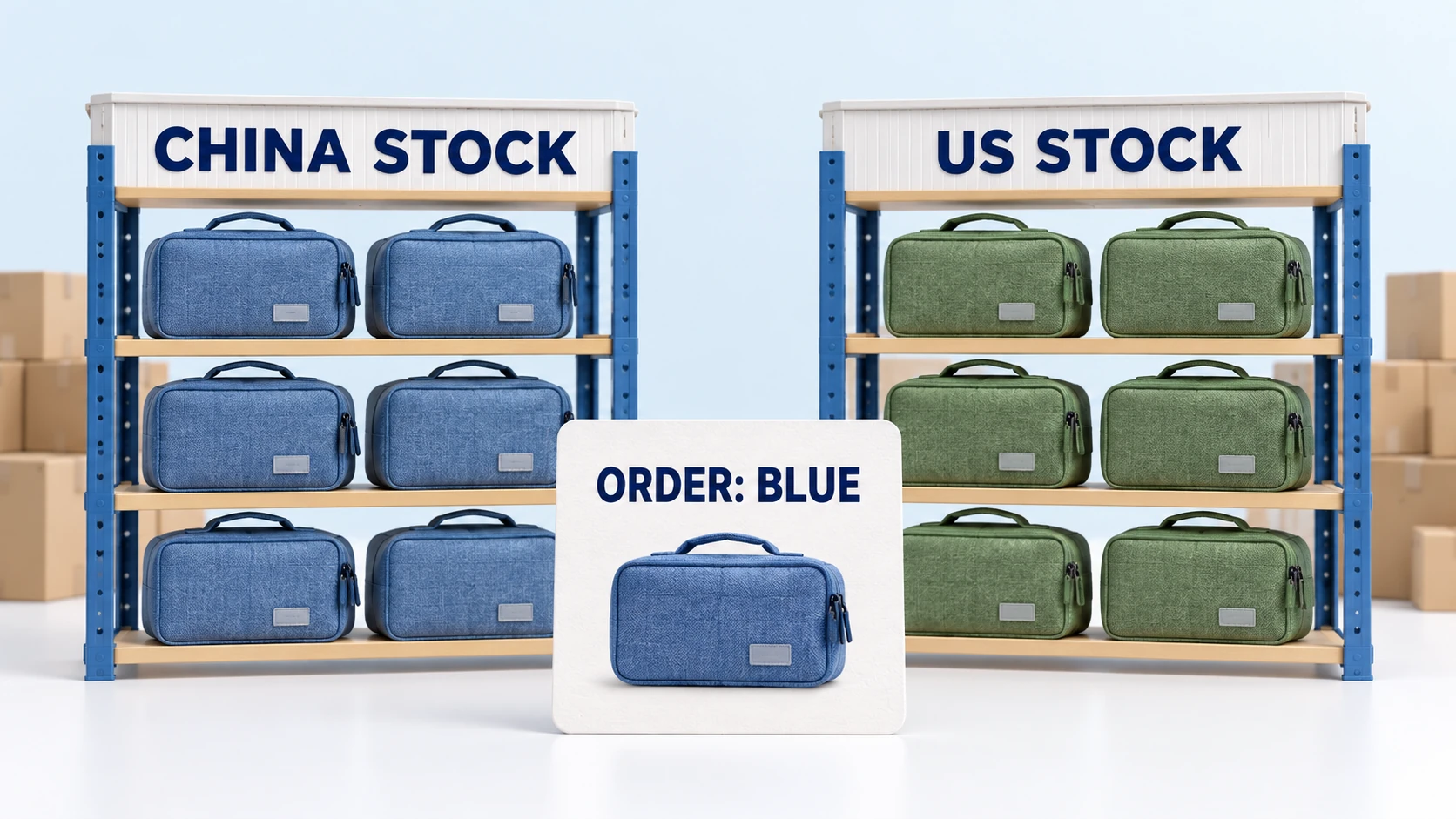
Consider a blue organizer and a green organizer with different variant codes. A domestic warehouse showing green inventory does not make the blue listing ready for domestic delivery. If the blue units are still in China, either change the delivery offer honestly or wait until the required stock is available.
CJ’s current service-fee page states minimum overseas stocking quantities of at least 10 units per variant and 100 units in total for the described service. Those terms concern sending stock to overseas warehouses; they should not be turned into a claim that every individual catalog order requires 100 pieces. The same page labels transfer rates as references subject to change.
Pre-stocking shifts the decision from “can I buy one order?” to “can I fund and sell this batch?” If you purchase 100 units but demand favors only one of five colors, inventory can be available in total while the selling variant runs out. Use variant-level demand and replenishment information rather than dividing total stock by total orders. The inventory-management guide explains that operating problem.
For delivery estimates, distinguish procurement, warehouse preparation and carrier transit. Ask which stages the quoted range includes. We could not access a live product-specific shipping quote without logging in, so this review does not present one universal CJ shipping time as a verified promise.
04
Sourcing and inspection need a written product specification
CJ’s sourcing service can be useful when the catalog does not contain exactly what you want. The request becomes much stronger when it describes the product rather than asking for “the same as this photo.”
For a travel organizer, specify dimensions, material, color reference, zipper construction, compartments and included pieces. For an electrical item, the required market, plug, voltage and applicable compliance evidence materially change the request. A low quote for a different specification is not a saving.
Ask what the inspection includes and what record you will receive. Counting units, checking color and looking for obvious damage are different from testing strength, verifying electrical performance or checking documentation. Do not describe a product as certified merely because a parcel passed a warehouse check.
A useful approval record includes the sample variant, dated photos, the accepted specification and the defects that would cause rejection. If the supplier changes the material or factory later, require review before the changed product is sent under the same listing. Otherwise, the approved sample can become disconnected from what customers receive.
The quality-control guide covers how to turn those expectations into a repeatable check. The practical limit remains important: inspection reduces uncertainty about the checked goods and attributes; it cannot prove that every future unit is identical.
CJ also distinguishes products it sources from “service products” supplied through an outside arrangement. Its published dispute terms apply different conditions to those goods, including the relevance of CJ inspection. Before sending your own supplier’s stock into its warehouse, clarify who is responsible for an existing defect, a handling error and a transit loss. Do not assume the warehouse has taken over the supplier’s product-quality obligation.
05
Custom packaging creates its own stock problem
Custom boxes and inserts are a useful reason to consider a coordinated fulfillment service. They also become inventory that must be available at the right place and connected to the right product.
CJ’s packaging FAQ describes designing and buying the packaging, connecting it, waiting for it to arrive at the warehouse, and then using it on orders. An approved design alone does not put the physical materials beside the goods.
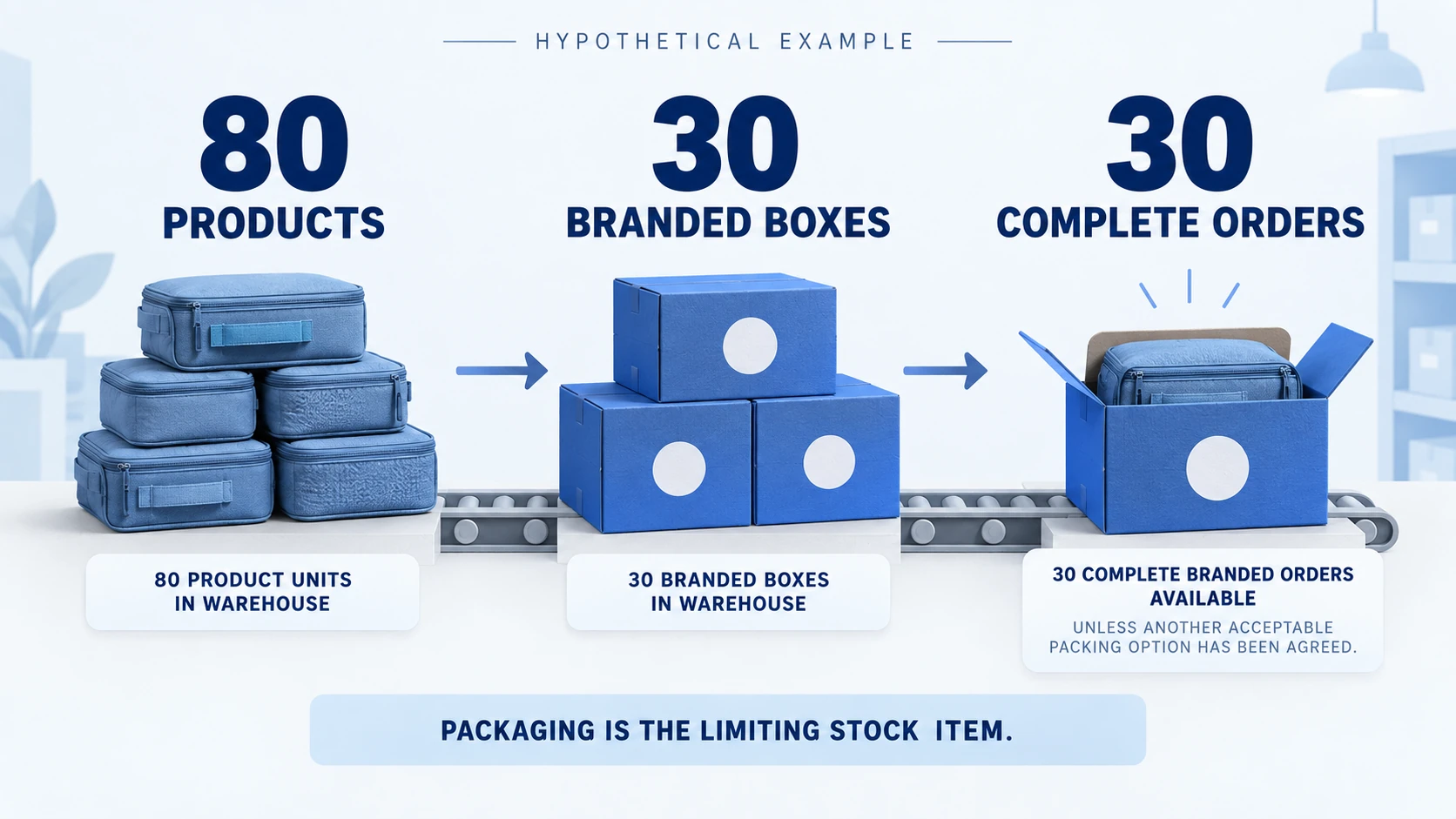
Imagine the warehouse holds 80 units of your product and 30 branded boxes. You have 30 complete branded orders available unless another acceptable packing option has been agreed. Shipping the remaining 50 in generic boxes may keep parcels moving, but it can break a customer-facing promise if the branded box is part of the offer.
Approve the product inside the finished pack. Check fit, movement, cushioning, closure and the address-label position. A larger box can increase chargeable shipping weight; a smaller one can expose the product to damage. The cheapest packaging unit price is not necessarily the cheapest delivered result.
Set a rule for missing materials before they run out. The merchant might permit a specific plain box for ordinary orders while holding gift orders that require branded packaging. That is a business choice to document, not a decision for a packer to improvise.
06
Connect orders without losing control of release
CJ’s current site lists integrations including Shopify, WooCommerce and eBay. That establishes supported connection routes, not that every store-specific configuration is correct immediately after authorization. Check the relevant account, SKU mapping and fulfillment location.
The first controlled order should demonstrate a complete chain: it appears in CJ, contains the right variant and quantity, is paid once, moves through preparation and dispatch, and returns appropriate tracking to the store. Keep the merchant’s order number and CJ order reference together.
The CJ order-status FAQ distinguishes paid pending orders, processing with a tracking number and dispatched orders. Those distinctions matter when a customer asks whether the parcel is actually moving. Avoid treating a label or a storefront fulfillment marker as proof of carrier possession.
If the order is not progressing, investigate the existing order reference before paying again. Confirm whether the issue is payment, stock, address data or the physical dispatch stage. Repeating the purchase can create a duplicate without resolving the first order.
When changing from another app, ensure only one system releases each order line. You can leave the old connection active for previously accepted orders while routing new orders differently, but the changeover must be explicit. Customer notifications should match the actual shipment, particularly when an order contains products from more than one fulfillment source.
07
Read the refund policy before writing your store policy
CJ’s refund, resend and return policy requires evidence and contains reason-, route- and destination-specific limits. Examples include a 45-day post-departure threshold for delayed US orders and restrictions where tracking shows delivery. Damaged-goods claims need prompt evidence; ordinary buyer remorse and an incorrectly selected SKU are not equivalent to a supplier sending the wrong item.
The policy also treats service products differently and describes returns to China. These conditions are important when estimating reimbursement, but they are not a ready-made customer policy. Your own promises and applicable consumer obligations remain separate.
For a wrong-color complaint, retain the store order, the agreed supplier variant, a clear photo of what arrived and the shipping label. That helps distinguish a mapping error in your store from a picking error during fulfillment. The customer needs a solution either way; the distinction tells you whom to ask for reimbursement and which process to repair.
For a delayed parcel, give the customer an update based on actual tracking and the next action. A supplier’s longer dispute threshold does not mean the customer will accept indefinite waiting. If you refund before the supplier’s case is resolved, track the customer refund and the potential recovery separately.
Returned goods need an agreed destination. Do not tell a customer to post an item to an address copied from a package, or assume an overseas fulfillment warehouse accepts returns. Confirm authorization, handling and the likely recovery value. The dropshipping returns guide helps decide when return shipping is economically sensible.
08
How to interpret the positive and negative reviews
The public feedback contains both useful praise and significant complaints. On the Shopify five-star review page, BIA Activewear reported in September 2026 that its agent helped obtain specifications, pricing and minimum quantities as it moved into prepaid inventory. Other visible reviews praise product importing and order synchronization. Those reports identify benefits worth checking for your own business.
On the one-star page, LeafyHabit described a prolonged transit problem in July 2026, repeated follow-up and a customer refund paid by the merchant. We did not verify that account’s order records, and one account does not establish the failure rate of the service.
These samples were selected to inspect both positive and critical experiences, not to estimate customer satisfaction. They suggest different questions: can your contact obtain the product details you need, and can the service give an actionable resolution when a parcel stops moving? A friendly initial conversation does not answer the second question.
Keep your own record of response quality. A useful reply identifies the affected order, explains what is being checked and gives a next step. Repeated general reassurance without progress should influence how much new volume you send through the arrangement.
09
Who should use CJ and who should compare alternatives
CJ is worth shortlisting for a merchant testing a defined catalog or building a more coordinated sourcing, packaging and fulfillment process. It is especially relevant when you want the option to move from individual orders toward reserved stock without replacing every part of the operating workflow.
It is a less comfortable fit if your business requires a narrow dispatch commitment that the chosen stock arrangement cannot meet, or if ordinary returns are central to the offer but no workable local return route exists. Those are operational mismatches, even if the catalog price looks attractive.
Compare DSers if you mainly need software around suppliers you select yourself. Compare Printful if the product is built around a print or embroidery design. Zendrop and EPROLO are candidates for another managed supply proposal. The CJ alternatives article explains their differences without assuming one provider wins every category.
Before committing more volume, obtain a complete quote, approve the item and packing, and follow an ordinary order through delivery. Decide in advance what result would stop expansion: a material mismatch, unavailable variant, unworkable margin or unresolved delivery promise. Small orders are useful because they make those problems cheaper to discover.
10
CJdropshipping review questions
Is CJdropshipping good for beginners?
It can be, particularly for a focused range with clearly specified products. A beginner still needs to understand supplier payment, variant matching, shipping and refunds. Starting with a few products makes that work more manageable than importing a large catalog immediately.
Does CJdropshipping have a minimum order?
The requirement depends on the service. Do not confuse buying an individual catalog item with purchasing packaging, custom production or moving inventory overseas. Obtain the minimum quantity for the exact arrangement you plan to use.
Does CJ guarantee product quality?
Do not infer a universal guarantee from sourcing or inspection services. Agree on the product specification, check a sample, define the inspection scope and read the applicable dispute terms. External service products can carry different conditions from CJ-sourced goods.
Can I use CJ without paying upfront for inventory?
An order-by-order arrangement can avoid buying a large stock batch in advance, but each fulfillment still needs payment. Reserving inventory or purchasing custom materials changes that cash commitment. Confirm the arrangement before advertising immediate availability.
Is CJ cheaper than AliExpress?
Sometimes a particular quote may be, but that is not a platform-wide rule. Compare the same item, quantity, packaging and destination, including shipping and service charges. A lower product price alone cannot establish a lower delivered cost.