

Markaz dropshipping lets you sell products from its catalogue without buying a roomful of stock first. You choose the item and your selling price; Markaz handles the delivery arrangement supported for that order. Its reseller app focuses on selling to customers in Pakistan through channels such as WhatsApp, Facebook and Instagram. You can also export products for your own store.
The important difference is what happens after import. A product appearing in Shopify does not mean Markaz has received an order. Markaz’s specific export instructions describe a downloaded file, manual stock refreshes and manually placed source orders. If your store has a sale but Markaz has no corresponding purchase, that missing handoff is the first thing to investigate.
Before listing more products, take one SKU from the file and confirm where you’ll place the order when a customer buys it. The walkthrough uses public instructions checked on October 30, 2026. We did not test an account, shipment or withdrawal.
01
Choose between social reselling and your own store
The Markaz reseller page describes a straightforward social-selling arrangement: choose products, add your margin, share the offer and place an order when a customer confirms. For a supported COD order, Markaz arranges delivery and cash collection, then pays the reseller’s earnings after delivery.
An independent store adds jobs that the social offer does not require you to manage in the same way. You control the storefront, checkout and customer messages. You also need to keep the catalogue accurate and send the correct order to the source.
| Your selling route | What you prepare | What still needs attention |
|---|---|---|
| Reseller app and social messages | A clear product offer, price and confirmed customer details | Correct variant, supported delivery, order placement and later earnings |
| Your own Shopify or WooCommerce store | Product file, storefront, payment method and shipping setup | Stock refreshes, customer service and the actual source order |
Neither route supplies customers simply because a catalogue exists. Start with the channel where you can explain the product and respond when someone asks about it. Building a store may be worthwhile, but it also gives you another system to maintain.
Markaz’s terms set conditions for account use, including the ability to enter a binding contract, and say account details may include identity information. A free sign-up is not permission to bypass those requirements. Use the actual registration process rather than someone else’s identity or payout account.
02
Work out the customer's full price before adding a margin
The app and export tool are described as free to use. That is different from fulfilling an order for free. Goods, delivery, cash handling, customer acquisition and any applicable charges still affect what you keep.
Markaz’s export tool description says it shows delivery and COD charges for the selected product. Use those figures for the actual item and destination; an old fee quoted in a blog is not a rate card for your next order.
A cushion-cover offer in PKR
Suppose you are considering a sage cushion cover. The following figures are invented to demonstrate the calculation, not Markaz prices:
| Part of the order | Illustrative amount |
|---|---|
| Total the customer agrees to pay | PKR1,500 |
| Product cost | −PKR900 |
| Delivery | −PKR180 |
| COD handling | −PKR50 |
| Amount remaining before advertising and other costs | PKR370 |
| Advertising allocated to this order | −PKR100 |
| Amount remaining before tax, overhead and further costs | PKR270 |
If you advertise “PKR1,500 delivered,” do not add delivery again when placing the source order. If your storefront instead charges delivery separately, compare the final checkout total with the amount to be collected. The buyer and courier should not discover different totals at the door.
The PKR270 is not a forecast of net profit. It describes one completed, paid order under the stated assumptions. A refused parcel has no collected sale, while the treatment of its delivery and return costs depends on the applicable terms. Do not count that parcel as another PKR270 earned.
03
Make one product offer clear enough to buy
Before importing a large range, write the offer for one exact variant. For the cushion example, “sage cushion cover” is more useful than a room photograph with several cushions and an unexplained price.
The customer needs the finished size, the material information supported by the listing, the selected colour and the contents of the parcel. If the insert is not included, say so beside the price and images. Confirm that detail from the actual source product; the example here does not establish what any Markaz listing contains.
An initial product check should leave you with:
- One selected product and variant, tied to its actual exported SKU.
- A description and images that agree about what is included.
- A supported destination, payment method and delivery expectation.
- A price based on that combination, rather than another product’s charges.
Check the payment terms for the exact item you plan to sell. The general Markaz website promotes COD, including some China-sourcing language. Its more specific Shopify instructions currently say China-sourced export products require advance payment and describe a 10–17-day delivery window. Do not offer those rows as ordinary local COD stock just because the main site displays a COD message. Confirm the payment route for the actual item before accepting the order; the published window is an estimate, not a delivery guarantee.
That difference changes the offer itself. A customer wanting to pay cash for an item needed this weekend is not choosing the same service as a customer accepting advance payment and a longer wait.
04
Import the catalogue without mistaking it for a live connection
The specific Shopify guide describes a CSV route. You select favourites in Markaz, set selling prices, download the Shopify-format file and use Products → Import in Shopify. Read the preview before starting the import, then inspect the resulting product as a draft before publishing it.
For this route, three checks matter immediately:
- Currency: the exported numbers are in PKR, without automatic conversion. A value of 1,500 must not become a USD1,500 offer because the store uses the wrong currency.
- Identity: preserve the actual exported SKU so the store variant can be matched to the Markaz product. Keep a record of the handle used for repeat imports.
- Shipping: the export documentation says weights are absent. A weight-based checkout rule cannot infer the missing packed weight from a product photograph. Use an appropriate confirmed flat-rate arrangement or an inclusive price for the route.
This is a published-document walkthrough, not a report that we imported a file. Open the first imported draft on mobile and choose the intended colour. Check its contents, price, images and cart before publishing. A correct product page is the result of this check; sending a customer order to Markaz is a separate job.
Why refreshing the file needs more than another upload
Imagine Monday’s export contains the sage cover and a cream cover. Both become visible in your store. On Tuesday, the source removes the cream cover from the new export because it is unavailable.
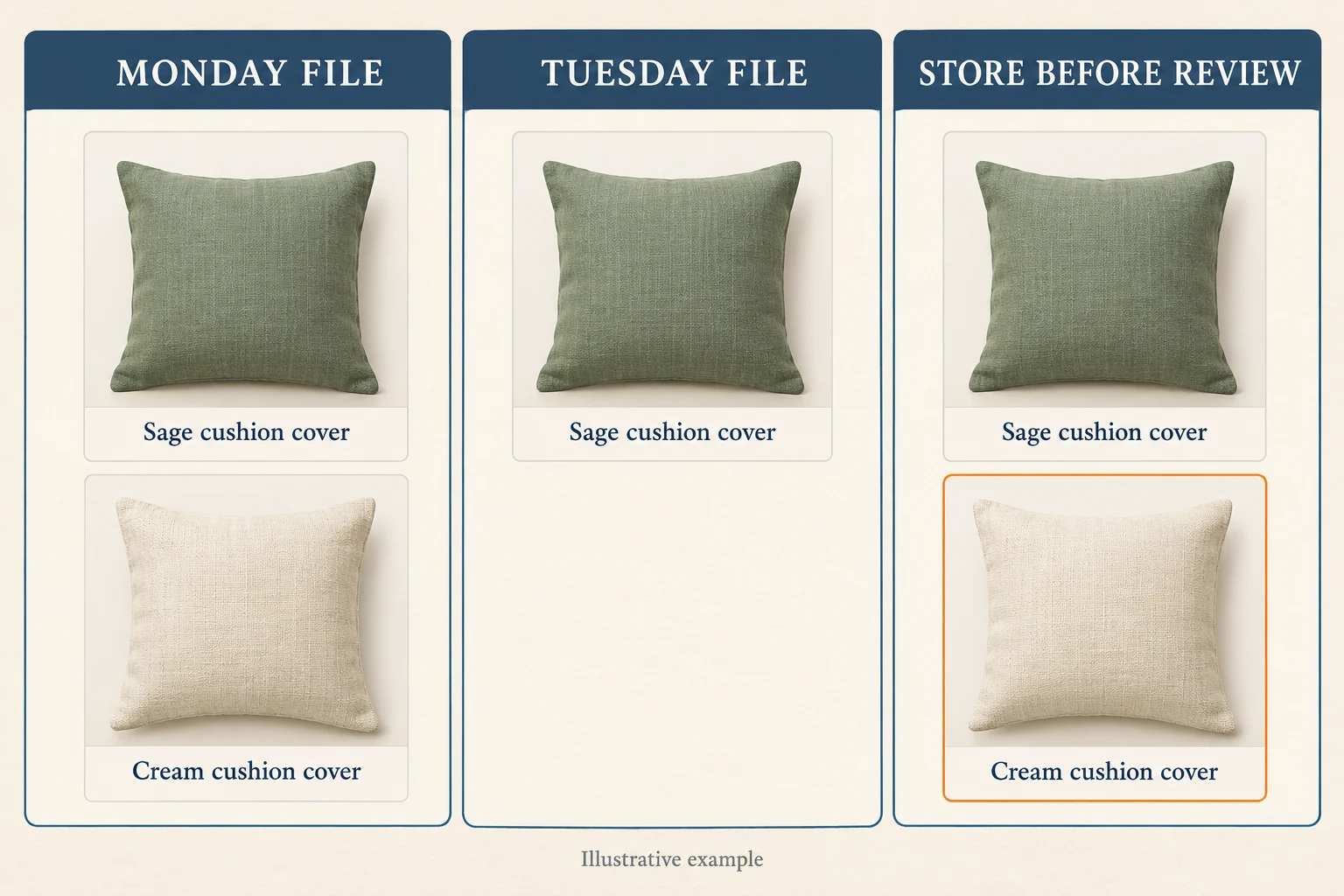
The missing row is not an instruction to delete your old listing. Markaz’s export notes say unavailable products are omitted; Shopify’s CSV import guidance says a product CSV cannot bulk-delete products. Uploading Tuesday’s file therefore does not establish that the cream cover has stopped selling in your store.
Compare the changed or unavailable products reported by the source with the existing offers. Pause an unavailable variant through your store’s inventory or publication controls as appropriate, then check what a customer can actually select. If stock is available and unchanged, there is no need to invent a problem or remove the listing.
Protect your edits when re-importing
Shopify matches existing products by handle when you select its overwrite option. Included fields can replace existing values, and an included blank optional field can clear the old value. Back up the products first; review the incoming columns before overwriting descriptions you have already improved.
Keep the variant data together. Shopify also warns that changing option values can recreate variant IDs and affect systems depending on them. Do not “clean up” the file by stripping out variant columns without understanding the result.
Treat the file as a copy of the catalogue on the day you downloaded it. Check the source before assuming yesterday’s colour or stock count is still available. Markaz’s broader portal page describes automation, but the specific export pages explicitly describe no automatic feed. If a different account integration is offered to you, establish its documented behavior separately rather than assuming this CSV route includes it.
05
Follow the customer's order through to one source purchase
Once a customer buys, the CSV has finished its job. The next task is to place the corresponding order through the supported Markaz process. Its specific Shopify instructions say to use the SKU from the store line item.
Continue the hypothetical cushion example. Your customer chooses one sage cover at the agreed PKR1,500 total. Your own store calls the order C-101; that is an illustrative store reference, not a Markaz order number.
| Record | What you need to match |
|---|---|
| Customer order | C-101, one sage cover, correct size and agreed PKR1,500 total |
| Source item | The exact SKU from the export, checked against the current Markaz variant |
| Delivery and payment | Correct recipient details and the payment route supported for that item/address |
| Source purchase | The actual Markaz order reference and confirmation that it was accepted |
| Shipment | The parcel reference and real movement of that order |
| Money | Collection evidence, later earnings/settlement and the receipt you can reconcile |
These are records to keep, not invented labels for buttons inside Markaz. The source interface and available status names may differ.
For COD, customer confirmation means the buyer wants the parcel; it does not mean you have received payment. For prepaid orders, establish that the required payment has actually succeeded. Our Shopify COD setup guide explains the checkout configuration separately.
Before releasing C-101, compare the source order with the buyer’s choice: one cover, sage, the right size, no insert if none was sold. Keep the customer’s accepted amount distinct from the amount your supplier charges. That difference is part of your economics, not a reason to change the customer’s total without agreement.
If there is a store sale but no source order
Check whether anyone actually submitted it. With a file-only route, waiting longer does not turn an imported product into a supplier purchase. If submission failed, establish the cause and complete the supported submission after checking the current item and price.
If a submission was attempted but its result is unclear, search the source account and your records before buying again. A retry after a delayed first submission can create two purchases for the same customer. Preserve both references if that has happened and ask which order can still be changed; do not simply conceal one by marking the store order complete.
Source acceptance is not proof that the parcel has moved. Keep the order reference so a delivery question can be answered about the correct purchase. For a controlled first order, the useful result is the right item reaching the intended recipient under the agreed terms, followed by a money record that you can explain. A successful product import proves much less.
06
Separate delivery, collected cash and available earnings
For social reselling, Markaz describes earnings being paid after delivery. That does not give us a verified payout time for your particular account. The public app listings and marketing pages contain payment-speed claims, but we have not observed a withdrawal and would not budget on a guaranteed next-day bank receipt.
Three records answer three different questions:
- Delivery: did the intended customer receive this parcel?
- Collection: what amount was actually taken for this order?
- Settlement: what earnings became available, what deductions applied and what reached the payment destination?
A delivery scan is useful evidence about the parcel. By itself it cannot explain a wallet adjustment or prove a bank transfer. Match the relevant records using C-101 and the actual Markaz order reference.

In the price example, the buyer’s PKR1,500 total was never all your spendable earnings. Goods and the agreed service charges have to be accounted for. Your advertising cost also belongs in your own result even if it does not appear as a Markaz deduction. Keep the provider’s settlement calculation separate from your business’s full profit calculation.
When the parcel or payment goes wrong
| What you can observe | Useful next step |
|---|---|
| Buyer refuses delivery | Record the refusal and establish the applicable outward/return charges; do not count it as a collected sale |
| Cover arrives in the wrong colour | Save the source/order variant and received-item evidence; request the appropriate correction through the actual support route |
| Delivery recorded, earnings absent | Match the correct order, check its settlement state and ask about the missing amount and release condition |
| Return agreed | Obtain the authorized recipient, method and cost treatment before sending the parcel |
For a missing payout, a useful message is specific: “For customer reference C-101 and Markaz order [your actual reference], delivery is recorded on [date]. The expected earnings are [your order’s amount], but the current earnings record shows [actual state]. Which deduction or release condition explains the difference?”
Markaz advertises a seven-day return window and quality-related support. That short statement does not establish every category’s eligibility, return freight, reseller deduction or refund timing. Read the conditions presented for the actual order and retain its support response. A supplier’s remedy also needs to be coordinated with the promise you made to your own customer.
07
Decide whether the manual work fits your business
Markaz is worth investigating when you want to sell to Pakistan and can manage a focused set of offers, customer conversations and source orders. Social reselling gives you a way to test that work without first building a large website. An own-store export makes more sense when you want the storefront and are prepared to maintain its data.
It is a weaker match if your plan depends on a CSV automatically reserving stock, purchasing every order or supporting every overseas destination. Those are service requirements to prove before choosing a provider. A US office address on a website does not establish a US warehouse or a delivery route to American customers.
Our supplier comparison guide explains the different supplier, marketplace and sourcing arrangements. Compare the job you need handled rather than the size of the advertised catalogue.
If your next problem is finding a particular product, checking its packaging or arranging a different China-side supply route, you can send AIDrop a sourcing request. Include the item, customer country, expected volume and packaging requirements. State any COD requirement explicitly so it can be assessed. AIDrop cannot resolve a Markaz account or release its wallet balance; this guide does not establish that AIDrop offers COD collection in Pakistan.
08
Questions about using Markaz
Is Markaz dropshipping available to US customers?
The reseller and export pages examined here describe Pakistan-focused delivery. Do not infer a US fulfillment service from English-language marketing or a US company address. Ask about the actual destination and item if you need another market.
Can I start without buying inventory?
That is the reseller model Markaz describes: place an order after a customer confirms rather than buying stock in advance. You still need to understand the applicable order costs, payment requirements and what happens to refused or returned goods. Free entry does not guarantee a profitable sale.
Does exporting products cost a monthly subscription?
Markaz describes its export tool as free. A Shopify store has its own costs, and a product order has its own economics. Do not combine those three things into a claim that the entire business has no cost.
Will I make the monthly income shown in its advertising?
No published maximum can forecast your result. Your outcome depends on customers buying, the real cost of acquiring them, successful delivery, returns and expenses. Work through actual settled orders before using earnings to fund expansion.
Can I use WooCommerce instead of Shopify?
Markaz offers a WooCommerce-format export as well as Shopify CSV and Excel. A file in the right format can help populate a catalogue. It does not, on its own, establish live stock synchronization or automatic order submission. Inspect the current instructions for your chosen route.
What should I do first?
Use Markaz’s own website to reach the official app or export tool. Complete its current account requirements, choose one identifiable product and confirm the full offer. Then follow that item through the route you intend to use. Keep the actual source reference when ordering: it is what lets you answer the next customer question without guessing which purchase belongs to them.
CJdropshipping Review: Costs, Warehouses, Quality and Fulfillment Fit
CJdropshipping is a practical option for sellers who want sourcing, store connections, packaging and fulfillment in one

CJdropshipping vs DSers: Who Sources, Pays and Ships the Order?
CJdropshipping can source and physically fulfill an order; DSers maps a store product to supported external suppliers

AutoDS Review: Evaluate the Automation You Would Actually Use
AutoDS can reduce listing and order work, but its value depends on your sales channel, tier, add-ons
