

RC Jewelry, MYNSU and Diamond Imports publish routes worth investigating for engagement-ring dropshipping. They serve different orders: a diamond ring selected from a catalog, a silver-and-moissanite style, or a custom-made ring shipped to your customer.
When a customer needs a ring for a particular proposal date, size and timing matter as much as the design. Confirm which stones the price covers, whether the chosen size is ready to ship, and the resizing or exchange terms before accepting payment.
Start with one ring you can explain and fulfill accurately. The comparison below helps you choose a source; the later checks turn that choice into a specific order request.
01
Suppliers to investigate for engagement-ring dropshipping
| Supplier | Relevant published offer | What to confirm for your ring |
|---|---|---|
| RC Jewelry / Richard Cannon | An engagement-ring catalog with natural- and lab-grown-diamond listings; a paid dropshipping program | Exact stone and metal variant, member price, available size and that item’s production time |
| MYNSU | Stock silver-and-moissanite jewelry; gold and diamond work through custom projects | Whether your design is stock or custom, center and accent materials, dispatch location and partner terms |
| Diamond Imports | Engagement and custom rings, with direct-to-recipient blind shipping advertised | Written specification, destination eligibility, price, making time and remedy for that order |
- RC Jewelry membership: the program lists $29.99 monthly and a $1 introductory offer. Its free Shopify connector requires active membership. Budget for the recurring fee, then confirm the selected ring and size; a connector installation does not establish availability.
- MYNSU collection choice: its wholesale information separates stock silver-and-moissanite styles from custom gold and diamond projects. Do not import the stock range under a diamond engagement-ring description.
- Diamond Imports custom inquiry: the manufacturer offers engagement rings, custom orders and blind shipping. Request the exact specification, destination, price, making time and remedy together. Direct shipping alone does not settle those conditions.
These are published sourcing leads, not a ranking based on our own ring purchases or delivery tests. For a wider range of jewelry business models, use the jewelry dropshipping supplier comparison.
02
Specify the stone and metal before comparing prices
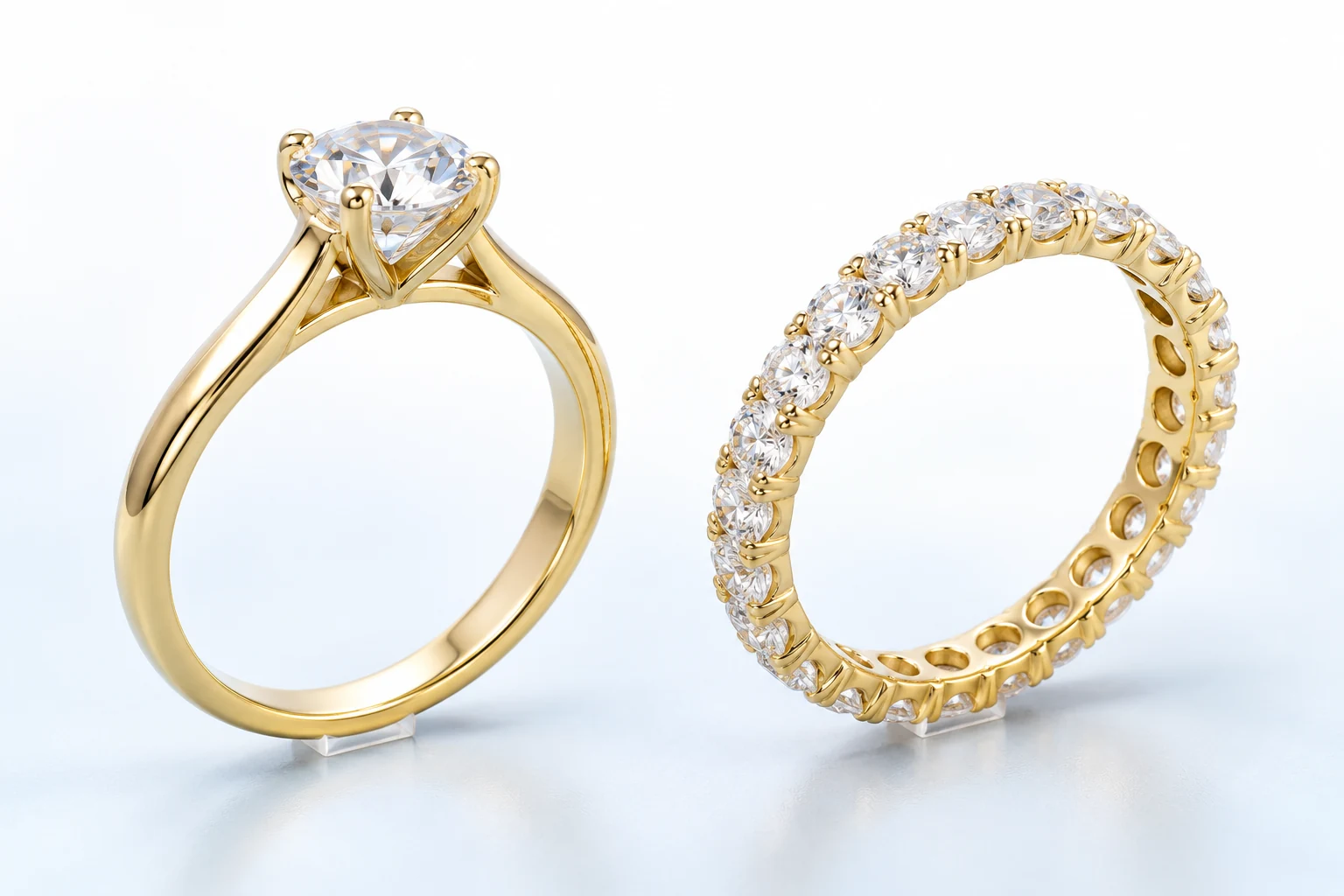
A ring can have a large center stone, a halo of smaller stones and more stones along the band. Record each part separately. “Diamond ring” in a search result is too little information to buy against.
The FTC’s gemstone buying guidance distinguishes natural stones, laboratory-created stones and imitations. A lab-grown diamond is a diamond made in a laboratory. Moissanite and cubic zirconia are different materials; moissanite does not become a lab-grown diamond because it comes with a report.
| Field | A useful answer | Unclear or incomplete specification |
|---|---|---|
| Center stone | Natural diamond, lab-grown diamond, moissanite or another named material | “Diamond look” or “1 ct stone” |
| Accent stones | Their material, quantity and stated total weight where relevant | Assuming they match the center |
| Metal | The specified alloy and fineness; any plating identified separately | “Gold color” presented as solid gold |
| Included pieces | One ring, with the stated box and documents | Assuming a photographed wedding band is included |
Photographs help you compare the shape and setting. They cannot establish metal fineness or stone identity. Obtain those facts for the exact variant, then keep your supplier record, product page and customer order consistent. The broader jewelry dropshipping guide covers the surrounding material and product-document questions.
Separate center weight, total weight and diamond-equivalent size
Suppose a hypothetical ring has a 0.80 ct diamond center and 0.20 ct of diamond accents. Its total diamond weight is 1.00 ct. The center still weighs 0.80 ct.

A second offer for a 1.00 ct center is describing a different specification. Comparing the two prices as though they buy the same center stone would give you the wrong result.
GIA explains that carat measures weight. Millimeter measurements describe dimensions. Total diamond weight combines stones; it does not tell you the weight of the largest one.
There is one more field to watch for in moissanite offers: DEW, or diamond-equivalent weight. MYNSU uses it to describe a moissanite stone’s diamond-equivalent size. It is not the stone’s actual diamond weight, and it does not change moissanite into diamond. Ask for the material and dimensions alongside that label.
03
Check what the grading report actually covers
Ask the supplier which stone the document describes. A grading report for a loose center stone does not automatically describe the completed mounting, the accent stones or the metal. An appraisal, warranty and laboratory report also answer different questions.
When a GIA or IGI report is offered, work through these checks:
- Identify the document. Obtain the issuing laboratory, report type, number and date. Confirm whether it concerns the center stone or another item.
- Use the issuer’s own lookup. Open GIA Report Check or IGI’s verification page, as appropriate. Compare the information available there with the supplied document.
- Match it to the offered stone. Check the reported shape, weight, measurements and other identifying fields against the supplier’s offer. Report formats differ, so use the fields on that report rather than assuming every document contains the same grading details.
- Resolve any mismatch before release. A different number, stone description or variant needs an explanation. Where physical identity remains uncertain, seek qualified verification rather than treating a database result as proof of the ring in the parcel.
GIA’s report terms explain important limits: a report is not a guarantee, valuation or appraisal. Finding a number in an issuer’s database does not by itself authenticate the physical stone being sold.
Likewise, a GRA moissanite document is not a GIA or IGI diamond report. Ask what the supplier’s document covers and describe it accurately. No report number or physical ring was authenticated for this article.
04
Confirm ring size and the resizing route
Before accepting payment, ask for the size and the sizing system. “Size 7” without a system, or a customer’s guess from a photograph, is an avoidable problem.
For an important purchase, suggest that the customer have the intended finger measured by a jeweler. Band width and the way the ring passes over the knuckle can affect fit. GIA’s ring-sizing guidance also explains why paper or string measurements can mislead and why some stone-set bands are difficult to resize.
Agree on these parts of the sizing service before offering it to your customer:
- Resizing eligibility. Check the permitted size range and whether the setting limits alteration.
- Authorized resizing service. Establish the authorization needed, the fee, shipping responsibility and expected turnaround.
- Alternative remedy. Obtain the applicable exchange or replacement terms before offering that remedy to your customer.
For example, RC Jewelry’s published policy allows resizing within one month for a fee, with return shipping paid by the merchant and an approximate two-to-seven-business-day turnaround. It excludes eternity rings from resizing. That is a design-specific limit, not a reason to promise the same remedy for every ring from every source.
A customer can choose the correct stated size and still need help with fit. Write a clear customer-facing size and service explanation while you still have time to choose another design or supplier.
05
Separate stock dispatch from custom production
Your customer’s date belongs at the beginning of the inquiry. Tell the supplier when the ring must arrive, then ask for production, dispatch and transit times separately.
RC Jewelry’s FAQ distinguishes stocked gold and silver lines from diamond pieces with item-specific making times. Its custom process includes design approval before making the ring, with a typical two-to-four-week production period. A general stock-dispatch figure cannot be applied to that custom order.
Consider an invented example: the proposal is 10 calendar days away, and the chosen custom ring needs two to four weeks to make, followed by shipping. Paying for a faster carrier does not remove those production weeks.
The useful choices are to obtain a genuinely feasible alternative, agree a later date with the customer, or decline that deadline. Do not take an occasion-specific order on the assumption that express delivery will rescue it.
For a custom ring, obtain approval of the design, stones, metal, size and engraving before production starts. Keep the approved version with the order. Ask what a later change would cost and whether it would restart the making time.
For a ready-stock ring, confirm the selected size and variant are actually available. A style appearing in a catalog is not the same as that ring being ready for today’s order.
06
Quote and release one complete ring order
Send a request that a supplier can answer without guessing which ring you mean. Here is an illustrative inquiry, not an available product or a supplier quote:
| Order field | Example request or required confirmation |
|---|---|
| Ring identity | Your chosen supplier style and variant code; attach the authorized reference |
| Center and accents | Request a 0.80 ct lab-grown-diamond center and 0.20 ct total lab-grown-diamond accents; confirm whether this specification is offered |
| Metal and size | Request 14K yellow gold, US size 7; confirm availability and any design limits |
| Personalization | No engraving; do not substitute another setting or stone without approval |
| Documents and contents | Identify the offered center-stone report, included ring box and other documents; confirm that no separate wedding band is being ordered |
| Date and destination | Supply the actual destination and required arrival date; ask for production, dispatch and transit estimates separately |
| Price and remedy | Obtain the ring price, shipping, applicable fees, cover limit, size remedy and custom-order conditions in writing |
Compare the returned offer line by line. A cheaper quote with moissanite substituted for the requested center, a different metal or no stated making time is not a matching quote.
Add the relevant membership cost to your business forecast. Confirm signature requirements, delivery restrictions and loss or damage procedures for the selected service. RC Jewelry’s shipping information, for example, describes insurance based on wholesale value. Do not assume the covered amount equals your retail selling price or expected profit.
What the first order should establish
Before promoting a large collection, place a small first order through the route you intend to use. This is a proposed check, not a test we performed:
- The supplier’s order shows the selected style, stone specification, metal, size and approved personalization.
- The parcel contains the correct ring, agreed box and stated documents. Arrange qualified assessment where the material or stone needs verification; a photograph alone cannot do that work.
- The dispatch, tracking and handover follow the agreed route, including any signature or insured-value requirements.
If the supplier proposes a substitution, pause the affected order and resolve it before shipment. If the delivered item or documents differ, preserve the order record and packaging, then use the supplier’s claim process. Correct the offer or source before sending more customer orders through the same unresolved problem.
07
Read the trade remedy before promising a return
A retail returns banner may not govern the order you place as a dropshipping partner. Open the partner terms and check the date and type of order covered.
MYNSU partner orders
For new partner orders under its current partner facts, the wrong-size dropshipping remedy has these conditions:
- Request a same-style exchange within 15 days of delivery, with authorization first.
- Expect an exchange, not a cash refund; the merchant pays shipping both ways.
- Check the separate reporting window for wrong, missing, damaged or faulty items so your support team can act in time.
RC Jewelry standard and custom orders
Its returns policy distinguishes ordinary eligible returns from custom work:
- An ordinary return must meet the unworn, undamaged and unaltered conditions, with the required packaging and documents.
- Custom mountings and pieces outside its listed range are noncancelable and nonrefundable under that policy.
- Original shipping is not refundable.
Write the customer remedy your store can actually support. Include any cost or service you intend to provide beyond the supplier’s remedy. Supplier terms do not, by themselves, settle every obligation your store has to its customer.
For a ring-specific supply inquiry, send AIDrop the design, stone and metal requirements, size, destination and required arrival date. Include the documents you require so the team can request a matching offer. Supplier availability, price and timing still need confirmation before you accept the order.
08
Questions before selling an engagement ring
Can I start without keeping rings in stock?
That is the purpose of a direct-to-customer supply route. You still need the funds to pay the supplier, handle any membership charge and support the order. Confirm when the supplier requires payment; do not assume customer payment and your access to those funds happen together.
Can I sell moissanite as a lab-grown diamond?
No. They are different materials. Describe the center and accents accurately and keep that description consistent across the listing, quote and order confirmation.
Does a ring box mean the wedding band is included?
No. Confirm the number and identity of the jewelry pieces. A styled image can show a combination that the selected variant does not include.
Should I import the whole supplier catalog immediately?
Start with the designs whose specification, size options, making time and remedy you can explain. A smaller verified range is easier to support while you establish the actual ordering and delivery process. Expand when that process works for the products you intend to add.
Sources and scope: linked primary catalogs, programs and policy pages were reviewed on November 5, 2026. Confirm current terms for your order. The weight calculation, inquiry and deadline scenario are illustrative; no supplier account, purchase, sample or laboratory verification was performed.

Clothing Dropshipping: Sizes, Variants, Samples and Returns
Verify apparel sizes, variants, samples, labels and returns before launch. Build a clothing dropshipping offer around accurate
Clothing Dropshipping Suppliers: 5 Options for Different Stores
Compare Trendsi, Printful, Printify, Apliiq and BrandsGateway by clothing model, fit information, stock, shipping and return costs.
Shoe Dropshipping: Sizing Evidence, Variants and Return Exposure
A shoe listing needs model-specific fit evidence, exact size-color stock and a workable exchange route. Compare one
