
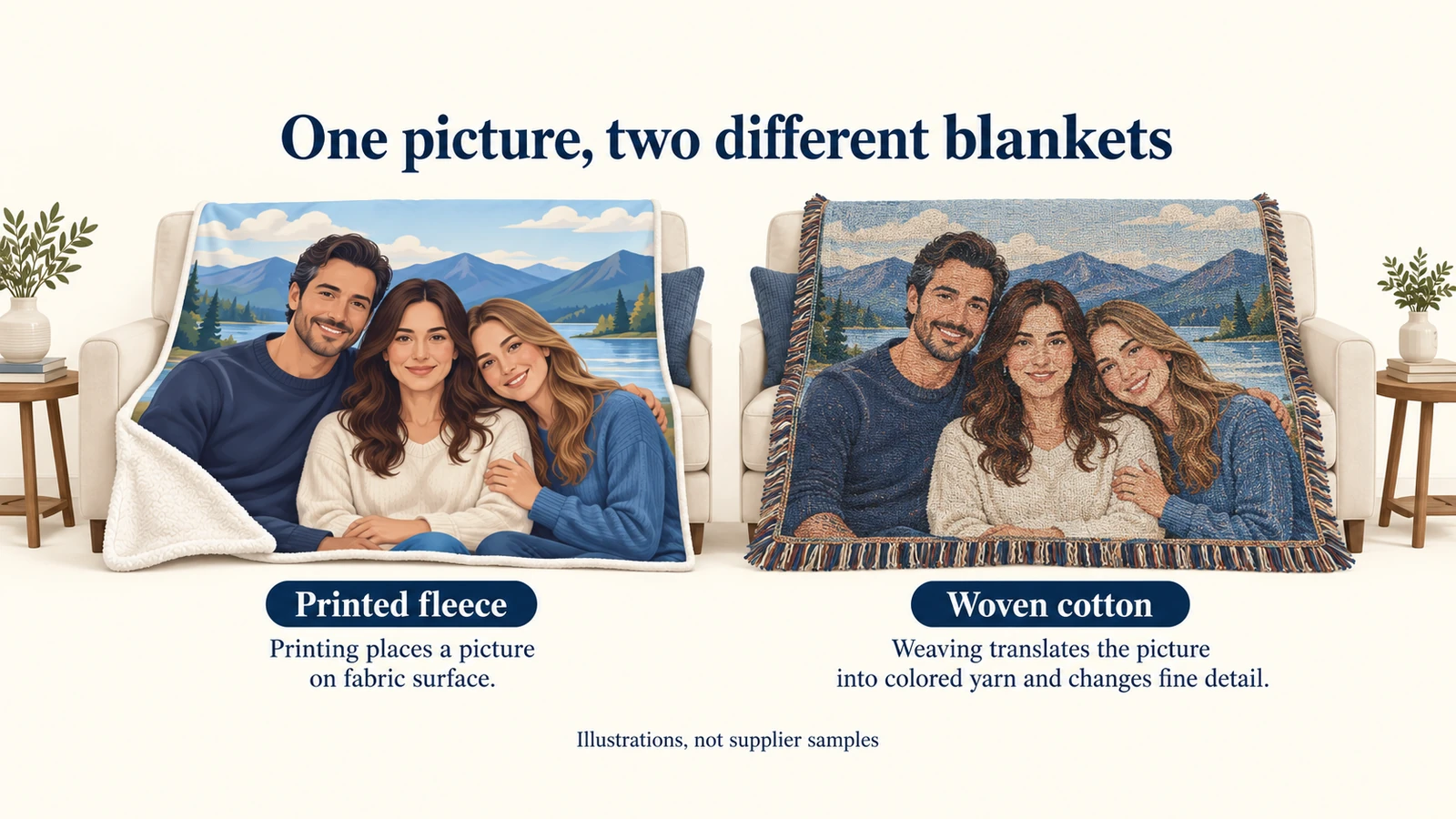
When a buyer uploads a photograph for a blanket, the order includes a crop decision as well as a fabric and size choice. A supplier can print or make the approved version and ship it straight to the buyer. First choose the exact blanket, show how the picture will sit on it, inspect one finished sample and price the packed delivery. Otherwise the customer may receive a usable blanket that still looks nothing like the picture they approved.
Suppose you want to sell a 50 × 60-inch photo throw for an adult’s sofa. The customer uploads a family picture; you arrange it on the supplier’s template. The supplier prints, finishes and sends the throw. Your store still handles the crop approval, delivery promise and any disappointed customer.
The image on your screen is only part of the product. A fleece print and a woven cotton blanket can turn the same photograph into noticeably different objects. A sharp digital preview also cannot tell you how the reverse, edges or fabric will feel.
Start with one offer you can explain: one material, one size, one picture layout and a route to your first customer market. This guide follows that photo throw from product choice to a paid order, including the cash needed before your payment processor releases the sale proceeds.
The wider print-on-demand guide explains the business model. Here, the practical question is how to make a customer’s picture work on a full-size blanket.
01
Printed fleece and woven cotton make different pictures
For the family photo, begin by comparing a printed throw with a woven one. Printing puts the image onto the fabric’s surface. Weaving builds it from colored yarn. The weave has its own texture and a limited palette, so faces, fine lettering and gradients can change.
| Route | What the customer receives | What to check before choosing it |
|---|---|---|
| Gooten fleece/sherpa | Polyester, a smooth printed front and an unprinted fluffy reverse; listed sizes include 50 × 60 inches | Front image, reverse color, edge finish and destination shipping |
| Printful sublimated sherpa | A polyester throw printed on the smooth side; listed sizes include 50 × 60 inches | The exact template, reverse and current sample-order total |
| Gooten woven | A cotton blanket with fringe; the reverse shows a negative of the front design | Photo versus graphics conversion and how small details survive the weave |
| Prodigi H-BLANKET-WOVEN | A cotton jacquard blanket, including a 50 × 60-inch option, fulfilled from the US | File conversion, finished-size tolerance and destination availability |
On a phone, swipe the table sideways to compare every column.
These are real catalog routes, not four samples we have tested. The product and file details were checked on September 28, 2026; obtain the current variant and shipping quote before committing to a customer price.
For the first product, decide which result matters to the buyer:
- Recognizable photo: Try printed fleece, then inspect whether the pile softens faces and colors even with a sharp file.
- Textured object: Try woven cotton if a fringed blanket matters more than photo fidelity. Gooten’s woven guidance describes photo conversion and favors large, bold text over tiny handwriting.
Prodigi’s woven page lists US fulfillment, a 120-hour production estimate and a restricted set of destination markets: UK, EU, US, Canada, Australia, India, South Korea and Brazil. That is not a worldwide promise or a five-day arrival guarantee. Its page also describes the palette as both 195 and 200-plus combinations; ask for the actual converted proof rather than sell an exact color-count claim.
For our first offer, choose the printed 50 × 60-inch throw. A woven version can become a separate product once its own sample has shown what the photograph looks like in yarn.
02
Separate finished size from the upload canvas
The finished size describes the blanket. The upload canvas may be larger because the picture must extend into bleed: extra image around the edge that accommodates cutting and finishing. The safe area sits farther inside, where important faces and words should remain.
For example, MuZeFab lists a 30 × 39-inch finished sherpa blanket with a 31 × 41-inch print area. Those numbers answer different questions. Do not promise a 31 × 41-inch blanket because the file template has that size, or borrow its margins for another supplier’s 50 × 60-inch product.
Prepare the photograph at its real printed size
Download the chosen size’s template and keep its orientation, bleed and safe-area guides visible while arranging the picture. Extend ordinary background into the bleed; keep faces and lettering inside the safe area. Check the whole picture and the important details at full size.
DPI means pixels per printed inch in this context. As a hypothetical calculation, a 50 × 60-inch picture area at 150 DPI requires 7,500 × 9,000 pixels before adding that product’s bleed. A 6,000 × 7,200-pixel photograph stretched over the same area supplies 120 pixels per inch. Increasing the file’s pixel count does not restore missing facial detail.
More DPI metadata does not recover detail
If the source is too small, ask for the original camera file. Otherwise offer a smaller picture within a designed background, or choose a smaller blanket after checking its template. Do not quietly enlarge a social-media thumbnail and hope the digital mockup hides it.

A usable brief for the first photo throw
Send the supplier a brief like this, replacing the proposed fields with its actual product details:
- Product: adult sofa throw, printed polyester, proposed finished size 50 × 60 inches; identify the exact SKU.
- Layout: one portrait photograph on the front, faces inside the template’s safe area, background extended through bleed; no printing promised on the reverse.
- File: original photograph plus the size-specific export; record the file version and obtain a crop preview before production.
- Checks: confirm finished-size tolerance, reverse color, edge finish, packing, care and shipping to the customer’s postal code.
Save the actual crop and permission
Ask the customer to confirm the crop and that they have the right to use the photograph. Keep that approval with the order. An approved preview records the intended composition; it does not prove the final fabric’s color or texture.
03
Follow the actual provider file and order route
File instructions belong to a product. Gooten’s fleece guide, rechecked October 11, specifies 150-DPI JPG/PNG files. However, it describes an RGB canvas in one place and designing in CMYK before exporting PNG/JPG with an sRGB profile in another. Those instructions do not establish one unambiguous working color mode.
Before exporting the production file, ask Gooten to confirm the current workflow for your chosen fleece template: working color mode, export profile and any required conversion. Keep that answer with the approved export and compare a physical sample’s color. Do not silently apply the fleece guidance to a woven blanket or another provider’s sherpa product.
Prodigi’s woven blanket lists JPG/PDF uploads at 96 DPI. Its approximately 12-DPI woven-effect preview shows how the picture may look in yarn. That preview is not a 12-DPI upload instruction. The physical sample remains the useful check for a face, small text or subtle shading.
From catalog to a sample order
For a Printify route, its Sherpa Fleece Blanket product is a concrete place to start. It lists 30 × 40, 50 × 60 and 60 × 80-inch options, one-sided printing and a fluffy reverse. The displayed starting price is not the delivered cost of your selected size and destination.
- Open your provider account and select the product. Choose the print provider and 50 × 60-inch variant, then check available destinations, production estimates, product cost and shipping. Save the provider/SKU pairing; switching providers can change the product.
- Download that variant’s current template. Arrange the original photograph, export to its stated format and upload it. Check the crop, orientation, faces and edges in the preview. Resolve any file warning before ordering.
- Submit one sample to your own address. Include the variant, quantity, design version, full address and selected shipping service. Review the complete order charge, including any applicable taxes or fees, before paying.
- Inspect the delivered sample. Compare it with the saved file and approved crop. Record which product and provider made it, and whether its size, print, reverse and packing support your proposed offer.
- Publish that approved product. Use the provider’s supported store connection or place orders manually while testing your workflow. For each paid customer order, match the variant and approved file, submit the actual delivery address, pay the supplier and pass tracking to the customer.
A catalogue connection does not approve the photo
Avoid promising automatic personalized-file handling simply because a catalog connects to your store. Decide who checks each upload and whether production waits for crop approval. The print-file and sample guide gives a fuller approval record for keeping those versions straight.
Recheck the crop when the blanket size changes
Suppose the customer changes the proposed front-printed throw from 50 × 60 to 60 × 80 inches. Keep the original camera file, but use the newly selected size’s actual template and obtain a new crop approval.
Before the changed order
Record the selected supplier product, provider, size and front-only print. Arrange the photograph against the new finished area, bleed and safe area. Do not stretch the old export and assume the faces remain safely placed.
After exporting the new version
Reopen that export and the corresponding product preview. Confirm the approved people, crop, orientation and size, then compare them with the supplier’s accepted order. If production has locked, ask what can actually be changed before promising a correction.
The reviewed Printify product 238 also notes possible ±3-inch variation in its preconstructed blank. Keep that specific tolerance beside the selected product; it is not Gooten minky’s two-inch example, permission to ship a different size, or a universal tolerance for all blankets. No changed order or physical blanket was tested here.
04
Inspect a sample and write the product page
Lay the sample flat beside the approved preview. Start with the customer’s reason for buying it: can you recognize the faces, and does the crop include the people they approved? Then measure the finished blanket and inspect the reverse, stitching, corners and any fringe.
Use a short approval record rather than “looks good”:
- Picture: File version, orientation, crop, visible detail and any color difference
- Physical blanket: Measured width/length, material, reverse, edges and product-specific tolerance
- Care: Supplier instructions; if you wash a sample, record the actual method and resulting changes
- Delivery: Production date, dispatch date, route, packing condition and arrival date for that sample
Do not use one sample’s arrival date as every customer’s guarantee. Separate production from parcel transit and tell customers when the clock starts: at paid order submission, or after they approve the photograph. Build your displayed delivery window from the chosen supplier and shipping route.
Ask how the folded throw is protected and what happens if an order contains more than one product. Gooten’s packing guidance says products from different facilities may ship separately; a blanket and a mug are not automatically one parcel. Include the actual number of parcels in your delivery explanation when known.
Turn the checks into a clear offer
For the hypothetical photo throw, make the offer easy to inspect:
- What arrives: Adult sofa throw, material, finished size and confirmed tolerance; printed front and unprinted reverse.
- What the buyer approves: The picture crop before production.
- What use requires: Care instructions for this product and separate production and delivery estimates.
Add real sample photos once you have them; label a mockup as a mockup.
Check size and label claims on the selected blanket
Tolerances belong to the actual blank
Use the actual SKU’s sizing limits. Gooten’s minky product, for example, describes pre-cut blanks with up to two inches of size variation and edges that may not form a perfect rectangle. That is not permission to apply the same tolerance to every woven or sherpa blanket.
For US sales, FTC textile guidance covers blankets and throws. Covered labels generally identify fiber, origin and the responsible business by name or RN. Ask for the actual label and match the online origin claim to it. A US dispatch warehouse does not establish US manufacture.
The separate Care Labeling Rule guidance concerns wearing apparel and certain apparel piece goods; do not automatically apply that clothing rule to an ordinary nonwearable throw. Still provide accurate care instructions for the chosen product. A hooded wearable or infant product needs its own assessment.
Before accepting orders, confirm product availability and the replacement policy. If your selected blank disappears, pause the listing. A different reverse, size or fabric is a changed product that needs approval, not an invisible supplier substitution.
05
Price the packed blanket and pay before payout
Request a quote for the exact finished blanket sent to a specific postal code. Include the folded parcel’s size and weight, packing, shipping service and who pays any applicable import charges. A catalog’s product price alone cannot answer what one delivered customer order costs.
A hypothetical $59 order
The following illustrative USD figures are not a provider or AIDrop quote. Assume the supplier separately quotes $28 for the blanket, $2 for packing and $9 for shipping: $39 altogether, including the applicable supplier/delivery charges assumed in this example. In a real quote, verify taxes and duties, and avoid adding packing twice if it is already included.
| Per customer order | Hypothetical amount |
|---|---|
| Sale proceeds | $59.00 |
| Blanket | $28.00 |
| Packing | $2.00 |
| Shipping | $9.00 |
| Payment processing | $2.10 |
| Advertising | $7.00 |
| Allowance for future remedies | $2.00 |
| Listed costs and allowance | $50.10 |
| Amount left after those items | $8.90 |
On a phone, swipe the table sideways to compare every column.
The $2 allowance is a planning reserve, not a refund already paid. The $8.90 is contribution toward your other expenses; it is not guaranteed take-home profit. Store subscriptions, your time, taxes and any extra production changes still matter.
Suppose you buy two separately shipped samples at $39 each: $78. Ten orders leave $89 after the listed per-order items, so subtracting those samples leaves $11 before other overhead. An apparently healthy selling price can leave little room during the first small test.
Check the bank balance as well
Production needs money before payout
At the assumed $39 supplier charge per blanket, ten paid orders need $390 before customer payouts arrive. Keep separate cash for ads and for a $59 refund or $39 remake if an order fails. A refund and remake are alternative remedies for the same customer; neither is funded by a supplier credit until that credit is actually available. Replace the $39 with the selected blanket’s full product, packing and shipping quote before scaling.
06
Fix a crop, wrong size or damaged parcel
Ask for the order number, a photo of the whole blanket and close-ups of the problem. For size complaints, request a photograph showing how it was measured. Retrieve the ordered SKU, uploaded file, approved crop and tracking record before deciding what went wrong.
A face was cut off although the approved file kept it inside the safe area
Compare the production result with that file and request correction. Keep the customer’s evidence with the supplier claim.
The wrong size or material arrived
Match the received item with the ordered variant. A different SKU is a fulfillment error, not a reason to tell the customer that all blankets vary.
The product matches an approved crop, but the customer dislikes it
Investigate what the page and approval process promised. A new crop may require a newly paid order; it is not automatically a manufacturing defect covered by the supplier.
For a damaged parcel, preserve packaging and product photos and report it promptly. Give the customer a clear remedy and date for the next update under your applicable obligations and store policy. Do not leave their case unanswered while waiting for upstream credit.
Supplier claim and buyer remedy have different rules
Printful’s supplier policy provides a 30-day reporting window for misprinted, damaged or defective items after receipt, and for lost shipments after the estimated delivery date. It generally excludes buyer remorse or a customer’s wrong size/color choice. Those supplier terms do not replace the rights your own customer may have. A wallet credit also is not cash already returned to your bank.
Ask about the exact blanket and destination
If you are arranging production with a China-side blanket supplier, AIDrop’s product-sourcing service can help communicate the exact blank, artwork, sample and packing request. Send the product/supplier link, finished size, file reference and destination through contact. Approval of image quality, labeling or product claims still needs evidence for the actual blanket.
07
Frequently asked questions
Can I sell a blanket printed on both sides?
Yes, where the exact product supports it. Gooten’s current minky catalog offers one- and two-sided options, while the sherpa products discussed here print the front and leave the fluffy reverse unprinted. Confirm both the variant and price; “custom blanket” does not mean two-sided printing.
Does every blanket need a 300-DPI file?
No. The chosen product’s instructions control the file. Gooten’s fleece guidance uses 150 DPI; Prodigi’s woven product lists 96 DPI for its upload. Start from the actual size-specific template, not a generic blanket chart. A low-resolution woven-effect preview serves a different purpose from the upload file.
Will a woven blanket reproduce a photograph exactly?
No exact match should be promised. Yarn conversion changes colors and fine detail, and the reverse also differs. Review the converted image and a physical sample before showing customers a woven version of the offer.
What washing instructions should I give?
Use the supplier’s instructions for the selected SKU. For example, Gooten’s fleece/sherpa page calls for a cold gentle wash and low tumble drying, with no ironing. Do not reuse those directions for every cotton weave, trim or other fabric. A sample wash can help you observe changes, without establishing lifetime durability.
Can I turn this offer into a baby blanket?
This guide’s offer is an adult sofa throw. A smaller size, soft fabric or supplier “hypoallergenic” claim does not establish suitability for infants. Treat an infant or child product as a separate offer with its own intended-use, safety and labeling assessment before marketing it that way.
For the first launch, keep the promised product easy to recognize: one approved printed throw, a clear crop preview and a price that covers the delivered order. Add another size or woven option after its own file, sample and shipping calculation are ready.
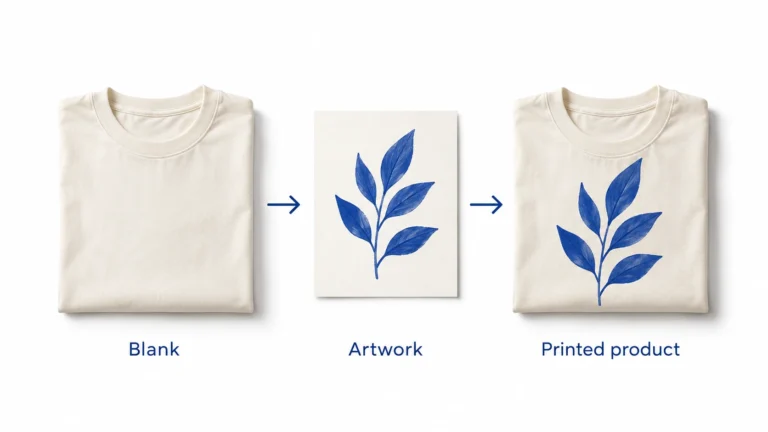
Print on Demand Dropshipping: From Design to a Fulfilled Product
Understand print-on-demand dropshipping, approve designs and samples, calculate full order costs, and manage production, delivery and customer
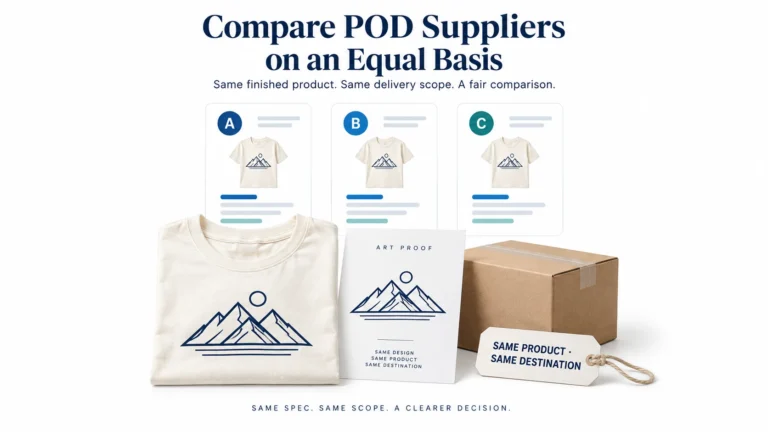
Print on Demand Suppliers: Compare Production, Proofs and Fulfillment
Compare Printful, Printify and Gelato by product, routing, samples, complete order cost, integration and returns before choosing
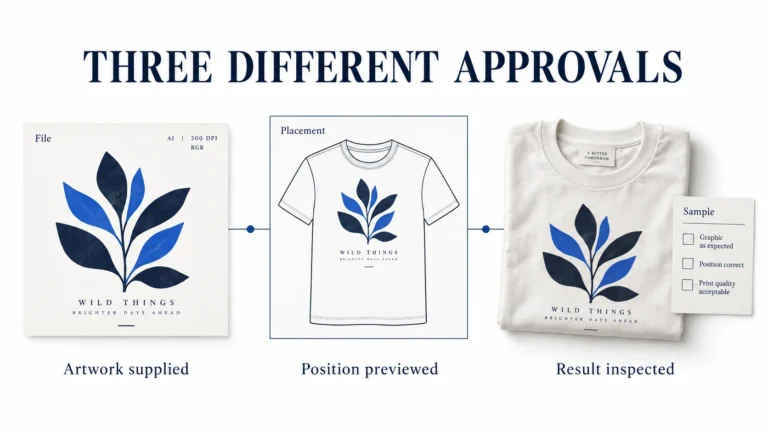
Print-on-Demand Files and Samples: Approve the Actual Print
Prepare each print file for the exact provider, product and print area, using its current template and
