
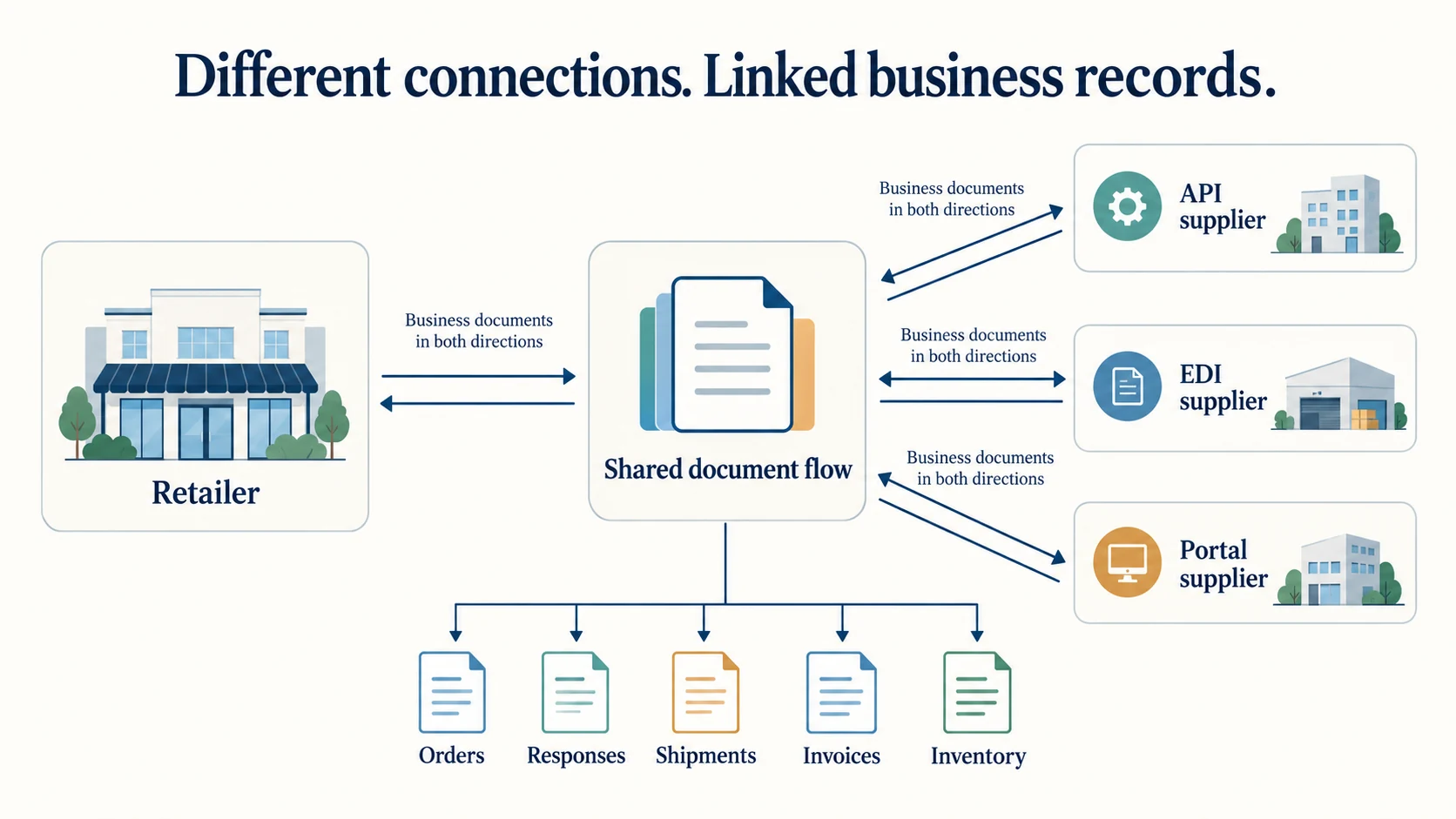
Logicbroker is worth evaluating when a retailer needs to connect suppliers with different systems and keep orders, supplier responses, shipments, invoices and stock information linked. If you are a supplier invited by a retailer, your task is narrower: choose an allowed connection and meet that retailer’s requirements. Those are different buying decisions.
The useful test is not how many connector logos appear on a website. It is whether your actual partners can complete the required work, which steps still need a person and whether the resulting savings justify the contract and implementation cost.
This assessment uses current public documentation. It is not a hands-on performance rating, a negotiated price quote or a forecast based on another retailer’s results.
01
Who should consider Logicbroker?
Logicbroker’s platform introduction describes connecting retailer and supplier data through a shared format. A retailer can exchange orders and related documents with partners using different systems, rather than making its internal system interpret each supplier’s files separately.
A retailer running a partner program
Consider a retailer whose suppliers use a mixture of an ERP, Shopify and a web portal. Staff may be copying order responses, chasing shipment notices and matching invoices by hand. That is a plausible reason to investigate a platform that brings those flows together.
The evaluation still needs the actual partners and documents. Connecting one supplier’s straightforward parcel orders does not demonstrate that another supplier’s partial cancellations, returns or product feed will work the same way.
A supplier joining a retailer
An invited supplier should start with the retailer’s onboarding instructions. You may need to process orders in the portal, connect an existing system or use a permitted connector. That does not automatically mean purchasing the same platform arrangement that a retailer uses to operate its whole supplier program.
If your main need is importing a few products or finding a supplier catalog, first compare the work covered by simpler dropshipping automation tools. Choose an arrangement that covers the required work and leaves someone responsible for the exceptions.
02
Evaluate document coverage for each partner
An order asks the supplier to fulfill something. An acknowledgment reports what the supplier accepts, cancels or backorders. Shipment information and an invoice perform different jobs again. A connection that moves the first document may leave another task manual.
The current connection-options guide makes this visible. Its supplier options include portal, API and EDI routes, with advanced connections subject to retailer support. The exact required documents vary by retailer.
| Connection example in the guide | Important scope for evaluation |
|---|---|
| Web portal | People can process work there; assign responsibility for doing it |
| API or EDI | Establish the required documents and partner specifications, not only transport connectivity |
| Shopify supplier connection | The guide describes automatic acknowledgments/invoices, with cancellations, returns and product feeds handled manually in the portal |
| ShipStation supplier connection | The guide identifies returns, inventory and product feeds as manual portal work |
These are documented connection scopes, not a promise that every retailer enables every option. Use the actual partner guide to complete your matrix.
Put a person’s name next to the remaining work
For each required flow, record the connection, whether it is automatic or manual, the person responsible for exceptions and the evidence that closes the task. “Someone checks the portal” is not an operating arrangement if no one knows which queue they own.
For example, an automatically created invoice can save typing while a partial cancellation still needs a manual acknowledgment. If you count the whole order as untouched automation, the business case will miss that retained work.
If the document names are unfamiliar, our dropshipping EDI explanation follows their business roles. Logicbroker can use other connection formats; EDI is one route rather than the definition of the entire platform.
03
Treat onboarding as setup, testing and signoff
Logicbroker’s supplier-onboarding process distinguishes connection setup, testing, retailer signoff and live operation. An account that can log in or receive a file has not demonstrated all those stages.
Establish partner and product identity first
The supplier and product setup guide describes partner company identifiers and product mapping. Those records determine which company receives an order and which supplier item corresponds to the merchant’s SKU.
A valid connection to the wrong partner or a mapping to the wrong variant can produce a perfectly readable document for the wrong business outcome. Retain the selected company, merchant SKU, supplier SKU and actual selling unit with your test.
Use our SKU mapping guide for the detailed variant work. In this evaluation, require the intended item to remain identifiable through the order, response, shipment and invoice, rather than checking the product import alone.
Ask for a pilot with representative partners
Choose partners that expose the different work your program needs: for example, one integrated supplier and one portal-based supplier, if both are part of the intended operation. Test their required outcomes before rolling the process out to everyone.
The on-demand retailer guide describes stage permissions and supplier-specific test groups. Use the actual program’s setup and signoff requirements. A general advertised onboarding time is not a deadline for a partner whose data, mapping or required test still fails.
04
Test an order that cannot ship in full
A successful ordinary order is useful. An order that cannot be fulfilled as requested reveals more about the exception process.
The provider’s Shopify supplier guide for Joy includes a partial-cancellation test requiring a manual acknowledgment before the remaining item is fulfilled. That is a named retailer’s workflow, not a rule to copy blindly into every program. It demonstrates why automatic acknowledgments and invoices do not remove every exception task.
Example: Joy’s Shopify prerequisites
For that specific Joy connection, the guide requires the Shopify products to be active, have unique SKUs and carry the Logicbroker tag. Its stage workflow includes checking the inventory import and completing test orders. A duplicate variant SKU can make a test fail before the later shipment and invoice checks. Those are concrete prerequisites to inspect in that program, not a universal instruction to tag every store’s catalog.
Follow the quantities through the documents
Suppose a fictional test order, PO-DEMO-6, requests six units of one item. Under this example’s agreed rules, the supplier accepts four, cancels two, ships four and invoices only the four shipped. Nothing is backordered.
| Stage | Expected result in this fictional test |
|---|---|
| Order | Six units requested for the correct partner and mapped item |
| Supplier response | Four accepted and two cancelled; the distinction is recorded |
| Shipment | Four units associated with the right order and shipment reference |
| Invoice | Four units under the example’s shipped-items billing rule |
| Outstanding quantity | No unexplained units waiting; the two cancelled units are not backorders |
Four shipped plus two cancelled accounts for all six requested units. If the invoice still shows six, or the retailer is waiting for two backordered units, the documents do not describe the same outcome.
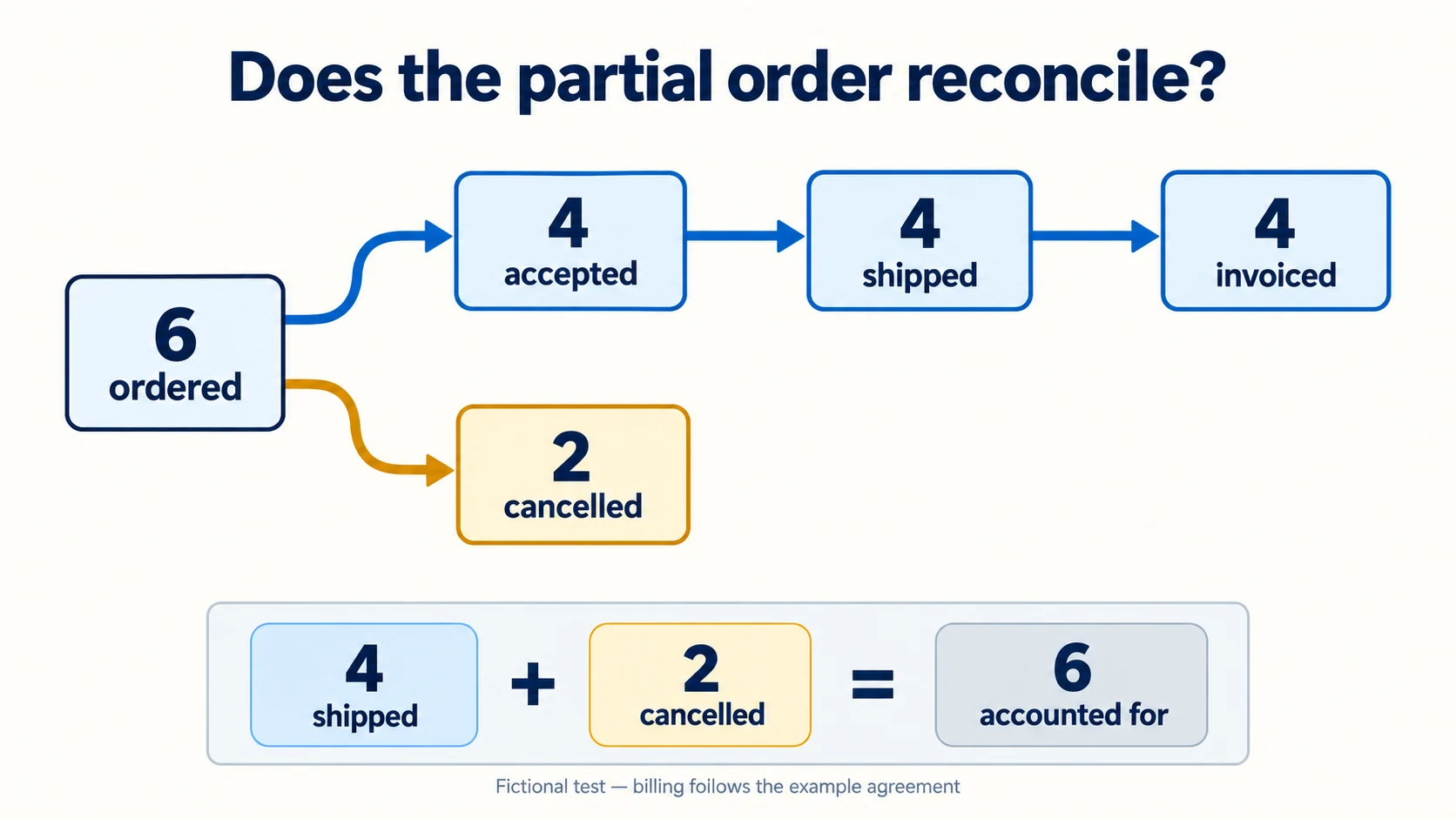
The exact acknowledgment, billing and closure rules come from your retailer agreement. The example is a proposed evaluation scenario, not an executed order, a valid API payload or a universal invoice rule.
Make the failure visible, then verify the correction
In the pilot, identify which screen, event or record exposes a missing cancellation and who receives the exception. After correcting it through the approved process, reopen the retailer and supplier views and compare the quantities again. Ensure the correction did not create another order or invoice.
Also test the wrong SKU, an unavailable item and the program’s required return or cancellation case. Keep the actual results with the partner’s approval. “The file was accepted” does not show that all those business outcomes were correct.
05
Check stock and routing separately from delivery of messages
A platform can transmit an order successfully while using inventory that no longer supports it. Establish what each supplier’s quantity means, when it was observed and how accepted orders affect it.
The same applies to choosing a supplier. Logicbroker documents an optional cost-based sourcing workflow that considers available suppliers, their latest inventory, costs and a compactness measure, and requires setup on the account.
Ask what the routing rule actually optimizes
That feature description does not establish a universal lowest landed cost for every order. A lower item cost and fewer supplier splits are useful inputs, but your intended policy may also need destination service, shipping charges, delivery promises or exclusions.
Bring a real proposed decision to the demonstration: which supplier should receive this order under your policy, why was it chosen, and what happens if its stock or delivery eligibility changes? Agree on the supported inputs and fallback rather than assuming the word automated covers them all.
If an AI-assisted action is part of the proposed service, ask for the same evidence: input, proposed action, permitted scope, exception handling and the resulting system record. A marketing dashboard is not a test of your supplier scenario.
Shipment information also needs careful interpretation. A recorded shipment or completed document flow does not establish that the customer has physically received the parcel. Use the applicable carrier and delivery records for that later event.
06
Build the business case from work that actually disappears
Obtain a quote for the retailer or supplier arrangement you actually need. Include platform charges, implementation, mapping, internal effort and ongoing exception handling. A supplier connection’s published terms do not price the retailer’s entire program.
The vendor’s Microsoft Marketplace listing describes an annual-contract model, but no negotiated price was available for this review. Do not fill that gap with a directory’s per-user estimate or reuse another company’s historical study result as your forecast.
Use net saved time, not gross automated time
The following USD calculation is wholly hypothetical. It is not Logicbroker pricing or a measured time-saving result:
- Assumed first-year platform, setup and additional fixed support cost: $30,000 in total.
- Previous manual work: 4 minutes per order.
- Work remaining after the proposed change: 1.5 minutes per order.
- Net time saved: 2.5 minutes per order.
- Assumed value of staff time: $30 per hour.
In this example, the $30,000 excludes the per-order handling already represented by the remaining 1.5 minutes. Count that work once; adding it again as a separate cost would double-count it.
The modeled time value saved per order is 2.5 ÷ 60 × $30 = $1.25. Dividing $30,000 by $1.25 gives an arithmetic break-even of 24,000 orders in the first year, equivalent to 2,000 per month if volume is even.
That is why the manual gaps in the connection matrix matter. If the actual net saving is only one minute at the same hourly assumption, the value falls to $0.50 per order and the modeled threshold becomes 60,000 orders per year.
Check what the saved capacity is worth
Saving staff time does not automatically reduce payroll by that amount. It may create capacity, prevent additional hiring or let staff work on other tasks. Decide which effect is realistic for your business before treating the modeled time value as cash savings.
Error reduction and improved service may add value, but estimate them from your own evidence and avoid counting the same saved work twice. Compare first-year and later-year costs separately when implementation is a one-time expense.
The practical decision is whether the actual contract and pilot results support your program. A vendor case study or an impressive network statistic cannot supply your order volume, partner exceptions or retained staffing requirement.
07
Frequently asked questions
Do suppliers have to pay for Logicbroker?
The public connection guide lists standard portal, API and EDI options as free for suppliers. That does not make every advanced connection, third-party implementation or retailer platform contract free. Follow the specific retailer program and obtain the applicable commercial terms.
Does the Shopify connection automate everything?
No universal all-functions promise is supported. The connection guide identifies manual tasks and says retailer support varies. The Joy guide supplies a concrete partial-cancellation example. Build the required-document matrix for your actual partner instead of relying on the Shopify logo alone.
Do I have to use EDI?
The documented options include other methods, but your retailer and required workflow determine what is acceptable. API connectivity still requires correct business data and testing; a portal option still requires someone to perform the work.
Does Logicbroker supply and pack the products for me?
Its documented integration role connects trading partners and their data. Identify the actual product supplier or warehouse and its physical responsibilities separately. Access to a connection network is not evidence that every partner will sell to you or that every product meets your requirements.
If you need a China-side product and packing operation to connect to a retailer’s requirements, contact AIDrop Agent with the product, destination and required handoffs. We can assess that physical work and its proposed data handoff separately. We do not claim a certified Logicbroker connection or retail-partner approval from this article.
What should I require before signing or expanding the rollout?
Require the applicable partner/document coverage, scoped commercial offer, a representative pilot with exception results and named owners for remaining tasks. Use those results to update the cost case. An automatically generated document is useful only when it accurately represents the intended order outcome.
Sources and scope
Sources checked October 26, 2026: linked primary Logicbroker support and retailer-specific guides, public API material and provider pricing-model context. Named retailer examples retain their scope. There was no private account, negotiated quote or live platform test. PO-DEMO-6 and all business-case inputs are illustrative; no measured onboarding speed, supplier quality, AI performance, star rating or ROI is claimed.
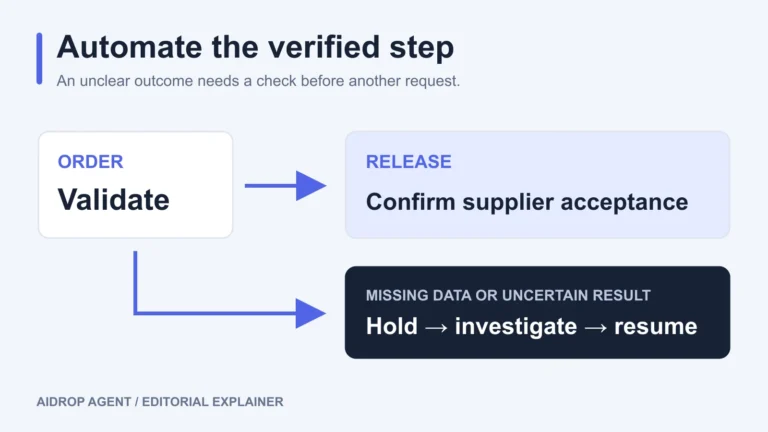
Automated Dropshipping Fulfillment: Setup, Holds, and Recovery
Set up automated dropshipping fulfillment with product mapping, release rules, supplier acknowledgments, holds and safe recovery after
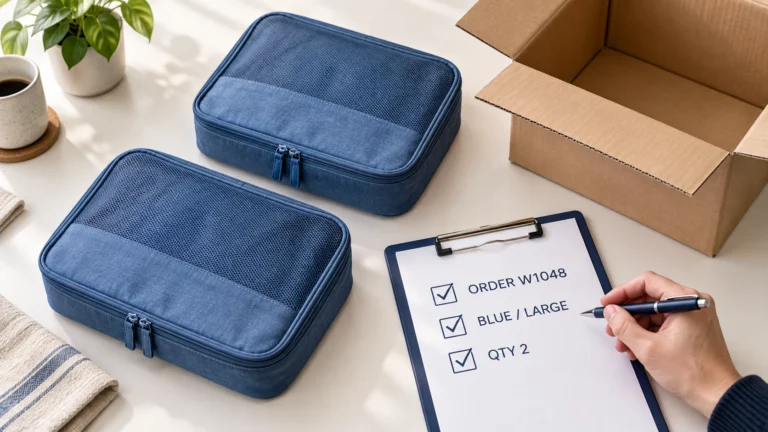
Dropshipping Order Release Checklist: From Hold to Supplier Acceptance
Release a dropshipping order only after its payment terms, risk review, exact items, delivery details, stock, supplier
Dropshipping SKU Mapping: Make Every Store Variant Reach the Right Item
A variant-level mapping and controlled order stop the wrong color, size or pack from reaching buyers.
