

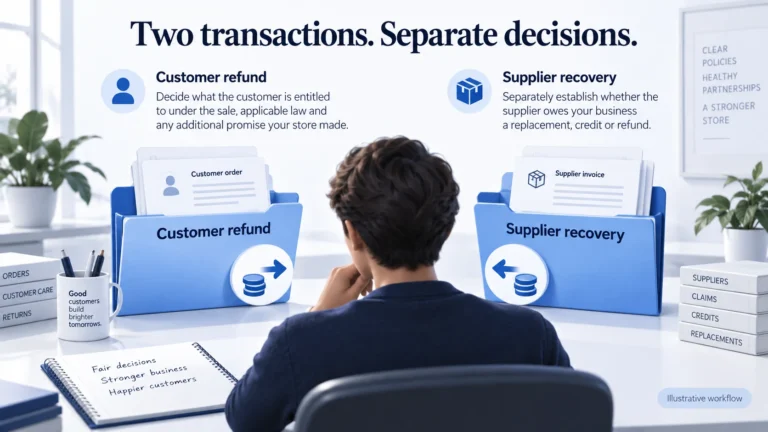
Dropshipping returns start with your store, even when a supplier shipped the product. Check what the customer is requesting, establish the applicable rights and sale terms, agree on a remedy, arrange any physical return, and issue the refund when it is due. Pursue eligible reimbursement from the supplier separately.
The customer refund, the returned item, and the supplier credit can move at different speeds. Keeping them separate prevents a common problem: a customer waiting for money because your supplier has not answered a claim that belongs to your business.
Explore the broader topic: Dropshipping Fulfillment: From Paid Order to Delivered Parcel.
Explore this topic
- Dropshipping Refund Policy: Write What Your Supply Chain Can Support
- Dropshipping Warranties: Verify the Promise Before You List It
- Dropshipping RMA Workflow: Keep the Return, Supplier and Refund in One Case
- Dropshipping Replacement Orders: Send the Correct Item Once and Close the Original Case
- Dropshipping Shipping Damage Claims: Save the Parcel Evidence Before It Disappears
- Returnless Refunds in Dropshipping: When Sending the Item Back Makes No Sense
01
Identify what the customer needs before sending a return label
Find the order, the affected item and quantity, the delivery date if known, and the date the customer contacted you. Read the request before choosing a reason code. “I want a refund” can describe a damaged product, a change of mind, or a parcel that never arrived.
| Customer’s situation | What to establish | Practical next step |
|---|---|---|
| The item arrived, but they changed their mind | Applicable withdrawal rights and the terms offered at purchase | Explain the available return or other remedy and any lawful return charges. |
| The item is wrong, damaged, or does not work as described | Which item is affected and what differs from the order or description | Gather useful evidence and determine the appropriate remedy. |
| The item has not arrived | Which parcel contains it and the last confirmed shipment event | Investigate delivery and address the customer remedy; there is nothing for them to send back yet. |
| The customer wants to cancel before dispatch | Whether the fulfillment provider can still stop the shipment | Seek confirmation of the stop and handle cancellation; a store status change alone does not confirm the parcel was stopped. |
For a mismatch or damage report, a clear photo of the item and its label may answer the question quickly. Ask for the evidence needed for that issue. Do not turn a supplier’s preferred claim paperwork into an automatic requirement for every customer request, particularly where the customer has a right to withdraw without giving a reason.
If the problem is non-delivery, use the dropshipping tracking guide to investigate the parcel. A return-to-sender event also needs investigation: it does not tell you by itself that the original supplier has received and credited the goods.
02
Separate customer rights from supplier return terms
Your customer bought from your store. Your supplier agreement determines what you may recover upstream; it does not, by itself, determine what you owe the customer. A supplier refusing change-of-mind returns can leave you funding a customer remedy that is still required by applicable law or the terms you offered.
Two jurisdiction examples show why copying a generic return window is unreliable:
EU consumer purchases from professional traders:
- For eligible distance purchases, consumers generally have 14 days after receiving goods to notify the trader that they are withdrawing, without giving a reason. Product exceptions apply, including clearly personalized goods.
- For change-of-mind returns, the consumer generally pays return costs if informed before purchase, unless the seller agrees to pay. Defective-product return costs belong to the trader.
Check the relevant national rules and the circumstances of the sale. Your Europe’s withdrawal guidance
Faulty goods are a separate issue from changing one’s mind.
- EU rules provide a minimum two-year legal guarantee, with repair or replacement at no cost and a full or partial refund where the required conditions are met—for example, where repair or replacement is impossible or cannot be provided within a reasonable time without significant inconvenience.
- National rules can provide additional protection. Do not treat the end of a voluntary return window as the end of these rights.
Your Europe’s legal guarantee guidance
US online purchases: The FTC’s federal three-day Cooling-Off Rule does not cover sales made entirely online.
- That exclusion does not mean an online store has no refund obligations.
- Check applicable state rules, the product and problem involved, your sale terms, and any marketplace requirements rather than borrowing the three-day rule. The FTC’s explanation of its Cooling-Off Rule
Record the basis for the remedy and the relevant deadline in the case. Where the applicable rule is unclear, have the person responsible for that market resolve it promptly.
Waiting for a supplier credit is not a substitute for determining and meeting the customer’s entitlement.
03
Choose a return destination that can actually receive the item
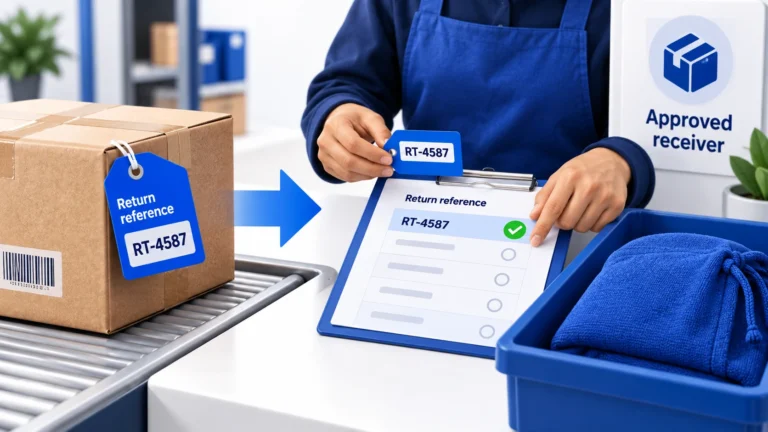
An address printed on the outbound parcel may be a shipping intermediary or a dispatch location that does not process customer returns. Confirm the receiving arrangement before telling the customer where to send anything.
Return to an authorized supplier location.
- Obtain the exact address, receiving contact, accepted items, and any required return merchandise authorization number, usually called an RMA.
- Match the authorization to the customer’s item and your supplier order.
An RMA helps the receiver identify and process a return; it is not evidence that a refund has already been paid. Shopify’s RMA explanation
Use a contracted local return facility.
A destination-country warehouse can be useful when local inspection, resale, or consolidation is worthwhile. It must agree to receive this product and provide the handling you need.
- Confirm inspection, storage, onward shipping, disposal, and charges before publishing its address.
- A warehouse willing to receive a parcel is not necessarily authorized to decide the customer’s refund.
Approve a remedy without a physical return.
Where appropriate and lawful, a refund or replacement without return can avoid spending more on transport and handling than the item can recover.
- Document the decision and tell the customer clearly that they do not need to send it back.
- Safety reports require suitable product-specific handling; do not casually tell someone to use, donate, or mail an item that may be unsafe.
Choose the destination before asking the customer to ship anything. Compare the expected recovery with the actual return transport, handling, and storage costs, while honoring the customer’s rights. If the supplier will not receive the parcel and you have no agreed local receiver, resolve that gap or approve another suitable remedy. Sending the customer an unusable address only creates another problem.

The returns and exceptions service explains how customer remedies, physical destinations, and recovery responsibilities can be coordinated. A particular address, handling service, or cost allocation still needs to be agreed for your operation.
04
Give the customer one clear set of instructions
- Explain which item the remedy covers, whether it must be returned, the approved destination, how to use the label or arrange postage, and who pays.
- Include any valid reference and packing instructions needed for receipt.
- Make the return and refund timing clear under the applicable rules and terms.
If you are offering an exchange, confirm that the replacement is available and that the customer wants it. A partial refund or store credit should be a valid, agreed option, not a way to pressure the customer out of a refund they are entitled to receive.
Make the next action yours to follow through.
- If the label does not work or the receiver refuses delivery, the customer should have a route back to your team rather than being left to negotiate with an unfamiliar supplier.
- Give a specific follow-up time that your team can meet whenever part of the arrangement remains unresolved.
For Shopify, you can upload an existing return label or create a return without shipping information.
The built-in option to create a return shipping label is available only when both the primary location and the customer’s shipping address are in the United States.
Check the actual options for your route instead of assuming the store can generate a label for every cross-border return. Shopify’s return creation documentation
05
Verify the refund separately from the return
An approved return is not a completed refund.
For an eligible EU consumer withdrawal from a distance sale of goods, the refund clock starts when you are informed of the withdrawal. Reimburse without unnecessary delay and within 14 days. Unless you offered to collect the goods yourself, you may withhold reimbursement until the goods return or the customer supplies evidence of sending them back, whichever happens first. Do not automatically wait for warehouse inspection after that evidence arrives. Article 13 of the Consumer Rights Directive sets those conditions.
The reimbursement includes the original delivery charge up to the least expensive standard delivery you offered; an expressly chosen express-service premium need not be repaid. Your Europe’s seller guidance explains this distinction. These are withdrawal rules, not a universal deadline for every refund. Faulty-goods remedies follow their separate applicable rules. Record which basis applies before setting the amount and due date.
- Check the item quantities, amount paid after discounts, shipping or other amounts that must be reimbursed, and any earlier partial refunds.
- Use the applicable deadline rather than inventing a standard wait for all orders.
- Shopify allows refunds without creating a return, but its documentation says you cannot create a return after issuing the refund. If you need that return record, create it first.
- Review the payment route carefully: some methods cannot be refunded to the original payment method, and a refund initiated in Shopify cannot be canceled or reversed. Shopify’s refund documentation
Keep the refund reference and check the transaction result.
- If it is pending or failed, follow the payment provider’s instructions and update the customer.
- “Refund issued” does not establish that the funds have appeared in the customer’s bank account.
- Avoid submitting another refund simply because the first one is not yet visible to them.
Also check the inventory action. A refund should not make an item available for sale when it is still with the customer or has not passed the required inspection. Your payment record and physical stock record need to reflect what actually happened.
Complete the Shopify refund without changing stock by mistake
For a Shopify order, the current refund instructions give this practical sequence. Arrange any required return record first; these steps are an instruction, not an account action performed here.
- Open the right payment: go to Orders, open the customer order and select Refund. Confirm the affected item quantities, earlier refunds, discounts and any shipping amount owed under the applicable remedy.
- Choose the amount and method: inspect the Summary and refund method before confirming. Original payment and store credit are different outcomes. If credit was issued earlier, sending another refund does not automatically remove that credit.
- Keep physical stock accurate: deselect Restock items when the goods remain with the customer or have not passed the required inspection. Check the actual availability of this control for the order’s inventory setup.
- Confirm once, then check: submit the agreed refund and save its reference, amount and payment result. Investigate pending or failed transactions through the provider; do not send a second refund just because the customer’s bank has not displayed the first.
06
A customer refund can be issued while a supplier claim stays open
Consider this fictional example, using illustrative USD amounts. A customer paid $45 for a navy tote and received a green one. Their photo and the order detail confirm the mismatch. The store approves a full returnless refund as a commercial resolution; the customer does not need to send the tote anywhere. The store originally paid the supplier $18 for the item and requests that amount back under its supplier agreement.
The customer refund and supplier claim have different completion evidence. At this point, the store’s records could read:

Customer handling
- Affected item: one tote, wrong color.
- Agreed remedy: $45 refund; no physical return required.
- Payment action: refund issued, transaction reference recorded; any pending or failed payment still needs follow-up.
- Customer message: the amount, payment method, and no-return instruction have been sent.
Supplier recovery
- Requested credit: $18, linked to the supplier order.
- Supporting material: ordered color, received color, photo, and the relevant supplier terms.
- Current result: claim submitted; credit not yet received.
- Next action: follow up with the supplier and record acceptance, rejection, or the actual credit.
Those figures are examples, not AIDrop Agent fees or recommended refund thresholds. The $18 claim may be rejected or settled differently. It should not be recorded as money recovered merely because someone requested it, and the $45 customer refund does not disappear if the supplier refuses to pay.
Once the refund has actually been issued, a message for this example could say:
We confirmed that you received the wrong tote color and have issued a $45 refund to your original payment method. You do not need to return the tote. Your payment provider may take time to show the refund; please contact us if it does not appear within the processing period shown in your refund confirmation.
Use that wording only when the amount, payment method, and processing information match the real transaction. The customer does not need to wait for a discussion about your $18 supplier claim.
- If a supplier requires an item for inspection, determine whether that is a workable recovery option before authorizing disposal or telling the customer to keep it.
- If you choose a returnless customer remedy anyway, record that this may reduce your ability to recover supplier costs.
The customer’s rights and the economics of your supplier claim still need separate decisions.
07
Close the physical and financial work, then address the cause
For an item that comes back, record where it arrived, what inspection found, and whether it will be restocked, repaired, consolidated, returned upstream, or disposed of appropriately.
A delivery scan at the return address does not establish that the item is fit to resell.
Record the actual customer refund, return transport and handling charges, replacement costs if any, and supplier credits received. Keep requested credits distinguishable from completed recoveries. The dropshipping profit margin calculation shows why refunded revenue and additional return expenses need separate treatment when assessing the effect on profit.
Finally, use the reason for the return to change something specific.
- Repeated wrong colors call for checking the supplier’s variant mapping and picking instructions.
- Repeated size disappointment may require better measurements or product information.
- Repeated transit damage calls for reviewing packing and the affected shipment evidence.
The dropshipping risk management guide covers how to turn that pattern into a preventive control.
08
Frequently asked questions
Do dropshipping returns always go back to China?
No. The appropriate destination may be an authorized supplier address, an agreed local facility, or no physical return at all. Confirm the receiver and the handling arrangement for the particular item. Its original shipping country does not settle the return decision.
What if the supplier refuses to refund me?
Review the reason, evidence, and supplier agreement, and pursue any available claim or dispute route. Continue meeting your separate customer obligations. A refused supplier claim may become a cost your business bears; it does not automatically justify withdrawing the customer’s agreed or legally required remedy.
Who pays for return shipping?
It depends on the applicable rights, reason for return, and valid terms of sale. For EU consumer purchases covered by the rules described above, defective-product return costs fall on the trader; eligible change-of-mind returns generally fall on the informed consumer unless the seller pays. Determine the answer for the actual case before issuing instructions, and separately establish whether your supplier will reimburse you.
Dropshipping Return Address: Choose the Destination Before You Instruct the Customer
Choose a workable dropshipping return address, confirm receiver approval, compare costs, and track returned goods without confusing

Damaged Items in Dropshipping: Evidence, Customer Remedy and Supplier Recovery
Handle damaged dropshipping items with useful evidence, a clear customer remedy, separate supplier claims, and controls that
Dropshipping Refund Policy: Write What Your Supply Chain Can Support
Write a dropshipping refund policy covering customer rights, return costs, addresses and refund timing, with practical market-specific
