
A dropshipping partial refund pays back the failed part of an order. Use what the buyer actually paid for that line, including the relevant discount and tax. Confirm shipping and the chosen remedy separately. Then check the payment destination and supplier claim.
The refund-policy guide covers what a store promises before purchase. This page is the calculation and order record after one item is damaged, missing or not delivered. The order may contain products from two suppliers, so “refund half the total” is often wrong even when one of two items has a problem.
Explore the broader topic: Dropshipping Returns: From Request to Refund.
01
Work from the paid order, not the product page today
Find the strap’s discounted paid value
Suppose an illustrative customer order contains a canvas tote listed at $40 and a detachable strap listed at $20. The store applied a $6 order discount, allocated here as $4 to the canvas tote and $2 to the detachable strap. The buyer paid $54 for goods, $5 shipping and, under this hypothetical tax setup, $4.32 tax. Total payment is $63.32. A damaged detachable strap does not automatically mean the customer receives $31.66. The detachable strap’s paid merchandise value in this example is $18, not its current catalog price and not half the whole order.

| Original order component | Canvas tote | Detachable strap | Total |
|---|---|---|---|
| Listed item price | $40 | $20 | $60 |
| Illustrative discount allocation | −$4 | −$2 | −$6 |
| Paid merchandise value | $36 | $18 | $54 |
| Example tax at 8% on merchandise | $2.88 | $1.44 | $4.32 |
| Customer shipping payment | — | — | $5 |
Use the transaction’s tax allocation
If the customer returns the damaged detachable strap and receives its merchandise and associated tax back under the real transaction’s rules, the example refund is $18 + $1.44 = $19.44. If the supplier also failed to deliver the canvas tote, shipping and other line amounts may need different treatment. The 8% and allocation above are merely arithmetic assumptions; tax, discount and shipping refunds depend on the sale, market and platform record. Use what the actual checkout stored, then check the applicable obligations.
Preview the affected line before submitting
Shopify’s current refunding-orders guidance allows a partial order refund and describes several platform-specific details. For example, applying a discount from the refund screen can affect the full quantity of a line item, and a gift-card payment can alter how a refund is applied. Do not click through a refund screen by treating its suggested amount as a universal formula. Preview the order’s final amount and payment destination before committing.
Refund the strap, not the whole tote order
For the $63.32 teaching order, the strap’s stored discounted price is $18 and its example tax is $1.44. That makes $19.44 before any separately owed shipping or other remedy. The 8% tax assumption is not a rule for your market.
Set only the affected quantity
In Orders → this order → Refund, set strap quantity to 1 and tote to 0. Preview the amount against the stored line allocation. Do not add another $2 discount: it is already included in the $18. Review shipping separately, following Shopify’s refund controls.
Check stock and payment
Deselect Restock items if the damaged strap is still with the buyer and cannot be sold. Review the suggested split across original payment methods; mixed gift-card orders may allocate to the gift card first. Confirm the actual available amounts and notification before submitting once.
If a physical return is part of the resolution, create it before refunding: Shopify cannot create a return for already-refunded items. Its refund-reason note is not the return-reason reporting field. Refunding an unfulfilled line also removes that line from fulfillment; keep the unaffected tote’s route intact.
Before issuing more money, reconcile the original charge, earlier refunds and any refund already initiated or pending. Check the provider’s available amount for each payment method. A pending attempt is not permission to pay the same $19.44 again; first find its status and reference.
Check each payment destination
For a store that accepts mixed payment methods, check the refund destination as carefully as the amount. A customer may have paid partly by gift card or store credit. The platform and provider can route the reversal according to the original tender and their rules. Your email should state the amount and expected channel shown by the actual transaction; avoid promising “back to the card” when that is not what the refund screen will do.
02
Decide what happens to the item before you close the case
Choose return, keep or replacement first
The right amount depends partly on the remedy. A broken detachable strap that the customer discards after you approve a refund is a different case from a usable detachable strap that the customer keeps in exchange for an agreed price reduction. A replacement may solve the problem without a merchandise refund, but it creates a new supplier cost, parcel and tracking number. Keep the customer-facing choice and supplier recovery separate.
Give the failed line its own case
Record the failed order line, quantity, exact variant, photos or other relevant evidence, supplier status, remedy chosen, buyer refund or replacement amount, return destination if any, and next update time. Do not ask for unnecessary evidence just to delay a legitimate resolution. The RMA workflow explains how to track the physical item, buyer remedy and supplier credit in one case; the partial-refund calculation here is the money component.
One item missing from a split shipment
Treat the strap’s tracking separately
If the canvas tote arrives but the detachable strap’s parcel has not, do not refund the detachable strap merely because the first tracking number says delivered. Check the detachable strap’s own parcel ID and last reliable carrier event. If it is only delayed, give a supported update. If it is confirmed lost or the delivery obligation can no longer be met, calculate the detachable strap remedy from its actual paid line and relevant shipping/tax rules. The split-shipments guide shows why one order can have two separate parcel states.
Refund the confirmed missing line
For the illustrative $63.32 order, suppose the detachable strap is confirmed undeliverable and the canvas tote arrived. The store may owe the detachable strap’s paid value and related tax, but whether any or all of the $5 customer shipping charge is also refunded depends on the original checkout and applicable policy or law. Write the decision and source in the case record; do not silently allocate shipping after a complaint because one supplier will not credit it.
Explain the shipping decision
If the buyer paid one $5 delivery charge for both items, compare the promise they actually bought with the outcome. Did the tote still arrive under the promised service, or did the failed strap consume a separately charged premium route? Those facts can change the shipping remedy. Put the decision in a line the customer can understand: “We refunded the missing strap’s paid item value and associated tax; the tote arrived on the delivery service you purchased, so the original shared shipping charge remains” only if that is consistent with the store’s policy and applicable rules. If the entire delivery promise failed, review the shipping charge again. The point is to explain the amount from the order, not from a supplier’s willingness to credit freight.
03
Put buyer cash and supplier recovery on different lines
Separate buyer money and supplier credit
Suppose the store refunds the example $19.44 to the buyer today. The detachable strap supplier later agrees to credit $9 for the item but not the original freight. The store has two separate entries: buyer refund $19.44 and supplier credit $9, with their own dates and references. Net recovery is not a $10.44 “refund”; the customer received $19.44, while the merchant recovered only part of its cost. Payment fees, tax, return shipping and any replacement expense must also be reconciled.
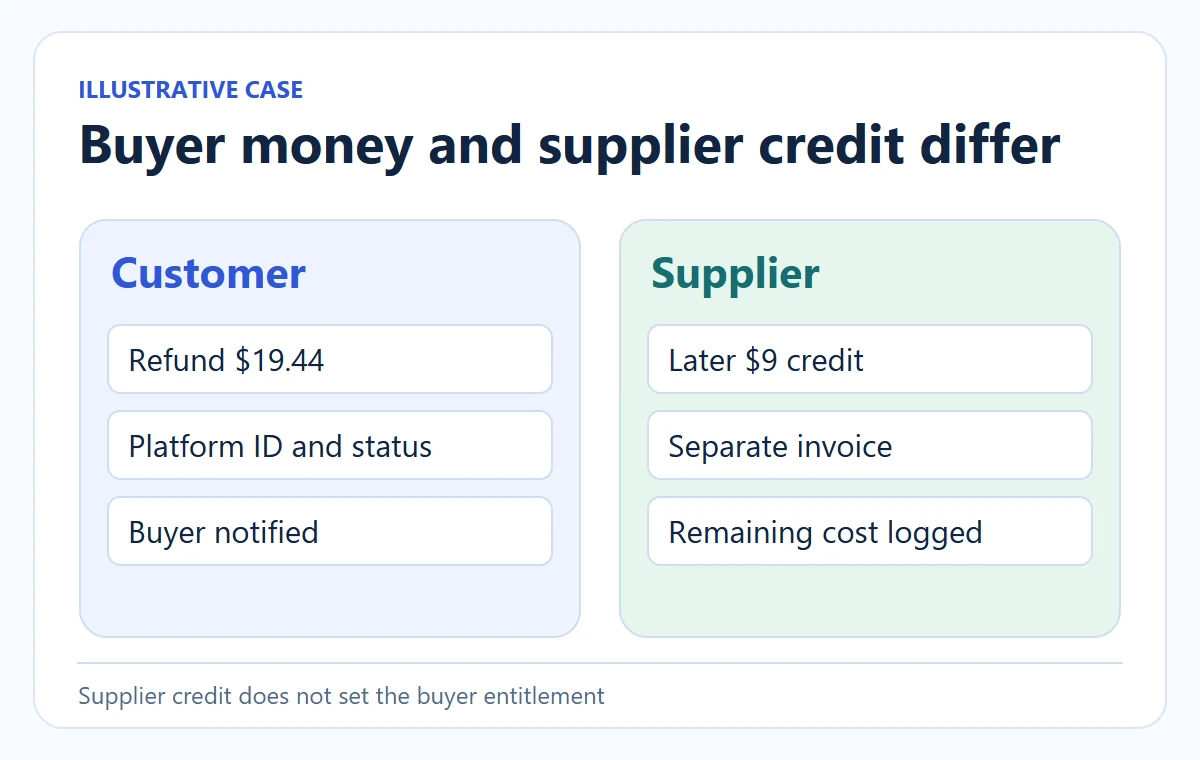
| Case event | Buyer ledger | Supplier ledger |
|---|---|---|
| Original detachable strap sale within order | Customer paid $18 merchandise plus example tax | Store incurred supplier item/parcel cost under its quote |
| Buyer remedy approved (not payment sent) | Proposed refund $19.44; payment not yet sent | Ask supplier for credit or replacement authorization |
| Supplier response a week later | No new buyer refund simply because supplier replied | $9 item credit recorded when actually issued |
| Case closure | Confirm buyer sees the refund and understands any parcel action | Match credit to supplier invoice and note unrecovered cost |
Do not substitute supplier recovery for the remedy
Do not show a customer the supplier’s $9 credit as if it were the amount they were entitled to receive. Similarly, a promise from the supplier is not a bank settlement. Track the reference number and actual posted credit before closing the finance side of the case. The dropshipping accounting guide covers the wider order-to-ledger reconciliation.
04
Check the platform's remaining refundable balance
Compare the final preview with the paid record
Before submitting, compare the proposed refund with the original payment, prior refunds, discounts, shipping and tax allocations. Shopify says additional partial refunds can be issued up to the order’s available refundable amount. Its guidance also warns that prior store-credit refunds and payment-method splits can affect what appears in the refund screen. If the platform’s amount differs from your manual calculation, pause and find the reason; do not force a refund by adding a second discount or a manual transfer without a clear record.
Check the other line remains correct
After submission, verify four things: the order shows the intended partially refunded state, the payment provider records the right amount and destination, the buyer notification explains the actual remedy, and the supplier request has not accidentally created a second shipment. For a multi-supplier order, make sure the unaffected canvas tote remains fulfilled and the detachable strap’s return or replacement status is handled separately.
A pending refund needs a status check, not a second payment
Approval is the store’s decision. Initiation is a payment request. Provider completion and receipt at the buyer’s bank are later events. Keep the $19.44 amount attached to its original attempt ID through these stages.
Open the existing attempt
Use Orders → the order → Timeline. Record refund status, amount, original method, reference and any error. For Shopify Payments, check the balance and account notices as described in the pending-refund guidance. Do not assume a successful button click means the buyer has the funds.
Resolve and communicate
If the attempt is pending, investigate that attempt; if it failed, follow its specific cause before retrying. Tell the buyer the amount, actual destination and current status. Keep supplier credit in another record. A supplier’s promised $9 credit neither reduces $19.44 owed nor proves it reached the buyer.
For the controlled test, expect tote quantity 0 refunded, strap quantity 1, the correct tax/shipping allocation, one refund request and no sellable stock restored for the damaged strap. These are expected observations to collect, not a live refund we performed.
Use two lines, a discount and shipping
A controlled test can prevent expensive mistakes. Use a test order with two lines, a discount and shipping. Run a small supported refund in the platform’s test environment or with a safe real order, inspect the generated records, then document where tax and discounts appear. Re-test when a payment provider, app or market setting changes. The purpose is to learn the behavior of your transaction, not memorize a theoretical refund percentage.
Close the buyer side against the original paid line, approved remedy, refund ID/amount and provider status. The supplier claim can stay open as a separate finance follow-up after the buyer is made whole.
If the refund has just been initiated, write: “Your strap did not arrive. We initiated $19.44 to [actual payment method], reference [actual ID]. The tote remains delivered. Current refund status: [actual status].” Use the live amount and destination. Only confirm receipt when the record supports it; an initiated refund is not a bank deposit.
If AIDrop Agent coordinates your China-side supplier, send the affected order line, supplier invoice reference, parcel state and proposed customer remedy through the review form. We can help define the upstream evidence and credit request. The merchant still decides and communicates the buyer refund under its store and market obligations.
05
Frequently asked questions
Can I issue a partial refund while the other item is still on its way?
Often yes, if the failed line and amount are clear and the platform supports that refund. Keep the other parcel’s status separate and tell the buyer what remains to arrive. Check the actual order and payment limits before submitting.
Should I refund half the shipping charge when one of two items fails?
Not by default. Check how the customer was charged, what delivery promise was made, the reason for failure and the applicable policy or law. A 50/50 split can be arbitrary when suppliers and parcel charges differ.
Can I wait for the supplier’s credit before refunding the buyer?
Supplier recovery and buyer obligations are separate. Check the actual customer and legal timetable, then fund the remedy your store owes. Pursue and reconcile the supplier credit independently.

Dropshipping Returns: From Request to Refund
A practical guide to customer return requests, approved return destinations, accurate refunds, and supplier reimbursement that stays
Dropshipping Customer Service: Build an Order-to-Resolution Workflow
Build dropshipping support from product questions to refunds: assign owners, verify actions, set honest response targets, and

Dropshipping Customer Service Templates for Delays, Stockouts and Returns
Six customer-service replies for common dropshipping order failures, with the evidence to check and the next action
