
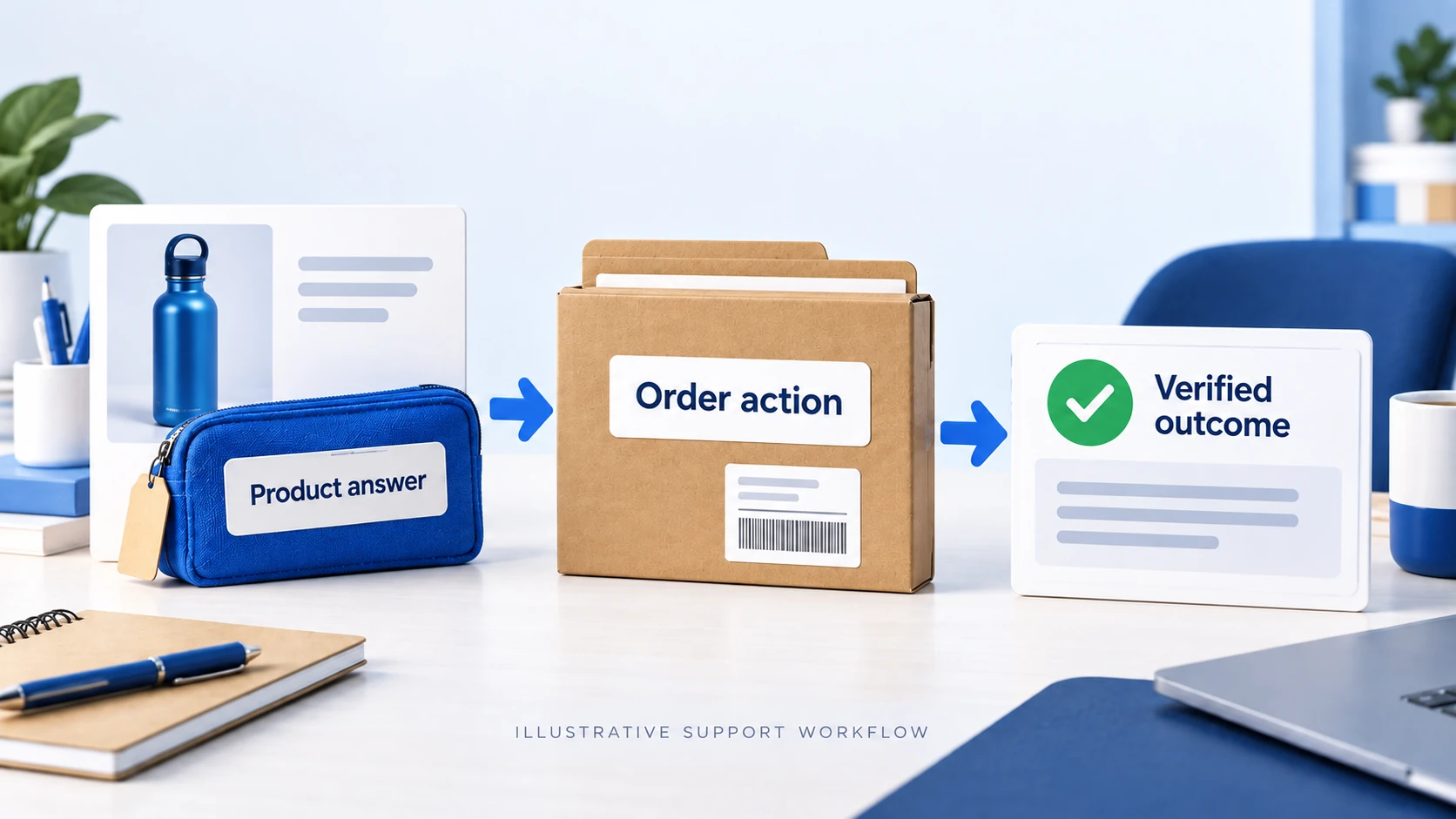
Dropshipping customer service connects the buyer’s question or problem to an accurate answer and a completed action. Before purchase, that means explaining the product and delivery offer honestly. After purchase, it means identifying the order, assigning an owner, coordinating with fulfillment and confirming that the promised refund, replacement or update actually happened.
A quick reply is useful; an unresolved promise still needs work. A store can answer every message within minutes while leaving cancellations unconfirmed and delayed parcels uninvestigated. Build the process around customer outcomes as well as response speed.
The operations section of the Dropshipping Hub connects support with the stock, fulfillment and shipping work behind it. Customer service should be able to see those handoffs and ask someone who can change them to act.
01
Define who answers, who acts and who approves
The store owns its customer conversation. The supplier may confirm availability, the warehouse may stop a parcel, the carrier may investigate transport, and a payment system may process a refund. Those roles should be explicit before an urgent case arrives.
For each common request, establish an answering owner, an operational contact and the person allowed to approve money or product changes. In a small business, one person may perform several roles. The distinction still matters because replying to a customer does not necessarily stop an automated shipment.
Use a short escalation directory containing the provider, contact channel, working hours, information required, next escalation route and who covers absences. Keep it current when suppliers or shipping accounts change. A saved contact who no longer handles that warehouse is not a usable escalation plan.
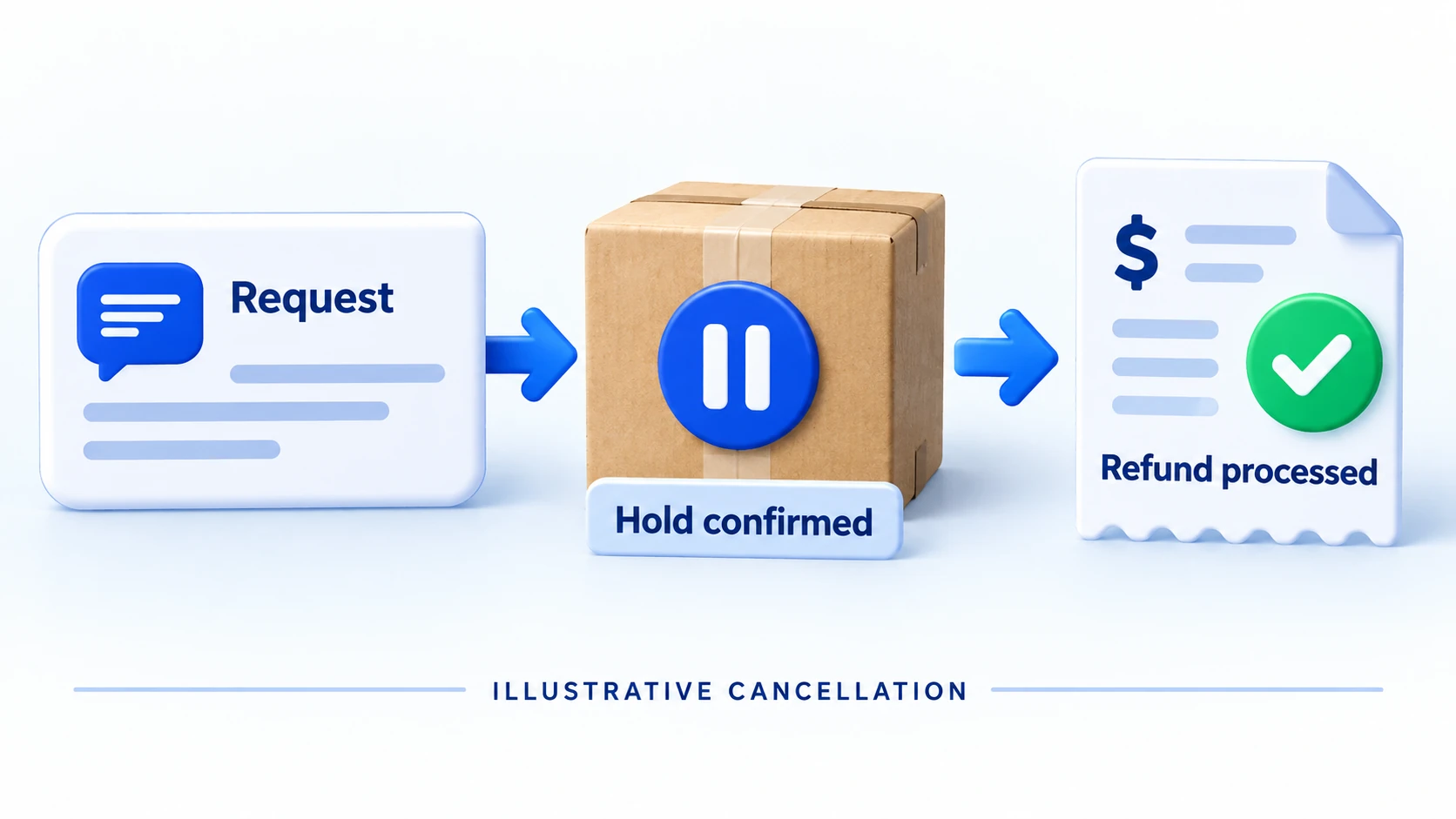
For an illustrative cancellation, support receives the request, fulfillment confirms the hold, and the authorized operator processes the applicable refund. Support then communicates the confirmed result. The response should not say “cancelled” while the fulfillment request remains active.
Agree what happens outside the provider’s working hours. If a request cannot be executed until the next shift, support should know whether an automated hold is available and what can honestly be promised in the meantime. Do not describe an unconfirmed request as a completed intervention.
02
Answer product questions before they become returns
Maintain a usable source of product facts
Give support the approved variant details, dimensions, materials, compatibility limits, included accessories and care instructions relevant to the offer. Identify which facts came from a supplier, which were checked on a sample and which remain uncertain.
An agent should be able to find the answer to “will this fit my device?” without guessing from a photograph. If compatibility is unverified, say so and obtain the exact requirement before recommending the product. An unsupported reassuring answer can create an avoidable return.
Store product facts by version or update date where changes matter. A supplier may replace an accessory, alter packaging or discontinue a color while an old saved reply continues describing it. Product and support owners should update the same approved facts.
Explain the complete buying commitment
Support should know the destination coverage, processing time, delivery estimate, shipping charge and any disclosed import arrangements. A carrier transit estimate alone may omit preparation. A delivery date that is suitable for an ordinary purchase may not meet a customer’s event deadline.
Ask about that deadline when it changes the recommendation, then answer from evidence. “It should probably arrive” is not a useful substitute for a supported service. The shipping-policy guide shows how product pages, checkout and support messages should express the same offer.
Explain product-specific restrictions before payment: customization approval, required information, unsupported destinations or a known restock wait. Keep these visible where the customer decides to buy rather than relying on a support agent to explain them later.
03
Choose channels that the team can maintain
Give customers a clear contact route and state its actual availability. Email or a helpdesk can suit detailed order problems; chat can help with product questions. Add channels because the team can respond and preserve context, not because a row of contact icons looks established.
If social messages, email and chat all reach the same team, connect conversations to one customer case. A buyer may ask the same question twice after receiving no useful answer. Merging the context should preserve the messages and deadlines, not silently discard one thread.
Shopify’s Inbox documentation describes staff-managed conversations and optional automated assistance. Its availability and first-reply settings let merchants communicate when staff are available. Configure the experience to match the operation, then test what the customer sees outside those hours.
Separate acknowledgment from a useful reply
An automatic acknowledgment can confirm that a message was received, show support hours and tell the buyer what identifier will help. It should not be counted internally as a staff member investigating the case.
A useful first reply identifies the issue, uses the information already supplied and names the next action. If more information is needed, ask for the specific missing detail. Do not send a long questionnaire to a customer whose order number and photograph already establish the problem.
Choose response targets from coverage and urgency. There is no universal target that fits a solo operator, a staffed seven-day team and a specialized technical product equally. State business hours, time zone and holiday coverage where they affect the expectation.
04
Create one record that survives a handoff
At minimum, record the customer contact, store order and affected line, issue, current verified facts, original promise, owner, next action and next update time. Add the supplier purchase, parcel or payment reference when relevant. A conversation transcript without an actionable summary makes each new agent repeat the investigation.
Use statuses that describe work accurately: new, investigating, waiting for customer information, waiting for provider, action approved, action in progress and resolved. Adapt them to your tools. The important distinction is what is still missing and who can supply it.
“Waiting for provider” should always retain a follow-up date. Otherwise it becomes a place to hide cases that are still the store’s responsibility. An agent should be able to sort all open work by the next promised update, including cases where the customer has stopped messaging.
Keep internal notes separate from customer-facing replies. A provisional diagnosis, supplier disagreement or unapproved refund proposal should not be sent as an established fact. Before replying, distinguish what you know, what you are checking and what you are now committing to do.
Verify identity in proportion to the action
Use the existing authenticated order or contact process before sharing private shipment or payment details. Apply stronger verification to sensitive changes such as redirecting a parcel or altering account information. Do not ask for complete payment-card details in a support message.
Limit staff and provider access to the information needed for their work. A warehouse may need shipping details and product instructions; it does not automatically need the customer’s entire support history. Keep sensitive documents out of broadly shared spreadsheets.
05
Prioritize requests by consequence and deadline
The newest message is not always the most urgent. A cancellation that can still stop production, an apparent product-safety issue, an account-security concern and a deadline for an applicable remedy can require attention before a routine product question.
Define escalation triggers with examples. Staff should know when they can answer from approved information, when a provider must act, and when a supervisor or qualified specialist must decide. Keep the customer informed while the case moves, without inventing the result.
Cancellation and address changes
Check the actual production or fulfillment stage. Request a hold through the party able to stop the order, then record its acknowledgment. An email to a supplier is a request; it is not proof that the warehouse stopped packing.
If an address change is possible, verify the new destination’s eligibility and any applicable charge before approving the change. Confirm which record was updated so a label is not generated from the old address. If handoff already occurred, explain the available carrier options and relevant customer rights accurately.
Stockouts and delayed dispatch
Establish the exact variant, allocation and realistic next step. Offer the appropriate wait, alternative or cancellation route based on what can actually be fulfilled. Do not replace the product without any necessary agreement.
For covered US sales, the FTC prompt-delivery rules address shipment promises and required delay handling. Keep the relevant market procedure in the support knowledge base; a friendly apology alone may not satisfy the actual requirements.
The out-of-stock workflow connects customer choices with purchasing and storefront changes. Support should know which paid orders are affected before telling everyone that the whole product is unavailable.
Delivery questions and apparently lost parcels
Read the last reliable carrier event and match it to the affected items. Distinguish a label, physical acceptance, a transit exception, a collection notice and receipt disputed after a delivered scan. Sending the tracking URL again is useful only if it answers the question.
When the evidence no longer supports a delivery expectation, open the relevant trace and decide the customer’s next option. The lost-package guide separates investigation from replacement, refund and commercial recovery.
Damage, wrong items and returns
Identify the condition and quantity affected, request proportionate evidence and arrange the applicable remedy. Treat safety concerns differently from cosmetic issues. Do not ask customers to perform unsafe tests merely to satisfy a template.
Use the damaged-item workflow for evidence and recovery, and confirm an authorized return address before instructing the customer to ship. A supplier’s address on the original label does not establish return acceptance.
Regional consumer rights can differ from the supplier’s commercial policy. UK government returns guidance illustrates why faulty goods and change-of-mind requests should not be compressed into one rule. Maintain the appropriate procedure for the markets actually served.
06
Write replies that lead to a decision
A useful message has four elements: the specific issue, the facts relevant now, the action or options, and the next update. The tone should be direct and considerate. Avoid making the buyer interpret internal logistics terminology or negotiate with your supplier.
For an unresolved delivery enquiry, an adaptable reply might say: “We have confirmed [last reliable event]. We are checking [specific missing information] with [responsible party]. Your available options are [verified options]. We will update you by [date/time], even if the investigation is still open.” Replace every field with the case’s actual information.
For a confirmed refund, state the amount and the payment action completed. For a requested refund awaiting approval, say it is being reviewed and give the next step. Those messages should not use the same “all sorted” ending.
Use saved replies as drafts
Create short templates for recurring cases, with fields that force the agent to insert the relevant facts. Review them after policy or provider changes. A template that still promises a retired shipping service is a systematic error, not a one-off typo.
Remove unnecessary paragraphs before sending. A customer asking for a corrected address does not need the full return policy. If a limitation changes the decision, explain that limitation and the practical alternative in the same reply.
Do not make a refund, remedy or escalation conditional on deleting a review or giving positive feedback. Resolve the underlying case on its merits. Feedback can inform quality improvement after the customer action is complete.
07
Give automation clear limits
Automation can acknowledge messages, surface approved facts, attach tracking information, assign a queue and remind staff of overdue work. It is most useful when the input and allowed action are defined. A missing or conflicting order state should be routed for review.
For AI-assisted replies, supply current approved product and policy information and restrict sensitive actions. Test unsupported claims, ambiguous delivery dates, requests for another customer’s information and conflicting instructions. Review whether the system says it does not know when the source is incomplete.
Do not let a generated reply declare a refund complete, promise a guaranteed date or approve a substitution merely because those words fit a familiar conversation. Bind action statements to verified system results. If the tool only drafted a message, it should not imply that it changed the order.
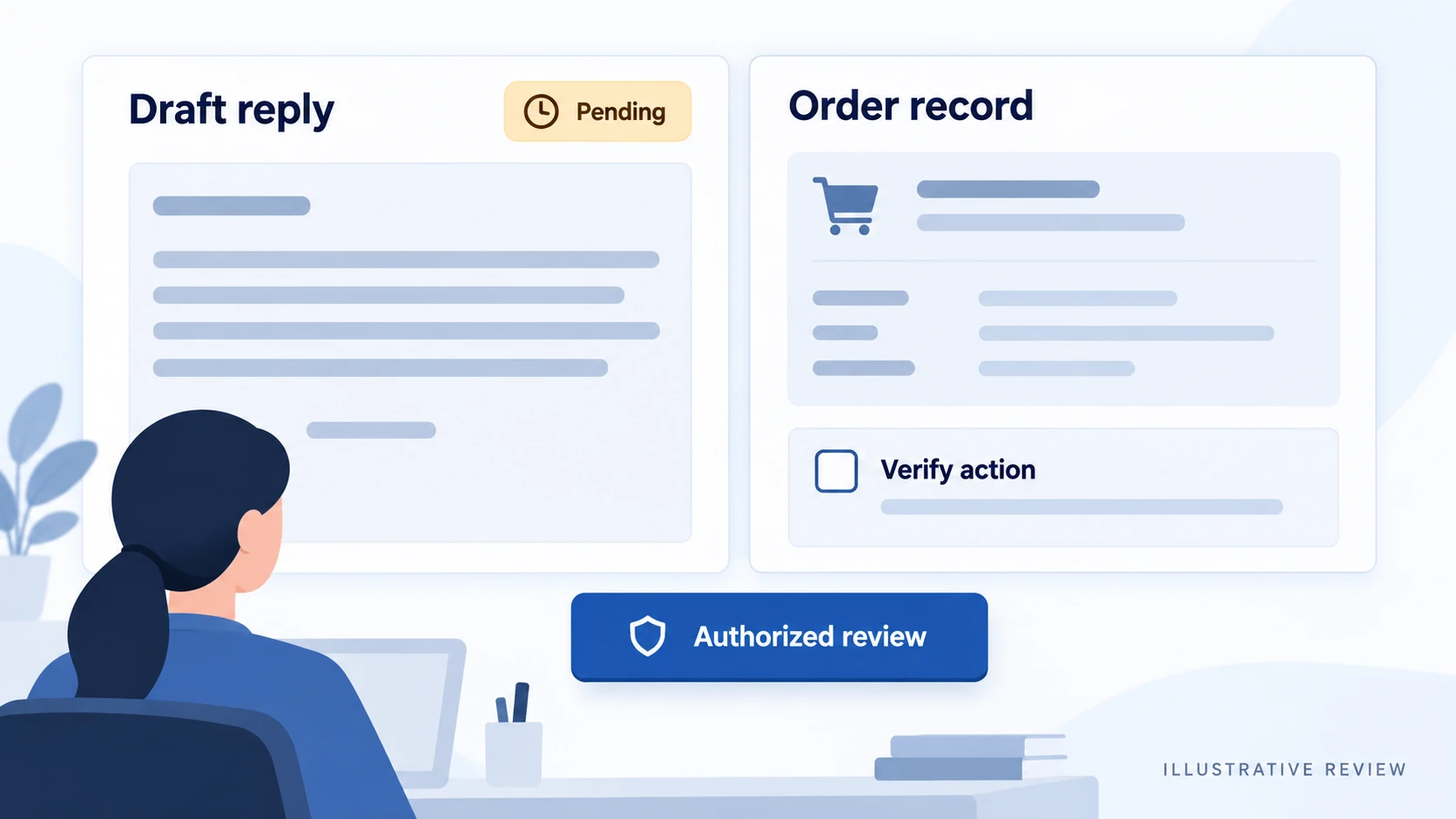
An illustrative support screen can show a draft reply beside an order record and an approval control. The draft remains pending until the authorized operator verifies the proposed action. That separation prevents a fluent answer from being mistaken for an executed refund or cancellation.
Keep a handoff route to a person and review escalations. If the same question repeatedly receives an uncertain automated answer, repair the underlying information or route it differently. Adding more promotional language does not fix a missing product fact.
08
Estimate staffing from the work, not order volume alone
Order count is an input, but contact frequency, complexity, channels and provider delays affect the workload. Separate active handling time from elapsed resolution time. A case waiting two days for a carrier may require little active work during that interval but still needs tracking and follow-up.
For a hypothetical daily plan, assume 60 new cases and an average of eight minutes of active handling per case. That is 480 minutes, or eight hours, before work on older cases, breaks, coaching, meetings or other duties. If older-case follow-ups require another two hours, the active workload is ten hours.
If each scheduled agent contributes five hours of available case-handling time in that day, two such agents provide ten hours. This simplified calculation has no spare capacity for uneven arrivals or unexpected incidents. It is not a universal staffing ratio or a claim that two agents can cover every support schedule.
Review when contacts arrive and when suppliers can answer. A team with enough total hours can still leave one time zone unserved. Plan coverage, overlap and escalation access rather than spreading staff evenly across a chart without regard to actual demand.
Outsourcing needs access, boundaries and review
Provide approved facts, example decisions, account permissions and an escalation route before assigning live cases. Decide which refunds or changes require approval. Test the provider on realistic difficult cases, not only product questions with obvious answers.
Review a sample of completed and still-open work. A low cost per reply is not a good result if the replies create extra contacts or promise actions that nobody performs. Keep customer data access and the return of records clear when the relationship ends.
09
Measure speed, completion and repeat causes together
Define each metric before using it. First meaningful response should exclude automatic acknowledgment. Resolution time needs a stated start and finish. Reopened cases, overdue updates and unfinished refunds expose work that a simple reply count misses.
For an illustrative weekly snapshot, 100 new cases arrive and 90 cases are marked resolved. That does not prove a 90% resolution rate for those new cases if the resolved group includes older work. Track a consistent cohort or state that these are separate arrival and completion counts.
Similarly, if 12 of 80 reviewed resolutions reopen, the observed reopen proportion is 15% for that reviewed set. Investigate why: an incomplete refund, a replacement not delivered, an inaccurate answer or a genuinely new issue. Do not assume all reopened cases represent the same failure.
Use satisfaction feedback with its response count and timing. A handful of responses can identify a problem without representing every customer. Pair scores with a review of what agents actually did and whether the agreed action completed.
Turn repeated contacts into operating changes
Code the contact reason and underlying cause separately. “Where is my order?” describes the customer’s question; a missed handoff, misleading estimate or unclear split-shipment message may explain it. Assign the repair to the team that controls that cause.
Check whether the change reduced the relevant repeat problem without hiding contacts or making support harder to reach. Fewer tickets after removing the contact form is not evidence that delivery improved. Retain access while improving the operation.
10
Test the complete service before increasing traffic
Walk through a product question, a cancellation before release, a dispatch delay, a split parcel, a damaged item, a refund and an unanswered provider enquiry. Use an appropriate test setup so the exercise does not create unintended purchases, shipments or customer messages.
For each case, check that the record has an owner, relevant evidence, an executable next action and a clear customer update. Verify that staff know who can approve the action and how completion appears. Test absence coverage and the next shift’s ability to continue without starting over.
Fix the failures that would leave a real customer stuck. An attractive help center cannot compensate for a cancellation request that never reaches fulfillment. Once the workflow works, publish accurate contact hours and maintain the approved answers as the product and supplier mix changes.
11
Frequently asked questions
Can the supplier handle customer service for my store?
Only under a clear agreement with suitable access, authority and communication standards. Even when a provider performs the work, the store needs visibility into customer promises and completed remedies. Do not send buyers to an unprepared supplier contact.
Do I need 24-hour live chat?
Choose hours and channels from customer needs and available coverage. State availability honestly and provide a reliable follow-up route. A permanently online widget that never produces a useful answer can create more confusion.
Which support software is best?
Choose from the required order visibility, channels, permissions, automation controls and reporting. Test the full workflow before committing. A feature list alone does not show whether the tool can stop a shipment or verify a refund in your operation.
What should I improve first?
Start with missed customer commitments and repeated preventable failures: unconfirmed cancellations, overdue remedies, inaccurate product answers and delayed follow-ups. Then use actual case volume and quality evidence to improve staffing and automation.