

A dropshipping shipping policy should tell customers where you deliver, how long preparation and transport take, what shipping costs, how tracking works, and what happens when an order is late, incomplete or missing. Write those terms from the operation you can support, then check the consumer rules that apply to your selling markets.
The customer buys a delivery promise from your store. A supplier may pack the parcel and a carrier may move it, but neither arrangement makes an unclear promise easier for the buyer to understand. “Worldwide shipping” and “delivery usually takes a few days” leave the important questions unanswered.
This guide provides wording to adapt, not AIDrop Agent’s own shipping terms or a universal legal template. Before publishing a delivery range, use the shipping-times guide to establish which part of the order journey the estimate actually covers.
01
Collect the facts before writing the policy
Start with your active products, dispatch locations and destinations. A policy for one warehouse and one country can be short. A store that mixes made-to-order products, supplier-direct parcels and stocked goods needs to explain those differences where they affect an order.
Ask each fulfillment provider for the information below and compare it with recent shipment records. Treat an unanswered question as a gap to resolve before offering that service.
| Policy detail | Operational fact to confirm |
|---|---|
| Processing | When an order enters preparation, the cutoff and time zone, working days and holidays |
| Delivery estimate | Dispatch origin, destination, service and the events used to start and stop the clock |
| Availability | Supported countries, postal-code restrictions, PO boxes and product restrictions |
| Charges | Checkout shipping amount, eligible free-shipping baskets and possible import charges |
| Tracking | When a number is sent, evidence of carrier acceptance and any final-mile tracking change |
| Exceptions | Who investigates delays, missing items, damage and returned parcels |
Keep the records behind the policy. A screenshot of a supplier’s advertised speed may explain where a number came from, but it does not demonstrate that your products consistently follow that route. Seasonal cutoffs, stock availability and service changes can all make an old range unsuitable.
Agree who updates the page when those facts change. The person selecting a replacement carrier should tell whoever owns checkout settings and customer messages. Otherwise the warehouse can switch services while the store continues to sell the previous delivery window.
02
Separate preparation from transit
Processing starts before the carrier receives the parcel. It may include order review, supplier acceptance, picking, agreed checks and packing. Transit covers movement after carrier collection. Shopify explicitly distinguishes transit time from order processing; publishing only the transport estimate can understate the buyer’s wait.
In an illustrative service, preparation takes 2–3 business days and transit takes 5–8 business days. If both ranges use the same working-day calendar and run consecutively, the estimated total is 7–11 business days. “5–8 business days” alone leaves preparation out. These are invented teaching figures, not a route offered or measured by AIDrop Agent.
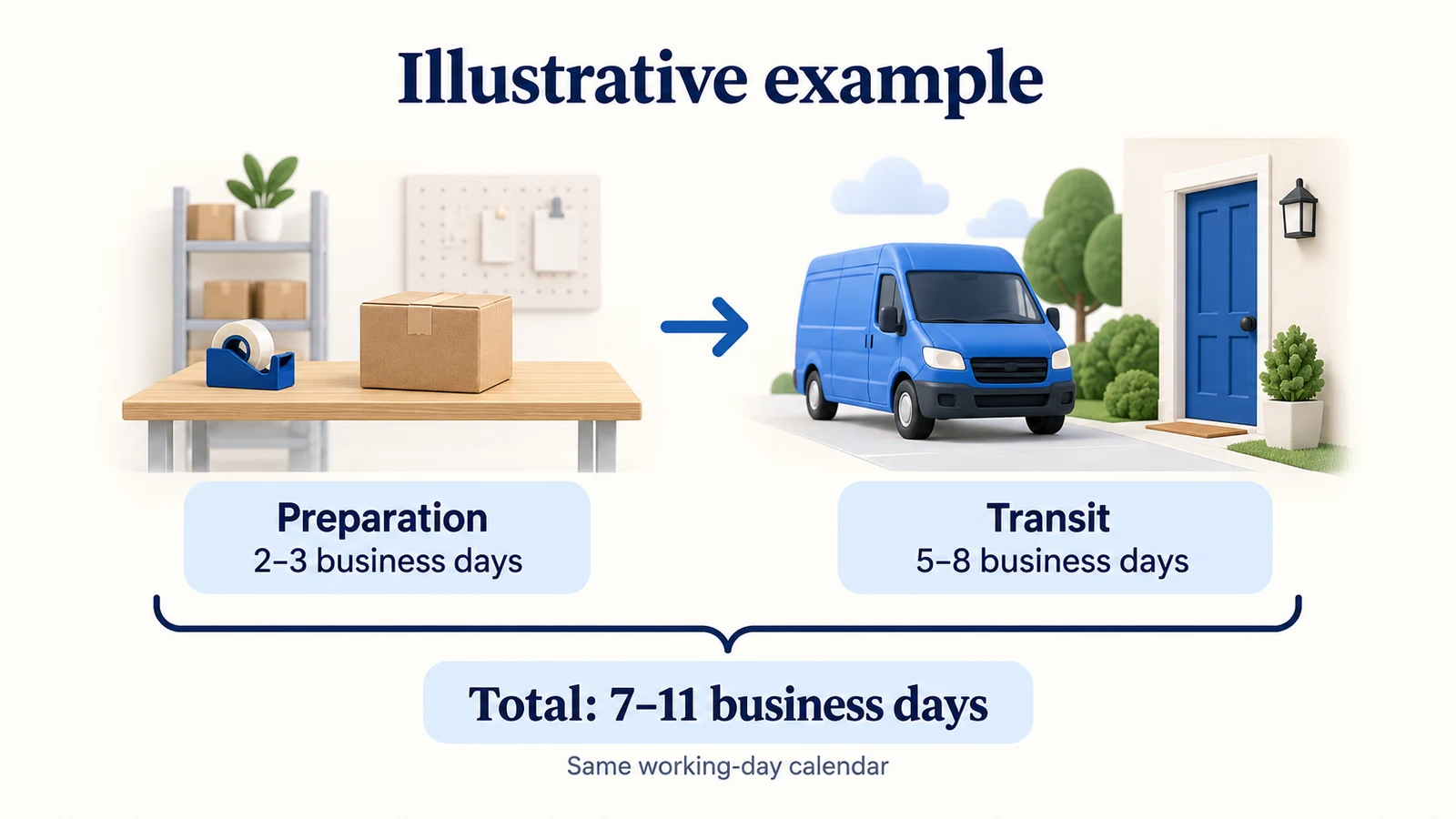
In practice, define which holidays and weekends count. The supplier’s working calendar, carrier pickup calendar and destination delivery calendar may differ. A Friday order placed after cutoff can wait through a weekend before preparation starts. A calculated delivery-date range can communicate that more clearly than asking the buyer to combine several clocks.
Avoid starting transit when a label is printed. UPS explains that “Label Created” means shipment details have been received; carrier possession is a later event. Your wording should distinguish an order confirmation, a tracking number and a parcel accepted for transport.
03
Adapt these shipping-policy clauses to your store
The examples below show the information to include. Replace every bracketed field, remove options you do not offer and reconcile the wording with product pages and checkout. Do not leave an attractive estimate in place simply because it appeared in a template.
Processing and dispatch
We prepare accepted orders within [verified range] business days. Our order cutoff is [time and time zone], and our processing days are [days], excluding [relevant holidays]. Orders placed after cutoff enter the next processing day. If we need information from you or cannot meet the stated dispatch timing, we will contact you with the next available options.
Define “accepted” in the surrounding store terms; do not use it to conceal a long period after payment. If customization or a particular product takes longer, disclose that timing before purchase and repeat it in the confirmation. A generic shipping page should not override a more prominent fast-delivery claim on the product page.
Destinations, delivery estimates and charges
We currently deliver to [supported destinations]. Available services, estimated delivery dates and shipping charges appear at checkout for your address. Preparation takes [range]; transit after carrier collection takes [range] for [service and destination]. [Explain any relevant remote-area or product exclusions.] Contact [support channel] before ordering if you need delivery for a particular date.
Provide a destination table if several markets have meaningfully different conditions. “International” is too broad when one service excludes islands, PO boxes or certain product types. Explain what an express upgrade accelerates: transport, preparation, or both. Do not sell an upgrade that still waits in the standard packing queue without making that limitation clear.
Tracking and separate parcels
We send tracking information when [verified event]. A newly created tracking number may appear before the carrier’s first acceptance scan. If your order ships in separate parcels, we will identify the items and tracking number for each parcel. Contact [support channel] if the information is unclear or an expected parcel has not arrived.
Only state that each parcel receives tracking if the selected services actually support it. Some final-mile partners use another number; explain where the buyer will see that update. Avoid promising a fixed scan interval unless the service and your records support it.
Delays, damage and missing parcels
If we learn that we cannot meet the timing promised for your order, we will contact you with the information available, any revised timing we can support, and the cancellation or refund options that apply. For a damaged, incomplete or missing delivery, contact [support channel] with your order number so we can investigate and explain the next step.
Tell customers what information helps: the missing item, parcel number or photographs of visible damage where practical. Requesting that evidence can support an investigation; it should not become a blanket reason to deny an applicable remedy. Avoid terms that make the buyer wait indefinitely for the carrier to pay your claim.
Import charges and address changes
For [specified destinations and service], [state accurately whether import duties and taxes are collected at checkout, paid by the seller or payable by the recipient]. Address-change requests must reach [support channel] before [actual fulfillment cutoff]. Once a parcel has been handed over, changes depend on the carrier and may not be possible.
“Free shipping” does not tell a buyer who pays import charges. Check the service arrangement and destination requirements before saying “all taxes included.” Explain any potential redirection or return charge accurately and subject to the customer rights that apply; a clause in your policy does not automatically make every charge enforceable.
Make cancellation and address changes actionable
To request an address correction or cancellation, contact [support channel] and provide your order number and the requested change. We will confirm whether fulfillment can still be stopped. A request is not confirmed until you receive our response. If the parcel has already been handed to the carrier, we will check the available options and explain any applicable charges before you approve a paid change. This operational cutoff does not limit cancellation or other rights available under applicable law.
Give support a way to place an order on hold before replying. Otherwise a cancellation request can sit in an inbox while an automated fulfillment instruction continues. Confirm the hold with the party that actually releases goods, then tell the buyer the result. If you cannot stop dispatch, explain what has already happened and the applicable next step; do not tell the buyer to create a second order until the original has been accounted for.
Specify how support handles an unexpected delivery
If tracking shows delivered but you cannot locate the parcel, contact [support channel]. We will check the delivery information with the fulfillment or delivery provider and explain the next step. If practical, check the stated delivery location and whether another member of your household received it. Please tell us if an item is missing or damaged and keep the packaging while we investigate, where safe to do so. Your applicable rights are not dependent on the carrier accepting our claim.
Add your actual support hours, time zone and an achievable initial-response window. Distinguish an initial reply from a final resolution; a warehouse investigation may need longer than acknowledging the message. If you recommend prompt reporting, explain that it helps preserve evidence rather than inventing a short universal deadline that removes consumer rights.
State the rule for failed delivery and return to sender
If a delivery attempt fails or a parcel is returned, we will check the reason and contact you about the available options. We will explain any proposed redelivery charge before arranging another shipment. Refunds and other remedies will be handled according to the circumstances and applicable rights. Please do not send goods to an address printed on a shipping label unless we have confirmed it as the appropriate return address.
An incorrect address, an inaccessible building, an unpaid import request and a carrier error are different cases. Do not apply one automatic deduction to all four. Your policy should connect to the store’s separate returns terms without attempting to make every return question part of shipping.
04
Match delay remedies to the market
Shipment and delivery deadlines are different legal questions. Do not copy one country’s rule into a worldwide policy or assume that adding “estimated” removes obligations attached to a promise.
For US transactions covered by the FTC’s Mail, Internet, or Telephone Order Merchandise Rule, a seller needs a reasonable basis for the advertised shipping time, or generally 30 days if none is stated. If the seller cannot ship on time, the rule requires an appropriate delay notice and customer consent or a refund. The details differ for first short delays and longer, indefinite or repeated delays; silence is not a universal form of consent. Consult the FTC’s explanation when setting the actual procedure.
EU consumer guidance addresses delivery: goods should generally arrive within 30 days unless another time was agreed. If delivery is late, the consumer normally gives an additional reasonable deadline before ending the contract; exceptions include a refusal to deliver or an essential agreed delivery date. The Your Europe guidance explains these conditions. This is a regional summary, not a complete assessment of every transaction or national rule.
| Question | US rule discussed above | EU guidance discussed above |
|---|---|---|
| Which milestone matters? | Shipping the merchandise | Delivering the goods |
| Can one generic 30-day clause cover everything? | No; the advertised promise and delay rules matter | No; the agreed delivery time and applicable exceptions matter |
| What should the store prepare? | Appropriate notices, consent handling and refunds | Delivery escalation and applicable cancellation/refund handling |
Keep the customer-service process as specific as the policy. Record the original promise, the date the problem became known, the notice sent, the response and the next deadline. If a revised date is uncertain, say so instead of inventing another estimate. Check additional market and platform requirements for the actual store before adopting final terms.
Prepare a delay message that leads to a decision
For a delay before dispatch, a useful message identifies the affected item, the original shipping date, the revised date you can substantiate, and a simple way to accept or cancel. If no date is supportable, state that explicitly. The FTC’s detailed business guide sets out different requirements for first and renewed US delay notices; a generic “please wait” email is not the full procedure.
For example, a store might draft: “Your [item] will not ship by [original date]. We can currently ship it by [revised date]. You can choose to wait or cancel the unshipped item using [no-cost response method]. [Explain the applicable refund and what happens if you do not respond.]” The final sentence must follow the applicable rules and type of delay. Do not publish that bracket as a blanket assumption of consent.
In the same order record, keep the promise the buyer saw, affected items, dated notice, buyer response, next decision deadline and refund or dispatch confirmation. A reply agreeing to one date should not be silently reused for a second postponement. If the supplier says it cannot supply the item, stop presenting delay as the only option.
05
Explain what a partial delivery means
An order can arrive in two parcels even when the customer paid one shipping charge. Suppose an illustrative order contains a bottle and a replacement lid. The bottle arrives on Tuesday; the lid remains in transit. The order is partially delivered, and the buyer still needs a clear status for the lid.
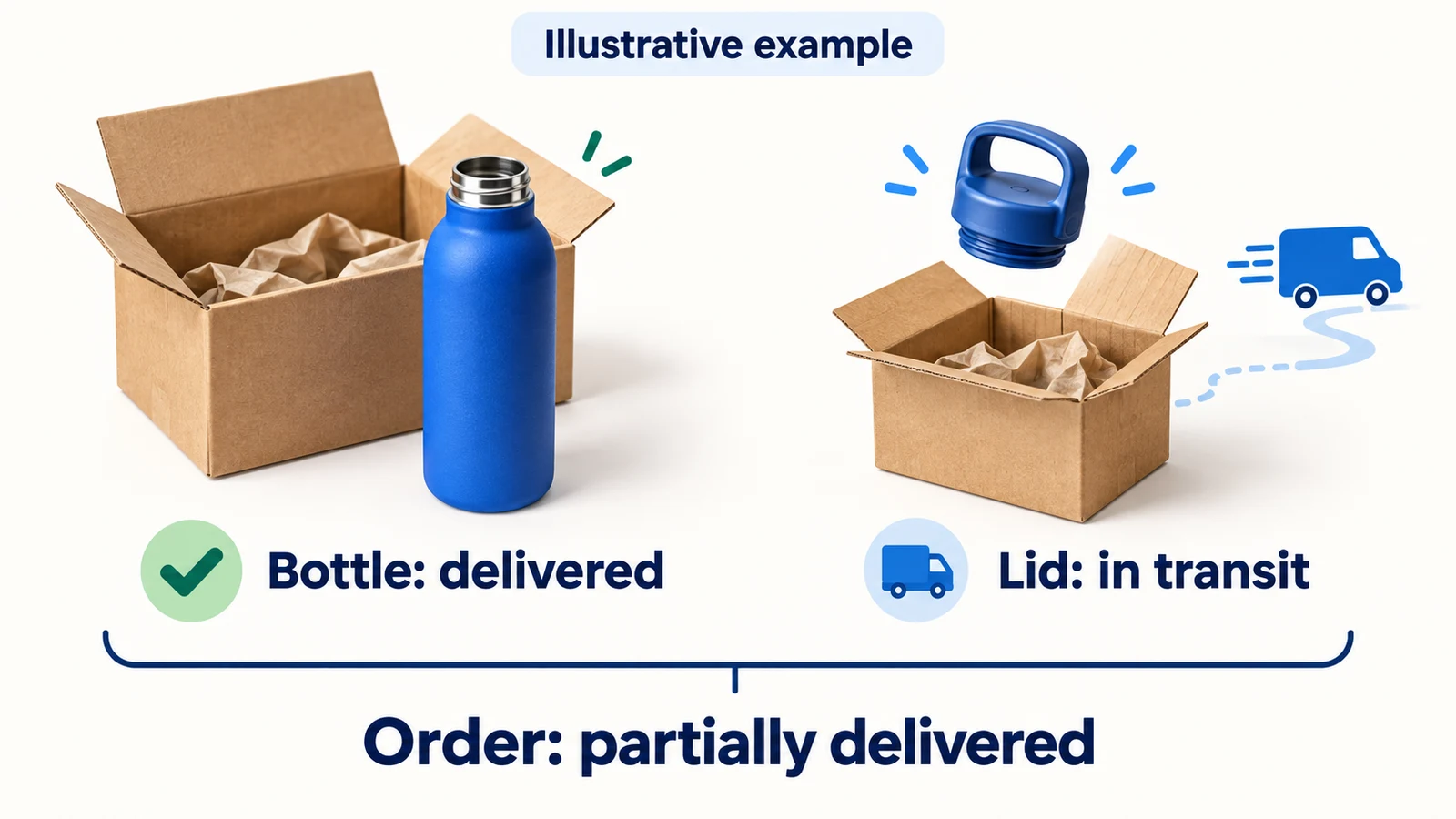
Map each item to its parcel in the order message. A single “Delivered” email for the whole order can trigger an avoidable missing-item complaint. State whether split shipments affect the buyer’s charge and explain the remedy if one item cannot be supplied. Do not turn a normal separate parcel into an extra charge after purchase without an appropriate basis and agreement.
For returned-to-sender and delivered-not-received cases, identify a support route rather than declaring every case closed by a scan. The relevant facts can include the address supplied, delivery evidence, carrier instructions and applicable customer rights. Your internal carrier claim and the buyer’s purchase are related, but they are not the same process.
06
Give each shipping problem an owner and a next action
Use the policy as the customer explanation and a separate internal procedure to carry it out. The following is an operational starting point, not a set of statutory deadlines. Set review times from the original promise, service terms and applicable obligations.
| Reported problem | Check before deciding | Owner and next action |
|---|---|---|
| Tracking number has no acceptance event | Physical handoff record, collection date and event availability | Fulfillment checks the parcel location; support gives a dated update, not another unsupported ETA |
| Carrier movement is late | Service estimate, last reliable event and any information request | Shipping coordinator opens the appropriate enquiry; support assesses the customer remedy separately |
| Delivered but not received | Item-to-parcel mapping, address and available delivery evidence | Support investigates without assuming a scan proves receipt by this buyer |
| One item is absent | Packing record and whether another parcel is still moving | Fulfillment identifies an omission or split shipment; support states the status for each item |
| Item or packaging is damaged | Photos where available, item condition and packaging | Support determines the appropriate buyer remedy; the shipping owner preserves claim evidence |
| Returned to sender | Recorded reason, address, contact attempts and charge basis | Support offers the applicable refund or redelivery options after checking responsibility |
Keep the investigation and the customer decision connected. Record a next update date even when the carrier has not replied. Escalate before that date if an applicable cancellation, refund or delivery deadline will arrive sooner. Close the case only when the agreed customer action is complete, not merely when an enquiry number is created.
07
Make the policy agree with the buying journey
Place a visible link in the footer and make relevant timing and cost information accessible before purchase. Product pages should disclose product-specific delays; checkout should show the service and charge for the actual destination. The order confirmation should preserve what was promised for that purchase. Shopify’s shipping-policy guide provides practical examples of information and placement.
Run a test checkout using a normal address, a restricted address and a multi-item basket. Compare the product claim, selected service, policy and confirmation. If one says “free shipping” while another adds a handling fee, fix the discrepancy before accepting traffic. If the store shows a calculated date, check that fulfillment time is included in the underlying settings.
Review the policy after changing suppliers, dispatch origins, services or destination coverage. Update the offer for future orders and separately resolve promises already made to existing buyers. Editing a page today does not rewrite yesterday’s purchase.
The operations section of the Dropshipping Hub connects shipping terms with fulfillment and exception handling. If the current operation cannot support the promise you want to publish, first work on reducing shipping delays, then revise the offer using the results.
08
Frequently asked questions
Can I copy my supplier’s shipping policy?
Use it as an input, not a finished policy. Your store may sell different products, serve different markets or combine parcels differently. Customers also need your contact route and the remedies applicable to their purchase.
Should processing be included in the delivery estimate?
The customer should be able to understand the complete wait. Show processing and transit separately or present a total delivery-date estimate that includes both. Explain the calendar and cutoff used.
Can I say I am not responsible after dispatch?
Avoid a blanket disclaimer. Carrier handoff does not universally end the seller’s obligations to the buyer. Check the relevant consumer rules and handle claims under terms that fit the transaction.
Does a shipping policy guarantee delivery dates?
A policy can distinguish estimates from a specifically guaranteed service, but the wording must accurately describe the offer. Calling a date an estimate does not justify an unsupported claim or remove applicable delay and refund duties.