
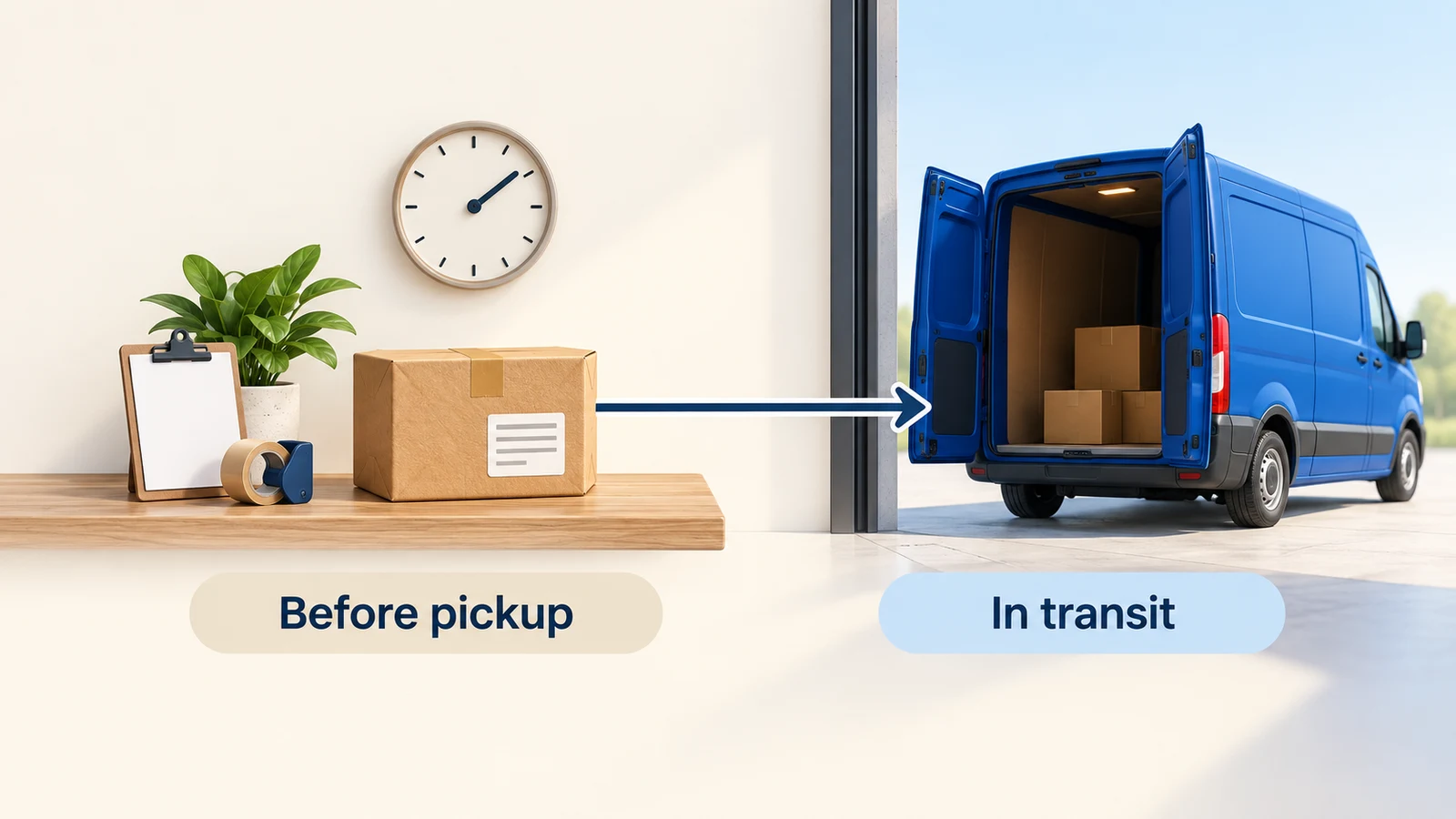
To reduce dropshipping shipping times, measure the full journey from payment to delivery, find the longest delay you can influence, and fix that part first. Confirm stock, complete order data, prepare packing requirements and secure timely carrier pickup. Then compare faster transport services using similar products, destinations and dispatch conditions.
A faster carrier cannot recover every day spent waiting before pickup. If an order sits for four days while a supplier confirms a variant, buying a service that saves one transit day addresses only a small part of the buyer’s wait. The first useful question is where the time went.
The dropshipping shipping-times guide explains the components of a delivery estimate. This article focuses on changing the operation and checking whether the improvement reaches customers, rather than simply publishing a shorter range.
01
Measure the customer’s clock and the operational stages
Track payment, release for fulfillment, supplier acceptance, physical carrier handoff and delivery. Use consistent time zones and preserve the original timestamps. Where a reliable customs or final-mile event exists, keep it too; where it does not, do not invent a precise stage duration.
Maintain two views. Paid-order-to-delivery measures the buyer’s wait. Release-to-handoff helps assess fulfillment work after an order is ready to proceed. A fraud review or address query may explain why those numbers differ, but it does not make the customer’s waiting time disappear.
| Interval | What a long interval can indicate | First check |
|---|---|---|
| Payment to release | Review queue, missing address or order-sync problem | Held orders and the reason for each hold |
| Release to supplier acceptance | Unconfirmed stock, unclear variant or delayed purchasing | Exact SKU, quantity and supplier response |
| Acceptance to handoff | Picking, inspection, packing or missed collection | Readiness records and pickup cutoff |
| Handoff to delivery | Route performance, clearance or final-mile problem | Carrier events, destination and open exceptions |
A tracking number is not a reliable substitute for the handoff timestamp. UPS distinguishes label creation from possession of the parcel. If your provider reports “shipped” when it prints a label, ask for the physical collection evidence and the relevant carrier event.
Do not automatically treat every gap between scans as inactivity. Long-distance shipments can move without frequent updates. Investigate an unexpected gap against that service’s event pattern, and describe missing evidence as missing evidence rather than confidently assigning blame.
02
Remove the largest avoidable wait first
Consider one hypothetical order that takes 12 calendar days: four days from payment to carrier handoff, followed by eight days from handoff to delivery. Preparing stock and packing instructions in advance reduces the first interval to one day. If transit remains eight days, the total becomes nine days.
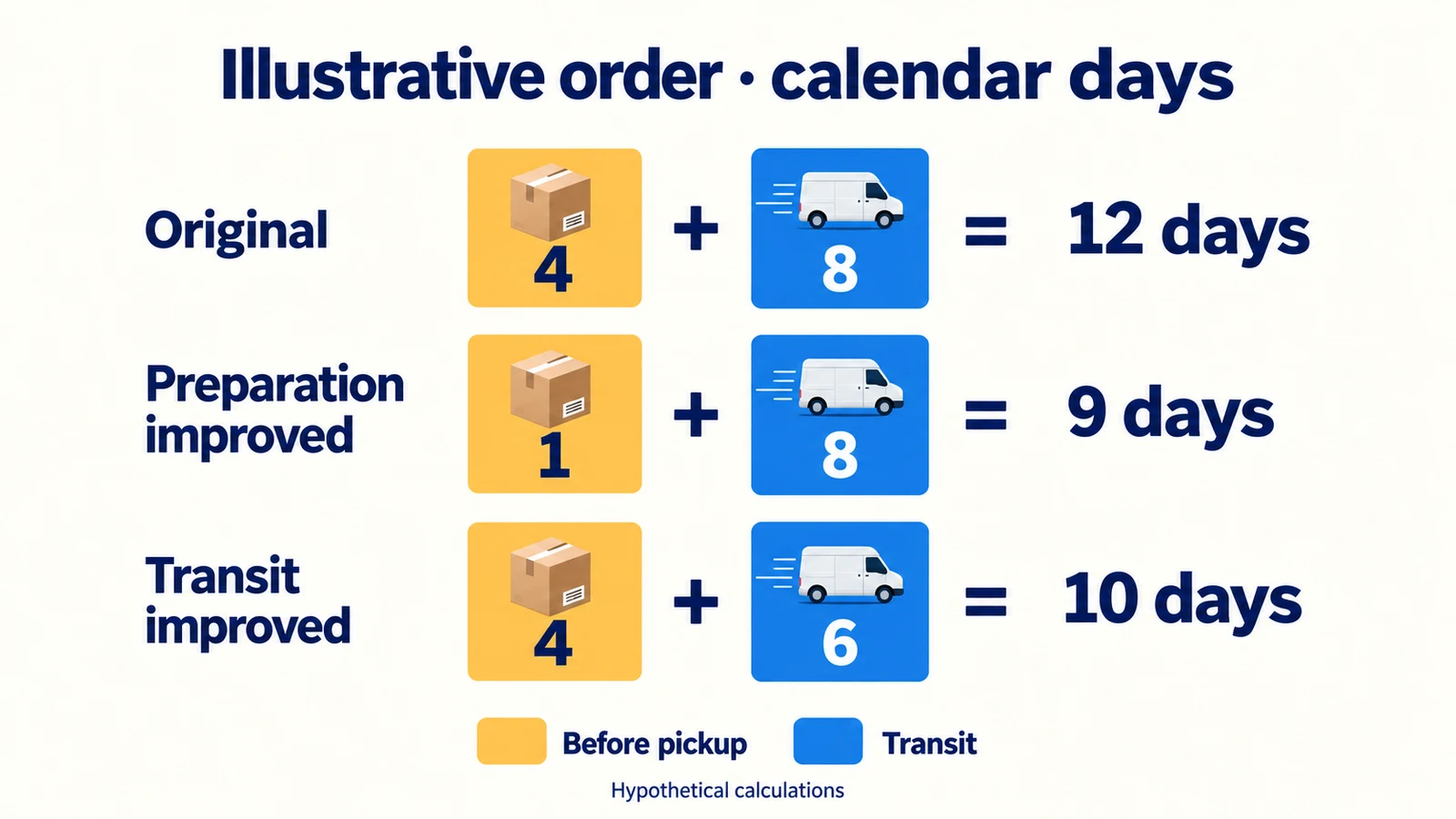
In a different change to the original order, a faster service reduces transit from eight days to six while preparation still takes four. Total time becomes ten days. The examples do not establish a typical saving; they show why a three-day preparation improvement can matter more than a two-day transport improvement. If both changes can be sustained together, the assumed total would be seven days.
Sort delayed orders by cause before choosing a project. A queue dominated by stock confirmation needs a different fix from a queue dominated by customs information requests. Count affected orders as well as the size of the delay: a recurring one-day wait across most orders may deserve attention before a rare unusual shipment.
Assign the change to someone who can perform it. “Ship faster” is not an instruction a warehouse can act on. “Approve the carton and insert before orders arrive” identifies a decision that can be completed before the packing bench is waiting.
Turn the diagnosis into a short working queue
Export the orders that missed their promised handoff or delivery date, together with open orders approaching that date. For each, record the last verified event, the missing action, its owner and the next review time. Look at representative records before assigning a cause; “supplier delay” is too broad if half the orders were actually waiting for your own packaging approval.
| Observed condition | Specific action | Person who can close it | Completion evidence |
|---|---|---|---|
| Order paid but never submitted | Check integration response and duplicate risk before resending | Store operations | Provider acceptance tied to the original order ID |
| Supplier cannot confirm a variant | Request actual availability; hold or revise the offer | Purchasing | Confirmed allocation or a documented customer resolution |
| Accepted order waiting on packaging | Approve the correct pack and make materials available | Merchant approver and warehouse | Packed order ready before collection cutoff |
| Label created, collection unclear | Check manifest and actual pickup | Shipping coordinator | Reliable handoff evidence or parcel located for dispatch |
| Clearance asks for information | Supply the accurate requested documentation | Designated shipping/customs contact | Request answered and response recorded; release is still the authority’s decision |
| Delivery attempt unsuccessful | Verify address and carrier instructions with the buyer | Customer support | Agreed next attempt or other customer resolution |
Separate a durable fix from clearing today’s queue. Manually submitting a missed order can help that buyer; it does not repair the connection that lost the request. Add an alert or reconciliation for that specific failure and check that the next ordinary order completes the same handoff correctly.
03
Make each order ready to fulfill
Confirm the exact stock and order data
Map storefront variants to supplier SKUs and confirm quantities before releasing orders. Color names, bundles and replacement parts are common places for a supposedly simple order to need clarification. Store a specific approved substitution rule; do not let a faster dispatch become the wrong delivery.
For products with recurring demand, agree how stock is reserved or refreshed. A catalog’s available quantity may be shared with other sellers. If availability is uncertain, resolve the affected order and adjust the offer instead of relying on a supplier’s optimistic restock message.
Check the shipping address, required contact information and service eligibility before submission. Keep requests proportionate to the destination and carrier. An incomplete apartment number can create work at the last mile that no air-service upgrade will solve.
Approve packaging and checks before the queue builds
The warehouse should already know the carton, protection, accessories and inspection scope for the SKU. Sending new packaging instructions after purchase can turn every order into a consultation. Keep approved versions accessible and identify what requires a hold.
Do not remove necessary product checks to improve a dispatch metric. A damaged or incorrect item that ships today can lead to a replacement journey tomorrow. Separate the time needed for the agreed check from delays caused by unclear instructions or unavailable materials.
Align order release with real pickup cutoffs
Ask when a packed parcel must be ready for each collection. A warehouse can finish an order on the same day yet miss the last pickup. Clarify weekend and holiday schedules, especially when the supplier, dispatch country and destination observe different calendars.
Automation can reduce time between an accepted order and a fulfillment request when the data and acceptance response are dependable. It should also expose failures, duplicates and unanswered requests. The fulfillment process provides the wider sequence for keeping those handoffs traceable.
04
Prevent avoidable customs queries
Prepare the product description, value, origin, classification and required shipment details before parcels enter the route. Ask the provider or qualified customs specialist what the specific goods and destination require. A generic description copied across unrelated products can create an avoidable request for clarification.
DHL identifies incomplete documents and information as a common cause of customs delays. Its guidance highlights the commercial invoice, shipment details, goods description, declared value, HS code and complete contact information. These should describe the actual shipment consistently.
Choose who will respond when additional information is requested. A complete invoice still cannot prevent every inspection or authority decision, but an unanswered query adds a delay you can often influence. Send accurate documents through the provider’s appropriate channel and record what was supplied.
Never lower the declared value, misdescribe the goods or label a sale as a gift to chase a faster result. A shortcut that produces an inaccurate declaration can create a larger operational problem. The sensible improvement is correct preparation and a prompt response, not a promise to bypass clearance.
05
Test a faster service under comparable conditions
Request available services for the actual product, packed dimensions, weight, dispatch origin and destination postal codes. “Express” alone does not specify the promise. Confirm collection arrangements, acceptance restrictions, tracking coverage and what happens if a delivery attempt fails.
Compare the complete experience, including cost. A service can save transit time but add a remote-area fee, require another packing format or exclude a product type. Use the shipping-cost comparison to keep those differences visible before offering the upgrade.
Run similar orders through the old and proposed service during comparable periods. Keep normal and remote destinations separate, and avoid comparing peak-season economy orders with off-season express orders as though service choice were the only change. A small pilot checks whether the route works; it does not establish a universal performance claim.
Record promised and actual dates, failed deliveries, damage and invoiced cost. A faster median accompanied by more unsuccessful deliveries may be a poor trade for the customer. Decide what improvement and cost are acceptable for the product before reviewing the result, so one unusually fast parcel does not determine the conclusion.
Decide what would justify the higher price before the pilot
Write the proposed change and acceptance conditions before routing test orders. For example: same product and packaging, the same eligible destination group, the same preparation procedure, and alternating comparable orders between services where practical. Record dates and the assignment method. Do not send all urgent, difficult orders through one service and later compare it with easy orders sent through the other.
Use criteria that fit the business. An illustrative decision could require at least a two-day reduction in the completed-order P90, no unresolved increase in loss or damage, and no more than $2 additional normal-parcel cost. Those are chosen example criteria, not industry standards. Confirm the sample is mature enough to observe late deliveries before applying them.
Suppose a hypothetical pilot has 40 orders in each group, all now delivered: Service A has P90 of 12 days and costs $8 per parcel; Service B has P90 of 9 days and costs $10. The observed three-day P90 improvement meets those example speed and cost conditions. It still does not establish that losses are equally rare: a small pilot can miss infrequent failures. Record damage and other exceptions, and increase volume gradually if the total result supports it.
If the faster service adds $2 to 100 monthly parcels, the extra transport expense is $200. Compare that with the contribution your business can actually retain. Do not assume fewer refunds or more conversions will fund the upgrade unless you measure them. If only a small customer group values the speed, an accurately described paid option may fit better than changing every order.
Pause or narrow the test when product eligibility, invoice scope or physical handoff cannot be verified. A missing basic condition is a reason to investigate, not a result to average into the speed comparison.
06
Use local or allocated stock when the saving justifies the commitment
Prepositioned stock can remove purchasing or cross-border movement from the individual customer’s waiting time. It moves that work earlier; it does not eliminate receiving, replenishment or inventory risk.
Start with variants whose demand and condition are sufficiently predictable. Calculate the cash tied up in stock, inbound transport, storage, handling and potential unsold units. A local warehouse containing the wrong sizes or colors cannot help the orders currently waiting for other variants.
Keep availability synchronized with the selling location. If the local allocation runs out and the order falls back to an overseas supplier, the delivery promise should change before purchase. A local-delivery badge should not remain attached to an order being fulfilled through a slower route.
Allocated stock near the original dispatch point can also help when supplier purchasing is the main delay. It may be a smaller commitment than stocking another country, but receiving and replenishment still need a clear owner. Choose the location according to the delay you are trying to remove.
Calculate the inventory commitment behind faster dispatch
Use demand by variant and a replenishment plan rather than a whole-catalog average. A planning calculation might use expected demand during replenishment plus a separately justified buffer. For example, 5 units per day across a stated seven-day planning calendar and a 10-calendar-day replenishment interval imply 50 units of expected demand while replenishing. An additional illustrative 15-unit buffer produces a 65-unit planning level. Demand variability, receiving delays and minimum purchases can change that figure.
At an assumed $12 landed cost per unit, those 65 units represent $780 of inventory value before storage and fulfillment charges. That is a quantity-planning example, not a promise that $780 funds the whole operation or a recommendation to buy 65 of every variant. Open purchase orders and sellable stock already held affect what actually needs ordering.
Compare that exposure with the particular delay removed. If supplier preparation is only one day and final-mile delivery dominates the complaints, purchasing a large overseas allocation may provide little benefit. If the main delay is repeated purchasing of a stable bestseller, an approved allocation can address the actual cause. Limit the initial commitment and set a review point for sell-through, aging stock and delivery performance.
07
Check improvement without hiding unfinished orders
Averages can conceal the slower orders that generate customer complaints. Review the median, a higher percentile such as P90, the number of completed orders and the age of unresolved orders for a defined cohort. Use one stated percentile method consistently.
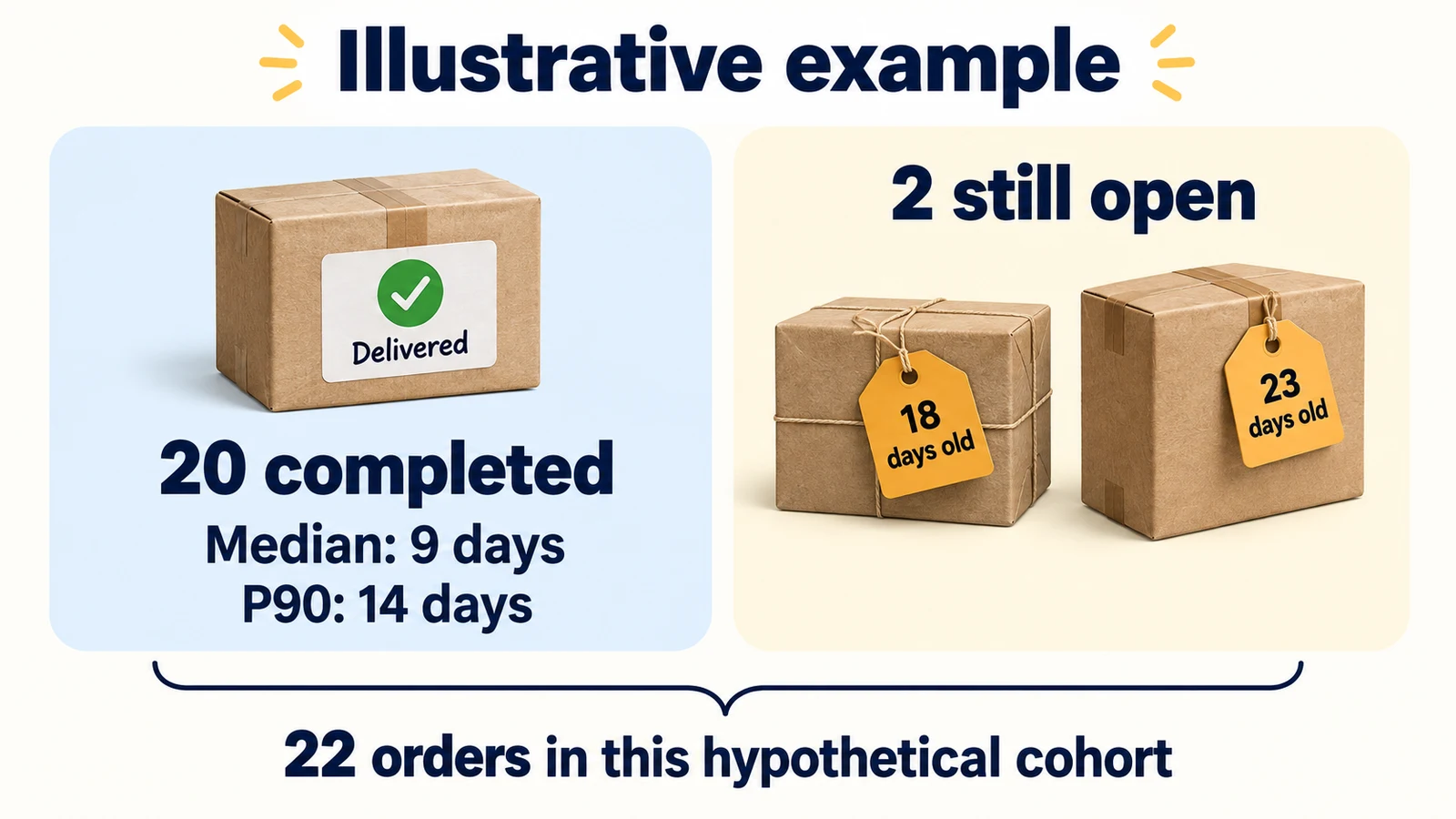
For a calculation example, imagine these 20 completed orders, measured in calendar days from payment to delivery and sorted from fastest to slowest: 6, 6, 7, 7, 7, 8, 8, 8, 9, 9, 9, 10, 10, 10, 11, 12, 13, 14, 16, 20. The median is 9 days. Using the nearest-rank method, P90 is the 18th observation: 14 days. These are synthetic numbers, not customer or AIDrop performance data.
Now suppose two more orders from the same cohort remain undelivered and are already 18 and 23 days old. Report them alongside the completed-order statistics. The 20 completed orders are only 20 of 22 orders in the cohort; excluding the open two from view would make the result look more settled than it is.
| Measure in the hypothetical cohort | Result | Interpretation |
|---|---|---|
| Completed-order median | 9 days | Middle of the delivered sample |
| Completed-order P90, nearest rank | 14 days | 18 of the 20 delivered orders took no more than 14 days |
| Completed orders | 20 of 22 | Two orders are still open |
| Open-order age | 18 and 23 days | The slower unresolved cases need action |
Do not add stage-level P90 values and call the sum the total-delivery P90. The slowest preparation orders may differ from the slowest transit orders. Calculate the complete duration on each order first, then compute its distribution. Use stage measurements to diagnose the reason for the delay.
Compare cohorts with the same definitions after the change. Preserve the exclusions and explain them, including cancellations or orders waiting on customer information. If volume is small, describe the result as preliminary and continue monitoring rather than turning a handful of orders into a marketing guarantee.
08
Update the promise after the operation improves
Reduce the published range when recent, relevant evidence supports it. Include preparation and the correct working-day assumptions. Shopify’s delivery-date guidance distinguishes fulfillment time from transit settings and describes the options for displaying estimates.
Keep product pages, checkout, confirmations and the shipping policy aligned. If a temporary disruption occurs, update the offer for future orders and communicate separately with customers whose existing promises are affected.
For a provider discussion, bring the timestamps, delayed-order examples, parcel specification and destination mix. That gives an operations partner a defined problem to investigate. The Dropshipping Hub’s operations section connects the stock, fulfillment and shipping decisions that influence the result.
09
Frequently asked questions
Is express shipping always the best way to reduce delivery time?
No. It helps when transport is the delay the service can reduce. If the main wait occurs before handoff, fix stock confirmation, order readiness or collection first and compare the complete improvement and cost.
Can I guarantee faster delivery after one successful test?
One delivery verifies that one shipment worked. It does not establish a dependable range across destinations, order sizes and operating conditions. Test relevant variations and keep incomplete orders visible.
Does local warehousing eliminate shipping delays?
It can shorten the customer journey when the correct stock is available locally. It still requires replenishment, accurate availability, packing and final-mile delivery. Its benefit must justify the inventory and operating costs.
Which measure should I watch first?
Start with paid-order-to-delivery and open-order age, then break completed orders into the stages you can verify. Those views show the buyer’s experience and help identify a specific fix.