
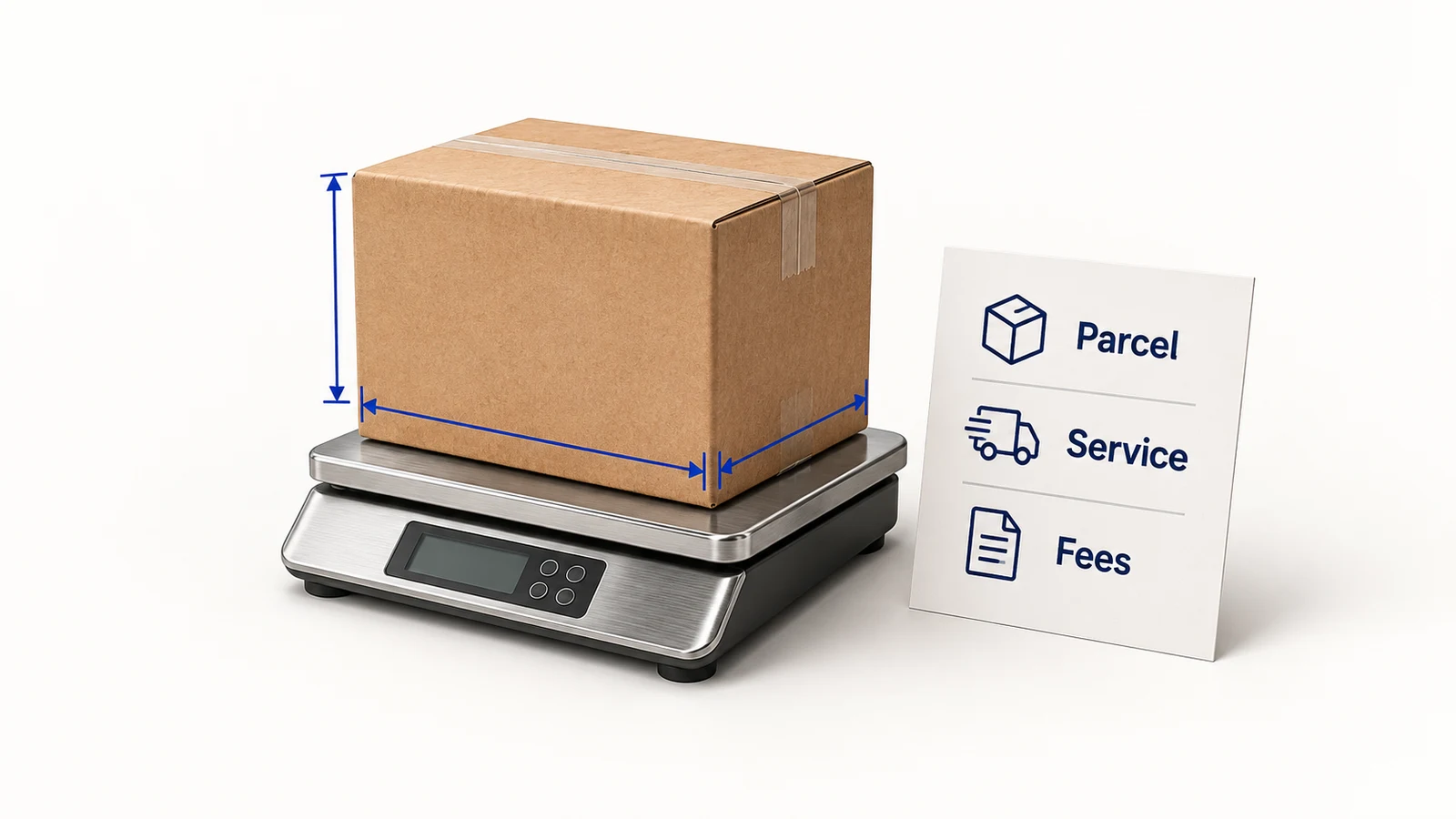
Dropshipping shipping costs depend on the packed parcel, dispatch origin, destination, service and chargeable weight, plus the fees included in the quote. Calculate transport together with handling, packaging and applicable surcharges. Keep import duties, taxes and the amount charged to the customer visible separately so you can compare the full order economics.
A low per-kilogram rate is not a complete parcel price. A light product in a large carton may be billed by volume, and an attractive base rate may exclude charges that appear on the final invoice. There is no dependable universal shipping price for every dropshipping product or country.
The practical comparison is the same packed order, sent to the same address, under a clearly described service. Pair the cost with the corresponding shipping-time estimate rather than comparing a slow untracked option with a faster tracked service as though price were their only difference.
01
Establish what the quoted shipping cost includes
Ask whether the figure covers only transport or the work needed to hand over a ready parcel. Suppliers may bundle product, packing and transport together; fulfillment providers may itemize them. Either approach can work if the scope is clear and nothing is counted twice.
| Cost | Confirm the charging unit and scope |
|---|---|
| Base transport | Per parcel, weight band, kilogram or shipment; origin and destination zone |
| Handling | Per order, parcel or item; whether the first pick is included |
| Packaging | Standard carton or mailer, protective materials and any custom inserts |
| Surcharges | Fuel, remote delivery, residential delivery, oversize or special handling when applicable |
| Import-related amounts | Duties, taxes, clearance or disbursement fees and who pays them |
| Exceptions | Address correction, redelivery, return to sender, loss and optional coverage |
Ask for the currency, validity date and any minimum charge. Identify whether quoted tax is included, excluded or not applicable to that line. If the service uses a weekly fuel adjustment, record the applicable basis and date instead of treating the percentage as fixed forever. UPS, for example, publishes fuel-surcharge rules that can change by service and shipment date.
Separate the expected cost of a normal parcel from contingent charges. You need both, but presenting a rare redelivery fee as if every order pays it obscures the comparison. Conversely, excluding recurring remote-area charges from a market with many affected addresses understates what that market costs to serve.
02
Measure the packed parcel, not the product listing
Use the outside dimensions and gross weight of the parcel ready to ship. Include the carton or mailer, protective material, accessories and inserts. A supplier’s product weight may exclude all of those.
For services that use dimensional weight, the calculation converts the space occupied into a weight used for charging. Confirm the divisor, units, measurement rules and rounding for the specific service. DHL Express’s weight-and-dimensions guidance gives a centimeter-based example using a divisor of 5,000 and charging the greater of actual and volumetric weight. Other services can use different rules.
Consider a hypothetical packed parcel measuring 30 × 20 × 15 cm and weighing 0.8 kg. With an assumed divisor of 5,000 cm³/kg, its dimensional weight is 30 × 20 × 15 ÷ 5,000 = 1.8 kg. The larger weight is 1.8 kg, even though the scale shows 0.8 kg.

If the illustrative service rounds chargeable weight up to the next 0.5 kg, the parcel is billed at 2.0 kg. That rounding rule is an assumption for this example, not a claim about every DHL or other carrier product. Obtain the actual rule before entering the parcel into a cost model.
Measure the final configuration again when packaging changes. A bulging mailer, another accessory or a different outer carton can change the billable dimensions. Keep a dated packed specification for each common order configuration instead of assigning every basket the dimensions of a single unit.
03
Work through a complete example
The figures below are invented in USD to demonstrate a calculation. They are not a carrier quote or an AIDrop rate card. Assume the parcel above is billed at 2 kg, base transport costs $4 per billed kilogram, fuel is 20% of base transport only, and the stated fixed charges apply once to this parcel.
| Illustrative charge | Calculation | Amount |
|---|---|---|
| Base transport | 2 kg × $4/kg | $8.00 |
| Fuel | 20% × $8.00 | $1.60 |
| Handling | Per parcel | $1.00 |
| Packaging | Per parcel | $0.50 |
| Remote-area charge | Assumed applicable to this address | $3.00 |
| Parcel total before import-related amounts | Sum of the five charges | $14.10 |
Now suppose a packing review confirms that the same product can be safely packed in 25 × 18 × 12 cm, with the gross weight still 0.8 kg. Dimensional weight becomes 1.08 kg. Under the same assumed half-kilogram rounding, the billed weight is 1.5 kg. Transport falls to $6 and fuel to $1.20.
If the smaller package costs $0.10 rather than $0.50, with handling and the assumed remote charge unchanged, the new total is $6 + $1.20 + $1 + $0.10 + $3 = $11.30. The saving is $2.80 per parcel. At 100 identical parcels under these assumptions, that would be $280; it is not a forecast for other products or services.

The example shows two separate changes: lower billed weight saves $2.40 including the assumed fuel effect, and packaging saves $0.40. If the smaller pack costs more, damages the item or triggers another handling rule, the answer changes. Approve protection and suitability before treating a smaller carton as a saving.
Do not automatically copy the example’s fuel basis. Real services may apply a surcharge to selected additional charges as well as transport. A correct percentage multiplied by the wrong subtotal still produces the wrong quote.
04
Give providers the same quotation request
Send a representative basket of parcel configurations and destination postal codes. Include at least the configurations that materially change weight, size or handling. A single easy urban address cannot represent a market with distant or restricted delivery areas.
The request should identify:
- Dispatch location, destination country and postal code, with residential or commercial status where relevant.
- Product description and any service-relevant characteristics, such as batteries, liquids or fragile contents.
- Item quantity, final external dimensions in centimeters and packed gross weight in kilograms.
- Required tracking, delivery service, pickup arrangement and any signature or coverage requirement.
- Expected shipment pattern, including split parcels and peak volume, without promising uncommitted volume.
- Who handles import clearance and pays each duty, tax and fee; quote currency and validity.
Ask each provider to return the billed weight and an itemized amount, including exclusions. If one cannot explain how the packed dimensions produce the charged weight, resolve that before comparing its total with another provider’s.
Request a written explanation of service substitution. An inexpensive route that may be changed without notice is difficult to price and describe to customers. If a product becomes ineligible or a destination requires another service, decide whether the provider should seek approval before buying the replacement label.
Use a quotation worksheet that providers can complete
Send the same dated specification to each provider and ask for a reply against each row. The example below describes the information to supply; it does not establish an actual eligible route or rate.
| Field | Example entry or required answer |
|---|---|
| Request identity | Quote version, date and the parcel configuration ID |
| Shipment | One ordinary non-battery item; confirm material and actual product description separately |
| Packed specification | 30 × 20 × 15 cm; 0.8 kg gross; one parcel |
| Route | Exact dispatch address and destination postal code supplied privately |
| Service requirement | Tracked service; provider identifies the actual product and expected transit scope |
| Weight calculation | Divisor, rounding increment, resulting billed weight and minimum charge |
| Charge breakdown | Transport, fuel basis, handling, packaging and destination-specific fees |
| Import arrangement | Named payer and clearance arrangement; included and excluded amounts |
| Validity and exceptions | Expiry, service substitution, correction and return-charge rules |
Save the provider’s answer together with the request. If a reply assumes 0.8 kg billed while another uses 2 kg, the two prices are not yet comparable. Ask whether that reflects a genuinely different service rule or a missed dimensional-weight input. Resolve currency and fee scope before ranking the totals.
05
Keep import charges and the customer promise aligned
Transport cost and import-related cost answer different questions. A parcel quote may exclude duties and taxes even when it includes delivery to the address. Who is billed depends on the agreed service and the transaction, and the legal tax responsibility should be checked separately.
DHL eCommerce UK’s international-shipping explanation distinguishes arrangements where the sender is charged import amounts under DDP from those where the recipient pays under DAP. Confirm the actual destination service, clearance arrangements and billing account rather than relying on an abbreviation alone.
If the buyer may receive a payment request before delivery, make that clear before purchase where required. Do not advertise “no extra charges” while using an arrangement that bills the recipient. Conversely, if the seller pays import amounts, include them in the order calculation rather than assuming the transport line already contains them.
Do not insert a universal duty rate or exemption threshold into every destination’s budget. Product classification, origin, customs value, destination and current rules can affect the result. Obtain the applicable calculation and distinguish an estimate from an assessed amount. The shipping-policy guide explains how to make those responsibilities visible in the customer offer.
06
Recalculate multi-item and split orders
Two units do not always cost twice as much to ship. They may fit in one parcel with a modest weight increase, or they may require a larger carton that changes dimensional weight. Different suppliers may also send them separately, creating two handling and transport charges.
For an illustrative two-item basket, compare the price of one suitable combined parcel with two separate suitable parcels. Include the extra time or consolidation work if the items are not already in the same location. A transport saving can be unattractive when consolidation postpones dispatch for an item that was ready.
Test the actual checkout rules for bundles, multiple quantities and mixed fulfillment locations. A rate based on one default package can undercharge a bulky basket. The fulfillment guide explains why item-to-parcel mapping matters after purchase as well as during quotation.
Keep the customer’s charge distinct from the provider’s invoice. You can choose a flat rate or absorb part of the shipping expense, but that is a pricing decision. It does not change what the parcel costs to deliver.
Weight the comparison by the orders you expect to send
A provider can be cheaper for the easiest parcel and more expensive for the actual basket mix. Use distinct combinations of parcel configuration and destination type, then weight each quote by the expected number of orders in that group. The counts should come from orders or an explicitly provisional sales assumption, not from whichever mixture makes a provider look best.
For an illustrative 100-order month, assume 60 ordinary single-parcel orders, 25 remote single-parcel orders and 15 two-parcel baskets. The following invented USD amounts are complete order-level charges under a common comparison scope, excluding the same import-related amounts for both providers.
| Order group | Orders | Provider A per order | Provider B per order |
|---|---|---|---|
| Ordinary single parcel | 60 | $8 | $9 |
| Remote single parcel | 25 | $14 | $11 |
| Two-parcel basket | 15 | $16 | $15 |
| Weighted monthly total | 100 | $1,070 | $1,040 |
| Weighted cost per order | — | $10.70 | $10.40 |
Provider A totals 60 × $8 + 25 × $14 + 15 × $16 = $1,070. Provider B totals $540 + $275 + $225 = $1,040. B is $30 cheaper for the assumed month even though A wins the ordinary single-parcel quote. The two-parcel row already includes both parcels; do not multiply that row by two again.
These groups also show sensitivity to destination mix. If remote orders fall from 25 to 10 and ordinary orders rise from 60 to 75, keeping 15 two-parcel baskets, A costs $980 and B costs $1,010. A now wins by $30. Refresh the weights when a campaign changes the customers you serve, and compare delivery performance separately before changing providers.
07
Set free-shipping thresholds from the changed basket
“Free shipping” means the customer sees no separate shipping charge under the stated conditions. The business still pays the shipping expense. Assess the total contribution of the resulting order rather than assuming a higher basket value always improves profit.
Suppose an illustrative additional item adds $15 in sales and $8 in product and other variable costs before its shipping effect. That leaves $7. If the larger parcel adds $2 of shipping, the item adds $5 of contribution. If qualifying for free shipping also removes a $4 shipping charge the customer would otherwise have paid, the net improvement falls to $1. These assumptions must be compared with the actual alternative order, not with zero sales.
The same promotion can work for one basket and fail for another. Recalculate if an extra item creates a second parcel, crosses a weight band or is sent to an address with additional fees. Make any exclusions clear and test them in checkout.
Feed the resulting product, fulfillment and shipping amounts into the dropshipping profit-margin calculation. Include other relevant variable costs and avoid counting a bundled packing charge again on another line.
08
Reconcile the first invoices before scaling
Match the actual invoice to the parcel specification, destination and accepted quote. Check charged dimensions, billed weight, service, currency, surcharges and import amounts. Keep evidence of any measurement or quote discrepancy and follow the provider’s billing-query procedure.
Review an ordinary parcel and the more difficult baskets or destinations you planned to sell. A clean invoice for one simple order is useful, but it does not validate every condition in a broad market. Where the provider remeasures parcels, investigate whether the packing process consistently matches the dimensions you supplied.
Update the cost model when the rate card, packaging, fuel basis or destination mix changes. The operations section of the Dropshipping Hub connects that review with shipping speed and fulfillment decisions. A good quotation remains useful only while its inputs still describe the parcels you send.
Investigate a quote-to-invoice difference line by line
Create one reconciliation row per parcel, tied back to its order, quote version and invoice. Keep quoted and invoiced service, measured dimensions, actual and billed weight, currency, fuel basis, extra fees and total in separate columns. A total difference tells you where to look; the underlying line explains what to fix.
Under the earlier hypothetical rate, the 2 kg parcel costs $14.10. If the invoice records a packed size of 32 × 22 × 16 cm, dimensional weight becomes 2.2528 kg and the assumed half-kilogram rounding produces 2.5 kg. Base transport becomes $10 and fuel $2; adding the unchanged $1 handling, $0.50 packaging and $3 remote fee produces $16.50. The $2.40 difference follows from billed weight and its fuel effect. It is not, by itself, evidence of overbilling.
Check the parcel specification, packing record and any available measurement evidence against what was invoiced. The carton may have changed, bulged or been measured differently; the record might also be wrong. Ask for the basis of the correction before deciding. UPS provides guidance on avoiding shipping-charge corrections and a billing enquiry process for its services. Use the relevant provider’s current terms and deadlines, rather than assuming every carrier follows the same dispute window.
For each difference, record an outcome: valid charge to add to the model, packing error to fix, rate applied incorrectly and queried, or unresolved pending evidence. Assign an owner and review date. If the label was purchased through a supplier or intermediary, establish who holds the carrier account and who can submit the query. Do not assume the store can directly amend that party’s invoice.
Finally, reconcile credits as well as charges. Mark a promised adjustment open until it appears on the account, and prevent the same discrepancy from being counted again next month. Escalate a repeated unexplained fee before scaling the affected route.
09
Frequently asked questions
How much does dropshipping shipping cost per order?
There is no single reliable amount. Obtain a quote using the packed dimensions, gross weight, product, origin, destination and service. Add the fees excluded from the base figure and identify who pays import amounts.
Why is a light product expensive to ship?
Its packaging may occupy enough space to trigger dimensional-weight charging, or the destination and service may add fees. Compare actual and dimensional weight under the quoted rules, then inspect the remaining charge lines.
Is the cheapest carrier quote always best?
Compare service coverage, timing, tracking, exceptions and total cost. A lower base amount can be offset by surcharges or a service that does not fit the customer promise.
Can I use the supplier’s product weight at checkout?
Only if the resulting rate setup correctly accounts for the full packed shipment. Product weight alone can omit the carton, protection, accessories and dimensional-weight effect. Test representative baskets against an actual provider quotation.