
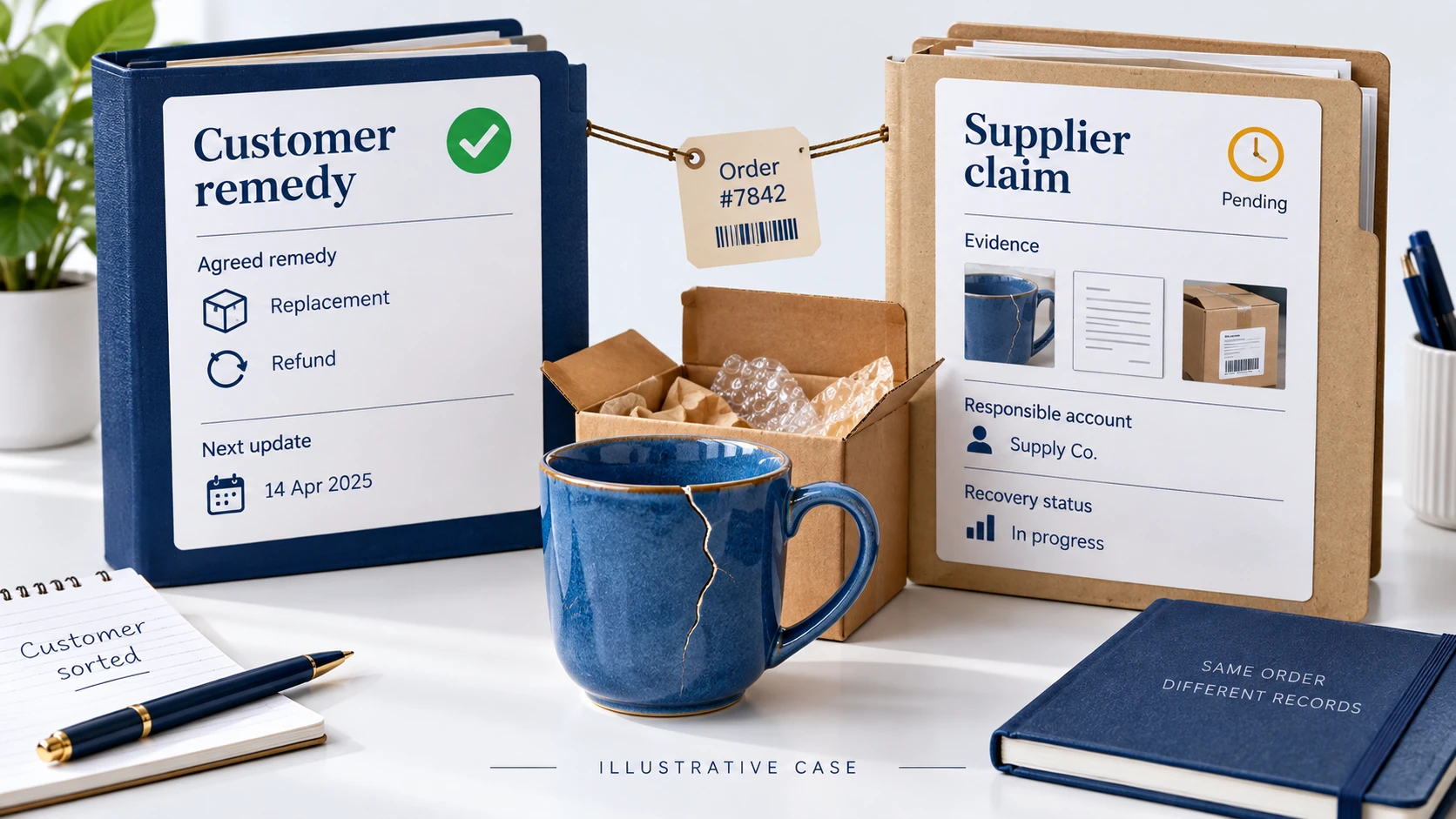
When a dropshipping customer reports a damaged item, confirm the affected product and any immediate safety concern, collect useful evidence, and arrange the remedy required for that order. Handle the supplier or carrier claim separately. Then establish what failed before sending a replacement or releasing more units through the same process.
The customer needs a resolution even while responsibility is being investigated. A supplier’s unanswered message, a carrier claim number or a pending credit does not tell the buyer what will happen to their purchase.
Keep two connected records: the customer’s case, with the agreed remedy and next update; and the commercial claim, with the evidence, responsible account and recovery status. The dropshipping returns guide covers the wider policy. This article follows the specific work created by a damaged delivery.
01
Make the first response useful
Acknowledge the problem in the existing order conversation. Identify the order, item, quantity and what the customer has observed. Ask whether the product itself is damaged, the packaging is damaged, or both. If the order has several parcels, establish which parcel contains the affected item.
Ask for information you do not already hold. A customer who has sent the order number and a clear photograph should not receive another generic form asking for the same details. Confirm what you have and explain the one missing piece needed for the next decision.
An initial response could read:
I am sorry that [item] from order [number] arrived damaged. We have your [photo or description]. Please tell us [specific missing detail], if available, so we can arrange the next step. We will update you by [achievable date or time]. Please do not send the item anywhere until we have confirmed whether a return is needed and provided suitable instructions.
Replace the fields with the actual case. The update time is an operational commitment, not a universal legal deadline. Assign an owner who can contact fulfillment and authorize the appropriate customer action, rather than passing the message through several unowned inboxes.
Treat a safety concern differently from a cosmetic mark
If the report involves an apparent safety hazard, do not ask the buyer to keep using, charging, opening or testing the item to produce evidence. Escalate to the appropriate product-safety or technical contact and follow relevant instructions for that product and location. An ordinary return label may be unsuitable for damaged batteries, leaking contents or other restricted goods.
The same caution applies to photography. A customer should not need to handle exposed sharp parts or dismantle an electrical item to satisfy a support script. Work with safe, available observations and obtain specialist handling guidance where necessary.
For an ordinary scratched non-electrical product, a close-up and a description may be enough to understand the complaint. Keep the request proportionate to the problem. A lengthy evidence demand can delay a straightforward resolution without adding useful information.
02
Collect evidence that answers a decision
The purpose of evidence is to identify the item, understand its condition and support the relevant remedy or claim. It should help someone decide what to do; collecting more files is not automatically an improvement.
Product and order identity
Keep the store order and line IDs, supplier purchase reference, variant, quantity and parcel tracking number. Include a serial, lot or batch reference when one exists and is relevant. A picture of a damaged blue pouch does not establish which of several similar variants or shipments it came from.
For a partially damaged order, record the number affected and the number apparently unaffected. Three units ordered, one visibly damaged and two not reported damaged is more useful than marking the whole order “defective.” Do not infer that unexamined units passed an inspection.
Condition and packing
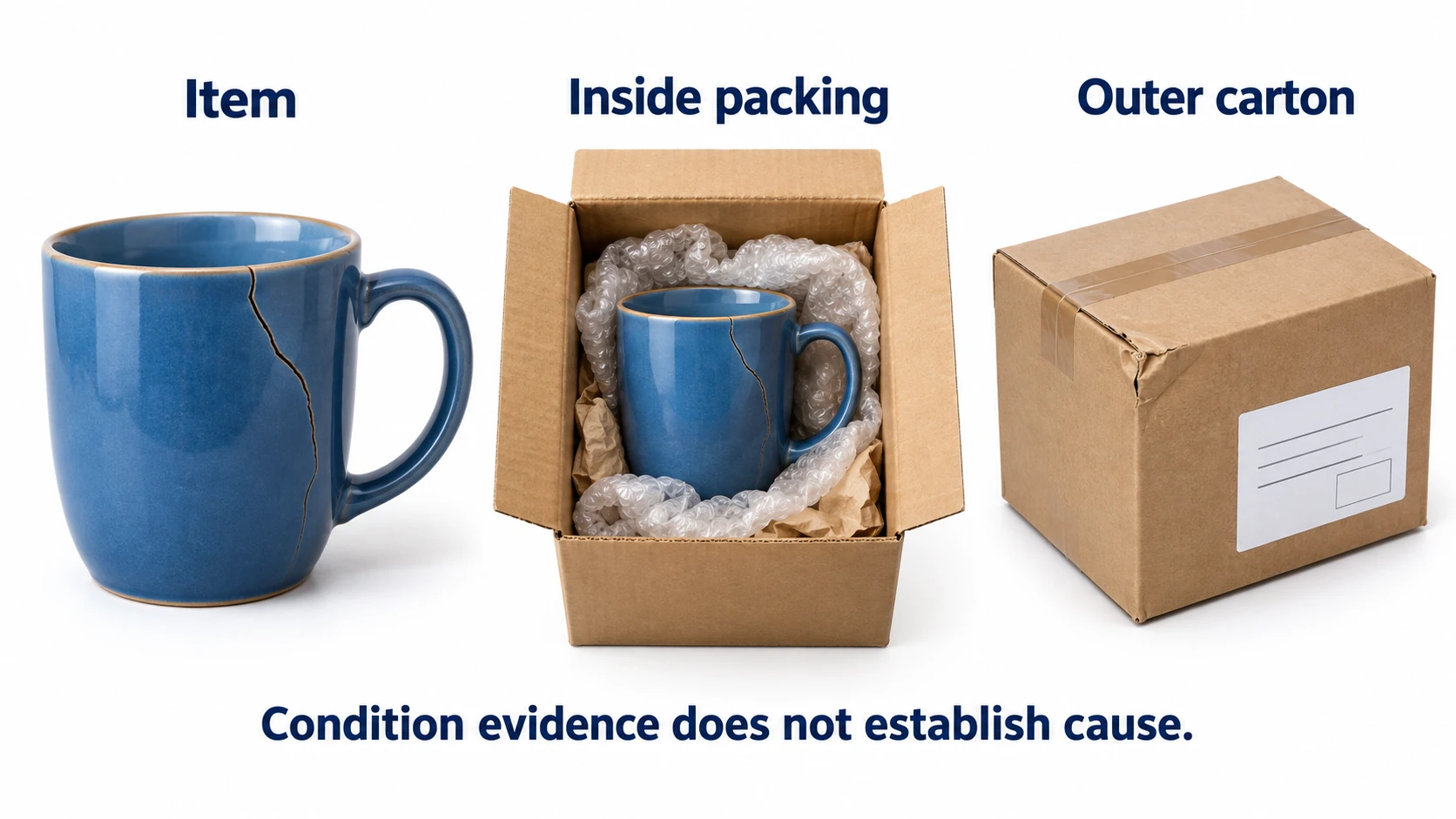
Ask for a clear view of the reported damage, the item as received within its packaging where available, and the outside of the parcel. Preserve relevant packing records already held by the warehouse. Those views can show different things: a torn corner, loose movement inside a carton, or a product defect with no visible outer-box damage.
UPS’s US claim guidance describes photographs of the damaged item and its packing, the shipping label, and the outside of the package, along with parcel dimensions. That is a useful example of a carrier’s evidence requirements; check the actual service’s request rather than imposing it on every customer case.
For an illustrative cracked ceramic cup, three views might show the crack itself, the cup’s position within its cushioning, and the outside of the carton. Together they describe the delivered condition and packing arrangement. They do not, by themselves, prove whether the crack started in production, packing or transport.
What happened and when
Record delivery date, when the problem was noticed, and the customer’s description in their own terms. Separate that description from the support agent’s interpretation. “Handle separated on opening” is an observation; “carrier dropped it” is a cause that may still be unproven.
If the product stopped working after use, ask what occurred without turning the customer into a repair technician. The investigation may need different information from a visibly crushed parcel. Preserve any relevant instructions supplied with the product and the description advertised at purchase.
Missing evidence is a question, not an automatic verdict
If the customer discarded the box, record that limitation and ask what evidence remains. If an image is unclear, explain which view would help and why. A carrier’s missing-document decision and the merchant’s customer obligations require separate consideration.
Do not invent a universal requirement for an unboxing video. It cannot retroactively document an event the customer was never expected to film, and a lack of video does not establish that the complaint is false. Investigate genuine inconsistencies using the order and shipment records you can verify.
03
Separate the observed problem from its cause
Outer packaging damage, product damage, missing contents and a functional defect can overlap, but they should not all receive the same cause code. Start with the condition reported and keep the cause provisional until the evidence supports it.
The outer carton is damaged but the item appears intact
Check whether the packaging is part of the product’s promised condition and whether the item needs a safe inspection. A crushed gift box may matter to the purchase even if the object inside works. Do not dismiss the complaint solely because a packing material is involved.
The item is damaged and the carton appears intact
Review the internal protection, item movement and pre-dispatch condition. An intact outer box does not prove the product was sound when packed, nor does it rule out damage during movement. Compare the actual packaging configuration with what was approved.
The product is wrong or incomplete
Check the picking and item-to-parcel records before opening a transit-damage claim. A missing accessory might have been omitted, packed in another parcel or lost through an opening. Each explanation leads to different corrective work and potentially a different claim.
Similar failures appear across several orders
Group the affected orders by product, variant, supplier batch, packaging version and route. Look for a shared condition without declaring the cause from one correlation. A new carton and a new carrier introduced together cannot be cleanly evaluated as if only one changed.
Hold affected unshipped stock or a particular packing configuration when the evidence warrants it. If a report suggests a broader safety problem, escalate through the relevant product-safety procedure instead of treating each case as an isolated refund. The quality-control guide explains how release decisions should relate to an agreed check.
04
Choose the customer remedy for the actual order
Check the selling market, the reason, the product and the stage of the case. The available remedy may involve repair, replacement, a price reduction or refund, with conditions determined by applicable rights and the transaction. Do not assume that your supplier’s preferred option is the only one you may offer the buyer.
For EU consumer purchases, Your Europe explains legal guarantees, including repair or replacement without charge and conditions for a price reduction or refund. UK guidance separately describes refund, repair and replacement obligations. These are jurisdiction-specific references, not a worldwide policy or a rule that every fault immediately produces the same remedy.
Replacement
Confirm available stock, the correct variant, any necessary check, and the revised delivery estimate before promising another shipment. Link the replacement order to the original case so support can trace it and finance can distinguish it from a second sale.
If the first item’s damage may come from its packaging, address that before repeating the shipment. Sending an identical parcel through an unchanged process can repeat the problem. If a replacement differs materially, explain the exact change and obtain the agreement required for that substitution.
Repair or a replacement part
This can be appropriate only where the product, customer rights and practical process support it. Establish who performs the work, whether it can be completed safely, how costs are handled and what happens if it fails. Do not ask the buyer to perform an unsafe repair to avoid the cost of another item.
A missing removable accessory and a cracked structural component are different problems. Confirm that the proposed part actually resolves the fault and that the buyer can use it as intended. A vague promise to “send something to fix it” is not a complete arrangement.
Refund or an agreed price reduction
Confirm the affected items, amount, payment route and any relevant shipping or tax treatment. Record a refund as completed only when the payment process confirms it, and explain the expected processing status accurately. Stop any replacement or supplier release that would conflict with the customer’s chosen resolution.
A discount should not pressure a customer to keep an unsafe or unusable product, or replace a monetary remedy they are entitled to receive. Where a price reduction is a valid agreed solution for a usable item, record what condition the customer is accepting. Keep that agreement distinct from the supplier credit you may recover later.
05
Decide whether the damaged item needs to move
Confirm whether the item must be retained for inspection, returned to an authorized receiver, or handled through another suitable route. Obtain the specific instructions before buying a label. An address printed on the original parcel is not automatically a damage-return destination.
FedEx’s claims guidance tells claimants to retain original packaging and contents while the claim is unresolved and describes possible inspection requirements. Where retention would create a safety issue, obtain appropriate safe-handling instructions rather than asking the customer to preserve a hazard indefinitely.
For ordinary goods that can be transported safely, the return-address guide helps confirm the receiver, reference and post-arrival action. State who arranges and pays for the return under the applicable circumstances. A support message should not require the customer to find an overseas destination or fund an unexplained shipment.
If a return is unnecessary, record that decision and communicate it clearly. Do not tell someone to dispose of a product that a carrier or supplier still needs to inspect. For regulated, electrical or other special products, establish an appropriate handling or disposal route before giving instructions.
06
Run supplier and carrier recovery in parallel
The customer’s purchase, your supplier agreement and the carrier shipment are separate relationships. Keep their references connected, but track the obligations and outcomes separately. A supplier may reimburse the product cost while excluding transport; a carrier may require a claim through the shipping account; neither result is guaranteed by sending a photograph.
Submit a supplier claim someone can assess
Send the purchase reference, exact item, affected quantity, reported condition, relevant evidence and remedy requested. Include the applicable agreed specification or packaging requirement if it helps explain the discrepancy. Ask the supplier to identify any missing evidence specifically rather than restarting the case with a general rejection.
Clarify what an approval means. Is it a cash refund, credit against future purchases, free replacement product, or coverage of product and freight? Ask when and how the recovery will appear and whether the damaged goods must be returned. Keep an unresolved promise open until it is actually fulfilled.
Establish who can handle the carrier claim
Identify the carrier service and the account used to buy the shipment. If your supplier or agent owns that account, agree who files the claim, responds to requests and receives any payment. Avoid opening duplicate claims without checking the existing reference.
Preserve the applicable terms and deadlines for that shipment. UPS and FedEx publish claim guidance with different conditions by country, service and type of loss. Check the current rule directly; do not copy a single number into every customer’s return policy. A carrier filing window does not define the full scope of consumer rights.
Keep proof of value and the relevant invoice along with the physical evidence. Declared value, sale price, replacement cost and recoverable amount are not automatically identical. State the amounts truthfully and follow the provider’s valuation requirements.
Escalate a disputed cause with the relevant record
If the supplier says the parcel was packed correctly, request the applicable packing record and approved configuration. If the carrier questions protection, identify the actual materials, product restraint and parcel dimensions. Evidence about a different item or a demonstration carton does not establish how this shipment was packed.
When the evidence cannot resolve responsibility, record that uncertainty and the financial exposure. Repeatedly forwarding the same unclear image is unlikely to settle it. Decide whether further inspection has enough value to justify the delay and cost, while continuing the required customer resolution.
07
Calculate the incident cost without double counting
A refund, a replacement and a supplier credit affect different parts of the order. Use separate entries so that a pending reimbursement cannot make a loss disappear on paper.
Consider a hypothetical original order with a $50 sale, $18 product cost, $7 outbound shipping and $2 payment fee. Ignore tax and overhead for this teaching example. Before the damage is resolved, its contribution is $50 − $18 − $7 − $2 = $23.
Suppose a no-return replacement is the agreed customer remedy. The second product costs $18, shipping costs $7, and the supplier later issues a $10 credit. Contribution becomes $23 − $18 − $7 + $10 = $8. Without that credit, it is −$2. These are invented figures, not an AIDrop case or a promised recovery.
In a separate refund scenario for the same original order, a full $50 refund and the same $10 supplier credit leave $23 − $50 + $10 = −$17, assuming the original costs remain incurred and the payment fee is not returned. If return transport, fee recovery or tax adjustments apply, include them explicitly. Do not add the replacement costs from the other scenario unless both actions actually occurred.
The example is not a reason to choose a cheaper remedy over the customer’s rights. It shows what the selected resolution costs. A supplier’s account credit may reduce a future purchase without adding cash to the bank today, so keep cash-flow forecasting separate from this contribution calculation.
08
Prevent the same damage on the next shipment
Use the case evidence to identify a testable change. If a product moved inside a carton, review restraint and cushioning. If several units from one batch show the same fault without obvious transit damage, inspect that batch and the relevant product feature. If picking records reveal the wrong accessory, repair that mapping or packing instruction.
Approve the change on the actual packed product
Record the old and new packaging versions, product variant and checks performed. Use the real item, accessories and shipping configuration. A visually attractive empty box says little about protection once the order is packed.
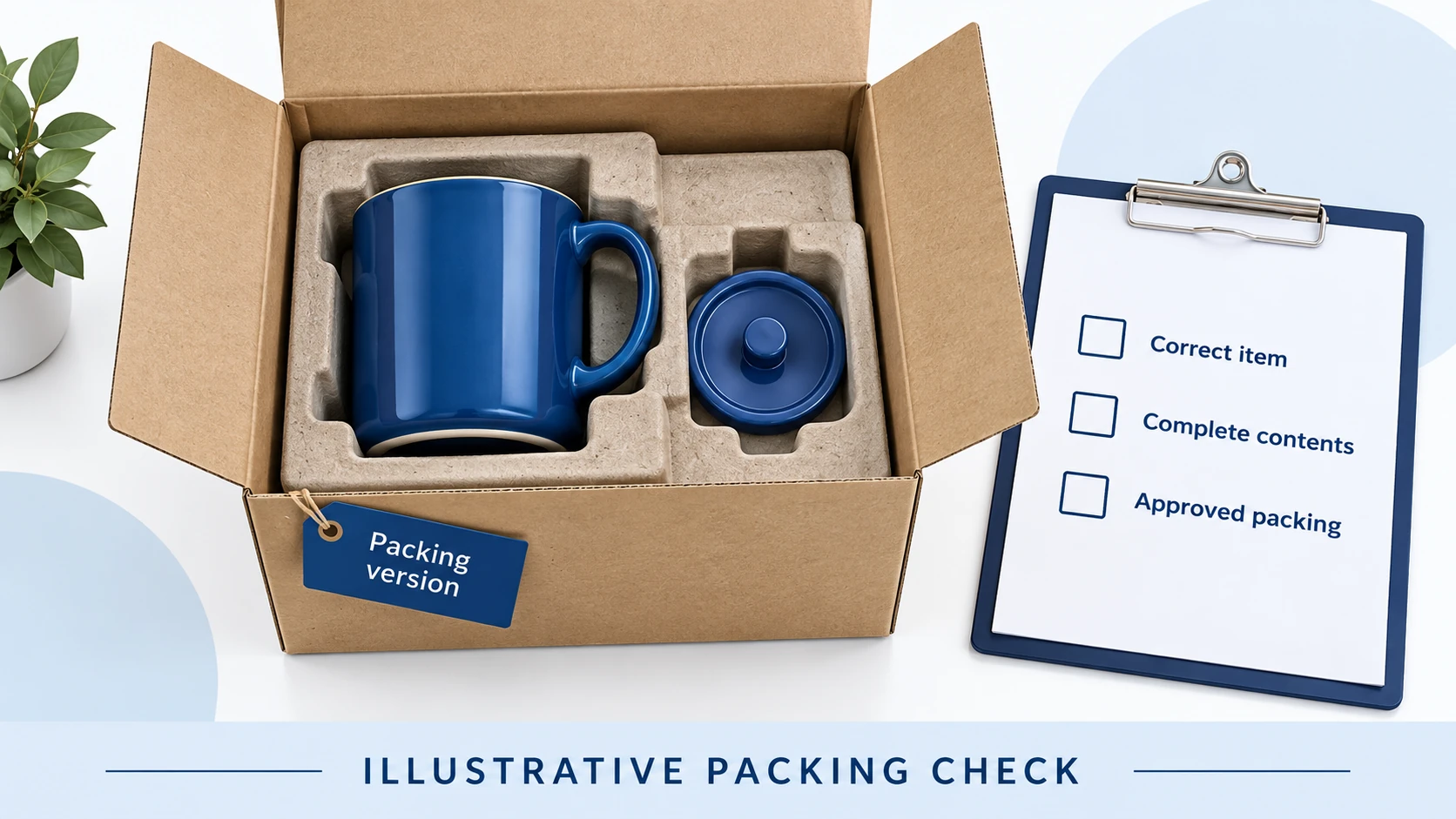
Do not invent a universal home-made drop-test threshold or call an informal check certification. Agree a suitable test or qualified assessment for the product and route, then document what it does and does not establish. The packaging guide connects the pack design with fulfillment requirements.
Check the result across a defined shipment group
Track the corrected configuration separately from old stock still moving through the route. Compare damage reports against the relevant delivered orders, allowing enough time for reports to arrive. Keep open and late reports visible.
For an illustrative comparison, six reported damaged orders among 200 delivered orders equal 3%. One report among 40 delivered orders equals 2.5%. The second percentage alone is weak evidence of improvement because the sample is small and reporting may still be incomplete. These synthetic counts show why volume, timing and comparable conditions matter.
Also inspect which failures remain. A lower total can hide a new problem affecting a particular fragile variant. Continue, revise or hold the changed configuration based on the actual evidence; do not promote a small pilot as a zero-damage guarantee.
09
Close the customer case and keep unfinished recovery visible
Confirm that the agreed refund was processed, replacement was delivered, or other remedy was completed. Keep the supporting reference and customer communication with the case. Creating a replacement order is a start, not proof that the buyer received a usable item.
Separately review the supplier and carrier records: claim submitted, further information requested, decision received, and credit or payment confirmed. If recovery is denied, record the reason and any justified next action. Do not leave the same expected credit in the forecast month after month without review.
Finally, connect the incident to the corrective work: affected variant or batch, likely cause and its evidence, revised check or packaging instruction, person responsible, and follow-up result. The Dropshipping Hub’s operations section brings those customer, inventory and shipping decisions together.
10
Frequently asked questions
Should I wait for my supplier before helping the customer?
Investigate with the supplier promptly, but assess and meet the customer’s applicable remedy and timing separately. Tell the buyer what you are arranging and when they will hear from you; a pending supplier claim is not a customer resolution.
Do I always need an unboxing video?
No universal rule makes a video necessary for every damaged-item complaint. Collect relevant available evidence and check the actual claim requirements. A missing video does not prove that an item arrived undamaged.
Can I automatically send a replacement?
First establish the remedy appropriate to the order and any required customer agreement. Confirm stock, specifications and the cause of the first failure. Avoid sending another item after the customer has already been promised a conflicting refund.
Who pays when the supplier and carrier blame each other?
Responsibility and recovery depend on the evidence and relevant agreements. Keep the customer’s rights separate, preserve both claims, and record unrecovered cost honestly. Do not assume either party will reimburse the full retail sale price.