

One buyer order can arrive in two or more parcels. Show which items travel separately, price all supplier freight and keep each tracking number tied to its contents. Then decide whether splitting, consolidation or waiting fits the offer.
If a customer buys a desk lamp and a replacement shade, the lamp may ship from China while the shade comes from a local partner. Promising “one parcel in five days” would be wrong even if the checkout accepts the order. The practical decision is whether to split, consolidate, or change the offer before taking payment.
Explore the broader topic: Dropshipping Fulfillment: From Paid Order to Delivered Parcel.
01
Find the split before checkout does
Find the real dispatch point for each item
List every item in the cart with its supplier, physical dispatch point, ready date and available destination services. Two products sourced from different suppliers may still be consolidated by an agreed agent; two products from the same brand may ship separately from different warehouses. Do not infer the parcel count from the supplier logo.
Keep checkout display separate from physical shipping
Shopify’s split-shipping documentation describes cases including preorders, subscriptions, separate locations and shipping profiles. It says checkout can display multiple shipments and shipping options, with limitations and rate behavior that can vary with a store’s configuration and Markets upgrade. That documentation concerns Shopify checkout. Your supplier app and physical warehouse still decide whether the parcels follow the displayed plan.
Compare the buyer charge with both supplier quotes
Use a test cart for the market and product combination you actually sell. If checkout shows one shipping line while two suppliers will each charge you, you may underprice the order. If it shows two charges when an agent will consolidate, the customer may abandon a cart that could have been cheaper. The multiple-suppliers article covers the broader sourcing model; this page focuses on what the buyer pays and sees for a specific order.
Check the shipping setting your Shopify store actually has
Shopify’s current split-shipping instructions distinguish stores upgraded to shipping options by market from those that still have a switch.
If the switch exists
Go to Settings → Shipping and delivery. Under the profiles, open split shipping or Manage as applicable. Select Show split shipping in checkout and Save. Reopen an eligible lamp/shade cart with the actual market address and check item groups, delivery choices and total charge.
If the store is upgraded
Split shipping is already active; that switch no longer applies. The same shipping option’s eligible flat/order-amount rates can use the highest matching rate once, showing Included on other groups. Different options, app-provided rates, or preorder plus ready items are added. Check the actual configuration rather than adding two supplier rates by default.
On a non-upgraded store, flat rates in the same location group can be charged once; separate groups/profiles are combined. Checkout display does not merge physical boxes. Splitting the same line’s quantity across locations is not a supported substitute for having its full quantity at one location.
02
Compare the three physical options
Split, consolidate and hold are not synonyms. Each changes cost, delivery timing and customer communication.

| Option | What happens to the items | Main tradeoff |
|---|---|---|
| Ship separately | Each source sends its own parcel to the buyer | More freight and tracking; the ready item can arrive sooner |
| Consolidate | Items move to one packing point, then one parcel goes to the buyer | Extra handling and possibly storage; one final parcel may be cheaper or clearer |
| Hold one item | Ready item waits for the other before dispatch | Fewer parcels, but the buyer waits for the slowest item |
Before choosing consolidation, ask who receives the inbound items, checks them, repacks them and owns a missing or damaged component. A theoretical single-box rate is not the full cost. The bundles guide is useful when the offer itself depends on every piece arriving together.
Check whether the buyer can use the first item alone
The relationship between items matters. If the shade has no use without the lamp and the lamp may arrive weeks earlier, the buyer may see an incomplete purchase even though each parcel is “on time” by its own route.
You might decide to hold both until the shade is ready or sell the shade as a separate optional order. That is a product decision as much as a shipping setting. Write the choice into the offer so checkout and fulfillment do not make contradictory promises.
Another option is to restrict the bundle to a shared supplier or destination where the parts can ship together. That can reduce variants and marketing reach, but it may lower support cost.
Compare the basket contribution before a settings change
Before changing the shipping profile, compare the contribution from the bundle with the cost of a second parcel, likely support contacts and any delayed-delivery remedy. A split is worthwhile when the buyer understands it and the order still works financially; one-box aesthetics alone are not a reason to pay for consolidation.
Respect the original ready-item promise
Do not hold a ready item without considering the checkout promise. A customer who buys a lamp and a preorder shade may be willing to wait for the shade but expect the lamp promptly. State the options before payment if they change shipping cost or delivery dates.
03
Price one order with two supplier charges
Use illustrative numbers to see why the cart needs its own economics. A store sells a lamp for $45 and a shade for $20, collecting $65 for products. Supplier A charges $18 for the lamp and $9 delivery. Supplier B charges $7 for the shade and $6 delivery.

Calculate both parcel costs before quoting
The two items cost $25 and both direct freight charges total $15: $40 altogether. From $65 product revenue, $25 remains before the other variable costs. If you budgeted only Supplier A’s $9 freight, you would expect $31; adding the forgotten $6 changes that to $25. Do not subtract the same $6 from $25 again.
Compare consolidation using its own full route cost
Now suppose a consolidation partner charges $4 to receive and combine the items plus $11 for the final parcel, and inbound supplier-to-partner freight is another $5. The consolidated handling and freight total is $20, compared with $15 for separate direct shipping in this simplified example.
One box is more expensive here. It might still improve the buyer experience, but the merchant should not claim it automatically saves money. Replace every number with actual quotes and account for packed weight, customs and returns before making the choice.
Compare the two routes using one buyer payment
These are your hypothetical basket inputs, not shipping-provider prices: buyer revenue $69, items $25, processing $2, and expected return/support allowance $3. Freight and receiving differ by route.
Direct parcels
Use 69 - 25 - 9 - 6 - 2 - 3: $24 before fixed costs. Keep the actual quotes and effective date beside the two freight entries; one buyer shipping line of $4 does not pay the suppliers only $4.
Consolidated parcel
Use 69 - 25 - 5 - 4 - 11 - 2 - 3: $19. The $5 inbound, $4 handling and $11 final freight replace the two direct freight entries. Adding direct freight again would count two incompatible routes.
Change final consolidation freight from $11 to $7 and the same sheet should show $23, still $1 below direct shipping. If customer revenue or packed weight changes, replace those inputs too. A better delivery experience might justify a lower contribution, but the numbers do not automatically justify it.
Build a quote the customer and order team can both understand
Keep three layers apart: what the buyer pays, what each supplier charges, and what each physical parcel promises. Using the same illustrative basket, suppose checkout charges $65 for products and $4 shipping. The two suppliers charge $40 in products and freight combined.
If payment processing is $2 and you set aside $3 for expected returns and support, $24 remains before fixed costs: $69 − $40 − $2 − $3. The $4 customer shipping line does not imply that shipping cost $4; supplier freight in this example is $15. If a route needs a separately quoted duty-paid service or other charge, subtract the real amount before calling $24 a usable contribution.
| Customer-facing group | Physical source | Supplier charge in this example | Promise to verify |
|---|---|---|---|
| Lamp, package 1 | Supplier A | $18 item + $9 freight | Destination service, dispatch window, first carrier scan |
| Shade, package 2 | Supplier B | $7 item + $6 freight | Separate readiness, route and tracking link |
| One checkout payment | Merchant store | $65 products + $4 buyer shipping | Two packages disclosed before payment, with item-level updates afterward |
Quote the basket, not two isolated product pages. A free-shipping threshold, discount or return allowance can change when both items appear together. At checkout, test the exact address and both variants.
Then compare the buyer’s displayed shipment groups with the supplier charges and with what your confirmation email will say. If the checkout cannot show the split clearly, decide whether a truthful pre-payment message and post-purchase order update can meet the buyer’s expectation before enabling the combination.
The shipping-cost guide helps build the complete per-order cost. Keep product revenue, customer-visible delivery charge and supplier freight as separate columns. “Free shipping” on the storefront is a pricing choice, not a disappearance of freight cost.
04
Make the confirmation say which item travels in which parcel
After checkout, the customer should be able to tell whether one or two packages are expected and which items each contains. If the platform can show separate shipment groups, verify the group labels and estimated timing in the order confirmation. If it cannot, send a clear merchant message based on the actual supplier plan. Do not create a second tracking number merely to make the interface look complete.
A plain example:
Your lamp ships from our first fulfillment partner. The replacement shade ships separately and may arrive later. We will send a tracking link for each parcel when the carrier receives it.
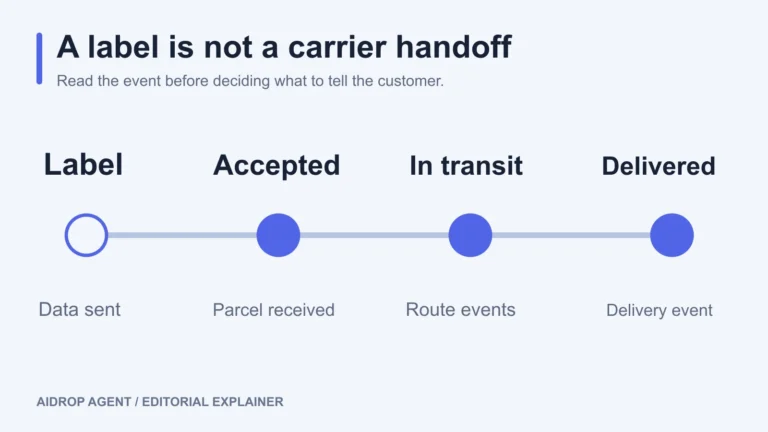
Replace the generic wording with real dispatch and delivery information when you have it. A printed label is not the same as a carrier acceptance scan; the tracking article explains that distinction.
Name the affected item and its own tracking
If one parcel is delayed, talk about the affected item rather than telling the buyer “your order is late” without context. A customer may have received the lamp and need only the shade. Support should see a line-item-to-parcel map: order ID, item, supplier, supplier order ID, carrier, tracking, last event and customer notification.
Reconcile the second parcel before closing the case
First parcel delivered is not whole order delivered
Some commerce systems show an order as partially fulfilled until all items ship. Shopify’s app-fulfillment guidance notes that items fulfilled by different services can arrive at different times and the order is fully fulfilled only after all are shipped. Make sure your customer service view can distinguish “first parcel delivered” from “whole order delivered.”
Suppose the lamp is delivered Tuesday and the shade’s tracking has no first scan by Friday. Do not answer the shade complaint with the lamp’s proof of delivery. Check Supplier B’s acceptance and carrier handover, then decide whether to replace, wait or refund that item according to the facts. The lost-parcel guide addresses evidence once a parcel is in the route.
05
Treat customs and returns by parcel, not by cart
Check customs and duty service for each parcel
Two parcels may cross different borders or use different import arrangements. The customer may pay one checkout amount, while each supplier creates its own customs document and freight charge. Confirm who is the importer, what product information each parcel carries and whether the delivery service includes duties for that route.
Do not call the whole order “DDP” because only one supplier quoted a duty-paid service. The DDP guide covers the information needed to verify a duty-paid quote.
If the lamp parcel is delayed at customs, that does not mean the locally shipped shade is also delayed. Give support access to each parcel’s origin, product and carrier status. If a buyer asks for a return, identify which item they are returning and which facility can receive it.
A single generic return address may send the shade to the lamp supplier, where it cannot be recognized or credited. The return-address article explains why the outbound origin is not automatically the correct return destination.
Keep the one-item remedy separate
Suppose the buyer rejects only the shade after the lamp has been delivered. Work the shade’s price, any item-specific shipping charge, discount and applicable tax through the platform’s partial-refund flow. Do not refund the entire order merely because its one checkout number represents two parcels, and do not refuse a valid shade remedy because the lamp is fine. Keep the supplier credit separate from the buyer refund.
The customer may not understand a split the first time
Tell the buyer what each package contains
A buyer who receives the lamp first may think the shade was omitted. Your confirmation and tracking page should name the contents of each package in ordinary language. If your system can only show two tracking numbers without contents, add a concise message: “Package 1: lamp; Package 2: shade.” Send an update when the second package’s first carrier event arrives, not a vague repeated “your order shipped” email that appears to refer to the first parcel.
Inspect the confirmation the buyer actually saw
If support tickets still spike, inspect the actual confirmation a buyer saw. A perfectly worded shipping policy buried in a footer will not fix an order email that says “all items delivered” after one package arrives. This is a content and data issue together: supplier parcel contents have to map to the store’s line items.
06
Run a two-item test cart before promotion
Test the real basket and each supplier handoff
Put the actual products in checkout with an address in the target market. Compare checkout shipment groups and shipping charges with both supplier quotes. Place a controlled order through the supported test or pilot route. Verify each supplier receives only its item, the customer receives the right notifications, and every tracking number attaches to the right line item.
Rehearse one failure through an isolated test or supplier-agreed pilot: Supplier B rejects the shade while Supplier A accepts the lamp. Confirm the buyer can see what still comes, the rejected line has a refund or replacement decision, and the accepted lamp is not cancelled or duplicated. If the controls fail, add a review step or change the combination before taking more real orders.
Keep the successful parcel open when the other fails
Write the failure result beside the test cart: shade rejected / lamp accepted / buyer notified / shade refund or replacement decided / lamp tracking remains active. That one line prevents a store-wide “order cancelled” status from hiding a real lamp parcel. Repeat the test when the supplier location, product bundle or checkout shipping profile changes. A configuration that was correct for two direct parcels may not be correct after one item moves to a consolidation warehouse.
AIDrop Agent can assess whether China-side sourcing, packaging and shipping can be consolidated for a particular basket. Send item SKUs, destinations, planned parcel count and available quotes through the review form. A consolidation quote depends on the actual items and route; it should not be inferred from this example.
07
Frequently asked questions
Will a split order always cost more to ship?
Not necessarily. It often means more than one direct freight charge, but consolidation adds receiving and repacking work. Compare actual end-to-end quotes for both routes.
Can I hide the split until after payment?
That risks a misleading delivery promise, especially when one item is slower or the buyer pays separate shipping. Show the material difference in checkout or the offer and confirm it after purchase.
Can one tracking number cover both packages?
Only if the carrier’s service genuinely links both pieces under that tracking arrangement. Otherwise keep separate tracking for each parcel and map each number to its contents.
Dropshipping Shipping Times: What to Promise Your Customers
Use product-specific processing and transit estimates to set a delivery promise. Named route examples and a worked
Dropshipping Shipping Costs: Compare the Whole Parcel Quote
Calculate dropshipping shipping costs from packed dimensions, billed weight and fees. Compare a worked parcel quote, import
Dropshipping Tracking: Set It Up and Handle Missing Updates
Set up parcel-level tracking, interpret carrier events, and investigate missing updates without mistaking a shipping label for
