

DDP dropshipping means arranging delivery on Delivered Duty Paid terms: the seller takes responsibility for the agreed delivery and import clearance, including applicable import charges. For a store selling cross-border, the attraction is a customer who receives a parcel without an unexpected duty-collection request.
That promise needs more than “DDP available” in a supplier’s price sheet. Your supplier agreement, the importer used for the shipment, and the account billed by the carrier must work together. This guide explains the arrangement, how to compare its cost, and what to check before offering it to customers.
01
What DDP actually covers
Under DDP Incoterms® 2020, delivery occurs at the agreed destination when the goods are available to the buyer on the arriving vehicle, ready for unloading. The seller handles the required export, transit and import formalities. The buyer normally handles unloading. The ICC’s explanation of DAP and DDP sets out those responsibilities.
Name the destination precisely. A quote for delivery to a consolidation warehouse does not describe the same service as delivery to your customer’s address. Ask whether the amount covers the final parcel leg, and identify the point at which the supplier considers its delivery complete.
The term also needs a specific transaction. You might buy from a supplier on one set of terms and sell to your customer on another. A freight provider may use “DDP line” as a service description. Obtain its actual service scope rather than assuming that description supplies every term missing from your purchase agreement.
DDP is not a complete sales contract. Payment timing, ownership transfer and remedies for late or nonconforming goods need separate treatment. The US International Trade Administration’s Incoterms overview explains these limits. Keep your customer refund promise and supplier reimbursement arrangement explicit.
02
Separate the seller, importer and carrier payer
In a dropshipping order, several businesses can perform different jobs. The store accepts the customer’s order. A supplier prepares the goods. A carrier moves the parcel, and an importer or its representative handles the required customs entry. One business might perform several roles, but the name on a shipping quote does not prove that it does.
An illustrative order has three records to reconcile: the supplier agreement states the delivery promise, the customs arrangement identifies the importer, and the carrier booking identifies the duty payer. Those records describe different responsibilities even when the same business appears in more than one of them.
Ask your supplier these questions together:
- Which business is selling the goods to us, and what destination does its price cover?
- Which entity will be named as importer, where required, and who represents it?
- Which carrier account receives import-duty, tax and clearance-service charges?
- Who provides the documents if a customer receives a bill or customs requests information?
The distinction is practical. DHL’s duty billing guidance describes billing services as instructions about who pays the carrier; it expressly distinguishes those services from the Incoterms in the sale contract.
A payer selection does not establish importer eligibility. Nor does it tell you whether the supplier will reimburse an incorrectly billed customer. Get those answers from the agreement and the actual clearance arrangement before relying on the service.
03
DDP or DAP: choose a promise you can fulfill
DDP: the seller assumes import clearance and its associated costs under the agreed terms. It can suit a store that wants to offer customers an inclusive delivery price, provided the seller can execute that arrangement.
DAP: the buyer handles import clearance and pays the relevant import costs. That can suit an informed business buyer with its own import arrangements, but a consumer needs clear information about charges they may face.
The difference does not identify a faster carrier or a better product. Both arrangements still need accurate shipment data and a workable route. For delivery estimates, use the full order timeline described in dropshipping shipping times, including preparation before carrier acceptance.
DDP can simplify the customer’s payment experience. For the merchant, it also means assessing costs before quoting the customer and deciding how to absorb differences between estimates and final invoices. The benefit is most useful when your billing process can support the promise consistently.
If your supplier cannot arrange import clearance lawfully, do not solve the problem by changing a checkout label. Either establish a suitable arrangement or offer a different delivery model with its obligations explained before purchase.
04
Check the destination and product before approving the route
Confirm who can import the goods before paying for a DDP service. ICC documents national restrictions affecting Incoterms, including requirements tied to local entities. A foreign seller’s contractual obligation does not override the destination’s rules.
Give the broker or shipping provider enough detail to answer a specific question. “Can you ship to Europe?” is too broad. Provide the destination country, product description, materials or ingredients where relevant, country of origin, value, quantity and intended shipment pattern.
Request written confirmation of the proposed importer and any registration, authorization or product documents the route needs. If the answer is only “we handle everything,” ask who is responsible for answering a customs inquiry and how you obtain the shipment records.
Your product information should describe what is actually being shipped. A price sheet for a plain textile item cannot automatically support a battery-powered variant sold under the same product family. Changes to the product or package should trigger a fresh check with the provider.
This review is specific to the destination and item. A successful sample parcel is useful operational evidence, but it does not establish that every future product, order value or destination can use the same arrangement.
05
Compare the complete quote, not the freight line
A useful DDP quote identifies the goods, destination and covered charges. Ask for the assumptions behind the amount as well as the amount itself. Otherwise, two prices can look comparable while one ends at a warehouse or excludes a clearance charge.
For the same product and destination, request:
- Product and package: variant, quantity, packed weight and dimensions used for pricing.
- Transport scope: collection point, international movement, final delivery area and service.
- Import scope: the duty, tax and clearance charges included, with exclusions stated separately.
- Price validity: currency, effective dates and the circumstances that trigger a revised quote.
- Exceptions: remote-area delivery, address correction, inspection, storage, return and redelivery treatment.
- Billing evidence: the invoice or reconciliation supplied after dispatch and the route for disputing a charge.
Consider an entirely hypothetical comparison for an identical parcel and destination. Quote A shows $8 for transport but excludes $5 of assumed import and handling charges. Quote B includes those same items for $12. On the stated assumptions, A totals $13 and B totals $12. The apparent $4 saving becomes a $1 disadvantage.
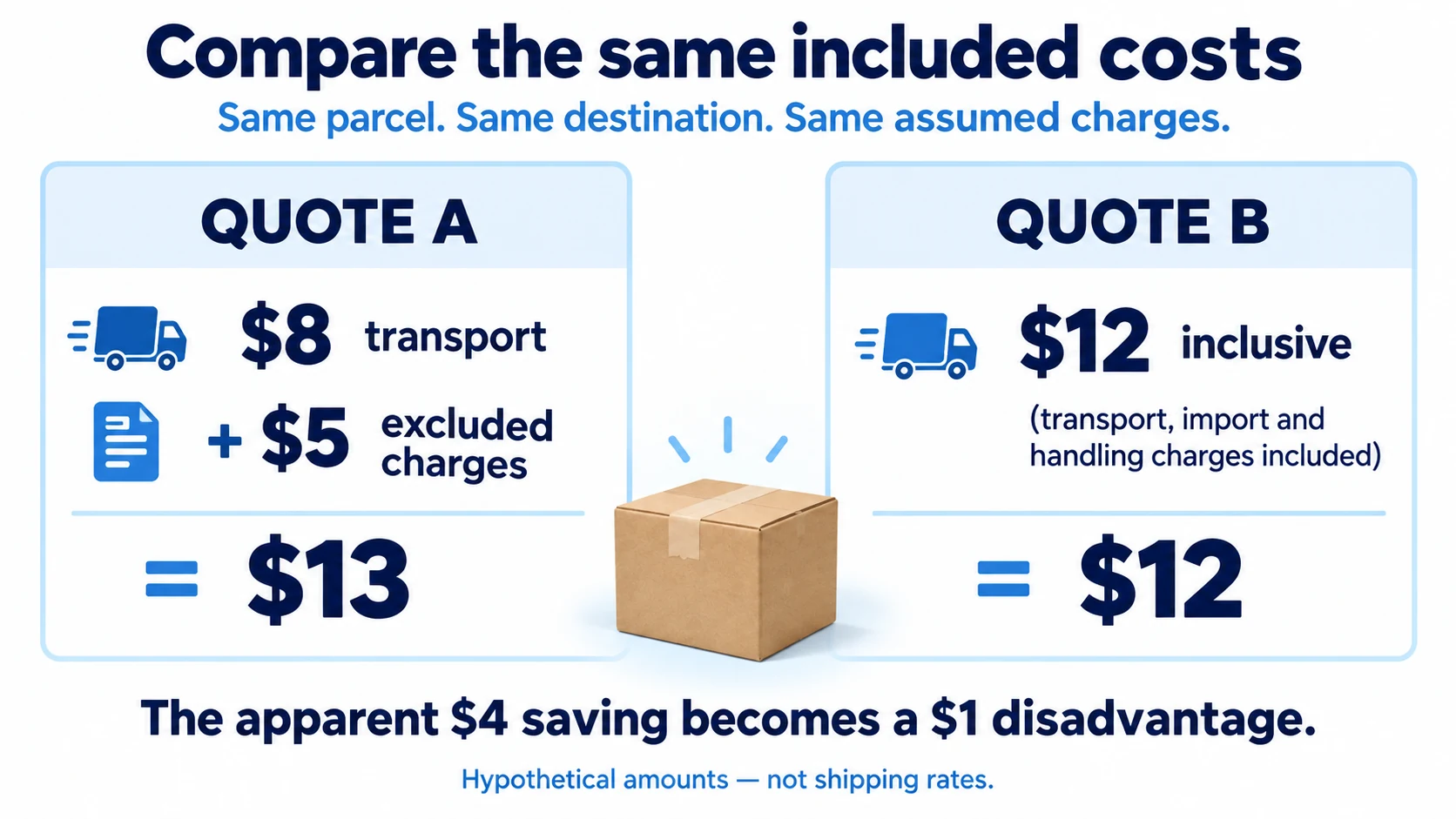
These figures are an arithmetic example, not current shipping prices or tax rates. The point is to compare matching inclusions. If B also excludes final delivery, neither quote is ready for the decision above.
Ask separately how later adjustments are handled. For example, if the provider changes its assessment of the parcel’s weight, which record supports the change, who approves it, and when will the invoice arrive? An inclusive price is useful only when the agreed exceptions are also understandable.
Do not assume a tax amount is recoverable when building your margin. Obtain destination-specific accounting advice for your arrangement. Until you have a supported treatment, avoid showing a tax refund as a certain saving in your internal comparison.
06
Connect checkout to the actual shipment
Start with one eligible product and destination rather than enabling the same delivery promise across every market. Map the customer’s selected service to the supplier’s approved route, then check how duty billing is passed into the shipment booking.
Collecting import charges at checkout does not configure a supplier’s label. Shopify’s duties and import taxes guidance explains that collecting charges must be paired with compatible delivery arrangements; support for DDP labels depends on the carrier and purchasing route. If the supplier buys the label outside Shopify, verify its booking separately.
Use a test order to inspect the handoff:
- Confirm the product, variant, quantity and destination match the approved quote.
- Check the transmitted customs description, origin and value against the order’s actual goods and the provider’s requirements.
- Obtain confirmation of the intended duty payer and import arrangement.
- Follow the shipment through carrier acceptance and delivery, then reconcile the invoice.
- Check whether the recipient was asked to pay anything that the store had promised to cover.
Record the result for that particular route. If the supplier substitutes another service, pause the affected promise until the replacement’s scope is understood. A similar transit estimate does not establish identical import billing.
Keep your customer wording as specific as the service. If duties are included only for selected destinations or services, make that limitation visible before payment. Customer support should be able to identify the promise attached to a particular order without reconstructing a later version of the checkout page.
07
When a customer receives a duty bill or the parcel is held
Treat an unexpected payment request as an order exception that needs evidence. Ask for the carrier notice, tracking number and charge description. Match them to the order before deciding whether the notice relates to duty, tax, clearance processing or another delivery charge.
Your provider then needs a concise record: the agreed quote, shipment reference, intended payer, recipient notice and the date by which action is requested. Ask whether the carrier can correct the billing and whether delivery is waiting for payment or for missing information.
Do not tell the customer to ignore a carrier deadline while the issue is unresolved. Give them a clear support contact and the next update you can actually provide. If your store authorizes a payment and reimbursement to protect the delivery, record the authorization and evidence needed for that reimbursement.
A customs hold may need documents rather than money. Identify the specific information requested and the party authorized to provide it. Avoid repeatedly resending the same incomplete invoice or creating a second shipment before you understand the first shipment’s status.
After the immediate order is handled, correct the cause for the affected route. A missing payer instruction calls for a booking fix; an excluded charge calls for a quote or customer-promise correction. Review other orders using that same setup without assuming unrelated routes have failed too.
08
Agree return and refund treatment separately
Delivery to the customer and movement back from the customer are different operations. Before using a route at scale, decide where a returned item goes, who buys its return label, and what happens if the supplier will not accept the return.
Record at least the return destination, authorization procedure, tracking requirement and treatment of return or disposal costs. A low-value product can be uneconomical to ship internationally twice, so the customer remedy needs a practical decision owner.
A customer refund also does not automatically reverse a customs payment. Recovery procedures and eligibility depend on the jurisdiction and shipment. Keep the commercial refund decision separate from any later tax or duty recovery, and retain the records your adviser or provider requires.
For an undeliverable parcel, ask the carrier or supplier about the available options and deadlines before choosing return, redelivery or another supported action. “DDP” on the original quote is not enough information to price that exception.
09
Frequently asked questions
Does DDP mean free shipping?
No. It describes how delivery and import responsibilities are allocated. The seller still needs to pay the relevant costs and can include them in the product price or delivery charge. Compare the customer’s total and your actual costs separately.
Is DDP always better for dropshipping?
It can make cross-border delivery easier for customers who do not want to handle import payments. It still requires a feasible import arrangement and a price the store can support. An experienced business buyer may prefer to manage imports itself.
Does DDP guarantee that the parcel clears customs?
No. The shipment still needs to meet applicable requirements. Confirm the product and importer arrangement with the relevant provider before dispatch, and identify who handles a request for more information.
Does DDP include insurance?
The term does not itself require the seller to obtain insurance for the buyer. Ask what cover, if any, is included in the actual transport arrangement, and check the loss or damage claim procedure separately.
Can I use the same DDP quote for every order?
Only within its agreed scope. A different destination, product, package, service or validity period may change the quote. Store the assumptions with the route so your team can recognize when a new confirmation is needed.
What should I send when requesting a route review?
Send the product details, packed dimensions and weight, origin, destination, order value, expected shipment pattern and the promise you want to give the customer. Ask for the importer arrangement, included charges and exception process in the response. That gives you something concrete to compare before accepting orders.