
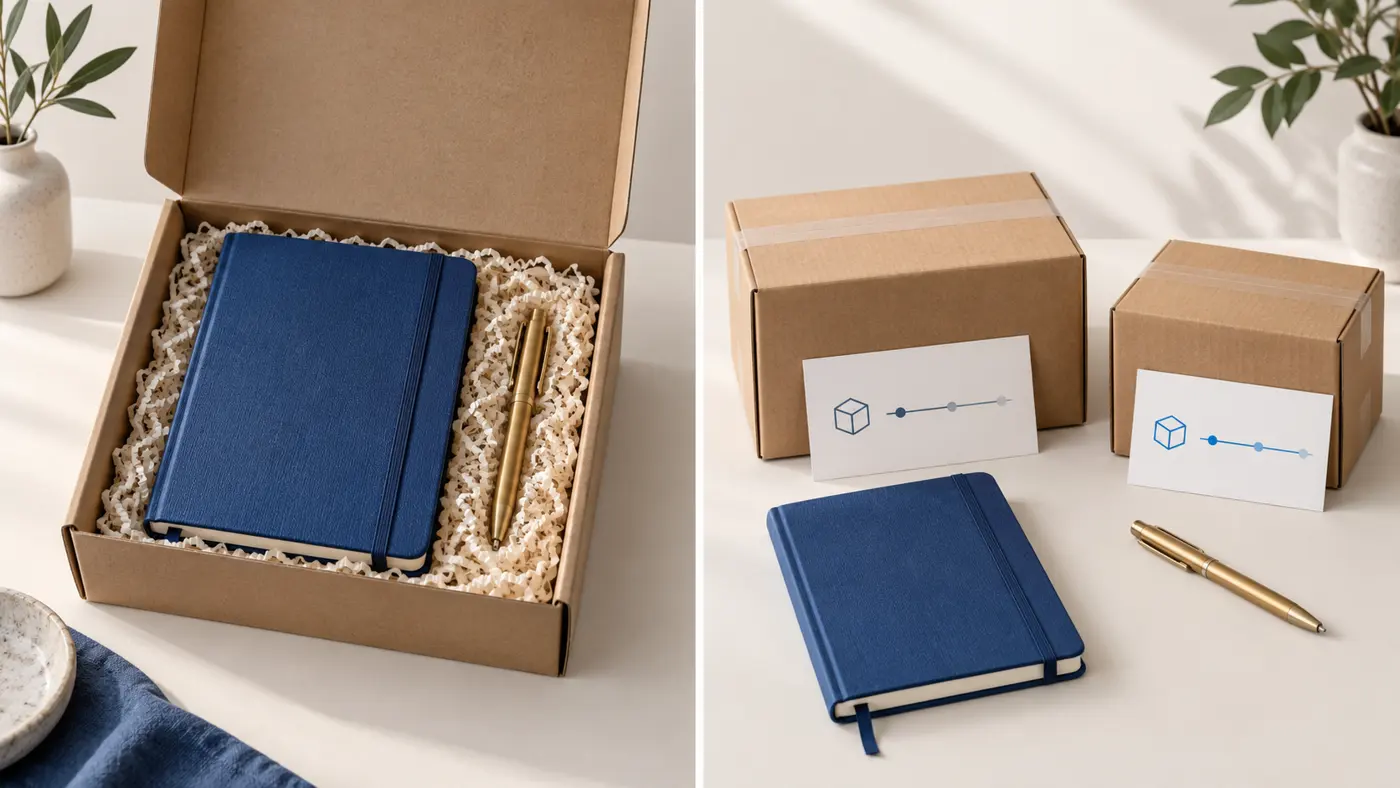
Yes, a dropshipping store can sell a bundle. No, one bundle listing does not make its components arrive in one box. A bundle on a product page is a selling offer; a physical bundle needs a supplier or warehouse able to receive every component, pack them together and ship one parcel. If two suppliers dispatch separately, price two shipments and tell the buyer what to expect before calling it a gift set.
Suppose you want to sell a notebook and pen as one desk gift. The buyer sees one price and may picture a matched package. Before publishing that page, draw the physical route for each item. The bundle can still be useful if the products arrive apart, but that is a different offer and customer promise.
Explore the broader topic: Dropshipping Upselling: Add Value Without Creating Fulfillment Problems.
01
Draw the parcel route before building the listing
For each component, ask where it is held, who can pack it and which parcel carries it. A single supplier with both items may send one parcel. Two independent suppliers may create two orders, dispatch times, postage bills and tracking links.
You can also receive both items at one fulfillment point and pack them together. That route needs its own quote for inbound movement, inspection, storage and handling.
| Route for the notebook and pen | What the buyer may receive | What the store must verify |
|---|---|---|
| One supplier combines them | One parcel, if the supplier agrees to pack them together | Exact components, packaging, one shipment charge and one tracking path |
| Two suppliers fulfill separately | Two parcels, potentially on different days | Two supplier charges, two tracking links and an honest delivery message |
| A warehouse assembles the set | One gift parcel after both items arrive there | Two inbound movements, receipt, packing labor, storage and return route |
On a phone, swipe the table sideways to compare every column.
This is not just theory. Zendrop’s own help says items from different suppliers on Zendrop cannot be consolidated into one package through that service, so separate supplier parcels carry separate tracking and shipping fees. That is Zendrop’s rule; another operator may offer a warehouse/consolidation service. Ask for its written workflow and test one order. Shopify’s dropshipping model help likewise notes that a mixed-supplier bundle may arrive separately.
Tie the buyer order to every parcel
One shopfront order can therefore become more than one physical delivery. Your customer support should connect the bundle order to all parcel references; otherwise a buyer can report “half my gift is missing” when the second parcel is simply still moving. The fulfillment guide explains that order-to-parcel mapping in more detail.
Write a short bill of materials before loading the desk gift into a store app. The parent offer is one sale, but these are separate physical items:
Required notebook
One ruled A5 notebook in the named cover, with its own supplier SKU.
Required pen
One blue pen of the approved ink and finish, with a different supplier SKU.
Sleeve only if promised
One gift sleeve only if the page promises it, with a source and packing owner.
Name who approves a substitute. A different pen color changes the offer even if the parent listing still says “desk gift.” Without component records, support cannot tell whether a missing pen was never packed, left with another supplier, or was never part of the approved set.
Make the bundle record match the parcel route
For example, parent DESK-GIFT-01 can point to notebook N-A5-BLK, pen P-BLU-01 and, if promised, sleeve S-01. Put the supplier and physical location beside each component.
Choose two parcels or a real assembly operator
If the notebook and pen are at different suppliers and neither can combine them, mark the offer two parcels and store both supplier order references under the buyer order. A one-gift promise waits until an operator confirms receipt of every component, accepts the packing job and quotes one-carton shipping.
A black pen is not an approved blue-pen substitute
This record is also a substitution rule. If P-BLU-01 is unavailable, the listing should not quietly substitute P-BLK-02 because the parent SKU still exists. Decide whether to stop the offer, ask the customer or approve a specific alternative with updated photos and copy.
A bundle app can track components; it cannot decide whether a different pen is an acceptable gift. Test the rule by making the pen unavailable in a controlled catalog state and checking whether the parent offer stops or remains buyable.
02
Choose the bundle type before choosing an app
The word bundle can describe three different operations. A virtual bundle is one storefront offer mapped to component SKUs; those components may still ship in separate boxes. A prepacked kit is assembled and stored as its own physical unit before the buyer orders.
Assemble on order: someone must pack the complete set
An assemble-on-order set stays as separate stock until a supplier or warehouse picks every part and packs one box. The listing may show one price in all three cases, but inventory, assembly labor, shipping and returns differ.
Choose for the buying occasion
Use the buyer’s reason for buying to choose. A notebook-and-pen gift promised for one birthday calls for a controlled one-parcel kit or a proven assemble-on-order service.
A practical refill pair may tolerate two tracked parcels if the page says so. An app can map the parent offer to components and calculate availability; it cannot make a warehouse receive a pen from another supplier or guarantee that both dispatch on the same day.
Record who makes the set sellable
Put the chosen type at the top of the offer brief: virtual / prepacked / assemble on order, followed by assembly location, component owners, parcel count and the event that makes the set sellable. If nobody owns assembly, do not advertise a single gift box. This one line determines which stock and cost calculation belongs in the next section.
03
Count complete sets, then count the true cost
Bundle availability depends on its least available required component. Shopify’s bundle inventory guidance calculates each component’s available quantity divided by how many of that component the bundle needs, rounds down, then uses the smallest result.
If you have 12 notebooks and seven pens and each set needs one of each, you can offer at most seven complete sets under those stock figures. If each set needs two pens, seven pens support only three complete sets. A glossy product card cannot create the missing component.
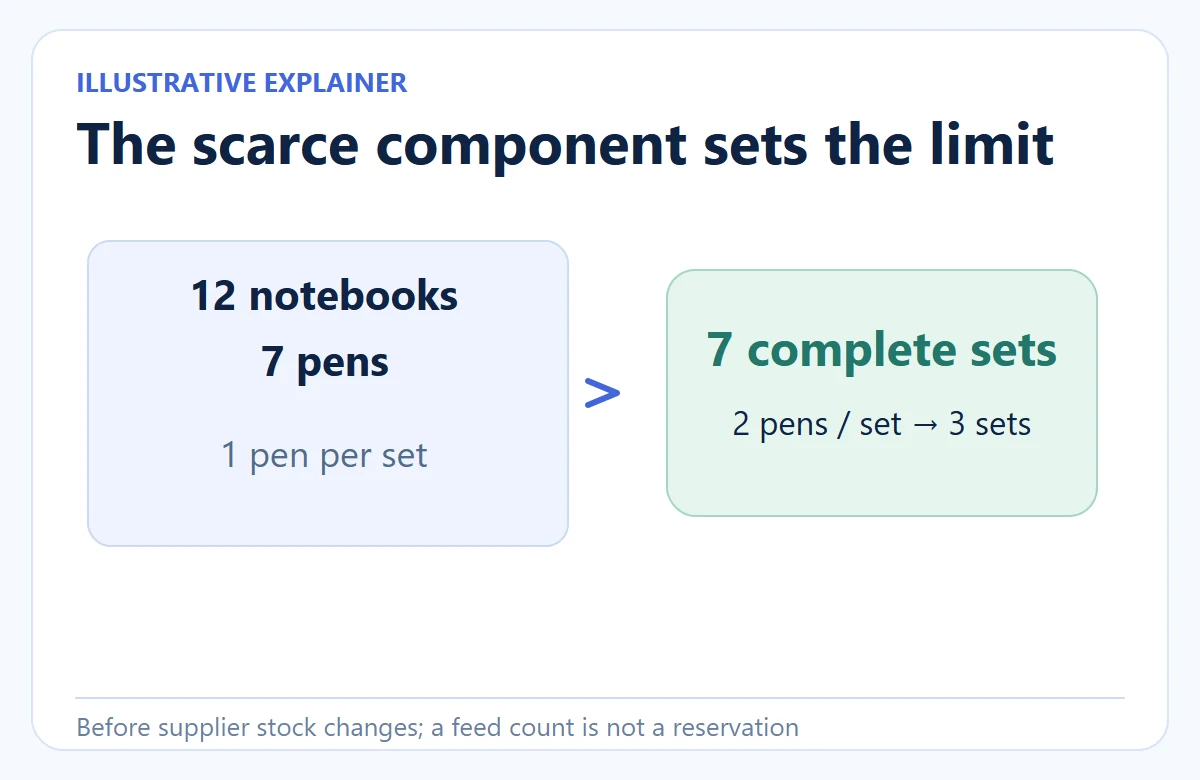
Those counts also assume the stock records are current and the components are sellable. With independent dropship suppliers, a synced seven-pen feed may change before the supplier accepts your order. Reserve or buffer according to the real provider’s capability, and avoid selling the last apparent set blindly. Our inventory-management guide covers the broader overselling controls.
Check stock tracking and physical location
Shopify’s bundle rules make two limits especially useful for this gift.
Confirm the limiting pen is counted
Check that required component inventory is tracked and that Continue selling when out of stock is not allowing an unavailable pen through. Shopify ignores untracked or continue-selling components in its limiting-stock calculation. Recheck the parent after the controlled stock change.
Do not confuse total stock with one packing point
Shopify Bundles calculates overall stock rather than bundle stock per location. Twelve notebooks in one warehouse and seven pens elsewhere do not prove seven one-box gifts can be packed. Confirm the promised assembly location or disclose the separate parcels before selling.
The seven-set and three-two-pen-set calculations assume current, sellable components and the correct quantities. They do not reserve a supplier’s shared stock.
Now price the parcel route. This hypothetical gift set sells for $35. The notebook costs $9 and the pen costs $7. Two separate suppliers each charge $5 to ship a parcel, so the store has $35 − $9 − $7 − $10 = $9 left before payment fees, advertising, returns and overhead. If a single operator actually combines the items into one $6 shipment at the same product costs, the illustrated remainder is $13 before those other expenses. Neither $5 nor $6 is an AIDrop rate or a supplier quote.
| Hypothetical route | Products | Customer-parcel charges | Remainder on $35 sale before other costs |
|---|---|---|---|
| Two suppliers, two parcels | $16 | $10 | $9 |
| Confirmed one-pack route | $16 | $6 | $13 |
On a phone, swipe the table sideways to compare every column.
Include the extra assembly costs
The one-pack route is not automatically better. It might require inbound freight, receiving, gift packaging, storage or a pick fee not included in the $6 customer parcel. Add those to the real quote before claiming a $4 saving.
Conversely, two parcels may be acceptable for a practical refill bundle where presentation and same-day arrival are unimportant. The decision depends on what the buyer was promised and what the store can deliver at a viable cost.
If you use Shopify Bundles, check its rules separately from supplier operations. Shopify says component stock drives a fixed bundle’s available quantity, while shipping rates use the components’ profiles. Its Bundles help also says changing a component price does not automatically change the parent price.
Create the draft in Shopify Bundles
The current Shopify Bundles instructions give Apps → Bundles → Create bundle. Enter the title, choose the exact notebook and blue-pen variants and quantities, then Save and continue.
Check the saved draft
The new product starts as Draft. Compare its saved components with DESK-GIFT-01, enter the intended parent price and check the product information and sales channels. Do not use the title alone to verify that the blue pen was selected.
Publish only the tested offer
After checking the draft’s components, stock and shipping setup, use product details to set Active, select the intended sales channel and Save for the permitted controlled order. Reopen the listing and checkout, then complete the delivery test before broad promotion. Hold the affected offer if the pen or promised sleeve is unavailable.
These instructions describe the documented app, not a store change we made. A draft that saves correctly has passed an editing step; it has not proved one-box delivery.
Review price and stock after supplier changes. These are Shopify software behaviors; another app may differ. Neither app can force independent suppliers to pack one carton.
Run the Shopify fixed-bundle test in this order:
Check components
Create the parent from the approved component variants. Check that the generated lines match the bill of materials. With 12 notebooks and seven pens at one of each, the parent should show no more than seven sets; at two pens per set, no more than three.
Test the limiting component
Reduce the pen’s available quantity in a controlled test. Check that parent availability responds, then restore the live value.
Review the parent price
Change one component’s supplier cost or selling price in the test. Inspect the parent retail price separately; Shopify Bundles does not promise to recalculate that price for you.
Test the actual shipping charge
View checkout with the actual shipping profiles. One parent product must not hide a two-supplier parcel charge or promise one box when two will ship.
Check which supplier can still stop dispatch
Cancellation can split too. Suppose the notebook supplier accepts its order but the pen supplier has not. Canceling the parent storefront order may not recall the notebook.
Check each component’s release status before promising a full stop. Tell the buyer what can still be intercepted and what remedy the store can provide. A parent order status does not prove both suppliers are at the same stage.
04
Write a promise that matches the packages
For a true gift bundle, test what arrives, not only whether checkout accepts the cart. Does the notebook match the pictured cover and the pen fit its holder? Is there one pack slip or two? Are both items protected?
Show separate delivery before checkout
If it is a two-parcel route, show that fact on the product page and order message. A buyer buying for Friday should not discover on Thursday that the pen has a separate tracking link and later delivery window.
Write the buyer promise for the route you tested. A one-parcel set can say it ships together when you have verified that pack. A two-supplier set should say the items may arrive separately and provide tracking for each.
One checkout line is not proof of one gift box. If the buying occasion requires everything on the same day, a split route may be a poor offer even when its margin looks attractive.
Prove the offer with one delivered set
Before launch, place one real bundle order to the intended destination. Keep a simple receipt: bundle listing, component SKUs, supplier order references, individual shipping charges, actual tracking numbers, delivered parts and customer message.
Open the delivered gift, not just the checkout
If the bundle is marketed as “one gift box,” open the parcel and confirm that presentation. If it arrives in two packages, either change the operational route or rewrite the promise. A truthful two-parcel offer is better than a one-box image that sets up an avoidable complaint.
The delivered test needs two passes:
System pass
checkout decremented the right components, charged the modeled parcel cost and sent the expected supplier orders.
Customer pass
every promised item arrived in the stated number of parcels and delivery pattern.
Identify which component step failed
One pass without the other is not enough. If a component is missing, stop the parent bundle. Find out whether it was out of stock, never transmitted or shipped separately. Then fix the stock rule, mapping or buyer message that actually failed.
05
Handle a return of one bundle component
Returns can split too. A buyer may keep the notebook but report a faulty pen. The illustration below isolates that component so the claim does not become an automatic return of the whole gift set.
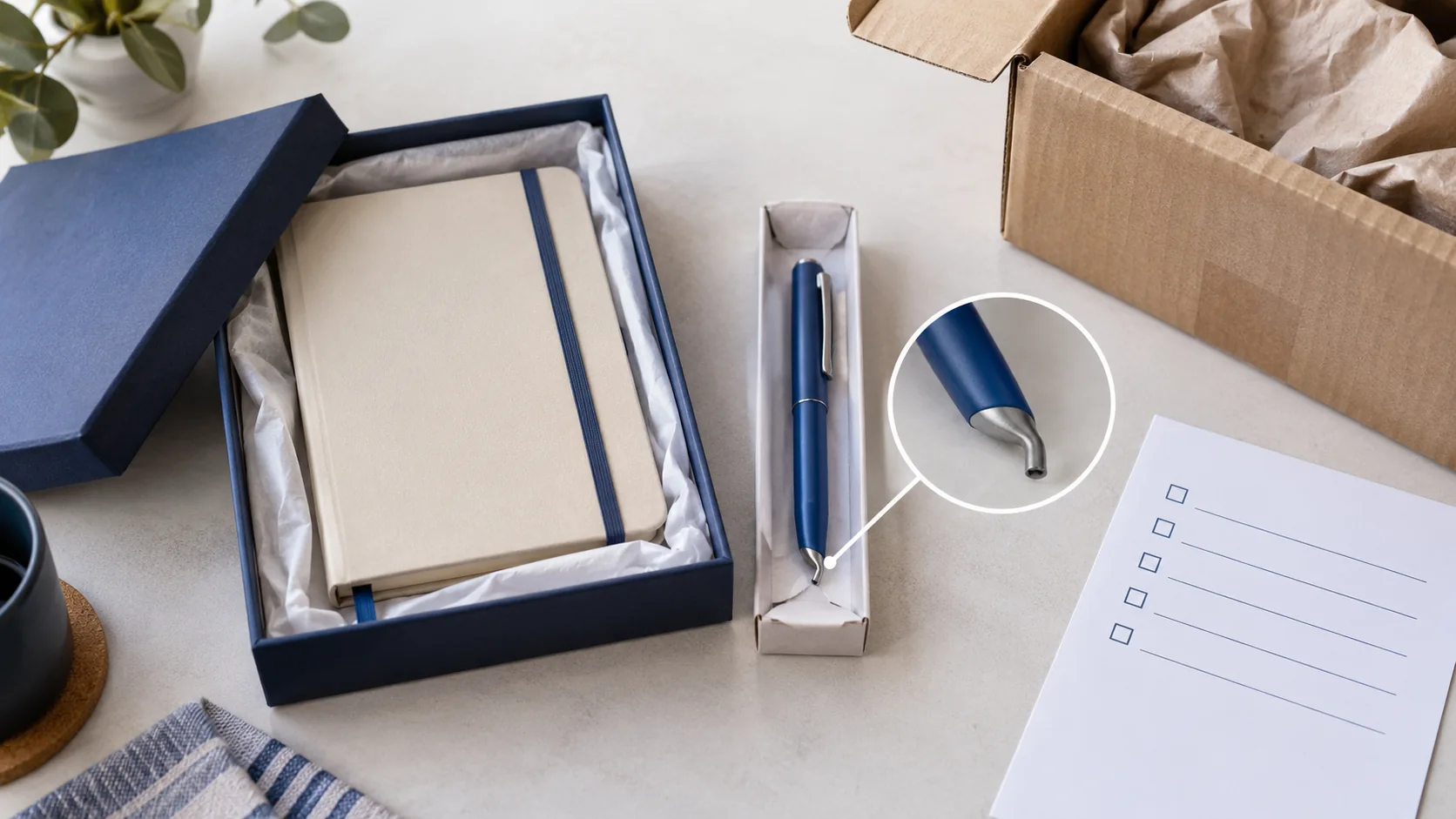
Ask each supplier how it handles the affected component. Your store then decides whether to replace the pen, refund part or offer another remedy allowed by its customer policy. Shopify’s bundle documentation notes that split fulfillment and returns can show components as separate line items. Keep them tied to the original offer. The returns guide covers the buyer-facing process.
A partial return needs the actual order’s component values, not just the pen’s supplier cost. Shopify’s bundle documentation describes allocating bundle discounts by component price and returning components individually.
Inspect the affected pen line and any allocated discount in the actual sale before calculating the customer remedy. The $7 supplier cost is not automatically the buyer’s refund. The $10 refund below is a fictional agreed-policy example, not a universal Shopify line value or legal entitlement.
Separate sale, supplier cost and customer remedy
Record three things separately: the original $35 offer, each component’s supplier cost and the remedy you give the buyer. That lets support explain the outcome without confusing wholesale cost with the sale price.
Here is fictional recordkeeping for the same $35 set. The remedy follows an assumed disclosed store policy; it is not a universal refund rule.
A fictional partial remedy
- Original customer sale: $35; faulty part: P-BLU-01; notebook retained by the buyer.
- If that policy selects a $10 partial refund, record $10 returned and $25 retained. Keep the original $35 order rather than replacing it.
- Supplier pen cost: $7. A supplier credit is recorded only if actually approved; it does not set the buyer’s refund.
Check the customer refund confirmation and order history, then link the separate supplier claim to the same component. Any retained payment fees, taxes or return freight need their own entries before you recalculate contribution.
The dropshipping pillar guide places bundling within the wider supplier-to-customer model. If the missing capability is physical consolidation, AIDrop Agent’s service overview shows how a defined set could be scoped across receiving, packaging and fulfillment after the components, destination and order volume are known. Send the two product specifications, origin points, pack expectation and destinations through our inquiry page. A real combined route and quote must be agreed before the product page promises it.
06
Frequently asked questions
Do I need a bundle app to sell two products for one price?
An app can help map the parent listing to component stock and orders, but the need depends on your store setup. Even a manual listing needs a bill of materials, a stock rule, a parcel route and a return method. Test those before choosing software; an app cannot physically consolidate suppliers’ boxes.
Can components from two suppliers arrive in one package?
Only if an operator receives both components and assembles the set, or a supplier has agreed to do that work. Otherwise expect separate parcels and charges. Get the inbound, packing, storage and outgoing parcel quote, then place a delivered test order before calling the offer a one-box gift.
How do I refund only one faulty component of a bundle?
Start with your customer policy and the buyer’s actual problem. Decide a fair partial remedy or replacement and document how you calculated it; the supplier’s component cost is not automatically the buyer’s refund. Keep the original offer, affected component, supplier claim and customer resolution linked in one record.
Dropshipping Marketing: A Plan from First Visit to Repeat Order
Plan dropshipping acquisition, product-page conversion and repeat sales around realistic margins. Compare channels and measure costs and

Dropshipping SEO: Build Search Pages Customers Can Trust
A practical SEO plan for dropshipping stores: map searches to the right pages, verify supplier claims, link

Dropshipping Customer Retention: Earn the Next Order After the First Delivery
A practical retention plan for dropshipping stores: meet the first-order promise, choose a relevant follow-up, and measure
