
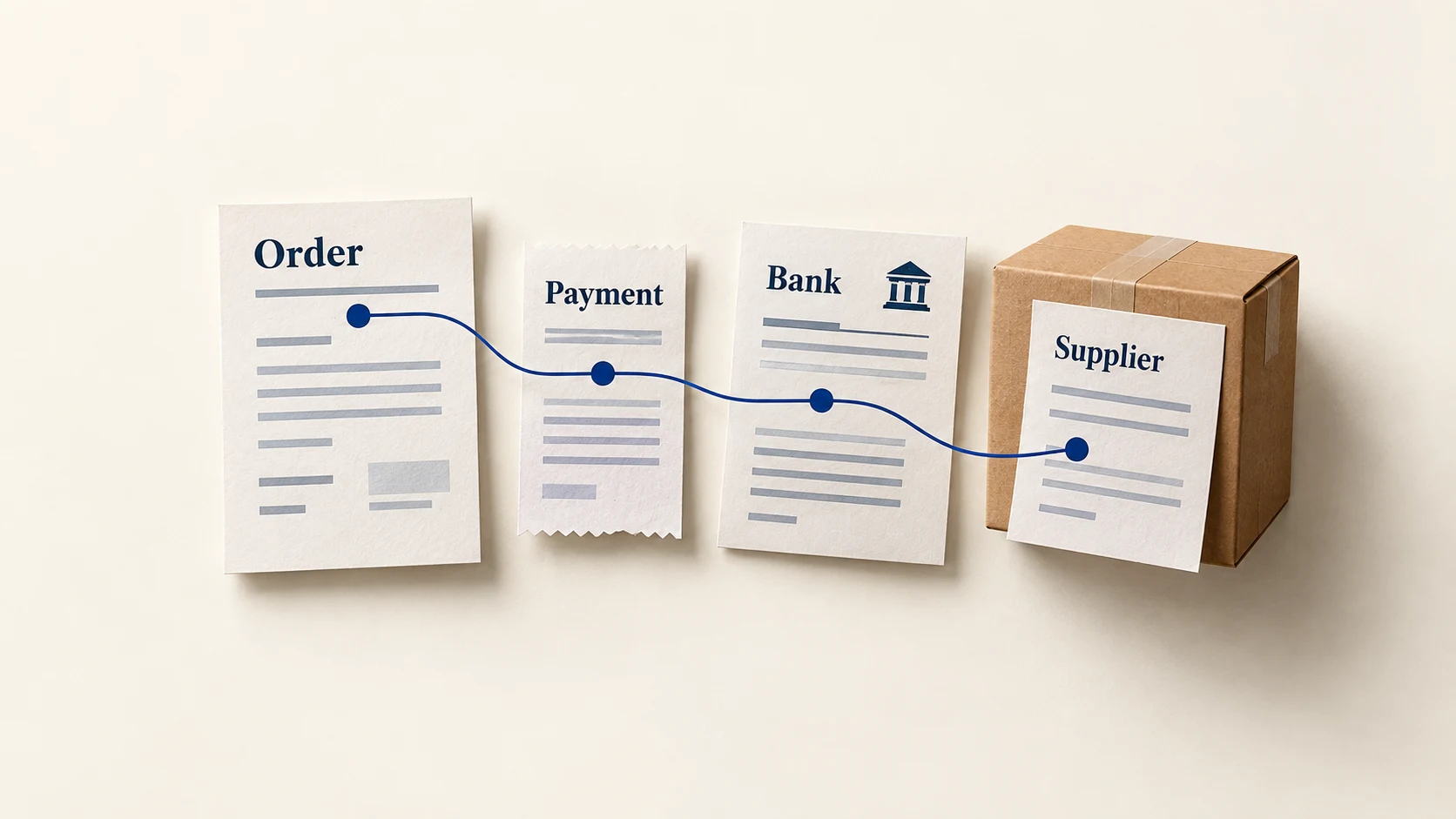
Dropshipping accounting starts by connecting four records: what customers ordered, what the payment processor recorded, what reached the bank, and what suppliers charged. Reconcile those records before treating a deposit as sales or a bank balance as profit. Fees, refunds, tax amounts, currency conversion and unsettled payments explain many differences, but every adjustment should have a source.
You can begin with a spreadsheet when the volume is manageable. The important requirement is that another person can follow an amount back to its order, transaction or invoice. The approach below is an operating reconciliation; your accountant should determine the applicable recognition, tax and reporting treatment for your entity and jurisdictions.
01
Start with records that can be joined
Keep business receipts and payments separate from personal spending, and export the original records before editing a working copy. Shopify’s dropshipping finance guidance recommends separating personal and business finances and checking the local requirements that apply to the business.
An order number alone is often insufficient. One order may have a partial refund, a second payment or several supplier parcels. One supplier invoice may cover many customer orders, while one payout may settle transactions from different days.
Retain the identifiers that connect those events:
| Record | Keep these details | Connection to preserve |
|---|---|---|
| Store order | Order ID, date, currency, items, discounts, shipping and tax lines | Payment transaction and supplier order |
| Processor transaction | Transaction ID, type, gross amount, fee, net amount and dates | Order, refund, dispute and payout |
| Bank transaction | Deposit or payment date, currency, amount and reference | Payout ID or supplier payment |
| Supplier document | Invoice number, ordered variants, quantities, shipping, credits and currency | Customer orders or an explicit allocation |
Keep the source file, its export date and the reporting timezone. A late-night sale can fall on different calendar days in different systems. That is a timing difference to explain, not a reason to change the original order date.
Separate source records from your category mapping. If a fee is reclassified later, you should be able to update the mapping without losing the amount that the processor actually charged. Preserve a note explaining the change and who reviewed it.
Give every amount a defined category
Create a mapping sheet before importing totals into the books. At minimum, distinguish merchandise receipts, discounts and returns, customer shipping charges, tax lines, product and fulfillment charges, payment fees, advertising, and overhead. Keep processor balances, supplier prepayments, unpaid invoices and owner funding separately identifiable. Your accountant should approve how those operational categories map to the accounts and accounting method used by the business.
For example, money an owner puts into the bank should not enter the sales column. An unpaid supplier invoice should not vanish simply because no bank payment appears yet. A product reserved under a purchase commitment may raise ownership and recognition questions that a generic “dropshipping expense” category cannot answer. Keep the contract with the transaction record.
Record one event per row and use a stable event ID. Retain order ID, supplier order ID, transaction ID, payout ID, currency, event date, gross amount, deductions and source reference where applicable. An order with three events needs three linked rows; repeatedly overwriting its original amount destroys the explanation of what changed.
02
Separate sales from the payout
A customer payment and a bank deposit describe different events. The payment processor may deduct fees or refunds, retain a reserve, and combine several transactions into a transfer. The supplier’s bill usually follows another path entirely.
Shopify explicitly describes its Payments activity report as a view of processor balance movements, not a revenue statement for accounting purposes. It recommends using individual payout details for a particular bank deposit and the activity report for a period-level review.
Use a processor clearing account or an equivalent reconciliation schedule to bridge these records. This is a place to explain funds moving through the processor. It should show an opening balance, transactions during the period, transfers to the bank and an explained closing balance.
A closing processor balance does not have to be zero. It can include legitimate unsettled or retained amounts. Forcing it to zero with an unexplained expense hides the very difference you need to investigate.
The reporting method matters. Stripe’s payout reconciliation documentation distinguishes automatic-payout reconciliation from balance-based reconciliation for manual payouts. It also notes that instant payouts need reconciliation against transaction history because the merchant controls their timing and amount. Select the report that matches your account’s actual payment flow.
03
Reconcile a hypothetical settlement
The following hypothetical USD example assumes no opening processor balance and one group of captured payments. It illustrates a reconciliation, not a platform’s current fee or reserve policy.
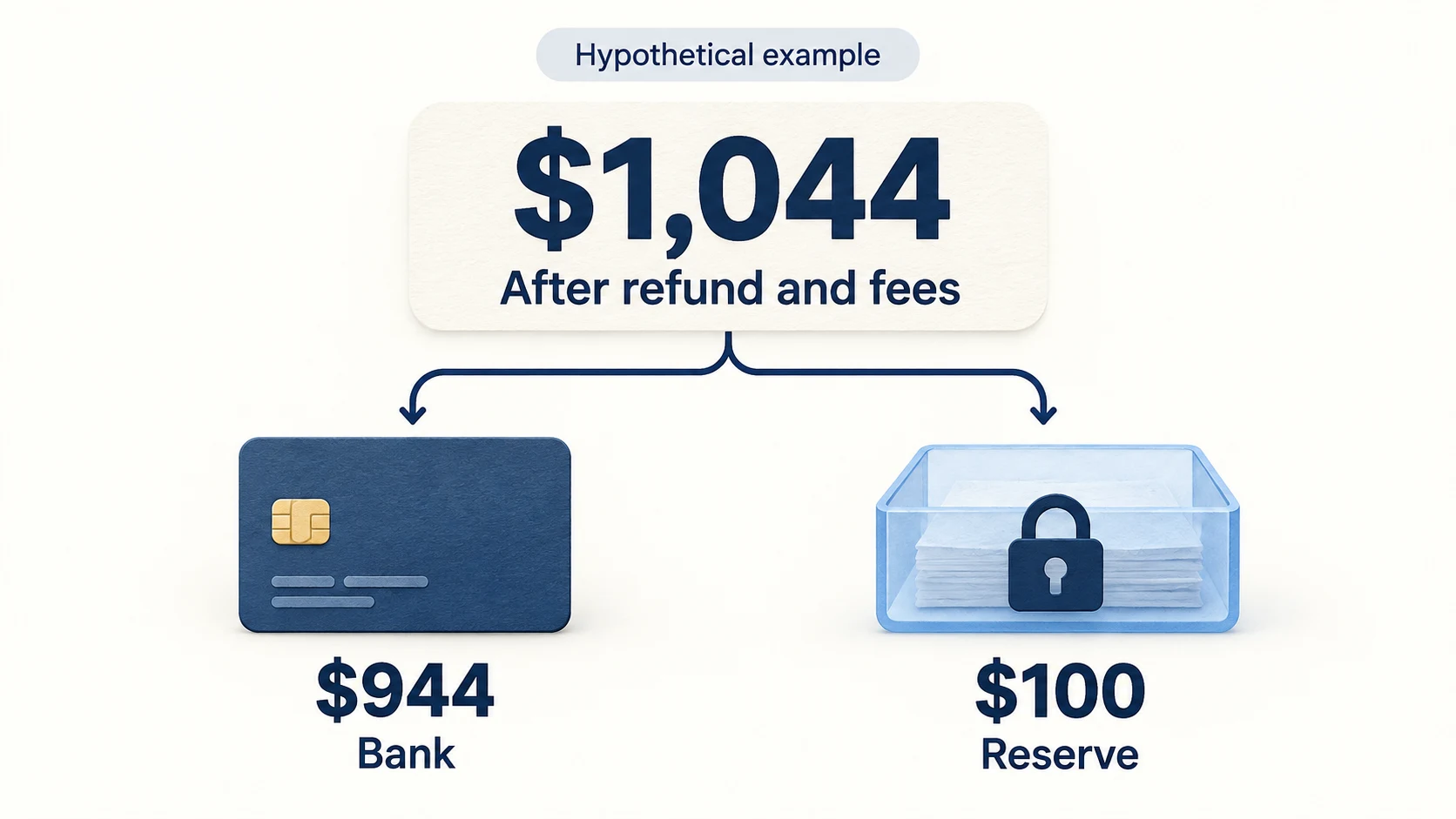
Customers pay $1,200: $1,100 for merchandise and $100 in separately tracked tax. A later $120 refund reverses $110 of merchandise and $10 of tax. The processor charges $36 in fees, retains $100 as a reserve, and transfers the rest to the bank.
| Processor movement | Amount |
|---|---|
| Opening balance | $0 |
| Captured customer payments | +$1,200 |
| Refund | −$120 |
| Processing fees | −$36 |
| Bank payout | −$944 |
| Closing processor balance | $100 |
The arithmetic is $1,200 − $120 − $36 − $944 = $100. The reserve explains that closing balance; it is not another $100 expense in this example. Recording both a $100 reserve expense and the closing balance would misrepresent the movement.
Now make the separate management calculation. Assume the retained tax amount is a liability rather than merchandise income under the treatment applicable to this illustration. Merchandise proceeds after the refund are $990. Supplier and shipping charges of $500, advertising of $220 and the $36 processor fee leave $234 before overhead and income tax. The remaining $90 tax amount is tracked separately.
The $944 deposit is therefore neither the $990 merchandise figure nor the $234 management contribution. It is the transfer after the processor’s adjustments. For the full distinction between order costs and contribution, use the dropshipping unit economics guide.
When the $100 reserve is later released and paid out, match the transfer to the existing processor balance. Do not record the same customer sales again. If a later fee or dispute reduces that release, retain the new transaction that explains the difference.
04
Match supplier charges to the orders
Review a supplier invoice against the item and shipping commitments, not just the total amount paid. Look for the correct variant, quantity, parcel charge and any agreed packaging or handling service. A payment can match an invoice perfectly while the invoice itself contains the wrong charge.
Where an invoice covers many orders, preserve the supplier’s line-level breakdown. If a cost has to be allocated, document the basis. A per-parcel shipping charge may need a different allocation from a product charge based on units. An arbitrary equal split can make one product look more profitable and another less profitable than they are.
Watch prepaid supplier wallets. A wallet top-up moves money into an account with the supplier or platform; subsequent order deductions explain how that balance is used. Recording the top-up and every deduction as the same expense would count the outflow twice. The precise accounting classification should follow the arrangement and your accountant’s policy.
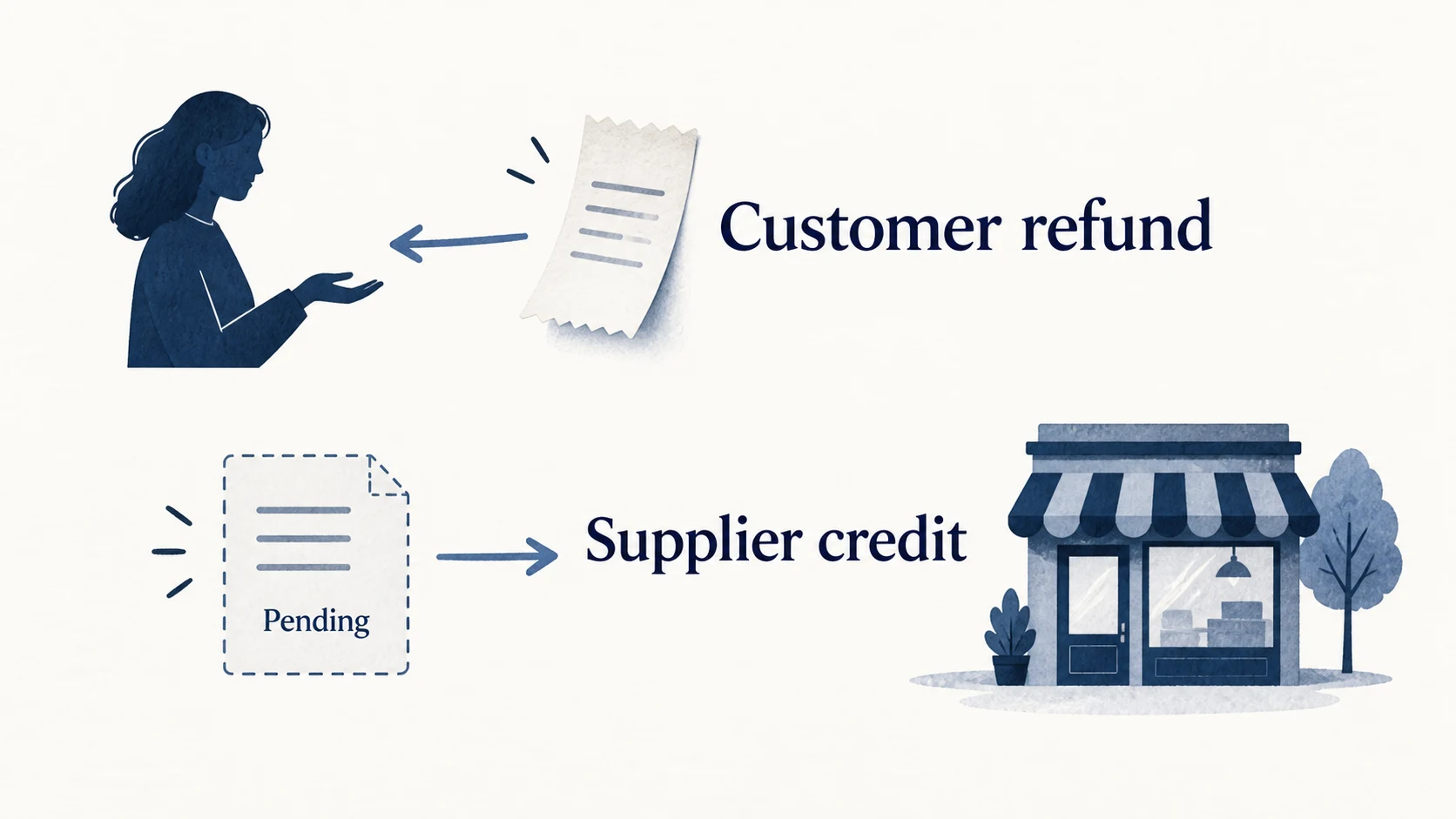
Returns create another important separation. A customer refund and a supplier credit are separate records, potentially with different dates and amounts. Record the customer transaction when it occurs in the relevant records. Track the supplier claim’s status rather than assuming a refund will be recovered upstream.
For every unresolved supplier difference, retain:
- The affected customer order and supplier invoice.
- The expected amount and the actual charge.
- The reason for the difference, if known.
- The credit, replacement or explanation requested.
- The responsible person and next review date.
Do not reduce an invoice to an expected figure without evidence that the supplier accepted the correction. A disputed amount should remain visible until its treatment is resolved. Otherwise a tidy spreadsheet can conceal a real liability or an unsupported recovery assumption.
Reconcile a prepaid wallet without double counting
Consider a separate hypothetical supplier wallet. It opens at $80, receives a $500 bank top-up, pays $420 of documented order deductions, and receives a confirmed $30 credit. Its closing balance should be $190: $80 + $500 − $420 + $30. Match that amount to the supplier’s statement in the same currency and at the same cutoff.
If the supplier shows $175, investigate the $15 difference. It might be a documented handling charge, an omitted order deduction or an error; the arithmetic alone cannot tell you. Request the missing transaction before changing the cost ledger. The $500 bank payment and the $420 of order deductions serve different reconciliation steps and should not both be imported as the same set of order costs.
For a combined parcel, retain the parcel charge once and the product charges at line level. If management reporting allocates that shipping across items, state whether the basis is units, weight or another supported method. Check that allocated amounts add back to the original invoice. An allocation changes product-level analysis; it does not create another supplier bill.
Keep the refund and recovery trail intact
Use separate statuses for a customer refund requested, submitted, failed and completed, and for a supplier claim requested, accepted, credited and settled. A support ticket saying “refund arranged” is insufficient evidence that money moved. Stripe’s refund documentation distinguishes pending and failed refunds, including the balance transaction associated with a failed refund’s return of funds.
Before creating a replacement refund, inspect the existing refund and any dispute against the original charge. Otherwise the same customer obligation may enter the reconciliation twice. Preserve the event history when a refund fails or a dispute is reversed; link the correcting event to its original transaction instead of deleting the original row.
05
Keep tax and currency differences visible
Track merchandise, discounts, shipping charges and tax lines separately in the source data. Their final reporting treatment depends on the relevant rules and on who is responsible for collection and remittance. A platform collecting an amount does not, by itself, answer every question about your obligations.
The US IRS provides a useful example of why universal shortcuts fail. Its small-business tax guide distinguishes sales taxes imposed on the buyer from taxes imposed on the seller when discussing gross receipts. That is a US rule in a particular context, not a worldwide instruction to classify every checkout tax line identically.
Ask your accountant to confirm the jurisdictions, entity, accounting method, tax registrations and marketplace arrangements before mapping tax amounts. Provide the underlying records so that a change in treatment can be applied consistently. This article’s worked example assumes a separate tax liability only to make the money movement understandable.
For foreign-currency activity, retain both the original currency and the settlement currency. Record the rate or converted amount supplied by the processor or bank, together with any separately identified fee. Do not invent a missing exchange rate by treating every difference as a bank charge.
If a supplier invoices in one currency and receives another, preserve the invoice, conversion and payment references together. Your accountant can then determine the appropriate currency treatment. The operating task is to make each stage traceable, including an unpaid balance caused by a short conversion or transfer deduction.
06
Close the month without forcing a match
Choose a cutoff and use it consistently. Reconcile each processor and currency before combining them into a business summary. Then compare transfers with the bank statement and supplier payments with the corresponding invoices or account balances.
An effective close can follow this sequence:
- Export orders, refunds, processor transactions, payouts, bank activity and supplier documents.
- Confirm the opening balances agree with the previous close.
- Match captured payments and refunds to their order references.
- Explain the movement from processor activity to each bank payout.
- Match supplier charges, payments, credits and remaining balances.
- List timing differences and unresolved exceptions separately.
- Review the resulting sales, cost and cash reports with the responsible bookkeeper or accountant.
Keep an unmatched amount visible until there is a supported explanation. Common investigations include a duplicate import, a partial refund, a payout crossing the cutoff, a missing supplier credit or a currency mismatch. “Miscellaneous expense” should not become a default destination for differences that have not been understood.
Use the close to improve the next period. If the same supplier repeatedly omits order references, ask for a better invoice format. If a payment integration duplicates refunds, repair that mapping before importing another month. A reconciliation is more valuable when it reduces repeated manual work.
The IRS’s recordkeeping guidance identifies supporting documents such as invoices, receipts and deposit information as evidence behind bookkeeping entries. For a US business, that guidance provides an official starting point; retention and reporting requirements elsewhere need their own check.
Carry timing differences into the next period
Suppose a hypothetical $200 net processor amount remains unsettled at September 30 and reaches the bank on October 2. The September reconciliation retains the $200 in its explained processor closing balance. October starts with that same balance and matches the transfer to it. The bank arrival does not create a second sale. Revenue recognition itself still follows the business’s approved accounting policy.
If an October refund relates to a September order, keep both the October refund event date and the September order reference. This allows the books to follow the applicable period treatment while a product-performance report can attribute the service outcome to the original order group. Do not silently move the refund’s actual date to make the earlier cohort look complete.
| Difference at close | Evidence to inspect | Resolution to preserve |
|---|---|---|
| Payout missing from bank | Payout ID, status, expected arrival and bank statement | Outstanding transfer carried forward; investigate a failed transfer |
| Processor amount imported twice | Repeated transaction ID across exports | Remove the duplicate import with a correction log |
| Refund amount differs from order total | Partial refund lines, tax/shipping adjustments and currency | Match the actual refund instead of assuming a full reversal |
| Supplier credit absent | Claim acceptance and issued credit document | Keep the recovery unresolved until supported |
| Invoice paid but balance remains | Payment reference, fees and currency conversion | Explain short payment or conversion before clearing the balance |
| Reserve release differs from expectation | Release and adjustment transactions | Match the actual movement to the retained balance |
Give each unresolved row an owner, amount, currency, source, explanation, next action and review date. Age the open items so an old missing credit is not continually carried forward without attention. A timing difference supported by a payout record is different from an unidentified amount with no source.
Before signing off, hand the reviewer the source exports, reconciliations, category mapping, supplier statements, open-item list and any changed accounting assumptions. Preserve the prior closing balances and record who approved adjustments. That package lets the next month start from a defensible opening position.
07
Choose tools around the exceptions
A spreadsheet can work when the records are small enough to review and the formulas are controlled. Use separate source tabs, consistent identifiers and protected calculations. Avoid overwriting a historical export merely because a new report uses the same filename.
When considering accounting software or a connector, test it with difficult transactions as well as an ordinary sale: a partial refund, a supplier wallet deduction, a second currency and a payout spanning the month-end cutoff. Check whether it preserves the original transaction IDs and explains its posting logic.
Automation should reduce repetitive entry while leaving a reviewable trail. A tool that makes every balance appear to match by combining taxes, fees and sales into one number can make errors harder to find. Evaluate it by the records it preserves and the exceptions it exposes, not only by the number of integrations advertised.
Finally, keep your cash forecast separate from the reconciled books. The books explain recorded activity; a dropshipping cash-flow calendar helps you plan upcoming supplier bills and usable payouts. Both are needed when sales are growing faster than money reaches the bank.
Once the records are reliable, use the economics and risk articles to examine the pricing and operating decisions behind those numbers.
08
Frequently asked questions
Is a Shopify payout my sales revenue?
No. It is a transfer from the processor after applicable balance movements. Reconcile the transactions behind it, including fees, refunds and retained amounts, and apply the appropriate accounting treatment to the underlying activity.
Can I use Excel for dropshipping accounting?
Yes, if the volume and complexity remain manageable and the records are complete. Preserve source documents, identifiers and review controls. Software becomes useful when manual matching and exception handling are consuming too much time or creating errors.
Does having no warehouse remove inventory or tax questions?
No. The contractual ownership of goods, payment arrangements and applicable rules still matter. Give your accountant the supplier terms and transaction records rather than assuming that the dropshipping label determines the treatment.